
On this page
A budget that lists categories still misses the days that cost money — a late-filing penalty, an instalment, an insurance lapse, a municipal tax PAD. The job is one annual view with enough lead time to act.
This isn't a first budget — that's How to Budget in Canada. How much to set aside is How to Budget for Expenses That Don't Happen Every Month. Where the dollars sit is sinking funds. The timed agenda, once a date is on the calendar, is the 20-minute monthly money review.
This page is when. Not tax advice, and not how to file.
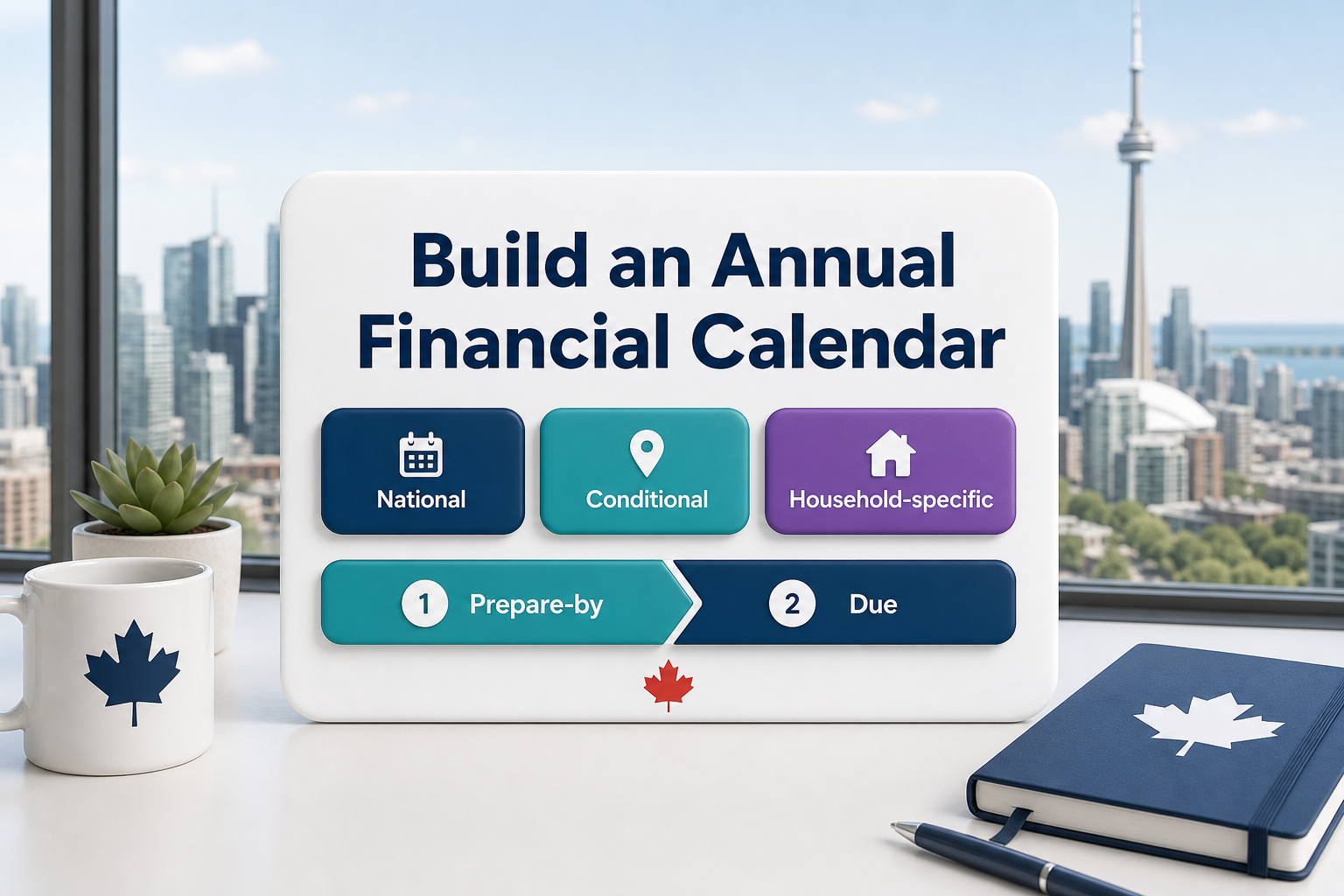
Three layers on one year
National (verified): dates CRA or Service Canada publish for everyone in the program — filing and payment for a named tax year, instalment days, TFSA room added 1 January, benefit payment calendars. Use the official page. Rebuild this layer every January from CRA, not from last year’s list.
Conditional: the same national calendar, but only if it applies — self-employed filing (payment is still April 30), instalments if net tax owing crossed the threshold, CCB if they have an eligible child, Canada Groceries and Essentials Benefit if they receive it, CPP or OAS if they are in pay. Skip unused rows. Don't nationalize Ontario Trillium or an Alberta child-and-family benefit.
Household-specific: dates from this lease, mortgage, insurer, municipality, provincial registrar, or mechanic — property-tax instalments, insurance renewals, plates, lease end, professional dues, winter tires. Never write these as Canadian national dates. If a date is not on the bill, it is not on this calendar yet.
Prepare-by is not the legal deadline
Two columns on every row.
Legal deadline / due date: the day CRA, the municipality, or the biller requires the action. CRA treats a filing as on time if it is received or postmarked the next business day after a weekend or holiday; a payment is on time if it is received the next business day.
Prepare-by: the household’s lead time so the action is possible — slips in hand, cash in chequing, quote requested, booking made. Prepare-by is not a CRA date. Typical offsets (household choice, not official): tax slips and file 2–6 weeks before April 30; RRSP first-60-days window 2–3 weeks before the 60th day; instalment cash one payday before the 15th; insurance renewal 30–45 days; property-tax instalment 21–30 days; seasonal maintenance 2–3 weeks to book.
FCAC says to set a reminder or book time in the calendar. It does not publish a national household calendar.
Confirmed 2025-tax-year dates (already passed)
These are the pattern, and they are history. CRA’s important-dates hub still listed the 2025 tax year as of 3 September 2026. Don't treat unposted 2027 calendar dates as confirmed.
- Monday, 2 March 2026: RRSP, PRPP, or SPP contribution deadline for amounts deducted on the 2025 return. 1 March 2026 was a Sunday. Claiming the deduction is a separate page.
- Monday, 23 February 2026: NETFILE opened. Most slips by the end of February; if a slip is missing by the end of March, contact the issuer.
- Thursday, 30 April 2026: file and pay 2025 taxes for most individuals. Interest starts the day after the due date if a balance is unpaid. Late-filing penalty if you owe: 5% of the balance plus 1% per full month, up to 12. File on time even if you cannot pay — that avoids the late-filing penalty; interest still applies.
- Monday, 15 June 2026: file if you or your spouse or common-law partner carried on a business in 2025. Payment was still 30 April 2026.
Standing rules for the next season: most individuals file and pay 30 April; self-employed file 15 June (pay still 30 April); RRSP first 60 days of the following year. Confirm the posted calendar date on CRA important dates before you treat it as this year’s deadline.
Instalments (2026)
Most individuals who must pay instalments for 2026: 15 March, 15 June, 15 September, 15 December. 15 March 2026 was a Sunday, so payment was on time the next business day — Monday, 16 March. Remaining: Tuesday, 15 September and Tuesday, 15 December.
Don't calculate the threshold here: net tax owing more than $3,000 for 2026 and in either 2025 or 2024 (Quebec $1,800). Farmers and fishers: one instalment 31 December. Omit the row if they do not pay instalments.
A TFSA is not an RRSP deadline
| Plan | When you can contribute | What 31 December means |
|---|---|---|
| TFSA | Any time unused room exists | Planning cutoff. Unused room carries forward. Missing 31 Dec does not forfeit a prior-year deduction. 2026 dollar limit $7,000, added Thursday, 1 January 2026. Withdrawals add back 1 January of the next year. 2027 dollar limit: confirm on CRA. Room math is TFSA contribution room. |
| RRSP | First 60 days of the following year can still be deducted on the prior year’s return | Confirmed instance: 2 March 2026 for the 2025 tax year (passed). Next instance: confirm on CRA. Age 71: last contribution to your own RRSP is 31 December of the year you turn 71. |
| FHSA | 1 January–31 December of the same year | Calendar-year cutoff for that year’s participation room. First-60-days contributions cannot be deducted on the prior year. |
Which account is TFSA vs RRSP vs FHSA. Limits if you need the table: contribution limits. RESP or RDSP: 31 December is typically the date that year’s grant or bond calculation cares about. Charitable gifts: calendar year of the gift.
Benefit and document checks
Remaining 2026 CCB (if they receive it): 18 September, 20 October, 20 November, 11 December. Recalculated every July from the prior year’s return — filing on time is how the July cycle stays honest.
Canada Groceries and Essentials Benefit (formerly the GST/HST credit): remaining 2026 payment Monday, 5 October 2026. January 5 and April 2 were GST/HST credit payments; July 3 and October 5 are CGEB. Don't relabel October as GST/HST.
CPP and OAS remaining 2026: 25 September, 28 October, 26 November, 22 December. Conditional on being in pay. Not a bill.
CRA My Account: payment reminders about a week before issue. Keep address and direct deposit current. TFSA room in My Account lags until around April processing of the prior year — use your own records before contributing.
Document check is a date: confirm slips by the end of March; open the renewal pack 45 days out; read the municipal notice when it arrives.
Add household rows from the bill
From last year’s statements and this year’s bills: insurance renewal anniversary; property-tax instalments as printed; vehicle registration; lease or mortgage renewal; professional dues; seasonal maintenance. Provincial plate rules are provincial. Variable-rate mortgage holders may optionally note remaining 2026 Bank of Canada announcement dates (28 October, 9 December) as a check-the-payment reminder — not a national due date.
If two dates collide in the same payday window, that's cash flow versus budget.
Quinn’s rest of 2026
The dates below are an illustrative household calendar, not an average Canadian year and not a CRA table.
Quinn owns a townhouse in Nanaimo, is paid monthly on the 14th, and has a mortgage PAD on the 14th (not the 1st). Remaining 2026 paydays: Monday 14 September, Wednesday 14 October, Saturday 14 November, Monday 14 December. Saturday 14 November — if the institution pulls the prior business day, that is Friday 13 November.
Not self-employed. Does not pay CRA instalments. No CCB. Does receive CGEB. Has unused 2026 TFSA room. No FHSA (already a homeowner). Property tax is billed by the municipality, not collected in the mortgage.
Household-specific dates come from Quinn’s bills, not from CRA.
| Date | Event | Layer | Legal due / official date | Prepare-by |
|---|---|---|---|---|
| 1 Jan 2026 (Thu) | 2026 TFSA dollar limit $7,000 added | National | Official add date | Room exists from this day if eligible |
| 2 Mar 2026 (Mon) | RRSP / PRPP / SPP for 2025 tax year | National | Deadline (passed) | Would have been mid-February; next season confirm on CRA |
| 30 Apr 2026 (Thu) | File and pay 2025 taxes (most individuals) | National | Deadline (passed) | Slips in hand by end of March |
| 15 Jun 2026 (Mon) | Self-employed file 2025 return | Conditional | File deadline (passed); pay was still 30 Apr | Quinn skips — not self-employed |
| 2 Jul 2026 (Thu) | Property-tax instalment 1 | Household | Quinn’s bill (passed) | ~30 days (2 Jun) — not a national date |
| 3 Jul 2026 (Fri) | CGEB payment | Conditional | Official issue date (passed) | Direct deposit the week before |
| 2 Sep 2026 (Wed) | Prepare-by: October property-tax instalment | Household | — | 30 days before 2 Oct. Payday that can still fund it: 14 Sep |
| 15 Sep 2026 (Tue) | CRA instalment | Conditional | Official due date | Quinn skips — does not pay instalments |
| 2 Oct 2026 (Fri) | Property-tax instalment 2 | Household | Quinn’s bill | Same Friday is also the insurance prepare-by |
| 2 Oct 2026 (Fri) | Prepare-by: 16 Nov auto-insurance renewal | Household | — | 45 days before renewal |
| 5 Oct 2026 (Mon) | CGEB payment | Conditional | Official issue date | My Account reminder ~1 week prior |
| 14 Oct 2026 (Wed) | Payday | Household | Pay date | Not a CRA date |
| 17 Oct 2026 (Sat) | Winter-tire swap (booked) | Household | Appointment | Book 2–3 weeks out (~1 Oct) |
| 14 Nov 2026 (Sat) | Payday; mortgage PAD may pull Fri 13 Nov | Household | PAD | Weekend due-date |
| 16 Nov 2026 (Mon) | Auto-insurance annual renewal | Household | Insurer anniversary | Prepare-by was 2 Oct |
| 1 Dec 2026 (Tue) | Prepare-by: year-end registered-plan planning check | National planning | — | Confirm unused TFSA room from own records |
| 15 Dec 2026 (Tue) | CRA instalment | Conditional | Official due date | Quinn skips |
| 31 Dec 2026 (Thu) | TFSA / FHSA / RESP / gifts planning cutoff | National planning | Calendar-year end | TFSA is not an RRSP deadline. Unused room carries forward. FHSA calendar year does close. |
| 1 Jan 2027 (Fri) | Next TFSA dollar limit added | National | Standing 1 Jan add | Amount: confirm on CRA. Don't invent the 2027 dollar limit |
| Spring 2027 | 2026-tax-year file / pay / RRSP first-60-days | National | Confirm on CRA when posted | Do not treat unposted 2027 calendar dates as confirmed |
16 November minus 45 days is 2 October. Insurance prepare-by and the property-tax due date land on the same Friday. That is a when collision, not an amount problem. 2 October minus 30 days is 2 September.
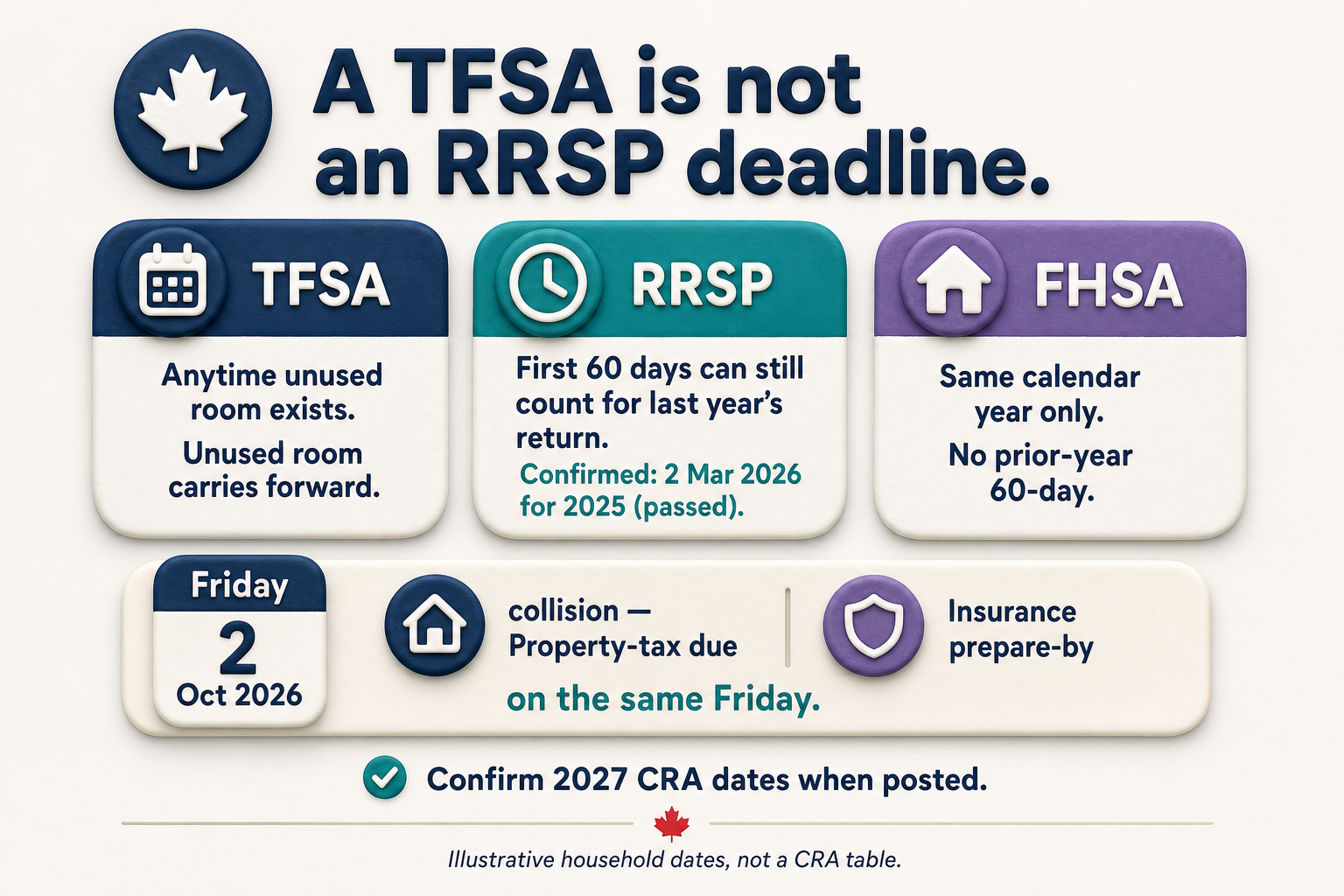
If Quinn contributes to a TFSA in January 2027 instead, that uses 2027 room (plus carry-forward of anything unused). It does not miss an RRSP-style deduction deadline. Contrast with the 2 March 2026 RRSP deadline that already passed for the 2025 return.
A renter skips property tax. A self-employed filer adds the June file row and still pays April 30. Rebuild next January from CRA and this year’s bills.
See prepare-by and due date together
Finnomia tracks upcoming bills and dates so the year is visible. It doesn't hold accounts or move money. If you want those dates in one place, start a 30-day free trial.
What belongs on a Canadian financial calendar?
Verified national dates from CRA and Service Canada, conditional rows only if they apply, and household dates copied from your bills — each with a prepare-by date in front of the legal deadline.
Is 31 December a TFSA contribution deadline?
No. Contribute any time unused room exists. 31 December is a planning cutoff. Unused room carries forward. The RRSP first-60-days deadline is a different rule.
When is the 2026 tax return due?
Confirm on CRA when the 2026-tax-year dates are posted. The standing rule is 30 April for most people (15 June to file if self-employed; pay still 30 April). Do not treat last year’s calendar as this year’s until CRA publishes it.
This article was published in September 2026 and is general information, not tax, legal, or financial advice. Confirm current CRA, benefit, municipal, and insurer dates before you act. Prepare-by offsets are household choices, not official policy. Property tax and insurance dates are not CRA dates.