TFSA vs. RRSP vs. FHSA (2026): Which Should You Fund First?

Aaron Smith

You've found some room in the budget.

Maybe a raise finally showed up on the paycheque. A bonus landed. You finished paying off something. Or this month was simply less expensive than usual.

Now you have another question:

Should the next dollar go into a TFSA, RRSP or FHSA?

There isn't one answer for every Canadian.

These accounts solve different problems:

  • TFSA: maximum flexibility and tax-free withdrawals
  • RRSP: a tax deduction today in exchange for taxable withdrawals later
  • FHSA: combines a tax deduction with a tax-free qualifying withdrawal for a first home

The best place for your next contribution depends primarily on:

  1. whether you're saving for a first home
  2. your tax rate today versus later
  3. how soon you might need the money
  4. whether an employer is matching contributions
  5. what other financial priorities you have

Let's turn those rules into an actual decision.

TFSA vs. RRSP vs. FHSA at a glance

| | TFSA | RRSP | FHSA |
| -------------------------------------------- | -------------------------------------------- | ------------------------------------------------------------------------------------------------------------------------ | ----------------------------------------------------------------------- |
| Main purpose | Flexible saving and investing | Retirement and tax deferral | First-home saving |
| 2026 new room | $7,000 annual dollar limit, plus unused room | Generally 18% of prior-year earned income up to the 2026 dollar limit of $33,810, adjusted for pension and other factors | $8,000 in first year opened; up to $8,000 unused room can carry forward |
| Lifetime contribution limit | No fixed lifetime dollar cap | No fixed lifetime dollar cap | $40,000 |
| Contribution deductible? | No | Generally yes, within deduction limit | Generally yes |
| Investment growth | Generally tax-free | Tax-deferred while inside account | Generally tax-free while inside account |
| Normal withdrawal | Tax-free | Taxable income | Taxable unless qualifying first-home withdrawal |
| Contribution room restored after withdrawal? | Yes, on January 1 of the next calendar year | No | No for qualifying withdrawals |
| Best known for | Flexibility | Retirement + current tax deduction | First-home savings |
| First-home feature | Withdraw normally, tax-free | HBP can allow eligible withdrawal of up to $60,000 | Qualifying withdrawal can be tax-free |
| Repayment after first-home withdrawal | No | HBP withdrawals must generally be repaid | No |
| Age limit to contribute | No upper age limit under the TFSA rules | Generally through December 31 of the year you turn 71 | Must satisfy FHSA age and eligibility rules |

Those headline limits are only part of the story.

Your actual available contribution room can be very different.

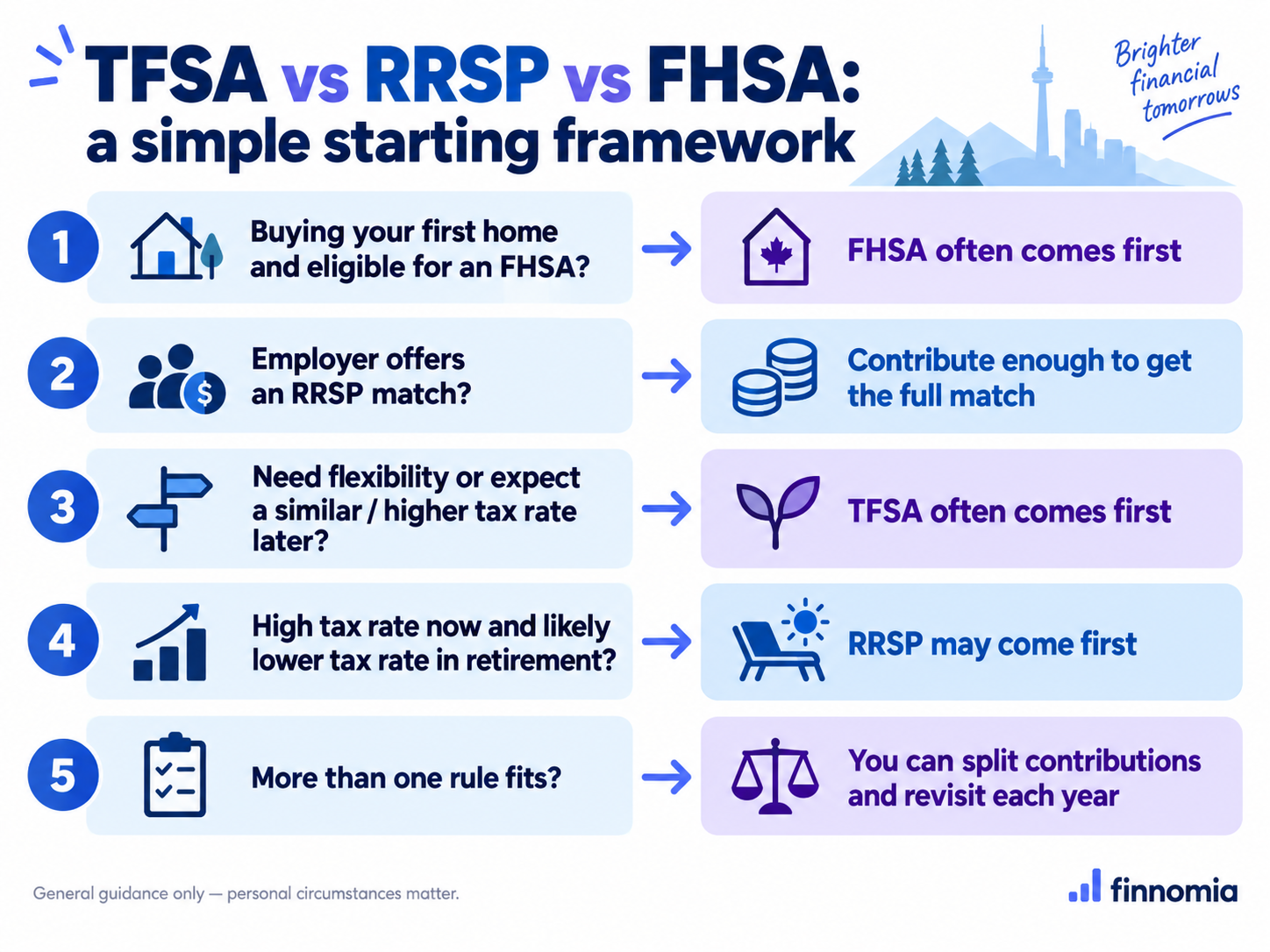
The short answer: which one should come first?

Here's a useful starting framework.

If your employer matches RRSP contributions

Consider contributing enough to receive the full available match first.

An employer match is part of your compensation. Turning it down because another account has slightly better tax characteristics can mean leaving compensation on the table.

Just remember that workplace pension arrangements and employer plans can affect your future RRSP room, so check your plan documents and CRA information.

If you're eligible for an FHSA and seriously saving for a first home

The FHSA is often the strongest account to examine first.

You can generally receive an income-tax deduction when you contribute and make a tax-free qualifying withdrawal when you buy the home.

That's an unusually attractive combination.

If flexibility is your biggest priority

The TFSA usually deserves serious consideration.

You don't receive a deduction for contributing, but withdrawals are generally tax-free and the amount withdrawn is added back to your contribution room the following calendar year.

If you're in a relatively high tax bracket now and expect a lower tax rate later

An RRSP can become particularly valuable because you're receiving the deduction while your marginal tax rate is relatively high and eventually recognizing the withdrawal as taxable income later.

If you're early in your career and expect your income to rise considerably

A TFSA may be more attractive today, especially when flexibility matters.

You can also contribute to an RRSP and choose to claim some or all of the deduction in a later year, provided you stay within the relevant contribution and deduction rules.

If you're fortunate enough to have more money to save

You don't have to pick one winner.

Many Canadians eventually use all three accounts for different jobs.

Before choosing an account, check two things

Registered-account optimization shouldn't necessarily be the very first use of every spare dollar.

Do you have accessible emergency savings?

If a broken transmission or sudden job interruption would force you immediately onto a high-interest credit card, locking every available dollar into retirement planning may leave your finances fragile.

An emergency fund gives you room to absorb an unexpected expense.

A TFSA can sometimes be used to hold emergency savings, particularly when you have sufficient contribution room and keep the money in an appropriate liquid investment such as cash or a savings product.

But remember the TFSA withdrawal rule:

Room from a withdrawal doesn't come back until January 1 of the following year.

CRA specifically warns against withdrawing and then recontributing in the same calendar year unless you know you have enough unused room. (canada.ca)

Are you carrying high-interest debt?

Suppose you're paying 20% interest on a credit-card balance.

A registered-account tax advantage doesn't make that 20% cost disappear.

In many cases, reducing high-interest debt can be one of the most valuable uses of additional cash.

That doesn't necessarily mean contributing nothing—especially if an employer match is available or an FHSA deadline matters—but debt should be part of the comparison.

For a deeper look, see Debt Payoff Strategies in Canada.

TFSA: the flexibility account

The Tax-Free Savings Account is badly named.

It isn't merely a savings account.

A TFSA is a registered account that can potentially hold investments such as:

  • cash
  • GICs
  • bonds
  • mutual funds
  • ETFs
  • stocks
  • other qualified investments

What makes it distinctive is the tax treatment.

You contribute with money you've already paid tax on.

There's no deduction for making the contribution.

But investment income and growth inside the account are generally tax-free, and withdrawals are generally tax-free as well.

TFSA contribution room in 2026

The 2026 TFSA dollar limit is $7,000.

That doesn't necessarily mean you can only contribute $7,000.

Available room can include:

  • the current year's $7,000 limit
  • unused room carried forward from previous eligible years
  • eligible withdrawals from the previous calendar year

For someone who hasn't fully used their TFSA in the past, available room can therefore be much larger than the annual limit.

CRA also recommends calculating your contribution room using your own records because financial-institution reporting can lag in your CRA account.

See our TFSA contribution-room guide for the detailed calculation.

The TFSA's major advantage: withdrawals are flexible

Suppose you withdraw $10,000 from your TFSA in June 2026.

The withdrawal itself is generally tax-free.

But that $10,000 doesn't immediately become new contribution room.

It comes back on:

January 1, 2027

If you already used all of your available 2026 room and put that $10,000 back before the end of 2026, you could create an over-contribution.

That's one of the most important TFSA rules to understand.

When a TFSA can make particular sense

A TFSA deserves strong consideration when:

  • you expect to need the money before retirement
  • you're building emergency savings
  • your current tax rate is relatively low
  • you expect your income to rise
  • you've already used an employer match
  • you want tax-free retirement withdrawals
  • you want flexibility around future goals
  • you've already filled your FHSA or don't qualify for one

The ability to withdraw without creating taxable income can also be valuable later in life.

RRSP: the tax-deferral account

The Registered Retirement Savings Plan works differently.

You can generally deduct eligible RRSP contributions from taxable income, up to your RRSP deduction limit.

Investment growth remains tax-deferred while it stays inside the RRSP.

When you eventually make a regular withdrawal, however, the withdrawal is generally included in taxable income.

So an RRSP isn't simply:

> “Contribute and save tax.”

A better way to think about it is:

> “Take a deduction at one point in your life and recognize taxable income at another.”

That timing can be extremely valuable.

RRSP contribution room in 2026

The 2026 RRSP dollar limit is $33,810.

But that is not automatically your personal contribution room.

Generally, new room is based on 18% of the previous year's earned income, subject to the annual dollar limit and adjustments such as pension adjustments.

Unused RRSP room can carry forward.

Your personal RRSP deduction limit is available on your:

  • latest Notice of Assessment or Reassessment
  • CRA account
  • Form T1028 where applicable

Use that figure rather than assuming the $33,810 maximum applies to you.

Example

Suppose your 2025 earned income was $80,000 and, for simplicity, you had no pension adjustment and no unused room.

18% of $80,000 is:

$14,400

That's below the $33,810 annual dollar limit, so approximately $14,400 would form the starting point for the new room in this simplified example.

Your actual CRA calculation may include other adjustments.

Why your current tax rate matters

Imagine two people each contribute $10,000 to an RRSP.

One person receives the deduction while paying a relatively low marginal tax rate.

The other claims the same deduction while their marginal rate is considerably higher.

The contribution is identical.

The immediate value of the deduction isn't.

That's one reason RRSP contributions become particularly interesting during:

  • higher-income years
  • peak earning years
  • large bonus years
  • years with unusually high taxable income

There is no universal income level where an RRSP suddenly becomes “better” than a TFSA.

Province, deductions, credits, benefits and future income all matter.

The principle is more important than a generic cutoff:

The RRSP becomes more attractive when the deduction is valuable today relative to the tax consequences you expect when withdrawing later.

You don't necessarily have to claim the deduction immediately

This is a useful RRSP feature that many people overlook.

You can contribute to an RRSP and report the contribution without necessarily deducting the entire amount that year.

CRA allows unused RRSP contributions to remain available for deduction in a future year, subject to the relevant rules. (canada.ca)

That can be useful if:

  • you have room today
  • you want the money invested
  • you expect to be in a higher tax bracket later

But don't confuse unused contribution room with an undeducted contribution. They're different concepts, and excess-contribution rules still apply.

RRSP withdrawals are much less flexible than TFSA withdrawals

For a normal RRSP withdrawal:

  • the amount is generally taxable income
  • the financial institution usually withholds tax
  • the contribution room is generally gone permanently

CRA's withholding rates for Canadian residents outside Quebec currently range from 10% to 30% depending on the withdrawal amount, with different withholding rates in Quebec. The withholding is only a prepayment—it may not equal the actual tax ultimately owing. (canada.ca)

That's why an RRSP is usually a poor place for money you expect to need casually next year.

There are specific programs such as the Home Buyers' Plan and Lifelong Learning Plan, but they're exceptions to the normal withdrawal rules.

FHSA: the first-home account

If you're eligible and genuinely saving for a first home, the First Home Savings Account deserves special attention.

Why?

Because it combines two of the most attractive characteristics of the other accounts:

RRSP-like contribution deduction

plus

TFSA-like tax-free qualifying withdrawal

You can generally deduct your own FHSA contributions.

If you later make a qualifying withdrawal to purchase or build an eligible first home, the withdrawal can generally be tax-free.

And unlike an RRSP Home Buyers' Plan withdrawal:

you don't have to repay a qualifying FHSA withdrawal.

FHSA contribution room

In the year you open your first FHSA, your participation room is generally:

$8,000

In subsequent years, additional room becomes available, and up to $8,000 of unused FHSA participation room can carry forward.

The lifetime contribution limit is:

$40,000

Unlike a TFSA, however, FHSA room doesn't begin accumulating merely because you're old enough and eligible.

You must open an FHSA before participation room begins accumulating.

That's an important planning difference.

Don't open an FHSA automatically just because you're eligible

You'll sometimes hear:

> “Open an FHSA immediately, even with $0.”

There's logic behind that advice because opening the account starts your participation room.

But opening it also starts the FHSA's maximum participation period.

Generally, the account eventually has to be closed by the earliest of several events, including the end of the maximum participation period and age-related limits.

So think about your likely first-home timeline.

If buying a home is a realistic possibility within the FHSA's life, opening the account can make sense.

If home ownership is decades away—or not something you expect to pursue—starting the clock immediately may not be necessary.

If you're planning to buy a first home

For an eligible buyer, an FHSA will often be one of the first registered accounts worth considering after immediate financial stability and any employer match.

Suppose you contribute:

$8,000

You may be able to claim an $8,000 deduction from taxable income.

The amount of tax that actually saves depends on your circumstances.

The investments can then grow inside the FHSA.

If you meet the qualifying conditions when purchasing your first home, the withdrawal can be tax-free.

There is no requirement to repay that qualifying withdrawal.

That's a powerful combination.

You can also delay claiming an FHSA deduction

Like an RRSP deduction, an eligible FHSA deduction doesn't necessarily have to be claimed immediately.

CRA allows unused deductible FHSA contributions to be carried forward and claimed in a future tax year. (canada.ca)

That may matter for someone who:

  • is eligible for the FHSA today
  • wants the money invested
  • expects significantly higher taxable income later

Again, contribution room and deduction timing are separate concepts.

What if you open an FHSA and never buy a home?

The money isn't necessarily trapped.

Provided the required conditions are met, property in an FHSA can generally be transferred directly to your own RRSP or RRIF without immediate tax consequences.

Importantly, that direct transfer generally does not use your unused RRSP deduction room. (canada.ca)

That gives the FHSA a useful fallback:

> First home if the plan happens; retirement if it doesn't.

A regular non-qualifying withdrawal is different and is generally taxable.

FHSA vs. the RRSP Home Buyers' Plan

Canadians buying a first home may potentially use both.

The Home Buyers' Plan currently allows an eligible person to withdraw up to:

$60,000

from their RRSP to buy or build a qualifying home.

CRA also allows an eligible FHSA qualifying withdrawal and HBP withdrawal to be used for the same qualifying home, provided the conditions for both programs are met. (canada.ca)

The major difference:

FHSA

Qualifying withdrawal:

  • tax-free
  • does not need to be repaid

HBP

Eligible RRSP withdrawal:

  • can be withdrawn without immediate tax under the HBP
  • must generally be repaid over time

So if you're specifically accumulating new savings for a first home and qualify for an FHSA, the FHSA often deserves attention before using an RRSP solely because the HBP exists.

Two people can potentially use their own accounts

If two eligible people are buying a home together, each person's registered accounts remain individual.

That can potentially mean:

  • Partner A's FHSA
  • Partner B's FHSA
  • Partner A's HBP
  • Partner B's HBP

provided each person independently meets the applicable eligibility conditions.

That can make registered-account planning particularly important for couples saving for a home.

Don't assume one person's eligibility automatically establishes the other's.

FHSA eligibility is more complicated than “I've never owned a house”

The FHSA has specific first-time home-buyer tests.

And the eligibility test for opening an FHSA isn't identical in every respect to the test for making a qualifying withdrawal.

Living in a home owned by a spouse or common-law partner can also affect eligibility in some situations.

Rather than relying on a simplified “never owned = eligible” rule, check CRA's current:

before contributing based on an expected home purchase.

TFSA vs. RRSP when you're not buying a home

If the FHSA isn't relevant, the most common decision becomes:

TFSA or RRSP?

Here's a useful way to frame it.

TFSA tends to become more attractive when:

  • your current tax rate is relatively low
  • you expect substantially higher income later
  • you may need the money before retirement
  • flexibility is important
  • you want withdrawals that don't create taxable income
  • you're building emergency or medium-term savings

RRSP tends to become more attractive when:

  • your current marginal tax rate is relatively high
  • you expect a lower tax rate when withdrawing
  • retirement is the primary goal
  • you're receiving an employer match
  • the deduction creates meaningful current tax savings
  • you're comfortable giving up withdrawal flexibility

But this isn't a permanent choice.

The same person might favour:

TFSA at 24

and

RRSP at 45

because their income and financial priorities changed.

That's exactly why there isn't a universal winner.

Don't choose based only on the tax refund

An RRSP or FHSA contribution can reduce taxable income.

That may produce or increase a tax refund.

But the refund isn't free money generated by the account.

It reflects tax that otherwise would have been payable given your income and deductions.

If you contribute to an RRSP solely because:

> “I'll get a big refund.”

and then spend the entire refund, you're missing part of the planning opportunity.

A more useful question is:

> What is the deduction worth at my current marginal tax rate, and what will I do with the resulting tax savings?

Some people choose to:

  • reinvest the refund
  • contribute it to a TFSA
  • add it to the FHSA
  • pay down debt
  • build emergency savings

The account decision and the refund decision should be considered together.

Where should emergency savings go?

Emergency money should first satisfy a more basic requirement:

You need to be able to access it when the emergency happens.

A TFSA can be useful for emergency savings when:

  • you have sufficient room
  • the money is held in a liquid, low-risk form appropriate for emergency use
  • you understand the withdrawal/recontribution timing

An RRSP is generally much less flexible for this purpose because normal withdrawals are taxable and contribution room isn't restored.

An FHSA should generally be treated as first-home money when that's the goal. A non-qualifying withdrawal is normally taxable.

The account label and the investment inside the account are also separate decisions.

A TFSA can hold cash.

It can also hold volatile investments.

Money that you may need next month shouldn't become risky simply because it's inside a TFSA.

Three transfer rules worth knowing

The full registered-plan transfer rules can get complicated, but three common situations are especially useful.

RRSP → FHSA

A qualifying direct RRSP-to-FHSA transfer:

  • uses FHSA participation room
  • is not a new deductible FHSA contribution
  • does not restore RRSP contribution room

So you don't receive a second tax deduction just for moving previously deducted RRSP money into an FHSA.

FHSA → RRSP/RRIF

A qualifying direct FHSA-to-RRSP or RRIF transfer can generally occur without immediate tax consequences and without consuming additional RRSP deduction room.

That's what creates the FHSA's retirement fallback if you don't purchase a home.

TFSA → FHSA

There is no special direct tax-deferred TFSA-to-FHSA transfer mechanism.

You can withdraw from a TFSA and make a new FHSA contribution if you're eligible and have room.

But those are two separate transactions.

Remember that TFSA withdrawal room doesn't come back until the following January.

Watch the contribution calendars

TFSA, RRSP and FHSA don't all use the same contribution timing.

TFSA

The contribution year follows the calendar year.

Your 2026 TFSA activity runs through:

December 31, 2026

FHSA

FHSA deductions also follow the calendar year.

A contribution made in January 2027 cannot be deducted for 2026 the way an early-year RRSP contribution potentially can.

RRSP

RRSPs have the familiar first-60-days rule.

CRA confirmed March 2, 2026 as the contribution deadline for amounts eligible to be deducted for the 2025 tax year.

For the 2026 return, verify the applicable early-2027 deadline on CRA once it has been officially posted.

Don't assume all three accounts share the RRSP rule.

Check your room before contributing

Over-contributing can create taxes and paperwork.

TFSA

CRA generally applies a 1% monthly tax to excess TFSA amounts.

There isn't a general $2,000 cushion.

FHSA

Excess FHSA amounts can also face a 1% monthly tax.

RRSP-to-FHSA transfers count when determining whether you've exceeded your FHSA participation room.

RRSP

RRSP rules include a limited $2,000 excess-contribution allowance that is generally not subject to the normal monthly excess-contribution tax.

But that doesn't make the extra $2,000 deductible.

And it isn't a target.

The safest approach is still:

Know your room before contributing.

A practical order for your next dollar

Here's the framework I'd use—not as a universal rule, but as a decision tree.

1. Cover immediate financial stability

Make sure required bills and minimum debt payments are covered.

Build enough accessible cash that an ordinary financial surprise doesn't immediately require expensive borrowing.

2. Capture an employer match

If you're eligible for matching contributions, understand the plan and consider contributing enough to receive the available match.

3. Deal with expensive debt

Pay particular attention to high-interest balances.

Compare the guaranteed interest cost you're eliminating with the benefits you're expecting from the investment contribution.

4. If you're an eligible first-home buyer, evaluate the FHSA

Ask:

  • Is buying a first home realistically part of my plan?
  • Does the FHSA timeline fit?
  • How much participation room do I have?
  • What is the deduction worth at my current tax rate?

For many eligible first-home savers, this can move the FHSA near the front of the line.

5. Compare TFSA and RRSP based on taxes and flexibility

Ask:

Is my tax rate relatively high today?

RRSP becomes more interesting.

Do I expect income to rise significantly?

TFSA may become more attractive.

Might I need the money?

TFSA usually offers more flexibility.

Is retirement clearly the goal?

RRSP may fit particularly well.

6. Use more than one account when that solves different jobs

There's no reason your financial plan has to declare allegiance to one registered account.

You might use:

  • FHSA for the home
  • TFSA for flexible investing
  • RRSP for retirement
  • TFSA for emergency cash
  • RRSP for employer matching

Different accounts can have different jobs.

How Finnomia handles Canadian registered accounts

Finnomia is the Canadian personal-finance platform behind this blog.

Investment tracking supports Canadian registered-account types including:

  • TFSA
  • RRSP
  • FHSA
  • RESP
  • LIRA

Rather than treating every brokerage account as a generic “investment account,” Finnomia can incorporate those account types into your broader financial picture.

Advanced users can view connected investment holdings and transactions and track registered-account contributions.

Finnomia also allows users to enter their own contribution-room information and compare contributions with that amount.

Finnomia does not retrieve official contribution room directly from CRA.

Always confirm official limits and your personal available room using CRA records and your own contribution history.

You can also use Finnomia's free calculators:

Finnomia currently uses Plaid for financial connectivity and is adding Flinks as a second provider to improve support across Canadian financial institutions.

Finnomia completes Open Beta on September 1, 2026. The registered-account and investment functionality described here is already live.

There doesn't have to be one winner

TFSA vs. RRSP vs. FHSA sounds like a competition.

It usually isn't.

Each account is optimized for a different problem.

FHSA:
How can I save tax-efficiently for my first home?

RRSP:
How can I shift taxable income from my working years toward retirement while investing along the way?

TFSA:
How can I grow money tax-free while keeping withdrawals flexible?

Your circumstances determine which question matters most today.

And that answer can change.

The account you prioritize at 25 doesn't have to be the account you prioritize at 45.

The useful goal isn't to find the universally “best” account.

It's to give each dollar the account that best matches what that dollar is supposed to accomplish.

If you want to track your registered accounts alongside your spending, debt, investments and broader financial picture, you can start a 30-day Finnomia trial.

Frequently asked questions

Is a TFSA better than an RRSP?

Neither is universally better.

A TFSA generally offers greater withdrawal flexibility and no deduction on contribution. An RRSP generally provides a tax deduction for eligible contributions but normal withdrawals are taxable.

Your current and future tax rates, timeline and goals all matter.

Should I max my FHSA before my TFSA?

If you're eligible and seriously saving for a first home, an FHSA can be particularly attractive because contributions are generally deductible and qualifying withdrawals can be tax-free.

But emergency savings, high-interest debt, employer matching, your expected home-buying timeline and your need for flexibility should also be considered.

What is the 2026 TFSA limit?

The TFSA dollar limit for 2026 is $7,000.

Your actual available contribution room may be higher because unused room carries forward and eligible prior-year withdrawals are added back.

What is the 2026 RRSP limit?

The 2026 RRSP dollar limit is $33,810.

Your personal RRSP deduction limit may be much lower or higher once unused room and pension-related adjustments are considered. Check your CRA records or latest Notice of Assessment.

What is the FHSA limit?

FHSA participation room is generally $8,000 in the year you open your first FHSA.

Up to $8,000 of unused participation room can carry forward, and the lifetime contribution limit is $40,000.

Can I use an FHSA and the Home Buyers' Plan together?

Yes, provided you independently meet the requirements of both programs.

CRA allows an eligible FHSA qualifying withdrawal and HBP withdrawal to be used toward the same qualifying home.

Do I have to repay an FHSA withdrawal?

A qualifying FHSA first-home withdrawal does not need to be repaid.

That's different from an eligible Home Buyers' Plan withdrawal from an RRSP, which generally must be repaid.

Does TFSA room come back after I withdraw money?

Yes, but not immediately.

The amount withdrawn is generally added back to your contribution room on January 1 of the following calendar year.

Can I transfer my FHSA to my RRSP if I don't buy a home?

Generally yes.

If the applicable conditions are met, a direct transfer from your FHSA to your own RRSP or RRIF can occur without immediate tax consequences and without using your existing RRSP deduction room.

This article was reviewed in August 2026 and provides general information, not personalized tax, investment or financial advice. Registered-account limits, tax rules and government programs can change. Confirm your personal TFSA, RRSP and FHSA contribution room and eligibility using current CRA records before contributing or withdrawing.

← All posts