
On this page
- The TFSA withdrawal rule in one example
- TFSA withdrawals are generally tax-free
- What happens to gains and losses?
- Moving a TFSA between institutions
- What if you over-contribute?
- Keep your own TFSA records
- TFSA withdrawal FAQ
- A larger example: several TFSAs and several transactions
- Partial withdrawals and in-kind withdrawals
- Withdrawals near year-end
- TFSA withdrawals for a home, emergency or retirement
- A year-end TFSA checklist
- Common TFSA withdrawal decisions
- When to get professional help
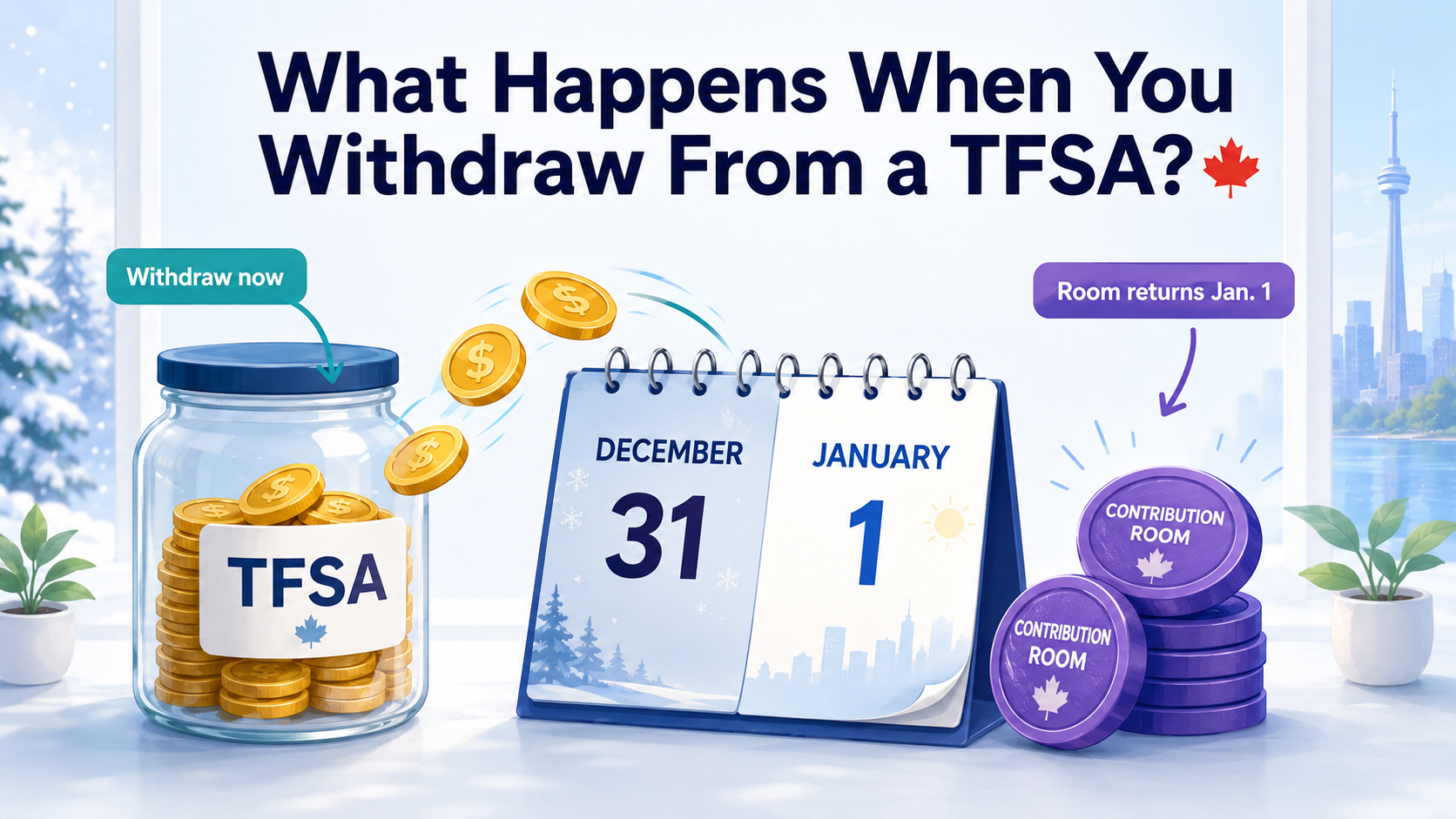
What Happens When You Withdraw From a TFSA?
You can generally withdraw money from a Tax-Free Savings Account at any time without paying tax. The withdrawal also does not count as income or reduce federal income-tested benefits and credits.
The catch is contribution room: the amount you withdraw is added back on January 1 of the next calendar year—not when you make the withdrawal. If you put the money back too soon and have no unused room left, you can accidentally over-contribute.
The TFSA withdrawal rule in one example
Suppose you begin 2026 with $7,000 of available TFSA room:
| Transaction | Available 2026 room |
|---|---|
| Contribute $4,000 in January | $3,000 |
| Withdraw $4,000 in February | $3,000 |
| Re-contribute $3,500 in October | $500 over-contribution |
The February withdrawal does not create new room during 2026. The $4,000 comes back on January 1, 2027, along with any new annual room for 2027.
That does not mean you must always wait until next year. You may re-contribute during the same year if you already have enough unused room. In the example above, up to $3,000 could still be contributed in 2026.
TFSA withdrawals are generally tax-free
Interest, dividends and capital gains earned inside a TFSA are generally tax-free, including when you withdraw them. Unlike an RRSP withdrawal, a normal TFSA withdrawal is not added to taxable income.
CRA also says TFSA income and withdrawals do not affect federal benefits and credits such as OAS, GIS, EI, the Canada Child Benefit, the Canada Workers Benefit and the GST/HST credit.
There are exceptions. Tax can arise when a TFSA contains an excess amount, a non-resident contribution or a non-qualified investment, or when trading activity amounts to carrying on a business. See CRA’s overview of TFSAs for the official rules.
What happens to gains and losses?
Investment performance does not directly change your contribution room.
- A gain inside the TFSA does not use room.
- A loss inside the TFSA does not restore room.
- If you withdraw an amount that includes growth, the full amount withdrawn is added back next January 1.
For example, if $20,000 grows to $27,000 and you withdraw all $27,000, then $27,000 is added to your room the following calendar year. If $20,000 falls to $14,000 and you sell and withdraw it, only the $14,000 withdrawal returns as room. The $6,000 investment loss does not.
Moving a TFSA between institutions
If you want to move a TFSA, ask the receiving institution to arrange a direct TFSA-to-TFSA transfer. Do not withdraw the money yourself and immediately deposit it into a new TFSA unless you have enough unused room.
A direct transfer does not count as a withdrawal or new contribution. A withdrawal-and-redeposit does—and can produce an accidental over-contribution.
What if you over-contribute?
CRA generally charges tax equal to 1% of the highest excess TFSA amount in each month that the excess remains. Unlike an RRSP, a TFSA has no $2,000 cushion.
If you discover an excess amount, remove it promptly and review CRA’s excess TFSA guidance. Removing it stops the excess from continuing into later months, but it does not erase tax already triggered.
Keep your own TFSA records
CRA My Account can lag because financial institutions report TFSA activity after year-end. Before contributing, reconcile:
- your unused room from the previous year;
- the current year’s annual limit;
- last year’s withdrawals; and
- every contribution made this year across all your TFSAs.
Finnomia can keep TFSA balances and user-maintained contribution-room records beside the rest of your financial picture. It does not connect to CRA or replace your Notice of Assessment and transaction records.
For the annual limits, see the TFSA, RRSP and FHSA contribution limits cheat sheet. If you are deciding which account to fund, compare TFSA vs RRSP vs FHSA.
TFSA withdrawal FAQ
Does TFSA withdrawal room return immediately?
No. The amount withdrawn is added back on January 1 of the next calendar year.
Can I withdraw and re-contribute in the same year?
Only if you already have enough unused contribution room. The withdrawal itself does not create room until next year.
Does a TFSA withdrawal affect my tax return?
A normal TFSA withdrawal is generally not taxable and is not reported as income.
Do TFSA withdrawals restore room for non-residents?
The withdrawal is added back the next year, but a non-resident generally cannot make a tax-free TFSA contribution until becoming resident again.
A larger example: several TFSAs and several transactions
Contribution room belongs to the individual, not to each account. Suppose Maya has one TFSA at a bank and another at an online brokerage. She starts 2026 with $12,000 of available room and makes these transactions:
| Date | Transaction | Effect on 2026 room |
|---|---|---|
| January 15 | Contributes $7,000 to the bank TFSA | $5,000 remains |
| March 20 | Contributes $4,000 to the brokerage TFSA | $1,000 remains |
| June 10 | Withdraws $6,500 from the bank TFSA | Still $1,000 |
| September 1 | Contributes $1,000 to the brokerage TFSA | $0 remains |
Maya has used all her 2026 room. She must wait until January 1, 2027 before replacing the $6,500 withdrawal, unless some transaction above is reversed or otherwise does not count as a contribution under CRA rules.
This example also shows why looking at one institution can be misleading. The brokerage may show only $5,000 of deposits, but room has been used across both issuers.
Partial withdrawals and in-kind withdrawals
The same room rule applies whether you withdraw cash, sell only part of an investment, or transfer property out in kind. For an in-kind withdrawal, the fair market value of the property at the time of withdrawal is generally the amount reported. Market movement before or after the withdrawal does not retroactively change that reported amount.
If you need a specific cash amount, leave time for securities to settle and for the institution to process the withdrawal. The tax rule may be simple while the operational timeline depends on what the TFSA holds.
Withdrawals near year-end
A withdrawal on December 30 and one on January 2 can produce very different contribution timing.
- A December 2026 withdrawal is added back on January 1, 2027.
- A January 2027 withdrawal is not added back until January 1, 2028.
That can make a late-December withdrawal useful when you know you will need the cash and expect to replace it early in the new year. Do not force the timing if selling an investment or rushing a transfer would create other costs. Confirm the transaction date that the issuer will report.
TFSA withdrawals for a home, emergency or retirement
The withdrawal rules do not change based on the purpose. You can generally use TFSA money for a down payment, emergency, education, retirement income or any other goal.
The planning consequences do change:
- Emergency: decide whether rebuilding the TFSA or rebuilding accessible cash should come first.
- Home purchase: compare the TFSA withdrawal with an FHSA qualifying withdrawal and the RRSP Home Buyers’ Plan.
- Retirement: a TFSA withdrawal generally does not raise taxable income, which can make it useful when managing income-tested federal benefits.
- Debt repayment: compare the guaranteed interest avoided with the future tax-free growth you give up while the money is outside the account.
A year-end TFSA checklist
- Reconcile contributions across every institution.
- Record all withdrawals and the year in which they occurred.
- Separate account balance from contribution room.
- Confirm whether any transfer was direct or completed as a withdrawal and deposit.
- Do not count investment losses as new room.
- Keep statements and transaction confirmations with your own room calculation.
Common TFSA withdrawal decisions
Should I sell investments or withdraw existing cash?
If the TFSA holds both cash and investments, the tax treatment of the withdrawal is generally the same, but the portfolio effect differs. Selling may change diversification, realize a market loss inside the account or leave the remaining holdings more concentrated. Review the asset allocation before choosing what funds the withdrawal.
Should I withdraw from a TFSA or a non-registered account first?
The answer can depend on unrealized gains, tax brackets, investment time horizon and the importance of preserving TFSA shelter. A non-registered sale may create a taxable capital gain; a TFSA sale generally does not. On the other hand, leaving long-term growth inside the TFSA can be valuable. Compare the specific holdings rather than choosing solely from the account label.
Can a withdrawal be cancelled?
Once an issuer completes and reports a withdrawal, depositing the money again is normally a new contribution unless the issuer can validly reverse an operational error. Do not assume that changing your mind restores the original transaction. Contact the institution promptly and verify how it will be reported.
What happens after death?
TFSA treatment after death depends on whether there is a successor holder, a designated beneficiary, the province or territory, the timing of distributions and growth after death. A spouse or common-law partner may have options that preserve registered treatment when the required conditions and timelines are met. Review beneficiary designations as part of estate planning rather than assuming an ordinary withdrawal rule applies.
When to get professional help
Seek tax or legal advice when the situation involves non-residency, a deceased holder, prohibited or non-qualified investments, frequent trading, a disputed excess amount or a transfer connected to a separation or estate. These cases can involve rules beyond the ordinary January 1 add-back.
This article provides general information, not personalized tax advice. Confirm your room using your own records and current CRA guidance.
Featured image
Concept: A bright January calendar flips from December 31 to January 1 while blue coins move out of a TFSA jar and contribution-room tokens reappear only on the new-year side. Minimal labels: “Withdraw now” and “Room returns Jan. 1.”