
On this page
- First, make sure the $1 million is investable
- What can a $1 million portfolio provide?
- CPP and OAS can change the answer substantially
- Three ways the same $1 million can look very different
- Retiring at 55 is not the same as retiring at 65
- Housing can matter more than the headline portfolio number
- The account mix changes how much you can actually spend
- What can derail a $1 million retirement plan?
- A practical $1 million retirement test
- So, is $1 million enough to retire in Canada?
A million dollars sounds like a retirement finish line. In practice, it is only one input.
For some Canadians, a $1 million investment portfolio plus CPP, OAS and modest housing costs can support a workable retirement. For someone retiring early, carrying a mortgage or rent, or spending $80,000 to $100,000 a year, the same portfolio can be much tighter.
The useful question is not “Is $1 million enough?” It is:
How much of the $1 million would you need to withdraw each year after pensions and other reliable income?
That turns a round number into a retirement plan you can actually test.
First, make sure the $1 million is investable
If you say you have a $1 million net worth, separate the assets that can fund spending from the assets that cannot easily do so.
A paid-off home can reduce retirement expenses substantially, but $700,000 of home equity plus $300,000 in investments is not the same retirement-income picture as a $1 million investment portfolio.
For this article, $1 million means investable retirement assets: RRSPs, RRIFs, TFSAs, non-registered investments and similar financial assets that can eventually fund spending.
If you are still trying to calculate your target rather than test a $1 million portfolio, start with How Much Do You Need to Retire in Canada?. It works from spending to CPP/OAS to the portfolio gap.
What can a $1 million portfolio provide?
A simple first pass is to convert the portfolio into an annual withdrawal.
For a $1 million portfolio:
- 3% = $30,000 in first-year withdrawals
- 3.5% = $35,000
- 4% = $40,000
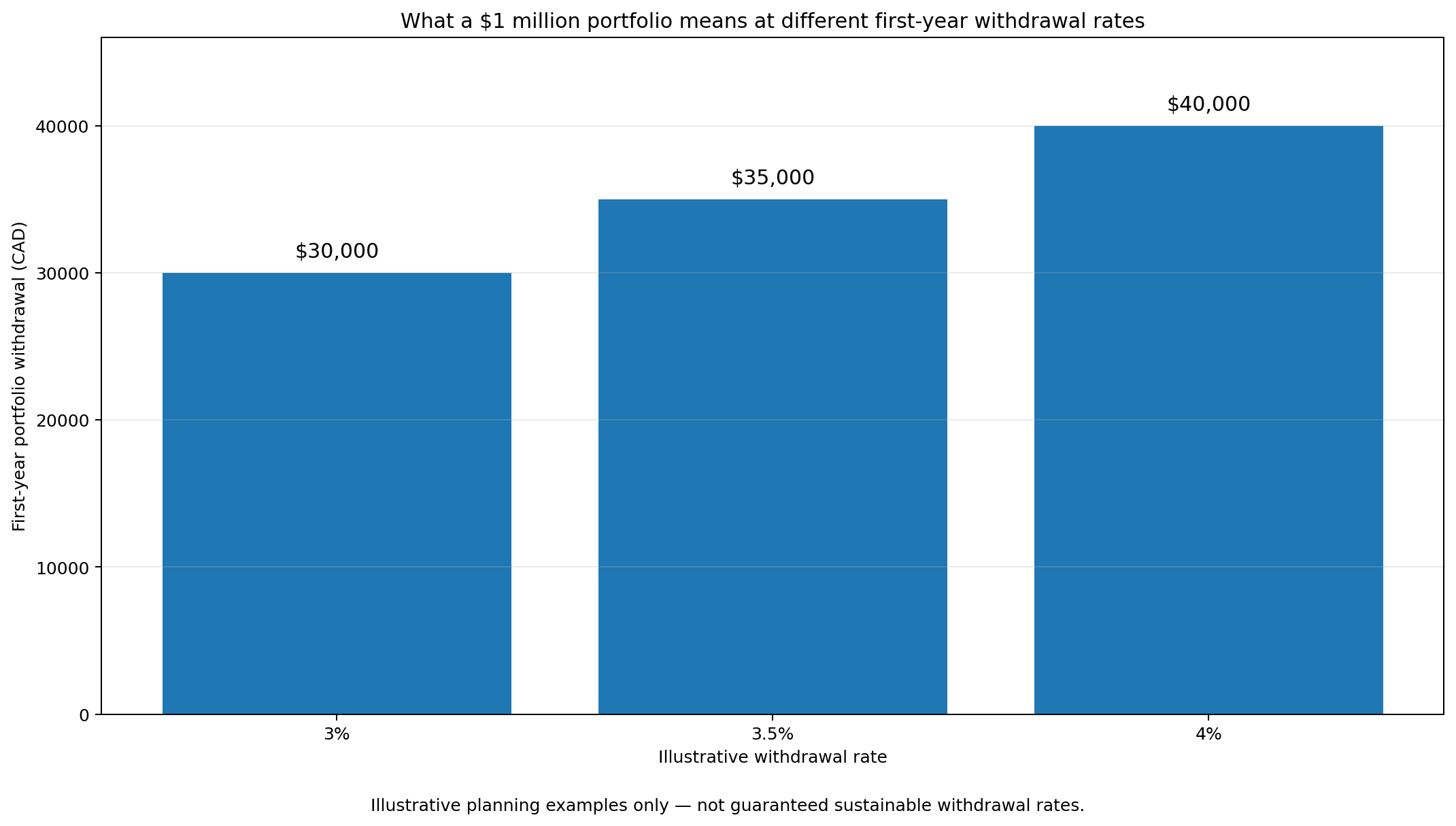
The 4% figure is a common retirement-planning rule of thumb, not a Government of Canada rule and not a guarantee. A sustainable withdrawal depends on retirement length, investment mix, fees, inflation, market returns, taxes and whether you can reduce spending after a bad year.
So $40,000 is not a promise that a $1 million portfolio will safely pay that amount every year for the rest of your life. It is a useful starting point for testing the rest of the plan.
CPP and OAS can change the answer substantially
A Canadian retiree does not necessarily need the portfolio to fund every dollar of spending.
As of 2026, the maximum CPP retirement pension for someone starting at 65 is $1,507.65 a month. The average for new beneficiaries at age 65 was $877.01 a month in April 2026. Your amount depends on your own contribution history and start age, so use your estimate in My Service Canada Account rather than assuming you will receive the maximum.
For July through September 2026, the maximum OAS pension is $751.97 a month for ages 65 to 74. OAS eligibility and the amount you receive depend on factors including age, Canadian residence history and income.
If you worked mainly in Quebec, use your Québec Pension Plan estimate rather than treating the CPP figures in this article as your pension.
For a simple illustration, suppose one retiree at 65 receives:
- CPP of $877.01 a month, using the current average for new age-65 beneficiaries only as a placeholder
- full OAS of $751.97 a month
- no workplace pension
That is about $19,547.76 a year of CPP and OAS before tax.
Now the portfolio only needs to cover the remaining gap.
Three ways the same $1 million can look very different
The following examples are deliberately simple. They use the CPP/OAS placeholder above and show gross annual cash flow before tax. They do not assume that the CPP average is your personal benefit or that everyone receives full OAS.
If you need $50,000 a year
Public pensions in the illustration provide about $19,548.
The portfolio needs to provide about $30,452.
That is an initial withdrawal of roughly 3.0% of a $1 million portfolio.
A retiree with low housing costs and a flexible $50,000 gross budget has much more room than someone whose portfolio must fund the entire $50,000.
If you need $60,000 a year
The portfolio gap rises to about $40,452.
That is roughly 4.0% of the portfolio in the first year.
This is close to the familiar 4% rule-of-thumb territory. It may be workable under some assumptions, but it leaves less room for taxes, poor early investment returns, unusually long retirement, large one-time costs or spending that rises faster than expected.
If you need $70,000 a year
The portfolio needs to provide about $50,452.
That is roughly 5.0% of the initial portfolio.
That does not automatically mean the plan fails. You might have a workplace pension, later CPP/OAS increases, part-time income, spending that falls later, or a plan to use home equity. But a persistent 5% draw deserves more stress-testing than a 3% draw.
The lesson is more useful than the exact percentages: a $1 million portfolio is generous or tight only relative to the gap it must fill.
Retiring at 55 is not the same as retiring at 65
Age changes the calculation because public pensions may not be available yet.
CPP can start as early as 60, while OAS generally begins at 65. If you retire at 55 and spend $60,000 a year with no workplace pension or other income, the portfolio may initially need to fund the full $60,000. That is a 6% withdrawal from $1 million before considering tax.
The draw may fall once CPP and OAS begin, but the first decade still matters. Those early withdrawals happen while the portfolio also needs to absorb market volatility and inflation.
Early retirees should therefore model retirement in phases rather than using one withdrawal rate forever:
- retirement date to CPP start
- CPP start to OAS start
- CPP/OAS years
- later years when RRIF minimum withdrawals, health costs or housing needs may change the cash flow
Finnomia's CPP at 60 vs. 65 vs. 70 guide explains the official CPP adjustment factors and the trade-offs around claim age. Delaying is not automatically the right choice for everyone.
Housing can matter more than the headline portfolio number
Two retirees with $1 million invested can have completely different plans if one owns a paid-off home and the other pays $3,000 a month in rent or mortgage costs.
Housing affects the plan in two directions.
First, it changes annual spending. A $36,000 yearly housing bill is $36,000 the portfolio and pensions have to support.
Second, a home may provide optional equity later through downsizing, selling or other arrangements. That can be a meaningful backstop, but it should not be counted as spendable investment income unless your plan actually includes using it.
Build the retirement budget from the housing situation you expect to have, not from your current net worth statement.
The account mix changes how much you can actually spend
A $40,000 withdrawal is not always $40,000 of after-tax spending money.
CRA generally treats RRSP withdrawals as taxable income. RRIF income is also reported as pension or retirement income. CPP and OAS are taxable.
TFSA withdrawals are different: they are generally tax-free, and CRA says TFSA income and withdrawals do not affect federal income-tested benefits such as OAS and GIS.
That distinction can matter when a retiree has a mix of RRSP/RRIF, TFSA and non-registered assets.
For the July 2026 to June 2027 OAS recovery-tax period, the minimum recovery threshold is based on 2025 income of $93,454. The recovery tax is 15% of income above the applicable threshold, up to the point where OAS is fully recovered. A $1 million portfolio by itself does not cause an OAS clawback; the relevant issue is taxable income and the recovery-tax rules for the period.
This is why retirement planning should eventually move beyond “What percentage can I withdraw?” to “Which account should fund the withdrawal, and what will the tax result be?”
For TFSA treatment, see What Happens When You Withdraw From a TFSA?. For the later-life RRSP-to-RRIF rules, see RRIF Rules: Conversion, Withdrawals and Minimums.
What can derail a $1 million retirement plan?
A plan that works on an average spreadsheet can still be uncomfortable in real life. Stress-test at least these risks.
Poor returns early in retirement
Large withdrawals during a market decline can permanently reduce the assets available to participate in a recovery. A flexible spending plan is stronger than one that requires the same inflation-adjusted withdrawal regardless of market conditions.
Inflation
A $60,000 lifestyle today will not cost $60,000 forever. CPP and OAS are adjusted under their own rules, but your portfolio still has to support rising costs that are not fully covered by pensions.
A longer retirement
Someone retiring at 55 may need the portfolio to last far longer than someone retiring at 70. Do not use the same planning assumptions without changing the time horizon.
Large irregular costs
Home repairs, vehicles, dental work, travel, family support and long-term care can sit outside a neat monthly budget. Include a reserve or a specific plan for them rather than assuming every dollar of the portfolio can support routine spending.
A rigid lifestyle
Flexibility is an asset. A household that can temporarily reduce travel or large discretionary purchases after a poor market year has more options than one whose entire budget is fixed.
A practical $1 million retirement test
You can get a useful first answer with six numbers.
- Annual spending: Build a realistic retirement budget in today's dollars.
- CPP: Pull your personal estimate from My Service Canada Account.
- OAS: Check your residence history and use the official OAS estimator.
- Other reliable income: Add workplace pensions, annuities or other dependable sources.
- Portfolio gap: Subtract those income sources from annual spending.
- Initial draw rate: Divide the remaining gap by $1 million.
For example:
($60,000 spending − $19,548 CPP/OAS illustration) ÷ $1,000,000 = about 4.0%
Then run the test again with less favourable assumptions:
- higher spending
- lower CPP than the placeholder
- no OAS before 65
- a lower withdrawal rate
- a market decline early in retirement
- a major one-time expense
- a longer-than-expected retirement
The Government of Canada's Canadian Retirement Income Calculator can combine CPP, OAS, workplace pensions and personal savings into estimates. It explicitly treats its results as estimates, not a substitute for detailed financial planning.
So, is $1 million enough to retire in Canada?
For many Canadians, it can be. It is especially plausible when:
- retirement begins near the start of CPP and OAS
- housing costs are modest
- annual spending is controlled
- public or workplace pensions cover a meaningful share of expenses
- the portfolio is diversified and withdrawals are flexible
- taxes and account types are planned rather than ignored
It becomes harder when:
- retirement starts well before public pensions
- rent or mortgage costs remain high
- the portfolio must support $70,000, $80,000 or more of annual withdrawals
- most spending is fixed
- the plan assumes strong returns every year
- the $1 million figure includes a large amount of home equity rather than investable assets
The round number is not the decision. The portfolio gap is.
If you want the broader planning process first, use Retirement Planning in Canada: Map, Process & Checklist. If you already know your spending and pension assumptions, Finnomia's Retirement Planner can help you compare nest-egg, CPP/OAS and claim-age scenarios alongside the rest of your financial picture.
This article reflects federal information available on September 9, 2026 and is general educational information, not personalized investment, tax, legal or retirement advice. CPP, OAS, tax rules and benefit thresholds can change. Confirm current figures on Canada.ca and CRA and use your own Service Canada estimates before making retirement decisions.