
On this page
The standard reference age for the Canada Pension Plan is 65. You can start as early as 60 or as late as 70. Earlier means a permanently smaller monthly cheque; later means a permanently larger one. There’s no benefit waiting past 70.
This page is the official factors, a personal decision framework, and a simple illustration that foots — not a rule that everyone should delay to 70. It is not how contributions are calculated. It is not Old Age Security residency or clawback. It is not “how much do I need to retire.”
Official factors
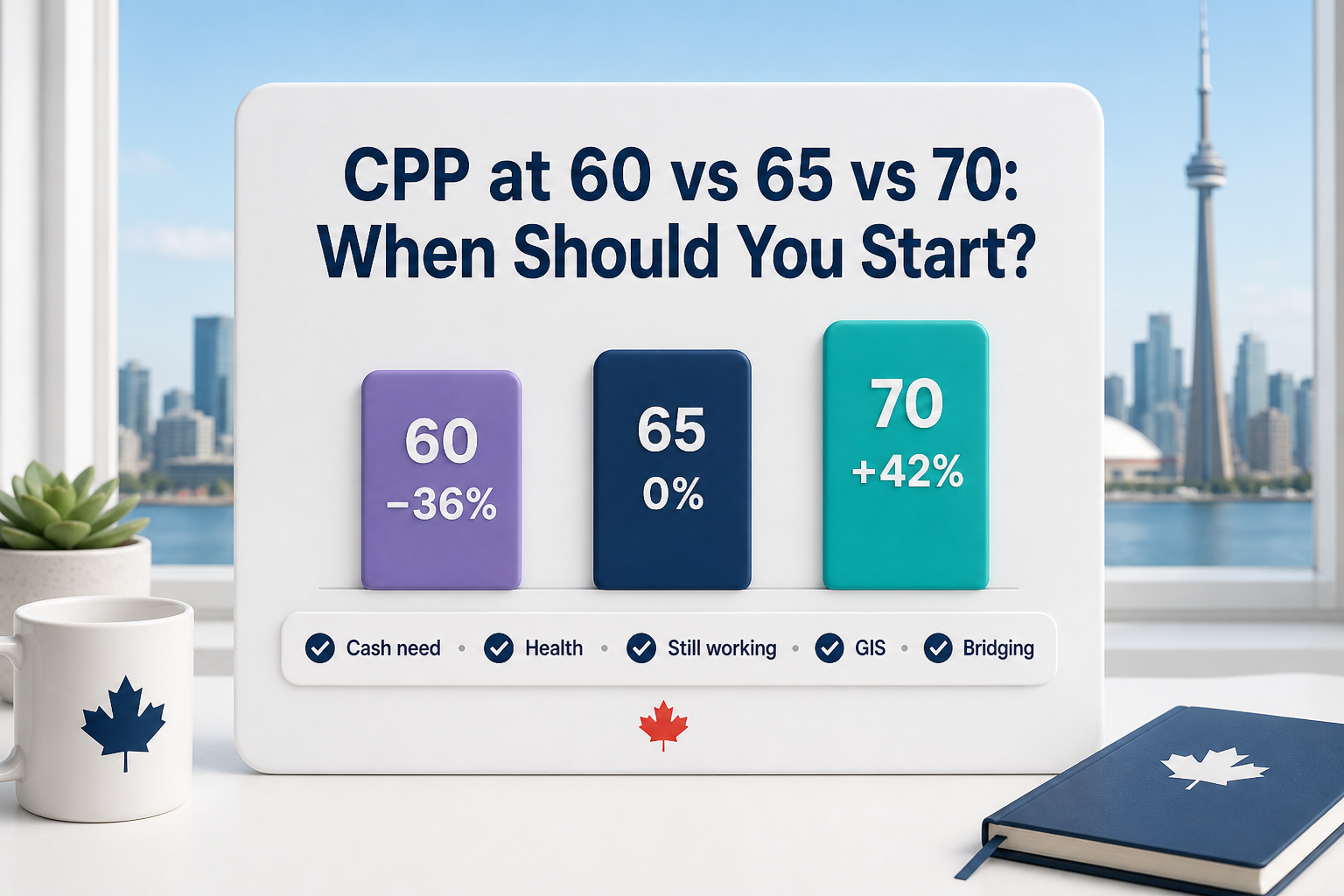
Before 65: −0.6% per month (−7.2% per year) → −36% at 60 (60 months).
After 65: +0.7% per month (+8.4% per year) → +42% at 70 (60 months).
| Start age | Adjustment vs age-65 amount | Factor |
|---|---|---|
| 60 | −0.6%/mo × 60 mo = −36% | × 0.64 |
| 65 | 0% (reference) | × 1.00 |
| 70 | +0.7%/mo × 60 mo = +42% | × 1.42 |
Your age-65 amount depends on your contribution history — pull estimates in My Service Canada Account. For context only: the maximum new retirement pension at 65 for benefits beginning January 2026 is $1,507.65 a month; the average for new beneficiaries at 65 is $877.01 (labelled April 2026 on canada.ca amount and payment-amounts pages). Derived from the max only: × 0.64 ≈ $964.90 at 60; × 1.42 ≈ $2,140.86 at 70 — label those as max × factor, not your cheque.
OAS uses different deferral math (+0.6% per month, up to +36% at 70) and cannot start before 65.
If you worked mainly in Quebec, you generally claim under the Québec Pension Plan (QPP). Retraite Québec administers it; claim rules differ — don’t use this page’s CPP factors as QPP rules.
Five factors to weigh
Service Canada’s own framing is personal circumstances — health, money now, retirement plans. Treat these as equal inputs. None of them is a trump card for “always wait until 70.”
1. Cash need now. If you need income to stop or cut work, pay debts, or fund retirement with little other income, an earlier start may fit. If you can bridge with other income, a later start stays on the table.
2. Health / longevity. Poor health or a shorter expected lifespan can favour more years of smaller cheques. If you’re healthy, expect to live long, and have other income, a later start can raise the lifelong monthly amount. Many healthy Canadians live well past their mid-70s — that’s population context, not a personal prediction. Longevity is one input, not a reason to ignore cash need or GIS.
3. Still working. Working while on CPP under 70 and still contributing can add a post-retirement benefit the following year (maximum new PRB at 65 in 2026: $54.69/mo; average new $25.76, April 2026 on payment-amounts). Continuing to work without claiming can replace some low-earning years before 65 in some cases. Contributions stop at 70 even if you’re still working. High earnings near OAS age can also interact with the OAS recovery tax — one reason to look at total income, not CPP in isolation.
4. GIS interaction. The Guaranteed Income Supplement is income-tested. CPP retirement income counts toward GIS income tests. Claiming CPP earlier can reduce or eliminate GIS; delaying CPP changes the income mix in bridge years. If you’re GIS-eligible or close, run the numbers carefully against official GIS guidance — this page isn’t a GIS tutorial. (Separately: if you’re GIS-eligible for OAS, Service Canada’s OAS tip is not to defer OAS — that’s an OAS rule, not a retell here.)
5. Bridging assets. RRSP, TFSA, and non-registered savings can fund spending while you delay CPP. Account priority is TFSA vs RRSP vs FHSA; tax-free bridge withdrawals are TFSA Withdrawal Rules. Funding the gap sits on How Much Should You Save Each Month?. This isn’t an RRIF factor table.
Remy’s illustration (labelled estimate)
The figures below are an illustrative example. They are not Remy’s real My Service Canada Account quote, not the official average, and not the official maximum.
Remy lives in Kelowna and is choosing a CPP start age. For this illustration, Remy’s labelled age-65 estimate is $1,000 a month — a round number so the official factors are easy to see. Remy should replace $1,000 with their own MSCA estimate before deciding.
| Start age | Official factor | Remy’s labelled monthly estimate |
|---|---|---|
| 60 | × 0.64 (−36%) | $640 |
| 65 | × 1.00 | $1,000 |
| 70 | × 1.42 (+42%) | $1,420 |
$1,000 × 0.64 = $640. $1,000 × 1.42 = $1,420.
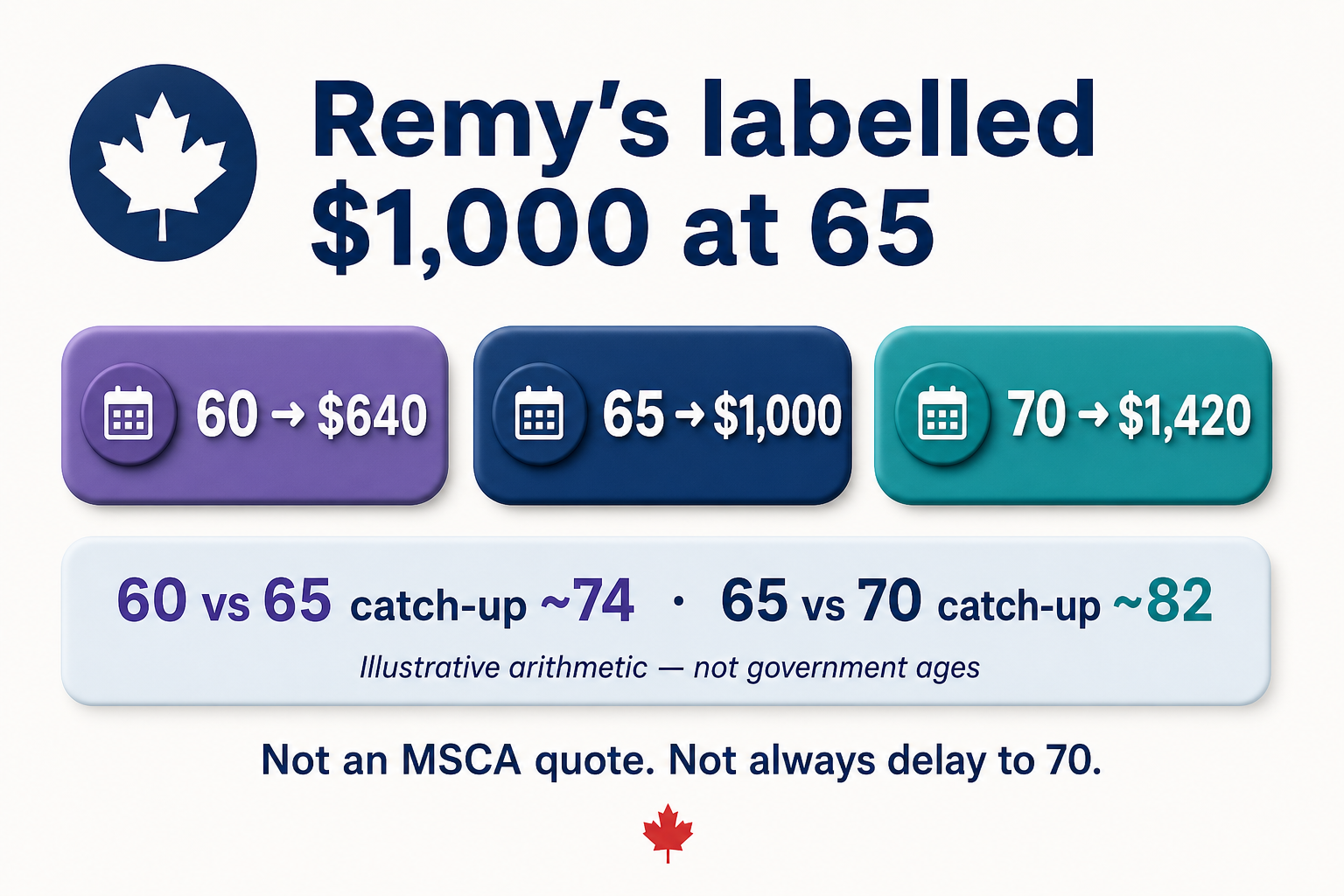
Simple cumulative cash catch-up. Assumptions stated up front: nominal dollars; no CPI indexing on the pension; no income tax; no investment return on money received early; no survivor or PRB side effects. Framework factors can outweigh this arithmetic.
| Comparison | Cash before the later start | Monthly gap after | Months to catch up | Approx. age |
|---|---|---|---|---|
| Start 60 vs wait to 65 | 60 × $640 = $38,400 | $1,000 − $640 = $360 | $38,400 ÷ $360 = 106.67 | ~74 |
| Start 65 vs wait to 70 | 60 × $1,000 = $60,000 forgone | $1,420 − $1,000 = $420 | $60,000 ÷ $420 = 142.86 | ~82 |
Ages ~74 and ~82 are illustrative arithmetic from the official −0.6% / +0.7% factors on this $1,000 labelled estimate. They are not government-published break-even ages, not advice, and they ignore indexing, tax, investment returns, and survivor benefits. Remy’s MSCA estimate, taxes, GIS, health, and bridging assets can move the decision either way — do not conclude “always wait until 70.”
Same catch-up ages under this simple model whenever the early factor is exactly −36% and the late factor exactly +42% (the dollar base cancels in the ratio) — still illustrative, still not a government age. On the 2026 max $1,507.65: × 0.64 ≈ $964.90; × 1.42 ≈ $2,140.86. On the April 2026 average $877.01: × 0.64 ≈ $561.29; × 1.42 ≈ $1,245.35 — derived, not guaranteed.
Apply and pull your number
You must apply — CPP isn’t automatic. Apply up to 12 months before your chosen start date (My Service Canada Account for most people).
If you apply after 65, your start may be up to 11 months before the application month, but not before the month after your 65th birthday. There’s no retroactivity if you apply in the month of your 65th birthday or earlier, and no retroactive payments for a start before 65.
Personal CTA: sign in to My Service Canada Account → View my benefit estimates and your statement of contributions. Optional: the Canadian Retirement Income Calculator for multi-source estimates. Estimates only — not advice.
Public pensions are a floor
Claim age sits beside the rest of the plan. Cash-flow hygiene is How to Budget in Canada. Once a savings amount exists, How to Automate Savings Goals in Canada is the PAC. Liquidity before optimizing claim age is How Much Emergency Fund Do I Need in Canada?.
Compare claim ages beside your other numbers
Finnomia’s Retirement Planner builds claim-age comparison scenarios and nest-egg / CPP / OAS estimates — not advice. It tracks those scenarios; it doesn’t hold accounts or move money. If you want that sitting next to your other numbers, start a 14-day free trial.
Should I take CPP at 60, 65, or 70?
There’s no single right age. Official factors cut the age-65 amount by 36% at 60 and raise it by 42% at 70. Weigh cash need, health, work, GIS, and bridging assets — then use your MSCA estimate, not an “always wait until 70” rule.
What are the official CPP claim-age factors?
−0.6% per month before 65 (−36% at 60) and +0.7% per month after 65 (+42% at 70). No advantage waiting past 70.
Is age 74 or 82 a government break-even?
No. Those ages in simple illustrations are arithmetic from the official factors on a labelled estimate. They are not Service Canada break-even ages.
This article was published in September 2026 and is general information, not personalized tax, legal, or retirement advice. Confirm current factors and your own estimate on canada.ca and My Service Canada Account (or Retraite Québec for QPP). Contribution history and personal circumstances change the decision.