
On this page
The Canada Pension Plan is a mandatory earnings-related public pension for most workers outside Quebec. It replaces part of work earnings in retirement. This page is how contributions work in 2026, why the published maximum is not a typical cheque, and how to read your estimate.
It is not when to claim — that is a different decision. It is not Old Age Security (a separate residency-based benefit). It is not "how much do I need to retire."
What CPP is
CPP pays a monthly, taxable retirement pension for life if you qualify. It is funded by employee and employer contributions; the self-employed pay both halves. The standard reference age is 65. You can start between 60 and 70 (see the glance table below). Contributions stop at 70 even if you are still working.
CPP also funds disability and survivor benefits. This article's depth is the retirement pension.
Who qualifies (overview)
You need to be at least age 60 and have at least one valid contribution — work in Canada outside Quebec, or credits from a divorce or separation credit split. You must apply; it is not automatic. You can apply up to 12 months before your chosen start date.
If you worked mainly in Quebec, you contribute to the Québec Pension Plan (QPP), not CPP, for most work in Quebec. Retraite Québec administers it; the plans coordinate if you worked in both. Don't use these CPP rates for QPP.
International agreements can count work abroad for eligibility. See canada.ca — this page does not teach country-by-country rules.
2026 contributions: two ceilings
There is a basic exemption of $3,500 (frozen). No contributions below that.
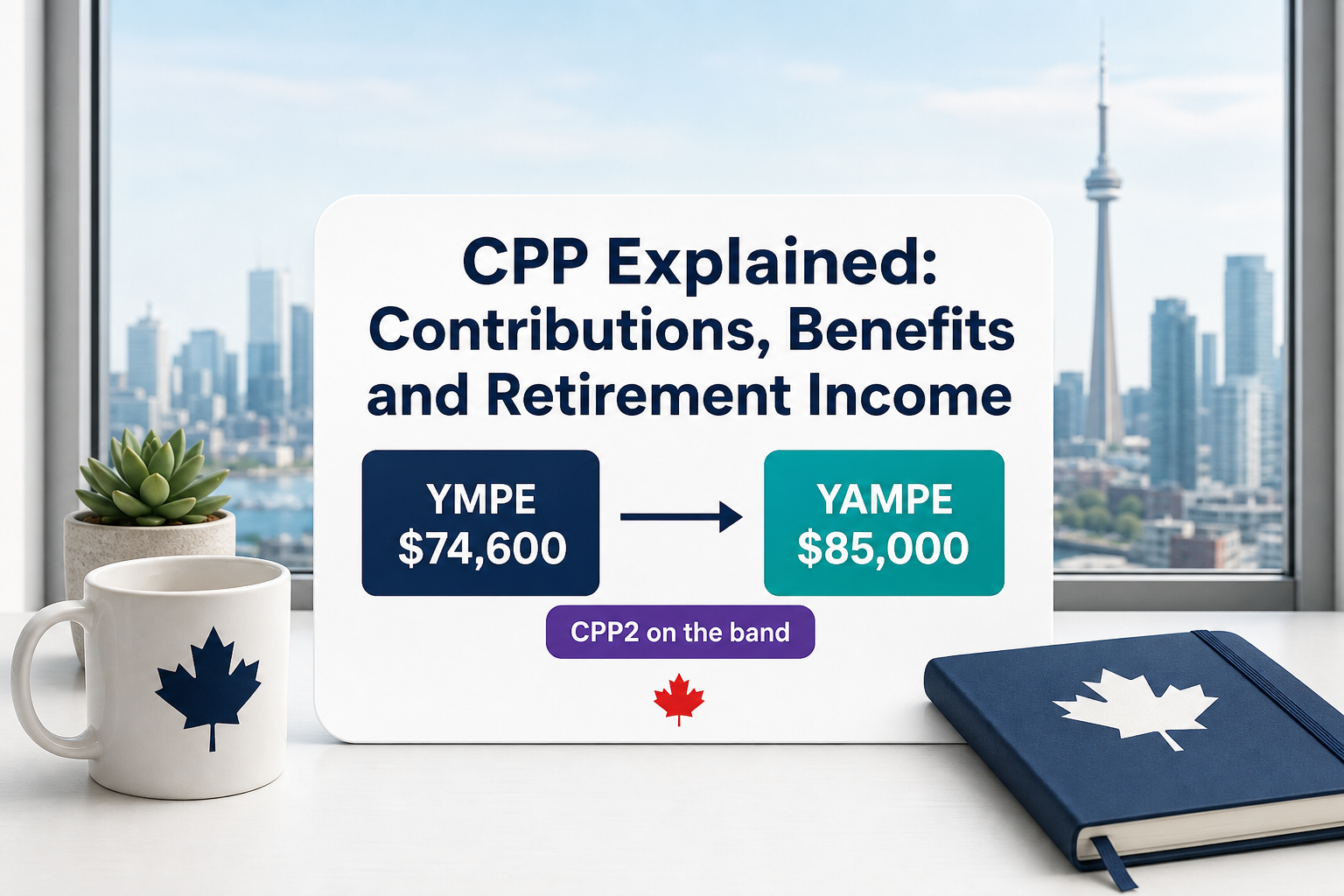
First ceiling — YMPE (Year's Maximum Pensionable Earnings) 2026: $74,600.
| Piece | 2026 figure |
|---|---|
| YMPE | $74,600 |
| Basic exemption | $3,500 |
| Max contributory earnings (base + first additional) | $71,100 |
| Employee / employer rate (4.95% base + 1% first additional) | 5.95% each |
| Combined rate | 11.9% |
| Max employee or employer (this tier) | $4,230.45 |
| Max self-employed (this tier) | $8,460.90 |
$71,100 × 0.0595 = $4,230.45.
Second ceiling — YAMPE (Year's Additional Maximum Pensionable Earnings) 2026: $85,000.
| Piece | 2026 figure |
|---|---|
| YAMPE | $85,000 |
| Band YMPE → YAMPE | $10,400 |
| CPP2 (second additional) employee / employer | 4% each |
| Self-employed CPP2 | 8% |
| Max employee or employer CPP2 | $416 |
| Max self-employed CPP2 | $832 |
($85,000 − $74,600) × 0.04 = $416.
Total max employee at full YAMPE: $4,230.45 + $416 = $4,646.45 (employer matches; self-employed both halves $9,292.90).
Confirm current payroll rates on CRA before you rely on a paycheque deduction.
Parker's 2026 cheque
The figures below are an illustrative example, not an average Canadian worker and not a My Service Canada Account benefit quote.
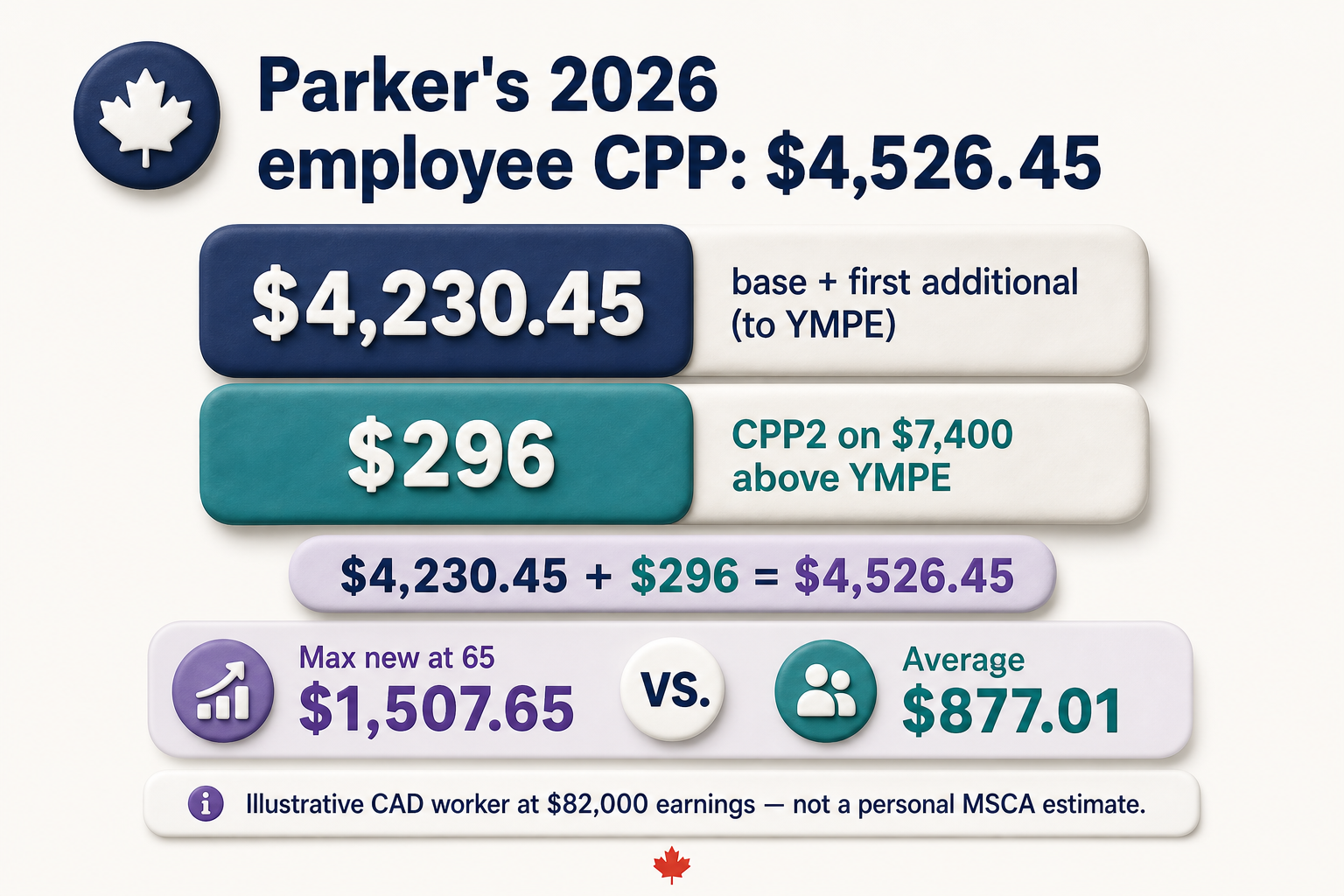
Parker works in Thunder Bay and earns $82,000 of pensionable employment earnings in 2026 — between YMPE and YAMPE. Mid-40s. Not claiming CPP this year.
| Slice | Earnings in band | Rate (employee) | Parker's 2026 employee CPP |
|---|---|---|---|
| Below exemption | $3,500 | 0% | $0 |
| Exemption → YMPE | $71,100 | 5.95% | $4,230.45 (hits this tier's annual max) |
| YMPE → $82,000 | $7,400 | 4% CPP2 | $296.00 |
| Above YAMPE | $0 | — | $0 |
| Employee total | $4,526.45 | ||
| Employer match | $4,526.45 | ||
| Combined into CPP | $9,052.90 |
$71,100 × 0.0595 = $4,230.45. $7,400 × 0.04 = $296. $4,230.45 + $296 = $4,526.45.
If earnings stayed at or under YMPE — say $58,000 — contributory earnings would be $54,500 and the employee share $3,242.75, with no CPP2. At or above YAMPE, the employee share hits the full $4,646.45. Self-employed at Parker's band pays both halves: $9,052.90; at full YAMPE, $9,292.90.
One year's contributions do not tell you Parker's monthly pension. That depends on lifetime earnings history and start age. Pull the estimate from My Service Canada Account.
Max vs average
Maximum new CPP retirement pension at age 65, for benefits beginning January 2026: $1,507.65 a month.
Average for new beneficiaries at age 65: $877.01 a month — labelled April 2026 on canada.ca amount and payment-amounts pages (the CPP hub also shows $877.01 for July to September 2026). Same dollar for this review. Not guaranteed.
The maximum requires near-maximum pensionable earnings across most of the contributory period. Most people get less. Don't treat the published maximum as your cheque.
The enhancement (since 2019)
Since 2019, CPP adds top-ups — not a separate benefit:
- First additional (phased 2019–2023) raises eventual replacement from 25% toward 33.33% of covered average earnings for post-2019 years.
- Second additional (CPP2) from 2024 covers earnings between YMPE and YAMPE (about 14% above YMPE from 2025 onward).
Full uplift of more than 50% on the max-pension path needs about 40 years of enhanced contributions. Today's workers build it gradually. Enhancement does not change eligibility. It does not raise benefits already in pay before 2019 for people with no post-2019 contributions.
What else can change the amount
Automatic or applied where you qualify: a general drop-out of roughly the lowest 17% of months (up to about eight years on the base); child-rearing provisions; disability drop-out or drop-in on the enhanced portion; credit splitting on divorce or separation; optional pension sharing with a spouse or common-law partner. See canada.ca's amount page for the rules — this article does not rework that math.
Working while on CPP under 70 and still contributing can add a post-retirement benefit the following year. Maximum new PRB at 65 in 2026: $54.69 a month; average new $25.76 (April 2026 on payment-amounts). You can optionally stop PR contributions from 65; contributions end at 70.
Your number: My Service Canada Account
Register or sign in to My Service Canada Account → CPP → View my contributions and View my benefit estimates. Compare history to your T4s. Fix errors with documentation. The current tax year may show "not yet available" until CRA remits.
Quebec exceptions: if you lived and worked only in Quebec, currently live in Quebec, or live abroad with Quebec as your last Canadian residence, you generally cannot view a CPP statement in MSCA. Use Retraite Québec's Statement of Participation instead.
After the statement, the optional Canadian Retirement Income Calculator can combine sources into an estimate. Estimates only — not advice.
Apply up to 12 months before your chosen start. If you apply after 65, retroactive start may be limited; early (pre-65) starts do not get retroactive payments.
Start age at a glance
| Start age | Adjustment vs age-65 amount | On 2026 max $1,507.65 (illustrative) |
|---|---|---|
| 60 | −0.6% per month × 60 months = −36% (× 0.64) | ~$964.90 |
| 65 | 0% (reference) | $1,507.65 |
| 70 | +0.7% per month × 60 months = +42% (× 1.42) | ~$2,140.86 |
The 60 and 70 dollars are max × factor, not a personal estimate. There is no advantage delaying past 70. This table is a glance only — not a break-even or an "always wait until 70" argument.
CPP is a floor, not the whole plan
Personal savings sit beside CPP. Where surplus goes is How Much Should You Save Each Month? and TFSA vs RRSP vs FHSA. Room formulas and deduction timing live on those pages, not here. Cash-flow hygiene is How to Budget in Canada. Once a savings amount exists, How to Automate Savings Goals in Canada is the PAC. Liquidity before optimizing retirement is How Much Emergency Fund Do I Need in Canada?.
See CPP beside the rest of the picture
Finnomia's Retirement Planner builds nest-egg and public-pension estimates, including CPP — not advice. It tracks those scenarios; it doesn't hold accounts or move money. If you want that sitting next to your other numbers, start a 14-day free trial.
How much is the maximum CPP pension in 2026?
$1,507.65 a month at age 65 for benefits beginning January 2026. Most new beneficiaries at 65 receive far less — the official average is $877.01.
How much do I contribute to CPP in 2026?
On earnings from $3,500 to $74,600 (YMPE), employee and employer each pay 5.95%, up to $4,230.45. On earnings from $74,600 to $85,000 (YAMPE), each pays 4% CPP2, up to $416. Your T4 and MSCA show your actual remittances.
Do Quebec workers pay CPP?
Usually no for work in Quebec — they pay into the Québec Pension Plan. See Retraite Québec. The plans coordinate if you worked in both.
This article was published in September 2026 and is general information, not personalized tax, legal, or retirement advice. Confirm current amounts, rates, and your own estimate on canada.ca, CRA, and My Service Canada Account (or Retraite Québec). Contribution and benefit figures change.