
On this page
- The short answer
- What is an emergency fund?
- What doesn't count as an emergency?
- Emergency fund vs. sinking fund
- Step 1: Calculate your essential monthly expenses
- Should you include wants?
- Should minimum debt payments be included?
- Should savings contributions be included?
- Step 2: Choose where you fit inside the 3–6 month range
- Think about how many incomes support the household
- Job replacement time matters too
- Variable income can justify more runway
- Renters and homeowners may face different risks
- Dependants matter
- Insurance can reduce—but not eliminate—the need for cash
- What about access to a line of credit?
- What about a credit card?
- What if 3–6 months feels impossible?
- How quickly should you build the emergency fund?
- Automate the contribution
- Redirect finished debt payments
- Should you build an emergency fund or pay off debt first?
- Three months or six months?
- Expenses vs. income: which method should you use?
- Should the emergency fund include mortgage payments?
- What about a mortgage emergency fund plus home repairs?
- Where should the emergency fund be kept?
- Deposit insurance matters
- Should emergency savings be invested in stocks?
- When should you actually use the fund?
- When should you not use it?
- How do you refill an emergency fund after using it?
- Review the target when your life changes
- A practical emergency-fund framework
- How Finnomia calculates an emergency-fund target
- Tracking the goal in Finnomia
- The target is runway, not a score
- Frequently asked questions
The car needs a $2,400 repair.
Or your employer announces layoffs.
Or an unexpected health problem means you can't work for a while.
The bill isn't in this month's budget, but the mortgage, groceries, utilities and insurance still have to be paid.
That's what an emergency fund is for.
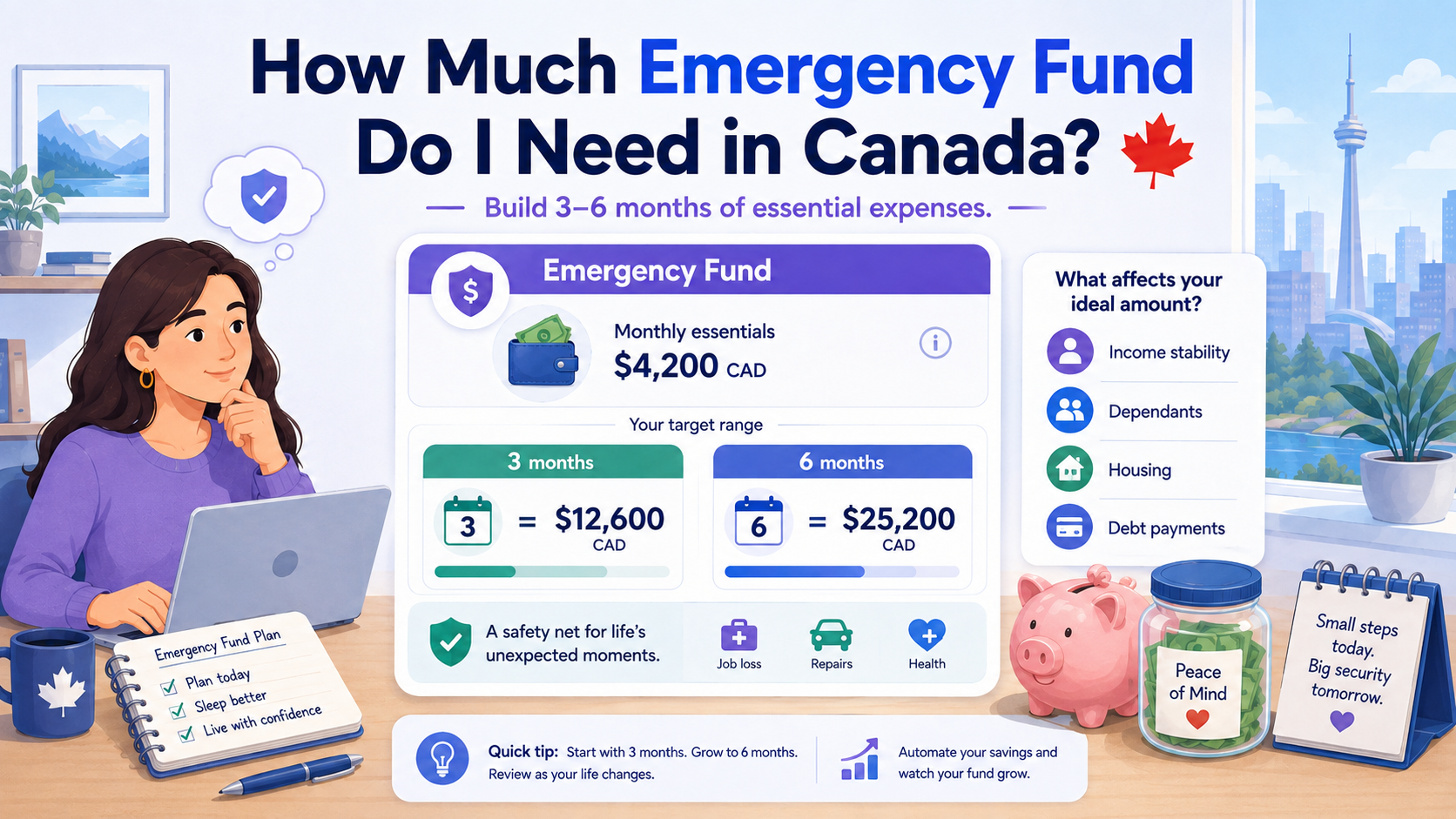
The Financial Consumer Agency of Canada recommends working toward roughly 3 to 6 months of regular expenses. It also says you can use 3 to 6 months of income as an alternative approach.
But that leaves the question most people actually have:
Does my household need three months, six months, or something in between?
There isn't one number that fits every Canadian.
A useful emergency-fund target starts with the expenses you would still need to pay during a financial emergency, then considers how difficult it would be for your household to recover from an income interruption.
For most people, the calculation begins here:
Monthly essential expenses × target months = emergency-fund target
Then you adjust the target for your own situation.
The short answer
If your essential monthly expenses are:
$4,200
then:
| Target | Emergency fund |
|---|---|
| 1 month | $4,200 |
| 3 months | $12,600 |
| 4 months | $16,800 |
| 5 months | $21,000 |
| 6 months | $25,200 |
That doesn't mean you automatically need $25,200.
The 3–6 month range is a starting framework, not a requirement that every household choose the maximum.
The better question is:
How much financial runway would my household reasonably need if something went wrong?
What is an emergency fund?
FCAC defines an emergency fund as money set aside for unexpected expenses.
Examples it gives include:
- unexpected vehicle repairs
- an urgent veterinary expense
- job loss
- unexpected home repairs
- health problems that prevent you from working
The purpose is to give you a source of cash before you have to turn to expensive borrowing.
An emergency fund can help prevent:
unexpected expense → credit card → carried balance → interest → bigger monthly cash-flow problem
It also gives you time.
If you lose your job, for example, emergency savings may let you continue paying essential expenses while you look for your next source of income rather than making every decision under immediate financial pressure.
What doesn't count as an emergency?
Not every large or infrequent expense is an emergency.
This matters because otherwise your “emergency fund” becomes the account that pays for everything you forgot to budget for.
Usually not an emergency
Examples include:
- Christmas gifts
- annual insurance
- routine vehicle maintenance
- winter tires
- school supplies
- a planned vacation
- property taxes you know are coming
- annual subscriptions
- regular home maintenance
These expenses may not happen every month.
But they're predictable.
They should generally be part of your regular budget or a separate savings goal.
More likely to be an emergency
Examples include:
- unexpected job loss
- urgent major vehicle repair
- sudden health-related income interruption
- emergency home repair
- urgent veterinary treatment
- another major, sudden and unplanned need
FCAC describes an emergency as a major and sudden need that's unplanned and not part of your current budget.
That's a useful test.
Emergency fund vs. sinking fund
The distinction becomes easier if you give predictable expenses their own place.
Suppose you expect:
$1,200 of vehicle maintenance over the next year
Instead of hoping nothing happens, set aside:
$100/month
That's a sinking fund or planned irregular-expense reserve.
Likewise:
$600 Christmas spending ÷ 12 = $50/month
Those aren't emergencies.
They're future bills.
Your emergency fund then remains available for events you couldn't reasonably put on the calendar.
For the broader budgeting process, see How to Budget in Canada.
Step 1: Calculate your essential monthly expenses
Before choosing three months or six months, calculate one month.
The goal isn't to reproduce every dollar you currently spend.
Ask:
If our income suddenly dropped, which expenses would still have to be paid?
For a fictional household:
| Essential expense | Monthly amount |
|---|---|
| Rent / mortgage | $1,900 |
| Groceries | $700 |
| Utilities | $220 |
| Phone + internet | $150 |
| Transportation | $450 |
| Insurance | $250 |
| Childcare | $350 |
| Minimum debt payments | $180 |
| Essential medications / health | $100 |
| Total essential expenses | $4,300 |
That gives this household an emergency-fund base of:
$4,300 per month
Then:
3 months = $12,900
6 months = $25,800
Those numbers are much more useful than:
“Save $20,000 because that sounds safe.”
They're connected to what the household actually needs.
Should you include wants?
Usually the purpose of the emergency calculation is to estimate the expenses you would need to keep paying, not to reproduce your full current lifestyle indefinitely.
If your current spending includes:
- $450 restaurants
- $200 entertainment
- $300 clothing
- $250 hobbies
you might reasonably assume some of that would be reduced during a job loss.
But be realistic.
A six-month emergency plan that assumes:
$0 entertainment
$0 clothing
$0 personal spending
perfect grocery discipline
may look good mathematically but be difficult to live with.
You can include a modest miscellaneous amount rather than assuming the household transforms overnight.
Should minimum debt payments be included?
Yes, if those payments would still be required during the emergency.
For example:
- credit-card minimums
- line-of-credit payments
- personal-loan payments
- auto loans
don't disappear simply because your income does.
If your emergency-fund calculation ignores required debt payments, it understates the household's actual cash-flow needs.
This is another reason reducing debt can improve financial resilience.
Pay off a loan with a:
$500 monthly payment
and your future emergency-fund requirement may fall because one mandatory monthly expense disappeared.
Should savings contributions be included?
Usually not in the same way as essential bills.
If you normally contribute:
$600/month
to long-term investments, you may temporarily pause or reduce those contributions during a genuine income emergency.
The purpose of the emergency fund is partly to prevent you from:
- accumulating expensive debt
- selling long-term investments at a bad time
- disrupting your finances more than necessary
You don't necessarily need enough emergency savings to maintain every normal savings contribution while unemployed.
Step 2: Choose where you fit inside the 3–6 month range
FCAC gives the range.
It does not prescribe:
“Three months if you have this job, six months if you have that job.”
The factors below are therefore a planning framework, not a government formula.
You may be comfortable closer to the lower end when:
- two household members have reliable incomes
- either income can cover a large portion of essential expenses
- your employment is relatively stable
- you're in an occupation where replacing income is likely to be reasonably quick
- you have few dependants
- your required monthly expenses are relatively flexible
- you have strong insurance coverage
- you have other accessible financial resources
You may prefer the higher end when:
- the household relies primarily on one income
- your income is variable
- you're self-employed
- your work is seasonal or contract-based
- replacing your income could take a long time
- you support children or other dependants
- you own a home with meaningful repair exposure
- you have significant required debt payments
- you have limited insurance or other financial backstops
- your household would have difficulty reducing expenses quickly
Again, these aren't official Canadian categories.
They're a way to think about financial runway.
Think about how many incomes support the household
Consider two households with identical:
$4,000/month essential expenses
Household A
Two people earn:
- $4,000/month
- $3,500/month
Either person's income could cover most or all of the essential budget temporarily.
Household B
One person earns:
$7,500/month
and the other currently has no employment income.
Same household income.
Very different income concentration.
If the sole earner in Household B loses their job, household employment income drops essentially to zero.
If one person in Household A loses their job, substantial income remains.
It may therefore be reasonable for the two households to choose different emergency-fund targets even though their normal monthly spending is identical.
Job replacement time matters too
Imagine two people each earn:
$90,000
One works in a field with many local employers and frequent hiring.
The other has a highly specialized role with only a small number of comparable positions.
Their salaries are identical.
Their income-replacement risk may not be.
Ask:
If this income disappeared tomorrow, how long might replacing it realistically take?
You don't need to predict the future perfectly.
You're deciding how much runway would make you comfortable.
Variable income can justify more runway
If your income comes from:
- self-employment
- consulting
- commission
- contract work
- seasonal employment
- fluctuating hours
the emergency isn't always:
income goes from 100% to 0%.
It can also be:
income suddenly drops 40% for four months.
An emergency reserve can help smooth that volatility.
It's still important to separate normal income variability from a true emergency.
If your business predictably slows every January, January isn't an emergency.
Your regular budget should already account for it.
For more on that, see Budgeting With Irregular Income in Canada.
Renters and homeowners may face different risks
Homeowners often have potential expenses that renters may not directly face.
For example:
- furnace
- plumbing
- hot-water tank
- roof
- major appliance
- electrical issue
That doesn't automatically mean:
homeowner = six months
but it can influence the amount of accessible cash you want available.
Some home repairs are predictable enough to belong in a home-maintenance reserve rather than the emergency fund.
Others aren't.
The key is not pretending home ownership has no possibility of sudden cash requirements.
Dependants matter
A single person may be able to react to income loss by:
- moving
- changing transportation
- cutting discretionary spending quickly
A household supporting:
- children
- an elderly parent
- someone with additional care needs
may have substantially less flexibility.
When other people depend on the household income, having more runway can become more valuable.
Insurance can reduce—but not eliminate—the need for cash
Your financial backstops matter too.
Depending on your situation, you may have:
- employment benefits
- disability insurance
- critical-illness insurance
- home insurance
- tenant insurance
- auto insurance
- employment-insurance eligibility
- severance
- other sources of support
Those can reduce certain financial risks.
But they don't necessarily replace emergency savings.
Insurance may involve:
- deductibles
- waiting periods
- exclusions
- limits
- claims processing time
And not every emergency is insured.
Think of insurance and emergency cash as different layers of financial protection.
What about access to a line of credit?
A line of credit can provide liquidity.
It isn't the same thing as emergency savings.
Suppose you have:
$25,000 unused LOC capacity
That doesn't mean you have a:
$25,000 emergency fund
You have permission to potentially borrow $25,000.
If you need it:
- interest begins accumulating
- the lender's terms apply
- your debt rises
Emergency savings gives you money you already own.
Credit gives you another obligation.
That distinction matters.
What about a credit card?
Same idea.
A:
$15,000 credit-card limit
is not $15,000 of emergency savings.
FCAC's emergency-fund guidance specifically emphasizes avoiding the need to rely on expensive credit when something unexpected happens.
The credit card can still be useful as a payment method during an emergency.
But ideally, the emergency fund is what ultimately pays the bill.
What if 3–6 months feels impossible?
This is common.
Suppose your essential expenses are:
$4,000/month
A three-month target is:
$12,000
Six months:
$24,000
If you currently have:
$300
saved, both numbers may feel enormous.
Don't make:
“I need $24,000”
the first milestone.
Create stages.
Milestone 1: first $500
Enough to absorb some small surprises.
Milestone 2: $1,000
A more meaningful buffer.
Milestone 3: one month of essential expenses
In this example:
$4,000
Milestone 4: three months
$12,000
Milestone 5: your eventual target
Perhaps:
$16,000, $20,000 or $24,000
depending on your circumstances.
FCAC specifically recommends starting with a small, realistic amount rather than becoming discouraged by the full target.
Progress matters long before you reach six months.
How quickly should you build the emergency fund?
As quickly as your budget reasonably allows.
But not so aggressively that:
- required bills go unpaid
- you're forced to borrow again
- you abandon the plan because it's unrealistic
Suppose your target is:
$15,000
and you can save:
$500/month
Starting from $0, ignoring interest:
$15,000 ÷ $500 = 30 months
Now suppose you add:
- $1,500 tax refund
- $1,000 bonus
- $500 from selling something
The timeline changes.
Emergency funds are often built from both:
regular contributions
and
occasional lump sums
Automate the contribution
One of the simplest ways to make the fund grow is to move the money before it becomes available for everyday spending.
FCAC recommends setting up an automatic transfer from your regular account to savings and notes that it can be scheduled around payday.
For example:
Paycheque arrives Friday
Automatic transfer:
$150 → emergency savings
You don't have to make a new decision every two weeks.
The saving becomes part of the system.
Redirect finished debt payments
Suppose you've been paying:
$400/month
on a car loan.
The loan ends.
Your budget now has:
$400/month
of newly available cash flow.
FCAC specifically suggests redirecting payments from finished loans toward emergency savings.
That's powerful because the household has already adapted to living without the $400.
Instead of letting it disappear into lifestyle spending:
old loan payment → emergency fund
Once the fund reaches your target, the same cash flow can be redirected again.
Should you build an emergency fund or pay off debt first?
This is one of the most difficult personal-finance trade-offs.
FCAC doesn't provide a universal percentage split between:
- extra debt repayment
- emergency savings
The reason both matter is straightforward.
High-interest debt is expensive
Paying it down can produce significant guaranteed interest savings.
Having no emergency savings is risky
The next unexpected expense may simply put you back into debt.
A practical approach can involve establishing some accessible cash protection while continuing to make every required debt payment, then adjusting how aggressively additional surplus is directed toward debt versus savings.
The exact balance depends on:
- debt interest rates
- job stability
- current savings
- household income
- dependants
- other financial resources
For the debt side, see How to Budget While Paying Off Debt.
Three months or six months?
Let's make the choice more concrete.
Suppose monthly essential expenses are:
$4,200
Three-month fund
$12,600
Potentially reasonable when the household has strong income redundancy and financial flexibility.
Six-month fund
$25,200
Provides twice as much runway and may be more attractive when income is concentrated, variable or difficult to replace.
Four or five months
Also perfectly legitimate.
There's nothing magical about choosing exactly:
3
or:
6
If your circumstances point toward something between them:
4 × $4,200 = $16,800
or:
5 × $4,200 = $21,000
may be the target that fits your household.
The range is useful precisely because financial risk isn't identical from household to household.
Expenses vs. income: which method should you use?
FCAC says you can target:
- 3–6 months of regular expenses
- or 3–6 months of income
Both methods can work.
For most household planning, I find essential expenses particularly intuitive because the emergency fund exists to keep the household's obligations paid.
Suppose:
Net household income: $7,000/month
but essential expenses are only:
$4,200/month
Six months of income:
$42,000
Six months of essential expenses:
$25,200
Those are very different targets.
The income approach creates a larger buffer because it assumes replacing a larger portion of normal income.
The expense approach asks:
How much cash do we actually need to keep the household functioning?
Neither is inherently wrong.
Choose the measure that matches what you're trying to protect.
Should the emergency fund include mortgage payments?
If the mortgage still has to be paid during an income interruption:
yes
Include it in monthly essential expenses.
The same applies to rent.
Shelter is one of the main expenses the emergency fund exists to protect.
What about a mortgage emergency fund plus home repairs?
Those can be considered separately.
For example:
Income-replacement fund
3–6 months of essential household expenses.
Home-maintenance reserve
Money deliberately accumulated for the long-term cost of owning and maintaining the home.
This helps avoid using the entire emergency fund for a roof that was already approaching the end of its useful life.
Again:
predictable future cost ≠ emergency
even when the bill is large.
Where should the emergency fund be kept?
The priorities are:
- safety
- stability
- accessibility
FCAC recommends keeping emergency savings in an account that is easy to access, separate from everyday spending, has low or no transaction fees, allows withdrawals without penalty and earns interest. :contentReference[oaicite:2]{index=2}
Common possibilities can include:
- high-interest savings account
- cash savings inside a TFSA
- other appropriate short-term savings products
The account shouldn't require you to take meaningful investment risk with money you might need tomorrow.
Deposit insurance matters
Eligible deposits held at a CDIC member institution can be protected up to $100,000 including principal and interest, per insured category, per member institution.
A TFSA is a separate insured category when it contains eligible deposits.
But not everything that looks like “cash” or “savings” is a CDIC-insured deposit.
CDIC specifically says HISA ETFs and HISA mutual funds are not CDIC protected. :contentReference[oaicite:3]{index=3}
If you use a provincially regulated credit union, check the applicable provincial deposit-insurance rules because those can differ.
For the full account-choice discussion, see HISA vs. TFSA for an Emergency Fund in Canada.
Should emergency savings be invested in stocks?
Generally, the core emergency reserve should prioritize money being available when you need it.
Stocks can fall substantially.
Imagine:
Emergency fund: $20,000
Market decline:
−25%
Fund value:
$15,000
Then you lose your job.
Now the event that created the need for cash may also force you to sell investments while they're down.
That's the opposite of what the emergency fund is supposed to accomplish.
Long-term investments and emergency cash solve different problems.
When should you actually use the fund?
FCAC's test is useful:
Is this a major, sudden, unplanned need that isn't already part of the budget?
Examples might include:
- urgent repair needed to keep the vehicle you depend on running
- unexpected income interruption
- emergency home repair
- urgent veterinary care
- another unavoidable financial shock
If the answer is yes, use it.
That's why you built it.
Don't create an emergency fund and then refuse to touch it during an actual emergency because seeing the balance decline feels uncomfortable.
When should you not use it?
Probably not for:
- routine shopping
- vacations
- planned upgrades
- predictable annual bills
- spontaneous discretionary purchases
If the expense can reasonably wait while you save for it, it may deserve its own goal rather than the emergency fund.
How do you refill an emergency fund after using it?
Suppose your target is:
$18,000
An emergency costs:
$5,000
Remaining fund:
$13,000
Your new goal is straightforward:
rebuild the missing $5,000
You don't necessarily need to stop every other financial goal immediately.
But make replenishing the reserve a deliberate part of the budget again.
If the emergency also changed your life—for example, your new expenses are permanently higher—recalculate the target rather than simply restoring the old number.
Review the target when your life changes
Your ideal emergency fund isn't permanent.
Recalculate after changes such as:
- new child
- buying a home
- moving
- becoming self-employed
- moving from one income to two
- moving from two incomes to one
- major increase in housing costs
- paying off a debt
- major change in insurance
- retirement
- substantial change in essential monthly expenses
Suppose your essential budget drops from:
$5,000 → $4,000
after paying off a loan.
A six-month target falls from:
$30,000 → $24,000
The extra $6,000 may now be available for another goal.
The reverse is also true.
If expenses rise, the fund may need to grow.
A practical emergency-fund framework
Here's the whole process.
1. Calculate monthly essential expenses
Include the bills that would continue during an income interruption.
2. Multiply by 3–6 months
That establishes a useful target range.
3. Evaluate your household risk
Consider:
- number of incomes
- income stability
- replacement time
- dependants
- housing
- debt obligations
- insurance
- other accessible resources
4. Pick a target inside the range
It can be three, four, five or six months.
5. Break it into milestones
Don't make $25,000 your first psychological finish line.
Start with the first $500 or $1,000.
6. Automate contributions
Move money into emergency savings regularly.
7. Keep it safe and accessible
This is emergency liquidity, not your highest-return investment.
8. Use it when a real emergency happens
That's its job.
9. Refill it afterward
Return the reserve to its target.
10. Recalculate when life changes
The target should reflect your current household.
How Finnomia calculates an emergency-fund target
Finnomia has a free Emergency Fund Calculator.
The basic calculation is intentionally simple:
Monthly essential expenses × target months
For example:
Essential expenses: $4,200
Target: 5 months
Emergency-fund goal:
$21,000
You can then compare the target with what you've already saved and the amount you're able to contribute regularly.
The calculator isn't deciding whether your household “should” choose three or six months.
That's a planning decision.
Its purpose is to turn the number of months you choose into an actual CAD target.
Tracking the goal in Finnomia
Finnomia is the Canadian personal-finance platform behind this blog.
Emergency savings can be tracked as a financial goal alongside the rest of your finances.
That means the goal doesn't have to sit separately from:
- your monthly budget
- actual spending
- recurring bills
- other savings goals
- debt
- household finances
You can see what you're trying to build in the context of the cash flow that has to fund it.
Finnomia currently uses Plaid for account connectivity and is adding Flinks as a second provider to improve connectivity and reliability across Canadian financial institutions.
Connections are read-only.
Finnomia cannot move your money and doesn't store your banking password.
The budgeting and financial-goal functionality described here is already live.
The target is runway, not a score
Having six months isn't automatically “better” than having four.
And having one month while steadily building isn't a failure because you haven't reached three yet.
The purpose of an emergency fund is simple:
Give yourself enough financial runway that an unexpected problem doesn't immediately become a debt problem.
Start by calculating one month of the expenses that truly have to keep being paid.
Then ask how much uncertainty your household needs to be able to absorb.
Maybe the answer is:
3 months
Maybe it's:
5 months
Maybe your situation makes you more comfortable with:
6 months or more
The useful target is the one connected to your actual expenses and financial risks—not an arbitrary dollar amount copied from someone else's household.
Start with Finnomia's free Emergency Fund Calculator to turn your monthly essentials into a target.
Then decide where to keep the money with HISA vs. TFSA for an Emergency Fund in Canada.
Frequently asked questions
How much should I have in an emergency fund in Canada?
FCAC recommends working toward approximately 3 to 6 months of regular expenses and also says 3 to 6 months of income can be used as an alternative method.
Your appropriate amount depends on your household's expenses and financial risks.
Is three months of emergency savings enough?
It can be for some households.
A household with multiple stable incomes, flexible expenses and strong financial backstops may be comfortable closer to the lower end of FCAC's range.
Others may prefer more runway.
Is six months of emergency savings enough?
Six months is the upper end of FCAC's commonly cited 3–6 month range.
Some people may decide they want even more based on their circumstances, although FCAC doesn't prescribe job-specific targets.
Should I calculate my emergency fund from income or expenses?
FCAC says either method can work.
Using essential expenses focuses on what the household needs to keep paying.
Using income generally produces a larger target when income materially exceeds essential spending.
What expenses should I include?
Consider expenses that would continue during an emergency, such as:
- rent or mortgage
- groceries
- utilities
- transportation
- insurance
- childcare
- essential healthcare
- minimum debt payments
Predictable annual expenses should generally already be planned separately.
Should I include discretionary spending?
You may assume some discretionary spending will fall during a genuine financial emergency.
But avoid building a target that requires an unrealistically perfect bare-bones lifestyle for months.
Should I have an emergency fund while paying off debt?
Maintaining some accessible emergency savings can help prevent unexpected expenses from creating new debt.
How much surplus goes toward debt versus savings depends on your debt costs, savings, income stability and household circumstances.
Where should I keep an emergency fund?
Prioritize safety, stability and easy access.
A HISA or an appropriate cash savings product inside a TFSA can both be options, depending on contribution room, taxes, accessibility and deposit protection.
See HISA vs. TFSA for an Emergency Fund in Canada.
Is a line of credit an emergency fund?
No.
Unused LOC capacity is access to borrowing.
An emergency fund is money you already own.
Should I invest my emergency fund?
The core emergency reserve should generally prioritize stability and liquidity rather than investment returns.
Money exposed to significant market declines may not be dependable when an emergency occurs.
What should I do after I use my emergency fund?
Rebuild it.
If the emergency permanently changed your monthly expenses or household circumstances, recalculate the target rather than automatically returning to the old amount.
How often should I review my emergency-fund target?
Review it whenever your essential expenses or financial risks change materially—for example after buying a home, having a child, changing employment, paying off debt or significantly changing household income.
This article was reviewed in August 2026 and provides general information, not personalized financial advice. Emergency-fund needs differ by household. Savings-product rates, deposit-insurance eligibility and financial circumstances can change; verify current terms before making financial decisions.