
On this page
- Step 1: find a conservative income floor
- Step 2: build a priority budget
- Step 3: use a holding buffer
- How large should the income buffer be?
- Choosing the stable household payment
- A priority rule for surplus income
- Separating business and personal transactions
- Late invoices and client concentration
- Seasonal income
- Benefits, insurance and retirement contributions
- What to cut in a low month
- Irregular-income review dashboard
- Step 4: plan for income tax and GST/HST
- Step 5: fund predictable irregular expenses
- Step 6: choose a larger emergency fund if needed
- Step 7: budget only money you have
- Using Finnomia with variable income
How to Budget With Irregular Income in Canada
When income changes every month, do not build the household budget around your best month. Build it around a conservative income floor, then give surplus money from strong months a clear job: taxes, future low-income months, irregular bills, debt and goals.
This approach works for freelancers, contractors, commission earners, seasonal workers and households with variable shifts.
Step 1: find a conservative income floor
Review 6–12 months of net cash actually received, not invoices sent. A simple starting floor is the average of your lower-income months or the lowest normal month after excluding one-off disasters.
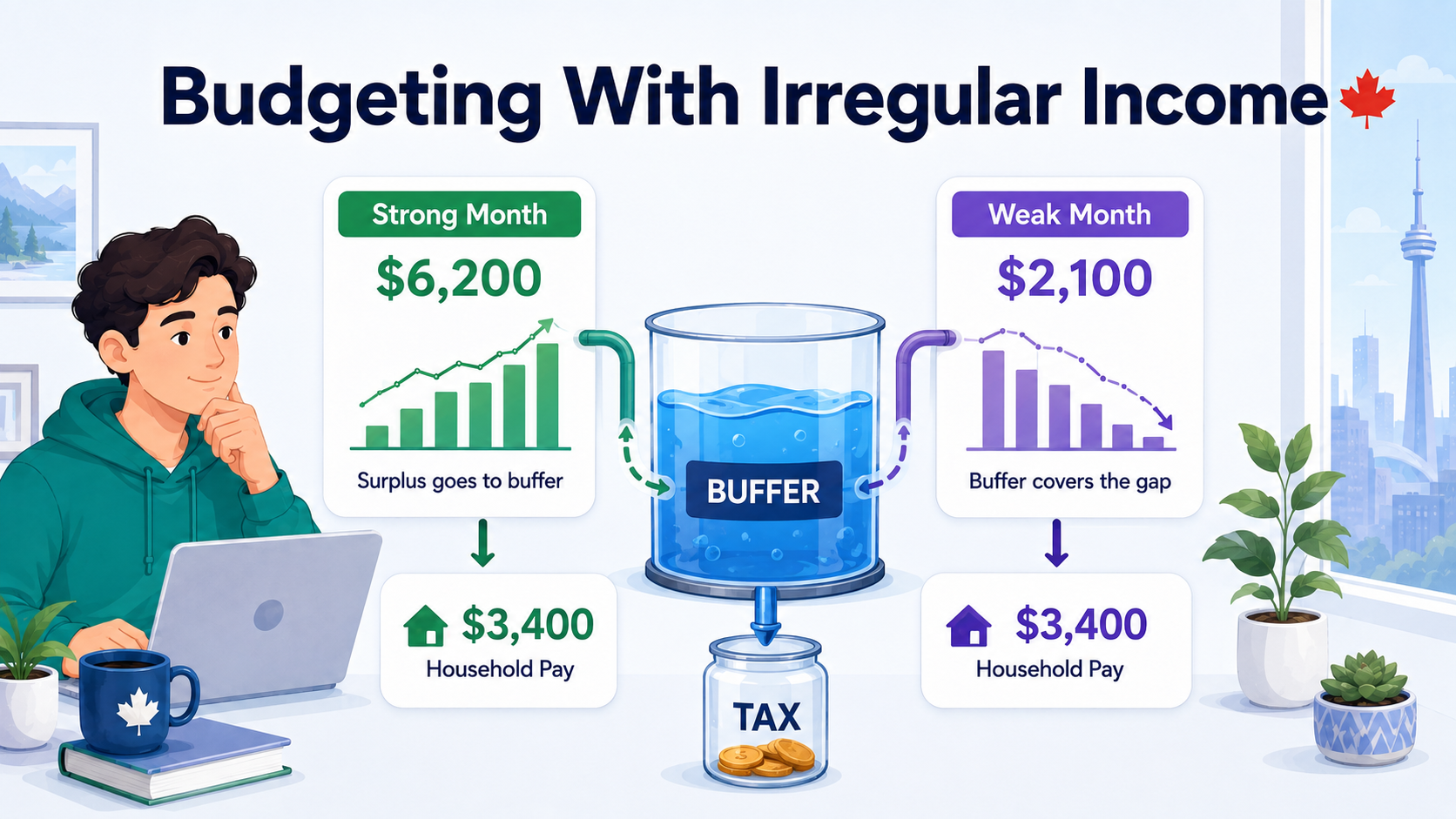
Suppose recent net monthly income ranges from $2,100 to $6,200 and essential household spending is $3,400. Use $3,400 as the first stability target rather than allowing spending to rise to $6,200.
Step 2: build a priority budget
Fund categories in order:
- housing and essential utilities;
- groceries and necessary transportation;
- insurance and minimum debt payments;
- tax and GST/HST set-asides where applicable;
- true-expense sinking funds;
- emergency savings;
- extra debt and long-term goals; and
- flexible wants.
This turns a low-income month into a decision sequence rather than a failed fixed budget.
Step 3: use a holding buffer
Let business or variable income arrive in a holding account, then pay the household a stable monthly amount.
Example:
| Month | Net income received | Household amount | Buffer change |
|---|---|---|---|
| Strong month | $6,200 | $3,400 | +$2,800 |
| Weak month | $2,100 | $3,400 | −$1,300 |
| Buffer after both months | $1,500 |
The strong month is not permission to spend $2,800 more. It finances stability.
Keep tax money separate from the income-smoothing buffer. It is not available household cash.
How large should the income buffer be?
Start by measuring the gap between weak months and the household amount you want to pay.
If the stable household amount is $3,400 and a normal weak month brings in $2,100, the gap is $1,300. Three similar weak months would require $3,900, before considering business expenses or taxes.
The buffer target should reflect:
- how volatile income has been;
- the longest typical gap between payments;
- client concentration;
- seasonal slow periods;
- business overhead; and
- the household emergency fund.
An income buffer smooths expected variability. The emergency fund protects against a more serious disruption. Keeping the two purposes distinct makes it easier to know whether the system is working.
Choosing the stable household payment
Do not set the monthly payment equal to average revenue without accounting for taxes, expenses and volatility.
A practical calculation starts with:
cash received − business expenses − tax/GST-HST reserves = cash available before buffer contributions
Then choose a household payment that can be sustained through ordinary low months. Revisit it after several months of evidence, not after one large invoice.
A priority rule for surplus income
Create the rule before the strong month arrives. For example:
- replenish tax and GST/HST reserves;
- cover next month’s business overhead;
- fill the income buffer to its target;
- fund annual business and household expenses;
- build the emergency fund;
- pay extra toward high-interest debt; and
- fund long-term goals and discretionary spending.
This prevents every high month from becoming a lifestyle increase.
Separating business and personal transactions
Use separate accounts and records where practical. This makes it easier to identify revenue, expenses, owner draws, taxes and household spending.
Money moved from the business account to personal chequing is a transfer or owner payment in the cash-flow system; it should not be counted as both business revenue and new household income without a clear reporting rule.
Keep invoices, receipts and tax records outside the budget where required. A personal-finance app can support cash-flow visibility but does not replace accounting or tax software.
Late invoices and client concentration
An issued invoice is not cash. Track the expected date, but do not let it fund a bill until the money is received or the timing is highly dependable.
If one client supplies most revenue, consider a larger buffer. Losing or delaying that client can affect several months at once. Diversification is a business risk decision as much as a budgeting decision.
Seasonal income
Seasonal workers should plan across the full cycle rather than averaging one busy quarter in isolation.
Estimate:
- total conservative annual net income;
- essential annual household spending;
- taxes and business expenses;
- the number and cost of low-income months; and
- the reserve that must remain when the season ends.
During high season, the holding account should grow. A large balance is not fully available if it must fund the off-season.
Benefits, insurance and retirement contributions
Employees often receive benefits and retirement contributions before take-home pay. Self-employed workers may need explicit budget categories for health costs, disability coverage, time off and retirement savings.
These are easy to postpone because they are not due like rent. Give them recurring jobs after the income floor and tax reserves are stable.
What to cut in a low month
Follow the priority budget rather than cutting every category equally:
- cover essentials and required payments;
- pause flexible wants;
- reduce extra debt or goal contributions temporarily;
- draw from the income buffer for the planned gap; and
- use the emergency fund only when the shortfall is outside normal variability.
If the buffer declines for many months in a row, the stable household payment may be too high or the income problem may be structural.
Irregular-income review dashboard
Track a small set of numbers:
- cash received this month;
- three- or six-month average cash received;
- unpaid invoices;
- tax/GST-HST reserves;
- income-buffer balance;
- months of essential household expenses; and
- next month’s committed bills.
These measures are more useful than comparing every month with one fixed salary assumption.
Step 4: plan for income tax and GST/HST
Self-employed income usually arrives without payroll withholding. Set aside a percentage based on your estimated federal and provincial tax, CPP obligations and deductions. A tax professional can help establish a suitable rate.
If registered for GST/HST, collected sales tax is not revenue available for personal spending. Track it separately and plan for remittances.
Step 5: fund predictable irregular expenses
Annual software, insurance, equipment, professional fees and seasonal household costs should become monthly sinking funds.
If a $1,800 professional insurance bill is due in nine months:
$1,800 ÷ 9 = $200 per month
This keeps the bill from colliding with a naturally weak month.
Step 6: choose a larger emergency fund if needed
Variable income increases the value of liquid reserves. FCAC’s general guideline is three to six months of expenses or income; irregular earners may reasonably favour the upper end or add a separate income-smoothing buffer.
Do not count unpaid invoices as emergency cash. Payment delays and client concentration are part of the risk the buffer must cover.
Step 7: budget only money you have
Forecast expected invoices, but do not assign them to spending until payment is reasonably certain. Track:
- invoice issue date;
- expected payment date;
- actual receipt date;
- client concentration; and
- taxes reserved.
If income arrives in multiple currencies, convert it consistently into CAD for planning. Finnomia reports CAD and USD using Bank of Canada foreign-exchange data, helping keep the household picture comparable.
Using Finnomia with variable income
Finnomia’s budgets, transaction categorization, recurring bills, goals and cash-flow forecasting help separate what has happened from what may happen. Use the forecast for expected invoices and due dates; use connected balances and transactions for reality.
Pair this plan with zero-based budgeting and how many months to save in an emergency fund.
Tax and GST/HST obligations vary by province, business structure and circumstances. Use CRA records and professional advice where appropriate.