
On this page
- Calculate your core monthly expenses
- Choose where you fit in the range
- Build it in stages
- Three months versus six months
- Expenses method versus income method
- What should not be counted as an emergency fund?
- Emergency fund versus paying down debt
- Homeowners, renters and vehicle owners
- How inflation and lifestyle changes affect the target
- A practical access structure
- Emergency-fund checklist
- Where should the money sit?
- When to use—and rebuild—the fund
How Many Months of Expenses Should You Keep in an Emergency Fund?
The Financial Consumer Agency of Canada suggests aiming for three to six months of regular expenses, or three to six months of income. For most households, expenses are the more useful method because they measure what the fund must actually cover.
Your target should reflect your risks. A household with two stable incomes and strong insurance may be comfortable near three months. A self-employed household with dependants and one income may prefer six months or more.
Calculate your core monthly expenses
Start with the costs that would continue during a loss of income:
- housing;
- groceries and basic household supplies;
- utilities and communications;
- insurance;
- transportation;
- medication and essential health costs;
- childcare needed to work; and
- minimum debt payments.
Exclude savings contributions and spending you could pause, such as premium travel, entertainment or non-essential shopping.
Example:
| Essential monthly cost | Amount |
|---|---|
| Housing | $1,800 |
| Food | $700 |
| Utilities and phone | $300 |
| Transportation | $350 |
| Insurance | $250 |
| Minimum debt payments | $200 |
| Monthly essentials | $3,600 |
| Target | Calculation | Amount |
|---|---|---|
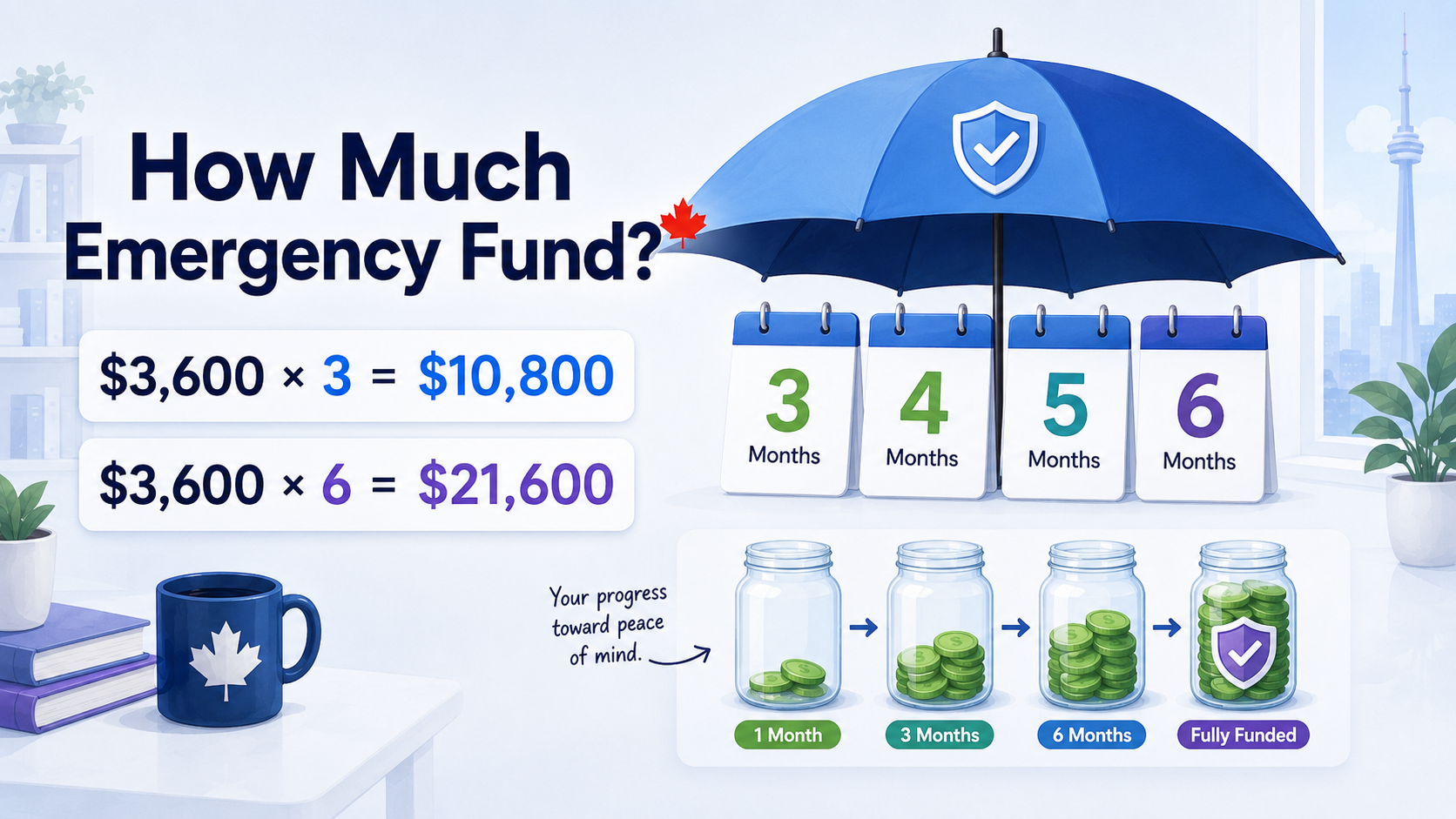
| 3 months | $3,600 × 3 | $10,800 |
| 6 months | $3,600 × 6 | $21,600 |
Choose where you fit in the range
Lean toward a larger fund when you have:
- irregular, seasonal or commission income;
- one household income;
- dependants;
- a specialized role that may take longer to replace;
- limited disability or employment insurance;
- an older home or vehicle;
- high deductibles; or
- little access to family support or other liquid savings.
A smaller target may be reasonable with two independent stable incomes, strong benefits, low fixed costs and other readily available cash.
Do not count a credit limit as emergency savings. Borrowing capacity can shrink precisely when income or economic conditions deteriorate.
Build it in stages
A full six-month target can feel remote. Use milestones:
- $1,000–$2,000 starter buffer for smaller shocks.
- One month of essential expenses to create breathing room.
- Three months as a strong baseline.
- Six months or a custom target for higher-risk situations.
Automate a transfer after each paycheque and direct windfalls or tax refunds to the current milestone.
Three months versus six months
The range is not a test you pass or fail. It reflects different exposure to financial shocks.
Consider a couple whose essential expenses are $4,500 a month.
- Partner A has stable salaried work with disability coverage.
- Partner B has separate stable employment.
- Either income can cover most core expenses temporarily.
A three-month fund of $13,500 may provide a reasonable baseline, especially if the household also has paid leave and accessible non-registered savings.
Now consider a self-employed parent whose household relies on one income, owns an older home and has a high insurance deductible. Six months—$27,000 in this example—may be more appropriate, and a separate business cash buffer may also be needed.
The expense calculation is the same. The risk determines the number of months.
Expenses method versus income method
FCAC says either three to six months of regular expenses or three to six months of income can be used.
The expenses method usually produces a more tailored target because taxes, savings and discretionary spending may fall when income stops. The income method is faster and may build a more conservative fund.
Suppose take-home income is $5,200 and essential expenses are $3,600:
| Method | 3 months | 6 months |
|---|---|---|
| Essential expenses | $10,800 | $21,600 |
| Take-home income | $15,600 | $31,200 |
Neither is universally correct. Choose the method that matches what you want the fund to replace.
What should not be counted as an emergency fund?
- Available credit-card or line-of-credit limits.
- Home equity that requires new borrowing or a sale.
- Volatile investments needed on a fixed timeline.
- Retirement money that is locked in or costly to access.
- Contribution room in a TFSA, RRSP or FHSA.
- Expected tax refunds, bonuses or invoices not yet received.
These may improve the household’s broader resilience, but they are not the same as accessible emergency cash.
Emergency fund versus paying down debt
High-interest debt makes holding a very large cash balance costly, but having no buffer can force the next surprise back onto the card.
A balanced approach is often:
- build a starter buffer;
- make every required payment;
- direct extra cash toward expensive revolving debt;
- increase the emergency fund as the debt falls; and
- revisit the full three-to-six-month target after high-cost debt is controlled.
The right balance depends on job risk, interest rates and access to support. Do not drain cash needed for next month’s bills to make an impressive one-time debt payment.
Homeowners, renters and vehicle owners
An emergency fund replaces income and covers broad shocks. Large asset-specific risks may justify separate reserves.
- Homeowners may keep a home-repair sinking fund in addition to the emergency fund.
- Vehicle owners can maintain a maintenance and repair fund.
- Renters may prioritize moving costs or a rent-deposit reserve.
Separating predictable ownership costs prevents them from consuming the general fund.
How inflation and lifestyle changes affect the target
Recalculate after a move, new child, separation, job change, major debt payoff or material change in insurance. Otherwise, an annual review is usually enough.
If essential spending rises from $3,600 to $4,000, a six-month target rises by $2,400. Update the goal; do not treat the old target as permanently correct.
A practical access structure
Some households use layers:
- immediate cash in a savings account for same-day needs;
- the remainder in another liquid savings account or redeemable product; and
- other investments outside the formal emergency target.
The structure can reduce temptation while preserving access. Check withdrawal delays, transfer limits, interest conditions and deposit insurance coverage.
Emergency-fund checklist
- Calculate essential monthly expenses.
- Select the number of months based on household risk.
- Separate predictable sinking funds.
- Keep the money liquid and low-risk.
- Automate contributions.
- Define what qualifies as an emergency.
- Recalculate after major life or cost changes.
- Rebuild after use without judging the withdrawal as a failure.
Where should the money sit?
Emergency money should be liquid, low-risk and easy to access. A high-interest savings account is often a straightforward home. A cash-based TFSA can also work if you have room and understand that withdrawn room does not return until the next calendar year.
Avoid exposing near-term emergency money to stock-market volatility or locking all of it into a product with inconvenient redemption terms.
Read HISA vs TFSA for an emergency fund for the account decision.
When to use—and rebuild—the fund
Use it for necessary, unplanned expenses or income interruptions: an urgent repair, medical cost, job loss or insurance deductible. A predictable annual bill belongs in a sinking fund instead.
After a withdrawal, update the target if monthly essentials changed and rebuild with automatic contributions.
Finnomia can calculate a CAD savings goal, track progress beside household cash flow and keep the emergency fund visible with debts, investments and registered accounts.
For variable earnings, pair this with irregular income budgeting. You can also use Finnomia’s free emergency fund calculator.