
On this page
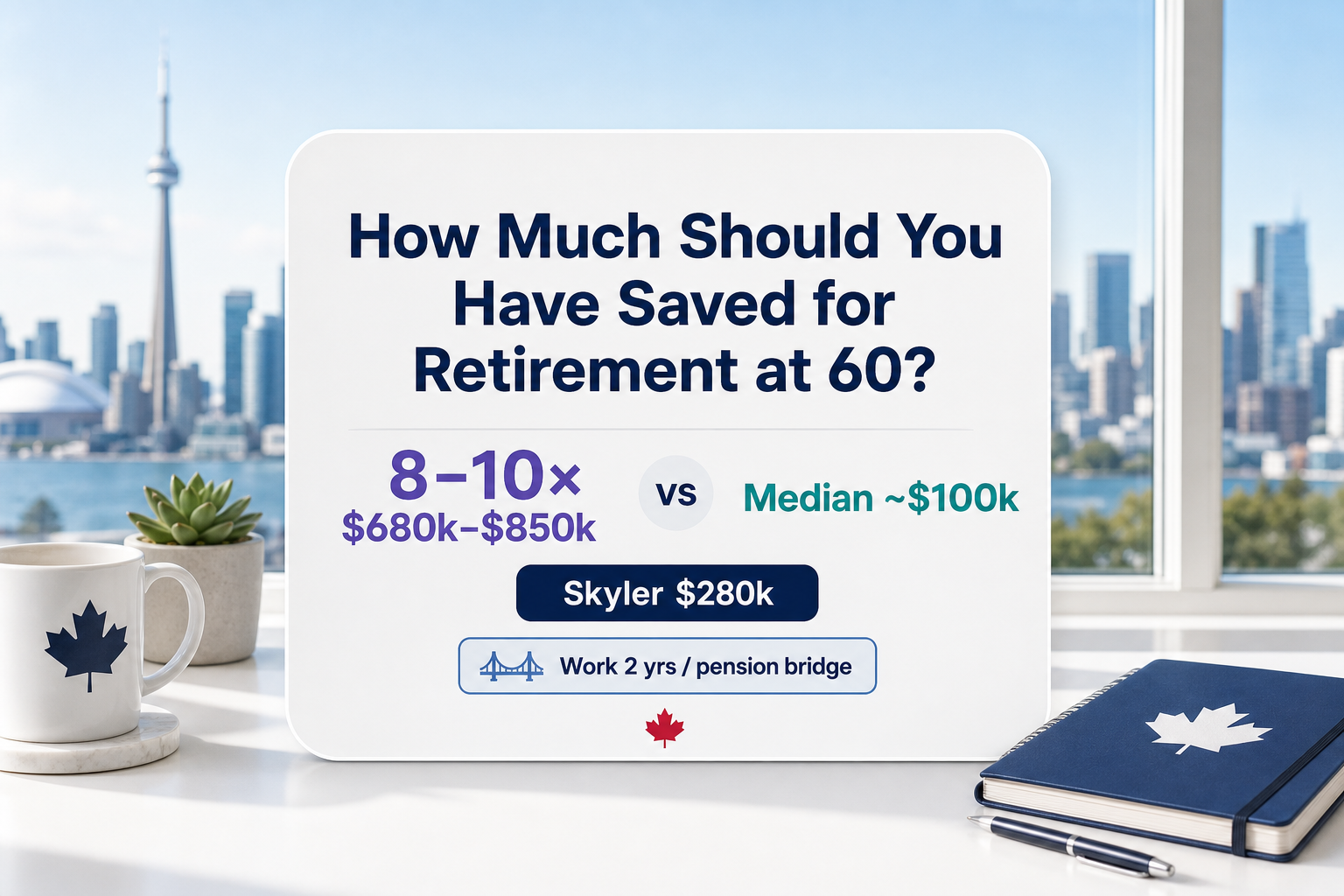
There is no single “correct” balance at 60. Two useful Canadian frames: a Fidelity-style ~8× by 60 / ~10× by late 60s guideline — aspirational, US-rooted, not law — and StatsCan median reality for the 55–64 band. Neither is “your number.”
The decade job is last-mile / near-claim — short compound runway left, public-pension window opening — not panic-comparing to a US retirement-multiple table and not cloning a 50s catch-up checklist. This page is not an age-40 habit sermon, not a nest-egg formula, and not a CPP claim-age essay.
The 8–10× guideline (not a grade)
Fidelity-style milestones commonly cited online run roughly ~1× by 30, ~3× by 40, ~6× by 50, ~8× by 60, and ~10× by the late 60s (~67). Fidelity Canada’s home-stretch framing also stamps nine times by 60 and ten times by 65. Finnomia owns the ~8–10× band as a goalpost.
The ladder is US-rooted and often assumes something like a 15% savings rate, long equity exposure, retirement near 67, and a US Social Security context. Canada’s CPP and OAS — and any workplace defined-benefit pension or paid-off housing — are a future floor, so the same lifestyle may need a lower personal multiple. Treat 8–10× as a guideline, not a pass/fail grade and not Canadian law.
Canadian median reality
For ages 55–64 (major income earner), widely cited Survey of Financial Security aggregations put RRSP/RRIF/LIRA median around $100,000 and mean around $216,900. Prefer the median. The mean is pulled up by high balances. Those dollar bands are secondary aggregations of StatsCan SFS; do not invent provincial medians. Housing and workplace DB can dominate net worth in this band — one clause, not a net-worth essay.
A household between the median band and an 8–10× multiple is normal, not a failure. The useful question: which last-mile levers still move the needle near claim ages, given short compound runway?
Dual view on an $85,000 salary
| Frame | Amount | Label |
|---|---|---|
| Gross salary (illus.) | $85,000 | Illustration |
| Fidelity-style 8× guideline | $680,000 | Guideline, not law |
| Fidelity-style 10× (late-60s fork) | $850,000 | Same ladder |
| SFS median RRSP/RRIF/LIRA, ages 55–64 | ~$100,000 | Prefer median; secondary aggregation |
| SFS mean (same band) | ~$216,900 | Skewed — not “typical” |
8 × $85,000 = $680,000. 10 × $85,000 = $850,000. On $95,000 salary, 8× = $760,000; 10× = $950,000.
Decade spine: last-mile / near-claim
From about 60 to a retirement age often cited near 65, you may have ~0–5 years of accumulation left (or you may already be retired or semi-retired). Own these as options, not a mandatory script:
- Work longer / delay full retirement — even one or two years compounds the balance and shortens the draw horizon.
- Trim spend before locking a retirement lifestyle.
- Housing — paid-off home or downsizing as an option (don’t invent downsizing dollars here).
- Delay benefits as options — CPP can start from 60 (−36% at 60 / +42% at 70 vs age 65); OAS from 65 (+36% at 70 if deferred). Cite canada.ca. This page doesn’t teach claim-age breakevens.
The 40s were habit and runway; the 50s were catch-up. Sizing the eventual nest egg is a separate method — use CRIC and MSCA for personal estimates; don’t rebuild a 25× waterfall here. Reverse “what income does $X generate?” is a different job — not this page.
Pension bridge (canada.ca stamps)
Public pensions are a floor / proximity story at 60, not a reason to skip last-mile planning:
- CPP maximum at 65: $1,507.65/mo (January 2026); average new at 65: $877.01/mo (April 2026). Factors −36% at 60 / +42% at 70.
- OAS Jul–Sep 2026: $751.97/mo (65–74) / $827.17/mo (75+). Deferral +36% at 70 (official deferred max $1,022.68 on the Jul–Sep 2026 table).
Quebec work usually means the Québec Pension Plan for that work — Retraite Québec; not a QPP tutorial. Near claim, use My Service Canada Account and the Canadian Retirement Income Calculator (estimates only).
One sentence: an RRSP must be converted or matured by December 31 of the year you turn 71 (CRA). Stop — no RRIF factor table here.
Where the money sits is TFSA vs RRSP vs FHSA. This page doesn’t re-rank accounts. Taxable RRSP withdrawals vs tax-free TFSA withdrawals are one clause on that page if you need the contrast.
Skyler’s vignette (Kelowna)
The figures below are an illustrative sanity check — not advice, not a forecast, and not a fail grade.
Skyler is about 60 in Kelowna, earns $85,000 gross, has no workplace DB in this illustration, and has a mortgage largely paid down. Invested retirement balance (RRSP + TFSA, illus.): $280,000 — above the ~$100,000 median band, well below the $680,000 8× guideline. Gap to 8×: $400,000. Between median reality and the aspirational multiple is a normal place to sit. Public pensions and housing (qualitative) change how far the personal multiple needs to stretch.
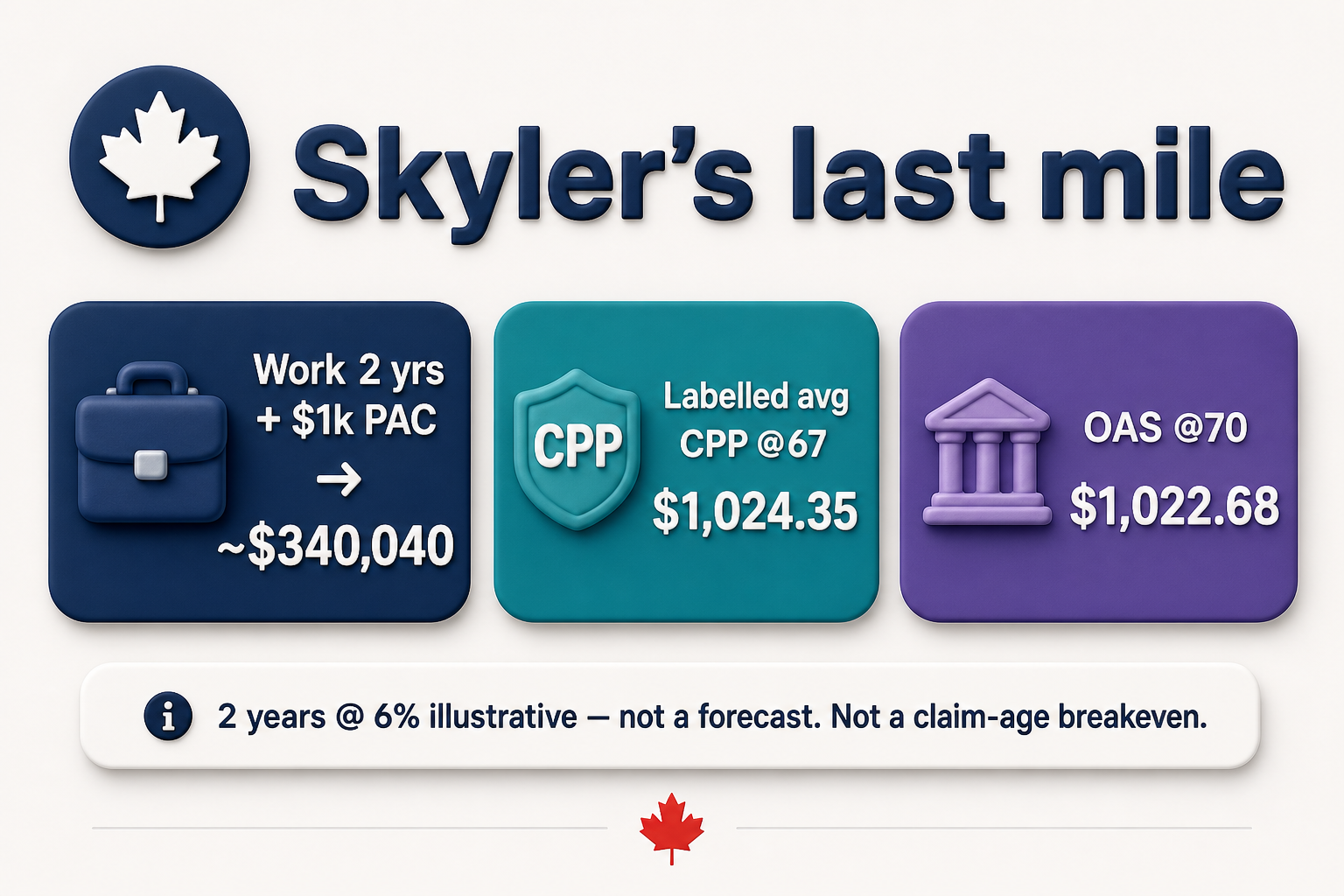
Last-mile option — work 2 more years. Assumptions: 2 years of continued work; 6% annual return (illustrative constant — not a forecast); end-of-month contributions; returns reinvested; today’s dollars; no fee or tax drag modelled. Honest framing: two years of compound cannot close a $400k 8× gap alone — which is why pension proximity and other levers matter.
| Item | Amount |
|---|---|
| Current invested balance | $280,000 |
| PAC while working 2 more years | $1,000 / month |
| Years | 2 |
| Illustrative return | 6% / year |
| Path | Future value (illus.) |
|---|---|
| $280,000 balance alone @ 6% / 2 yrs | $314,608 |
| Keep a lighter $500/mo PAC (annuity FV) | ~$12,716 |
| Total if keep $500 | ~$327,324 |
| Hold $1,000/mo PAC (annuity FV) | ~$25,432 |
| Total if $1,000/mo + work 2 yrs | ~$340,040 |
| Cash contributed at $1,000/mo over 2 yrs | $24,000 |
$280,000 × 1.06² = $314,608. Still about $340k vs a $680k 8× goalpost — guideline check, not a fail grade. Last-mile is also pensions, spend, housing, and claim timing as options.
Last-mile option — labelled delay stamp (not a breakeven). Using canada.ca factors only: labelled average CPP delayed 2 years past 65 (+0.7%/mo × 24 = +16.8%). Not Skyler’s personal estimate. Not a breakeven essay.
| Item | Amount | Label |
|---|---|---|
| CPP average at 65 (Apr 2026) | $877.01 / mo | canada.ca — labelled average |
| Factor if start at 67 | +16.8% | +0.7%/mo × 24 |
| Labelled average @ 67 | $1,024.35 / mo | $877.01 × 1.168 |
| Monthly delta | +$147.34 / mo | Option illustration only |
Optional max stamp: $1,507.65 × 1.168 ≈ $1,760.94 (+$253.29/mo) — maximum, not typical. OAS deferral: Jul–Sep 2026 max 65–74 $751.97 → at 70 $1,022.68 (+36%) — option, not advice.
Whether Skyler’s cash flow can sustain $1,000 a month (or free housing / spend trims) is owned by How Much Should You Save Each Month? — this page doesn’t reteach surplus math. Once an amount exists, How to Automate Savings Goals in Canada is the PAC. Liquidity before optimizing is How Much Emergency Fund Do I Need in Canada?.
Tools and next checks
Near claim: My Service Canada Account and the Canadian Retirement Income Calculator (estimates only). Finnomia’s Retirement Planner via trial for age-checkpoint and last-mile estimates — not advice.
See the last mile beside your other numbers
Finnomia’s Retirement Planner builds progress, last-mile, and scenario estimates — not advice. It tracks those scenarios; it doesn’t hold accounts or move money. If you want that sitting next to your other numbers, start a 14-day free trial.
How much should I have saved for retirement at 60 in Canada?
There’s no pass/fail CAD balance. A Fidelity-style ~8–10× salary checkpoint is a guideline, not law. Typical 55–64 median RRSP/RRIF/LIRA balances sit near ~$100,000 in widely cited SFS aggregations — far below 8× for many salaries.
What last-mile options still matter?
Work longer, trim spend, housing choices, and delay CPP/OAS as options — beside canada.ca benefit stamps. Short compound runway means pensions and levers matter as much as the personal multiple.
Is 8× salary a Canadian rule?
No. It’s a Fidelity-style / US-rooted milestone. Use it as a goalpost, not a CRA or Service Canada grade.
This article was published in September 2026 and is general information, not personalized tax, legal, or retirement advice. Guideline multiples and median aggregations are not personal targets. Confirm current CPP/OAS amounts on canada.ca and your own estimates in My Service Canada Account / CRIC.