
On this page
- A worked CAD example
- Step 1: estimate income you can rely on
- Step 2: fund essentials and minimum payments
- Step 3: add true expenses
- Step 4: assign money to goals and debt
- Step 5: leave a small buffer
- Step 6: adjust during the month
- Credit cards without double-counting
- Income that arrives at different times
- Sinking funds versus an emergency fund
- What happens when a category rolls over?
- Starting when the month is already underway
- When the plan does not balance
- A sample weekly check-in
- Common zero-based budgeting mistakes
- Zero-based vs 50/30/20
- Using Finnomia
How to Use Zero-Based Budgeting in Canada
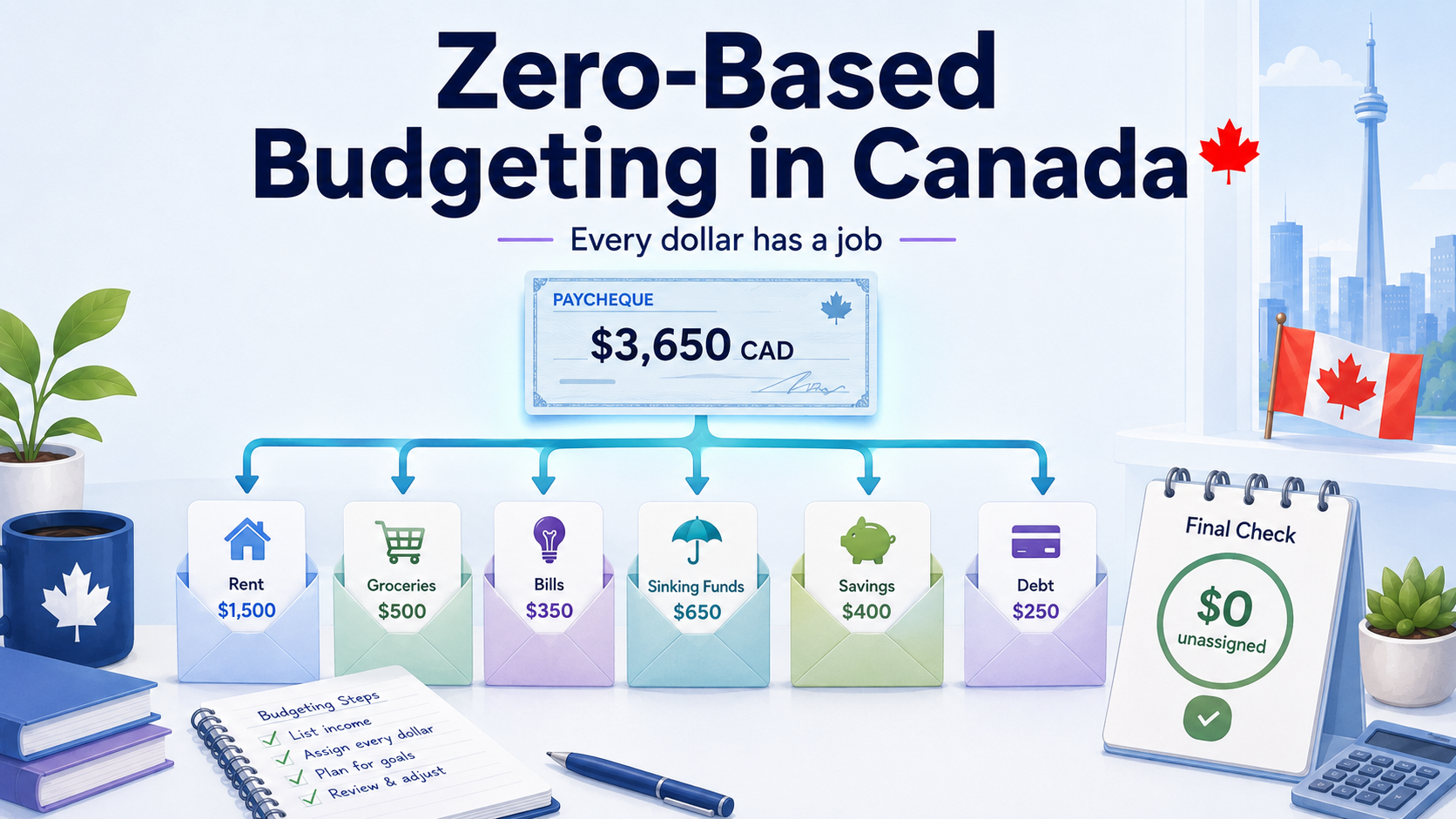
Zero-based budgeting gives every dollar of expected take-home income a job so that:
income − spending − savings − extra debt payments = $0
The zero does not mean spending your bank account down to nothing. It means every dollar is assigned—to this month’s bills, a future expense, savings, investing, debt or a buffer.
A worked CAD example
Suppose monthly take-home pay is $3,650:
| Job | Amount |
|---|---|
| Rent | $1,450 |
| Groceries | $500 |
| Utilities and phone | $260 |
| Transportation | $300 |
| Insurance | $140 |
| Minimum debt payments | $250 |
| Flexible spending | $250 |
| Annual-expense sinking funds | $200 |
| Emergency fund | $150 |
| Extra debt payment | $100 |
| Buffer | $50 |
| Total assigned | $3,650 |
Nothing is left unassigned, but $500 is improving future financial resilience rather than being spent today.
Step 1: estimate income you can rely on
Use take-home income. If pay varies, start with a conservative floor based on recent lower-income months. Do not assign an invoice that has not been paid.
Step 2: fund essentials and minimum payments
List housing, food, utilities, transportation, insurance and required debt payments. Put due dates beside recurring bills so the budget matches cash flow, not just monthly totals.
Step 3: add true expenses
Many “unexpected” bills are predictable but irregular: car repairs, gifts, annual subscriptions, school costs and property taxes. Divide the expected annual amount by the months remaining and save it in a sinking fund.
For a $1,200 annual insurance bill due in 12 months:
$1,200 ÷ 12 = $100 per month
Step 4: assign money to goals and debt
Emergency savings, a home down payment, retirement contributions and extra debt payments all receive explicit jobs. This prevents goals from depending on whatever happens to remain at month-end.
Step 5: leave a small buffer
A $25–$100 miscellaneous buffer can absorb small forecasting errors. If it is unused, roll it to a goal or leave it as next month’s opening cushion.
Step 6: adjust during the month
A zero-based budget is not frozen. If groceries run $40 over, move $40 from another category. The goal is to keep the plan balanced while making the trade-off visible.
Credit cards without double-counting
Categorize the purchase when it occurs. The later credit-card payment is a transfer that pays the liability; it is not a second grocery, restaurant or shopping expense.
If you carry a balance, separate new purchases from the amount assigned to debt payoff. That keeps spending and debt reduction visible.
Income that arrives at different times
A monthly budget can balance on paper while the chequing account goes negative mid-month. Add pay dates and bill dates to the plan.
If $3,650 arrives as two $1,825 paycheques, the first paycheque may need to cover rent and early-month bills while the second funds later expenses and goals. A cash-flow forecast helps determine when the assignments can actually move.
For irregular income, budget only money already received or use a conservative income floor. Extra income can follow a preset priority list rather than being assigned prematurely.
Sinking funds versus an emergency fund
Both hold cash for the future, but they solve different problems:
- A sinking fund covers a known or expected cost such as annual insurance, tires or gifts.
- An emergency fund covers an unplanned essential cost or income interruption.
Giving annual bills their own jobs protects the emergency fund from predictable withdrawals.
What happens when a category rolls over?
Decide category by category.
- Groceries may reset each month.
- Car maintenance should accumulate.
- A vacation goal should accumulate.
- A general buffer may roll into next month or be swept to a priority.
The goal is not identical treatment. It is knowing whether unspent money remains assigned or becomes available for a new job.
Starting when the month is already underway
You do not need to wait for the first day of a month. Begin with:
- cash currently available;
- income expected before month-end;
- bills and essential spending still outstanding; and
- goals that can realistically be funded.
Past spending is already done. Assign only the money and obligations that remain, then build the next full month with better information.
When the plan does not balance
If allocations exceed income, reduce or postpone jobs in order of consequence:
- protect housing, food, essential utilities and necessary transportation;
- make required debt and insurance payments;
- pause flexible wants;
- adjust savings goals or extra debt payments; and
- address a persistent structural gap through larger expense or income changes.
Do not use a credit-card purchase to make the spreadsheet equal zero. That shifts the gap into debt.
If money remains unassigned, give it to the highest current priority: a buffer, sinking fund, emergency savings, high-interest debt or another goal.
A sample weekly check-in
- Confirm new income and account balances.
- Categorize transactions and transfers.
- Compare remaining category amounts with days remaining.
- Move money between categories when priorities change.
- Check upcoming recurring bills.
- Leave completed spending in the historical category rather than rewriting the original plan.
Common zero-based budgeting mistakes
- Building the budget from gross rather than take-home income.
- Forgetting annual and seasonal expenses.
- Treating a credit-card payment as new spending.
- Assigning expected income before it arrives.
- Setting every category so tightly that one small variance breaks the month.
- Confusing $0 unassigned with a $0 bank balance.
Zero-based vs 50/30/20
| Method | Best for | Main trade-off |
|---|---|---|
| Zero-based | Detailed monthly control | More setup and maintenance |
| 50/30/20 | Fast high-level guardrails | Less precise for timing and irregular expenses |
You can combine them: use 50/30/20 to check the overall shape, then zero-base the detailed categories.
Using Finnomia
Finnomia’s transaction categorization, customizable budgets, recurring bills, goals and cash-flow forecasting support the full loop: see what happened, assign the next month, forecast timing and adjust categories without losing the bigger financial picture.
Read categorizing spending in Canada to clean up the transaction side, or automating savings goals to make future allocations happen outside the budget.