
On this page
- Start with categories that support decisions
- Use this transaction test
- Canadian examples
- Credit-card payments are the common double-count trap
- GST/HST belongs inside the purchase
- How automatic categorization should work
- Merchant names are evidence, not the final answer
- Transfers that deserve special attention
- Reimbursements and shared expenses
- Cash withdrawals
- Income categories need care too
- Category rules worth automating
- What to do with pending and duplicate transactions
- Building a category system that lasts
- A five-minute monthly cleanup
How to Categorize Spending Without Double-Counting Transactions
Good categorization is not about creating the perfect list of labels. It is about producing spending totals you can trust.
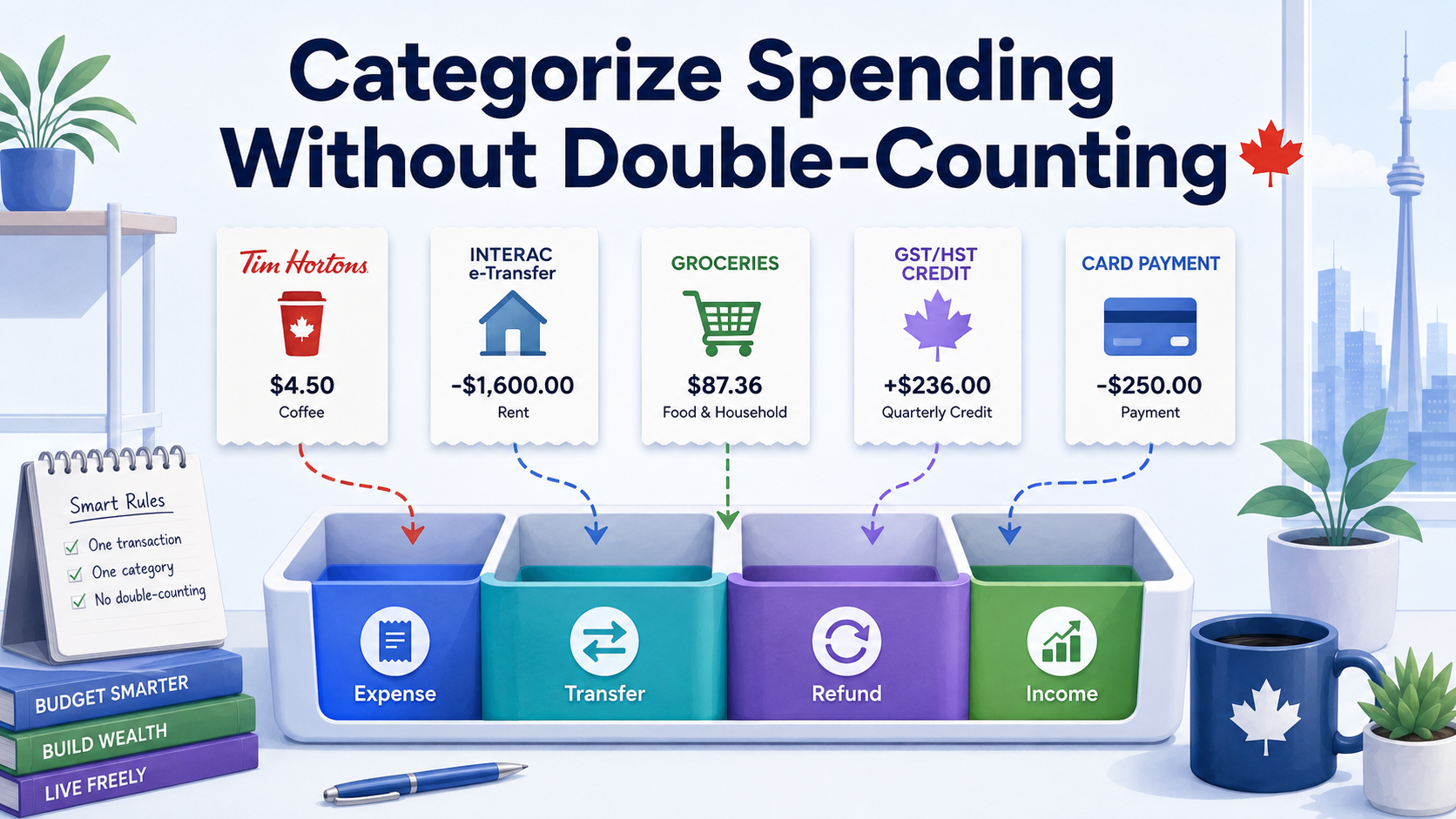
The most important rule is simple: categorize the underlying purchase once. Treat movements between your own accounts as transfers, not new spending or income.
Start with categories that support decisions
A useful Canadian household structure might include:
- Housing
- Groceries
- Restaurants and coffee
- Transportation
- Utilities
- Insurance
- Health
- Childcare
- Shopping
- Entertainment
- Travel
- Fees and interest
- Taxes
- Savings and investments
- Debt payments
- Income
- Transfers
Do not create a separate category for every merchant. “Tim Hortons” normally belongs under Restaurants and coffee; “RBC” could represent a fee, mortgage payment, card payment or transfer and needs context.
Use this transaction test
For each transaction, ask:
- Did money buy a good or service? Categorize the expense.
- Did money move between accounts I own? Mark it as a transfer.
- Did a merchant return money from an earlier purchase? Categorize it as a refund to the original category.
- Did I receive new money? Categorize the type of income.
- Did I lend, reimburse or split money with another person? Use a consistent reimbursement or transfer rule.
Canadian examples
| Statement description | Likely treatment | Check first |
|---|---|---|
| TIM HORTONS #1234 | Restaurants and coffee | Was it a personal or business purchase? |
| INTERAC E-TRANSFER | Depends | Rent, reimbursement, income or own-account transfer? |
| PAYMENT THANK YOU | Transfer | Is it a credit-card payment? |
| GST/HST CREDIT | Government benefit/income | Do not treat it as a purchase refund |
| MERCHANT REFUND | Original spending category | Match it to the purchase |
| BANK FEE | Fees and interest | Was it later reversed? |
An Interac e-Transfer is a payment rail, not a spending category. The recipient and purpose determine the category.
Credit-card payments are the common double-count trap
Suppose you buy $120 of groceries on a credit card, then pay $120 from chequing.
- The grocery purchase is $120 of spending.
- The payment from chequing to the card is a transfer.
If both are categorized as spending, the budget reports $240 even though you bought only $120 of groceries.
Debt payoff needs another layer. Interest and fees are expenses. Principal payments reduce a liability. Finnomia can show the cash outflow and debt reduction without pretending the entire payment is new consumption.
GST/HST belongs inside the purchase
For household budgeting, the amount charged at the register is normally the expense. You usually do not need separate tax categories for every purchase.
Tax treatment varies by item and province: many basic groceries are zero-rated, while prepared food and restaurant purchases may attract GST/HST. That can help explain price differences, but it does not change the core category.
How automatic categorization should work
Automation should make a reasonable first guess and learn from corrections. It should not hide uncertainty.
Review:
- new or unfamiliar merchants;
- large transactions;
- Interac e-Transfers;
- cash withdrawals;
- card payments;
- refunds and reversals; and
- split purchases, such as groceries plus pharmacy items.
In Finnomia, transactions can be reviewed, searched and recategorized, with categories tailored to the household. Connected accounts are read-only: editing a category changes the financial view, not the bank’s transaction.
Merchant names are evidence, not the final answer
Statement descriptions can contain processors, store numbers, abbreviated legal names or city codes. The same merchant can also sell items that belong in different categories.
A purchase at Costco might be groceries, clothing, electronics or a mix. A pharmacy transaction might include medication, cosmetics and household goods. Use the merchant as a useful default, then split material mixed purchases when doing so improves the budget.
Transfers that deserve special attention
Own-account transfers can appear as an outflow in one institution and an inflow in another. When both sides are connected, link or categorize both as transfers so neither affects income or spending.
Common examples include:
- chequing to savings;
- chequing to a credit card;
- bank to brokerage;
- moving cash between spouses’ accounts; and
- an Interac e-Transfer between accounts you control.
An investment contribution is a transfer from cash to an asset, not consumption. Investment fees may still be expenses.
Reimbursements and shared expenses
Suppose you pay a $120 restaurant bill and a friend sends you $60. Two consistent approaches are possible:
- record $120 of restaurant spending and $60 of reimbursement income; or
- offset the reimbursement against Restaurants so net personal spending is $60.
The second method is often more useful for a personal budget. Whichever approach you choose, use it consistently and do not categorize the repayment as unrelated income.
For roommates or couples, shared household views can reduce reimbursement noise by showing who paid and how the expense is allocated.
Cash withdrawals
An ATM withdrawal is a movement from a bank account into cash. Categorizing the full withdrawal as spending is convenient but imprecise if the cash is later used for several purposes.
Choose based on materiality:
- For occasional small withdrawals, a Cash spending category may be sufficient.
- For frequent or large cash use, track the underlying purchases.
- Treat ATM fees separately as Fees and interest.
Do not count both the withdrawal and later recorded cash purchases as spending.
Income categories need care too
Deposits are not automatically income. A positive transaction may be:
- salary or contract revenue;
- a government benefit;
- interest or a dividend;
- a refund;
- a transfer from another account;
- a reimbursement; or
- proceeds from selling an asset.
Sale proceeds are not necessarily the same as income or investment gain. The tax treatment belongs in tax records; the budget treatment should reflect where the cash came from without inflating ordinary earnings.
Category rules worth automating
Create a rule when the same description reliably means the same thing:
- a known employer deposit → Employment income;
- a mobile-phone provider → Phone;
- a recurring insurer → Insurance;
- a card-payment description → Transfer;
- a mortgage withdrawal → Mortgage or split principal/interest view; and
- a known savings-account transfer → Transfer.
Avoid aggressive rules for generic descriptions such as “Interac,” “POS purchase” or a marketplace with many product types.
What to do with pending and duplicate transactions
Some institutions show a pending authorization and later a posted transaction. A good connection should reconcile them, but timing or merchant-name changes can occasionally make them look separate.
Before deleting or excluding one, compare the amount, date, account and merchant. If the posted transaction replaces the pending item, keep only the posted expense in reporting. Similar purchases made on the same day may be real, so do not assume every match is a duplicate.
Building a category system that lasts
Start broad. Add a subcategory only when it changes a decision. “Food” may be too broad because groceries and restaurants behave differently. Twelve separate coffee-shop categories are probably too narrow.
A practical test is: Would seeing this number separately cause me to budget, reduce, protect or plan it differently? If not, the additional category may be noise.
A five-minute monthly cleanup
- Filter uncategorized transactions.
- Review transfers and card payments.
- Match refunds to original categories.
- Correct the largest merchants.
- Compare category totals with the budget.
That small review produces far more value than a complicated category tree nobody maintains.
Continue with zero-based budgeting or the broader how to budget in Canada guide.