
On this page
- The short answer
- First: build the emergency fund before optimizing the wrapper
- Emergency funds should be easy to access
- A HISA is designed for cash savings
- Interest in a regular HISA is generally taxable
- A TFSA can hold cash
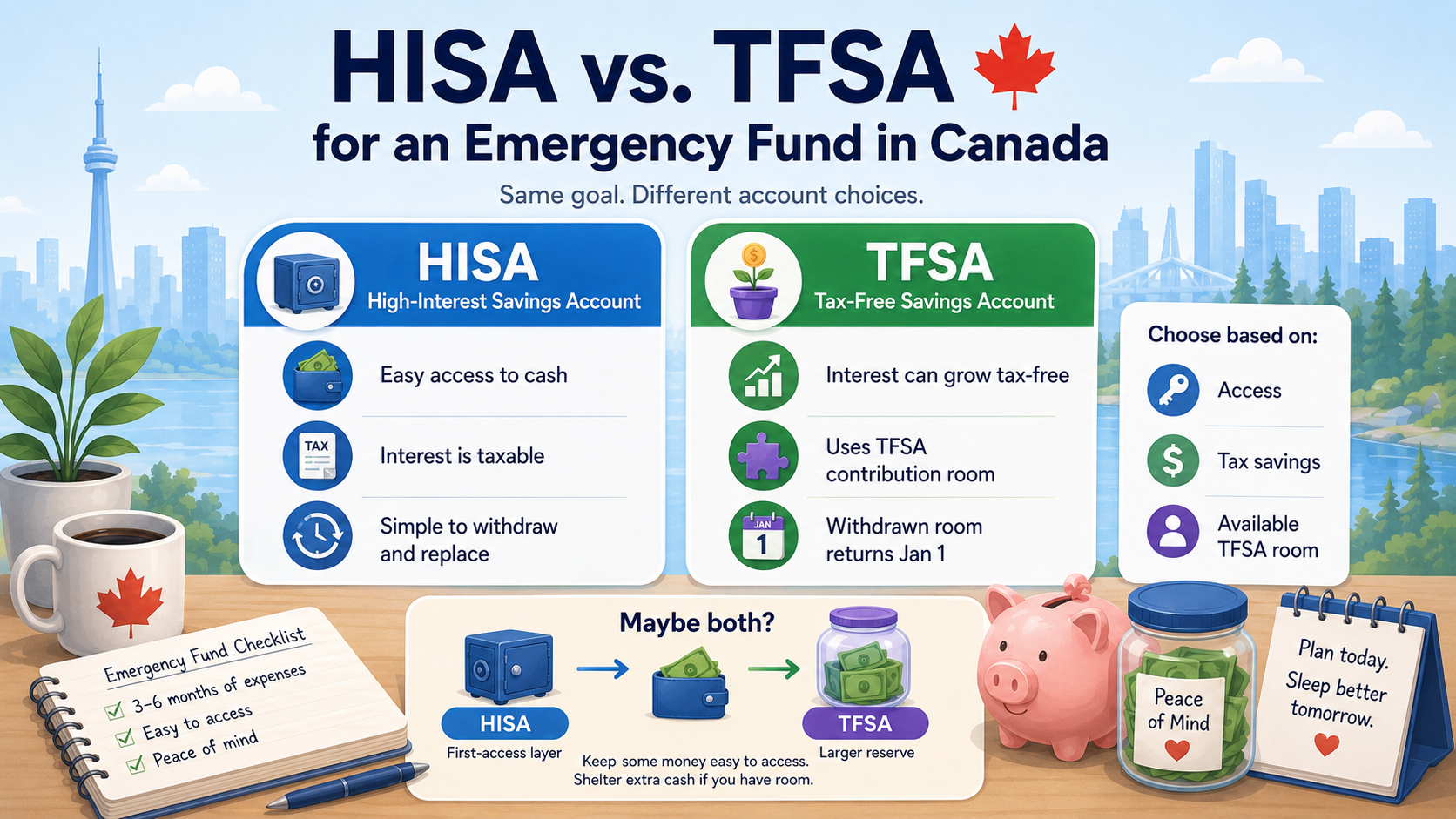
- HISA vs. TFSA emergency savings at a glance
- TFSA room has an opportunity cost
- When plenty of TFSA room changes the answer
- The big TFSA emergency-fund trap: replacing a withdrawal too soon
- If you already have unused TFSA room, you may be able to refill sooner
- TFSA room shown by CRA isn't a real-time balance
- What you hold inside the TFSA matters
- TFSA doesn't mean “invested”
- What does CDIC cover?
- HISA ETFs are not the same as insured HISA deposits
- What about credit unions?
- Should you put your entire emergency fund in a TFSA?
- A two-layer emergency fund can work well
- Emergency fund vs. sinking fund
- When a regular HISA is probably the better choice
- When TFSA emergency savings can make sense
- When both may be the best answer
- How Finnomia fits into the emergency-fund decision
- The emergency comes first. The wrapper comes second.
- Frequently asked questions
You've built an emergency fund.
Now where should you keep it?
A high-interest savings account?
A TFSA?
The first thing to understand is that those aren't actually opposite products.
A high-interest savings account (HISA) is a place to hold cash.
A Tax-Free Savings Account (TFSA) is a registered account structure that can potentially hold:
- cash
- a savings product
- GICs
- stocks
- ETFs
- mutual funds
- other qualified investments
So the more useful question is:
Should my emergency cash sit in a regular taxable savings account, or should I use some of my TFSA contribution room to shelter that cash from tax?
For some Canadians, a HISA inside a TFSA can make excellent sense.
For others, preserving TFSA room for long-term investing while keeping emergency cash in a regular HISA may be more valuable.
And many people can reasonably use both.
The short answer
If you're deciding today, start with the emergency fund's job:
The money needs to be safe, stable and quickly accessible when something genuinely unexpected happens.
Then consider the account.
A regular HISA may make sense if:
- you have little or no unused TFSA room
- you're using your TFSA primarily for long-term investing
- you want the simplest possible withdrawal and redeposit process
- you don't want to keep track of TFSA recontribution timing
- the amount of taxable interest is relatively small
- you want your emergency fund completely separate from investment accounts
A HISA or cash savings product inside a TFSA may make sense if:
- you have plenty of unused TFSA contribution room
- the money remains easily accessible
- you want the interest to grow tax-free
- you understand that withdrawn room doesn't return until the following calendar year
- holding emergency cash won't crowd out higher-priority uses of your TFSA
Using both can make sense if:
- you want a first layer of emergency cash available immediately
- your emergency fund is relatively large
- you have some, but not unlimited, TFSA room
- you want to balance convenience with tax efficiency
There isn't one universal winner.
First: build the emergency fund before optimizing the wrapper
It's easy to turn this into a tax-optimization question too early.
Whether your emergency fund earned a little more interest after tax doesn't matter much if the money isn't actually there when you need it.
FCAC defines an emergency fund as money reserved for unexpected expenses such as:
- an urgent vehicle repair
- an unexpected veterinary expense
- job loss
- a health problem that prevents you from working
It recommends working toward roughly 3 to 6 months of regular expenses, while recognizing that building that amount may take months or years.
Start with what you can manage.
If you don't yet have much emergency savings, the priority is:
build the fund
before spending too much time optimizing exactly where every dollar sits.
You can estimate your target using Finnomia's free emergency-fund calculator.
For the full process of determining the amount, see How to Build an Emergency Fund in Canada.
Emergency funds should be easy to access
FCAC's emergency-fund guidance says the account should:
- be separate from day-to-day spending
- have low or no transaction fees
- allow withdrawals without penalty
- earn interest
That's a useful test regardless of whether the account is registered.
If your car breaks down Wednesday morning and the repair is $2,400, the question isn't:
“Which account was theoretically most tax-efficient?”
It's:
“Can I access $2,400 without borrowing or selling something at a bad time?”
Liquidity comes first.
A HISA is designed for cash savings
A high-interest savings account is simply a savings account designed to offer a relatively competitive interest rate while keeping the money accessible.
Unlike a GIC with a fixed term, a typical HISA doesn't require you to lock the money away for several years.
That makes it naturally suited to goals such as:
- emergency savings
- a short-term purchase
- upcoming taxes
- a home-maintenance reserve
- other cash you don't want exposed to investment-market risk
The exact interest rate is set by the financial institution and can change.
Don't select an emergency account based only on a temporary promotional rate.
Also compare:
- regular rate after the promotion
- withdrawal restrictions
- transaction fees
- transfer times
- minimum balances
- deposit-insurance eligibility
Interest in a regular HISA is generally taxable
If your HISA sits outside a registered account, the interest you earn is generally taxable income.
Suppose your emergency fund is:
$20,000
and, purely for illustration, it earns:
$800 of interest
during the year.
The $20,000 principal isn't income.
But the $800 of interest would generally be taxable.
Your actual after-tax cost depends on your tax situation.
The financial institution may report interest income on a T5 where applicable.
This is one of the main arguments for putting cash inside a TFSA when you have sufficient contribution room.
A TFSA can hold cash
Despite its name, a Tax-Free Savings Account isn't one particular savings product.
CRA explicitly recognizes a deposit TFSA that can function like a savings account or hold a GIC.
So you could potentially have:
HISA outside TFSA
or
HISA/cash savings inside TFSA
The underlying emergency money can be similar.
The tax treatment is different.
Inside a TFSA, eligible interest and other investment income are generally tax-free, including when withdrawn.
That makes a TFSA attractive for emergency savings when the room isn't needed for something else.
HISA vs. TFSA emergency savings at a glance
| Regular HISA | Cash/HISA inside TFSA | |
|---|---|---|
| Principal stability | Generally stable as a deposit | Generally stable if held as an eligible cash deposit |
| Access | Usually easy; check issuer rules | Usually easy for cash deposits; check issuer rules |
| Tax on interest | Generally taxable | Generally tax-free |
| Uses TFSA room | No | Yes |
| Withdrawal taxable? | No tax on withdrawing your own deposit | TFSA withdrawal generally tax-free |
| Can redeposit immediately? | Generally yes | Only if sufficient TFSA room is already available |
| Withdrawn room restored | Not applicable | January 1 of the next calendar year |
| Deposit insurance | May qualify for CDIC/provincial coverage | Eligible TFSA deposits may qualify separately |
| Best advantage | Simplicity and no contribution-room concerns | Tax-free growth |
| Main drawback | Interest may be taxable | Uses valuable TFSA room |
The key trade-off is therefore:
tax-free interest versus using TFSA contribution room
TFSA room has an opportunity cost
Suppose you have:
$25,000 of emergency savings
and only:
$25,000 of unused TFSA contribution room
You could put the entire emergency fund inside the TFSA.
That would potentially shelter the interest from tax.
But now you've used all $25,000 of room.
If you also wanted to contribute $25,000 of long-term investments, you'd need to make a choice.
The same TFSA contribution room cannot simultaneously hold:
$25,000 emergency cash
and
another $25,000 of investments
unless you have $50,000 of available room.
That's the real cost of putting emergency cash inside a TFSA.
You're not paying a fee.
You're choosing what gets access to the tax-free wrapper.
When plenty of TFSA room changes the answer
Now imagine you have:
$80,000 of available TFSA room
but only:
$20,000 of emergency savings
and perhaps $15,000 of long-term investments to contribute.
There's much less competition for room.
In that situation, using part of the TFSA for emergency cash may be an easy way to shelter the interest without interfering with your investing plans.
This is why:
“Always invest inside the TFSA”
is too simplistic.
If you have far more unused room than you're likely to use soon, leaving emergency cash outside solely to preserve room you aren't using may provide little benefit.
Your own available room matters.
You can estimate it with Finnomia's TFSA contribution-room calculator.
For the underlying rules, see TFSA Contribution Room Explained.
The big TFSA emergency-fund trap: replacing a withdrawal too soon
This is the most important practical difference.
Suppose you:
- use all your available TFSA contribution room
- withdraw $10,000 for an emergency in May 2026
- recover financially by September
- put the $10,000 back into the TFSA
You may have just created an over-contribution.
Why?
A TFSA withdrawal doesn't automatically create replacement contribution room that day.
The amount withdrawn in 2026 is generally added back on:
January 1, 2027
If you had no other unused contribution room, you normally need to wait until then.
CRA says excess TFSA amounts are generally subject to a tax of 1% per month while the excess remains.
This doesn't make a TFSA unsuitable for emergencies.
It simply means you need to understand the refill rule.
A regular HISA doesn't have this problem.
Withdraw $10,000.
Put $10,000 back later.
No TFSA contribution-room calculation is involved.
If you already have unused TFSA room, you may be able to refill sooner
The rule isn't:
“You can never put emergency money back into a TFSA during the same year.”
Suppose after your withdrawal you still have:
$30,000 of unused TFSA contribution room
You can generally make another contribution within that existing room.
The withdrawal itself hasn't restored anything yet.
You're using room you already had.
That's an important distinction.
TFSA room shown by CRA isn't a real-time balance
If you're using a TFSA for money that comes in and out, keep your own records.
CRA says current-year TFSA contributions aren't instantly reflected in the contribution-room figure shown in CRA My Account.
Issuer reporting happens later.
So if you're making:
- investment contributions
- emergency-fund contributions
- withdrawals
- contributions at multiple institutions
you need to know what you've already done.
Don't look at a stale CRA figure and assume it represents what you can safely contribute this afternoon.
What you hold inside the TFSA matters
Saying:
“My emergency fund is in a TFSA”
doesn't tell us whether the fund is actually safe and accessible.
A TFSA can hold many different investments.
Cash or an eligible savings deposit
Usually aligns well with an emergency fund:
- stable principal
- easy access
- no need to sell market investments
Cashable/redeemable GIC
Potentially appropriate if:
- redemption terms genuinely allow access when needed
- penalties or restrictions are acceptable
Read the terms.
Non-redeemable GIC
Potentially problematic for the first layer of emergency savings.
The money may be guaranteed but inaccessible until maturity.
That's not very helpful when the furnace breaks tomorrow.
Stocks and equity ETFs
Generally a poor match for money you may need unexpectedly.
The market could be down precisely when the emergency happens.
Imagine:
$20,000 emergency fund
becomes:
$15,000
during a market decline.
Then you lose your job.
You're forced to sell at a loss to access the emergency money.
That's the risk emergency savings are meant to prevent.
TFSA doesn't mean “invested”
This distinction is important enough to repeat.
TFSA = account type
not
TFSA = stocks
You can have:
- TFSA HISA
- TFSA cash
- TFSA GIC
- TFSA investment portfolio
So when someone asks:
“Should my emergency fund be in a TFSA?”
the next question should be:
“What exactly will the TFSA hold?”
For emergency money, the answer usually needs to emphasize stability and accessibility.
What does CDIC cover?
Deposit insurance is another reason to distinguish the account from what it contains.
CDIC currently protects eligible deposits at member institutions up to:
$100,000 including principal and interest
per depositor, per insured category, at each member institution.
TFSA deposits are their own insured category.
So eligible deposits inside a TFSA may receive separate coverage from eligible non-registered deposits held in your individual name.
Examples of potentially eligible deposit products include:
- savings accounts
- eligible HISAs
- GICs
- other eligible term deposits
But being held in a TFSA doesn't automatically make an investment CDIC-insured.
HISA ETFs are not the same as insured HISA deposits
This is an easy source of confusion.
Some brokerages offer securities with names such as:
- high-interest savings ETF
- cash ETF
- money-market ETF
Those may be useful financial products.
But they're not the same thing as an eligible deposit held at a CDIC member institution.
CDIC specifically states that:
- HISA ETFs
- HISA mutual funds
are not protected by CDIC.
Likewise:
- stocks
- bonds
- ETFs
- mutual funds
- cryptocurrencies
aren't CDIC-insured deposits.
So don't assume:
“It says cash or savings, therefore CDIC protects it.”
Check what the product actually is and where the money is held.
What about credit unions?
CDIC primarily covers eligible deposits at its member institutions.
Provincially regulated credit unions may instead be covered through a provincial deposit-insurance system.
Coverage rules and limits can differ by province.
If your emergency fund is at a credit union, check the applicable provincial insurer rather than assuming federal CDIC rules apply.
Should you put your entire emergency fund in a TFSA?
Maybe.
Ask these questions.
How much unused TFSA room do I have?
If you have plenty, using some for emergency cash may be relatively painless.
If you're close to maxing the account, preserving room for long-term investments may be more valuable.
How quickly can I get the money?
Check the actual product.
A TFSA savings deposit may be easily accessible.
A locked GIC may not be.
Investments may need to be sold and settled first.
Will I understand the recontribution rule?
If you're likely to withdraw and refill the account repeatedly, the contribution-room bookkeeping matters.
How much tax am I actually saving?
If your emergency fund earns relatively little interest, the annual tax difference may also be modest.
Don't create a complicated system to save a tiny amount of tax.
What is the TFSA otherwise being used for?
If your TFSA is part of a long-term wealth-building strategy, compare the benefit of sheltering cash interest against sheltering potentially decades of investment growth.
There isn't a universal answer.
A two-layer emergency fund can work well
You don't have to keep the entire fund in one place.
Imagine your target is:
$24,000
You might choose:
Layer 1: immediate-access cash
$6,000
in an ordinary HISA.
Purpose:
- urgent repair
- emergency travel
- temporary cash-flow interruption
- immediate expenses
Advantages:
- simple withdrawals
- simple replenishment
- no TFSA room management
Layer 2: larger reserve
$18,000
in a TFSA savings product.
Purpose:
- longer unemployment
- larger financial emergency
Advantages:
- still conservative
- interest generally tax-free
- less likely to be withdrawn frequently
That's only an example.
There's nothing official about 25%/75%.
The useful concept is simply:
Different layers of an emergency fund can prioritize different levels of access and tax efficiency.
Emergency fund vs. sinking fund
Another reason emergency savings become unnecessarily large is that predictable expenses get thrown into the emergency category.
These aren't emergencies:
- Christmas
- annual insurance
- regular vehicle maintenance
- school supplies
- planned travel
- property-tax bills
- known annual subscriptions
You may not pay them every month.
But you know they're coming.
Put those into the budget as irregular expenses or separate savings goals.
An emergency fund should be available for the things you didn't reasonably plan for.
For the budgeting side, see How to Budget in Canada.
When a regular HISA is probably the better choice
I'd lean toward the ordinary HISA when:
- you're still building your first basic cash buffer
- TFSA room is limited
- you're actively using your TFSA for long-term investing
- the fund may be used and replenished frequently
- you value absolute simplicity
- you don't want another contribution-room calculation
- the tax on the expected interest isn't material to you
There's nothing wrong with paying some tax on interest if the result is a simpler financial system that works.
When TFSA emergency savings can make sense
I'd give the TFSA stronger consideration when:
- you have substantial unused contribution room
- you aren't close to using that room for investing
- your emergency fund is fairly large
- you want to shelter the interest from tax
- the TFSA holds liquid, stable savings
- you understand the withdrawal and recontribution rules
- the financial institution provides practical access
The advantage isn't that the emergency fund becomes safer because it says TFSA.
The advantage is:
the interest can generally grow tax-free
while the money remains accessible.
When both may be the best answer
Using both can be particularly useful when your priorities conflict.
You might want:
- immediate access
- simple replenishment
- tax-free interest
- room for long-term investing
One account doesn't have to solve every problem.
For example:
Regular HISA: immediate operating buffer TFSA cash: deeper emergency reserve TFSA investments: long-term wealth
provided you actually have enough TFSA room for both cash and investments.
That's often a more realistic way to think about emergency savings than declaring one account universally superior.
How Finnomia fits into the emergency-fund decision
Finnomia doesn't offer a HISA and doesn't hold your emergency money.
Instead, it helps you see the emergency-fund goal alongside the rest of your finances.
You can create savings goals, monitor progress and connect the goal to the broader household financial picture.
That matters because your emergency-fund decision isn't isolated from:
- monthly cash flow
- debt
- other savings goals
- TFSA contribution room
- investments
- household expenses
Finnomia's free emergency-fund calculator can help you estimate a target based on your actual expenses.
The TFSA contribution-room calculator can help you work through the room calculation if you're considering holding some of that emergency cash in a TFSA.
Finnomia currently uses Plaid for financial connectivity and is adding Flinks as a second provider to improve coverage and reliability across Canadian institutions.
Connections are read-only.
Finnomia cannot move your money and doesn't store your banking password.
The budgeting, goal, investment and net-worth functionality described here is already live.
The emergency comes first. The wrapper comes second.
The most important emergency-fund decision isn't HISA versus TFSA.
It's:
Do I have enough stable, accessible money to absorb an unexpected financial problem without immediately borrowing?
Once you've solved that, optimize where the money sits.
A regular HISA gives you:
- simplicity
- accessibility
- no TFSA room considerations
A TFSA savings product can give you:
- accessibility
- tax-free interest
- potentially separate deposit-insurance coverage
but it also consumes TFSA contribution room and introduces withdrawal/recontribution rules.
And using both is perfectly reasonable.
Build the fund first.
Keep it safe.
Keep it accessible.
Then decide whether paying a little tax on the interest or using some TFSA room is the better trade-off for your financial plan.
If you want to estimate how much emergency cash you actually need, start with Finnomia's free emergency-fund calculator.
Frequently asked questions
Is a TFSA better than a HISA for an emergency fund?
Not necessarily.
A HISA is a savings product, while a TFSA is an account that can hold a savings product.
A TFSA can shelter the interest from tax, but it also uses contribution room and has withdrawal/recontribution rules.
Can I have a HISA inside a TFSA?
Yes.
CRA recognizes deposit TFSAs that can operate like savings accounts or hold GICs.
Availability and rates depend on the financial institution.
Is interest from a HISA taxable in Canada?
Interest earned in a regular non-registered savings account is generally taxable.
Interest earned inside a TFSA is generally tax-free.
Does withdrawing my emergency fund from a TFSA create contribution room immediately?
No.
The amount withdrawn is generally added back to your available contribution room on January 1 of the following calendar year.
Can I put the money back into my TFSA in the same year?
Only if you already have enough unused contribution room.
Don't assume the withdrawal itself created room.
Are HISAs CDIC insured?
Eligible HISA deposits held at a CDIC member institution may receive CDIC protection.
CDIC currently protects eligible deposits up to $100,000, including principal and interest, per insured category at each member institution.
Not every product called a HISA qualifies.
Is a HISA ETF CDIC insured?
No.
CDIC specifically says HISA ETFs and HISA mutual funds are not CDIC-protected deposits.
Should an emergency fund be invested in stocks?
Generally, emergency money should prioritize principal stability and ready access.
Stocks can decline significantly in value at exactly the time you need the money, which makes them a poor match for the core purpose of an emergency fund.
How much should I keep in an emergency fund?
FCAC suggests working toward approximately 3 to 6 months of regular expenses.
Your appropriate amount depends on your expenses, job stability, household income, insurance, dependants and other sources of financial support.
Should I use my TFSA for investing or emergency savings?
It depends on how much contribution room you have.
If TFSA room is scarce, you may prefer to reserve it for long-term investments.
If you have substantial unused room, holding some emergency cash inside the TFSA can shelter interest from tax without necessarily interfering with your investment strategy.
This article was reviewed in August 2026 and provides general information, not personalized financial, tax or investment advice. Savings-account rates, deposit-insurance eligibility and financial-product terms can change. Confirm current rates, access rules, TFSA contribution room and deposit-insurance coverage before making a decision.