
On this page
- Start with one rule: credit isn't income
- Step 1: Build the budget before choosing the extra payment
- A complete example
- Step 2: Treat every minimum payment as non-negotiable
- Past-due debts need attention first
- Step 3: Don't make the debt payment so aggressive that the budget breaks
- Build a budget that can survive an ordinary bad month
- Step 4: Account for irregular expenses before calling money “extra”
- Step 5: Keep some protection against new debt
- Emergency fund and irregular expenses are not the same thing
- Step 6: Understand how credit-card purchases and payments appear in the budget
- Step 7: Know exactly what you owe
- Credit-card minimums are a floor, not a strategy
- Lines of credit need special attention
- What about lower-interest loans?
- What if the budget is already negative?
- Contact creditors before the situation gets worse
- Debt consolidation isn't automatically debt reduction
- When credit counselling may be worth considering
- What happens when a debt disappears from the budget?
- A practical debt-budgeting system
- How Finnomia approaches debt planning
- Sustainable beats aggressive
- Frequently asked questions
Paying an extra $1,000 toward your credit card feels like progress.
But if that leaves you short before the next paycheque and you put $600 of groceries, gas and bills back on the card, you didn't really make $1,000 of progress.
You made a debt payment your budget couldn't sustain.
That's the central challenge of budgeting while paying off debt:
Pay as much as you realistically can without creating a cash-flow problem that forces you to borrow again.
The Financial Consumer Agency of Canada calls creating a budget a key step in paying down debt. Your budget shows what you earn, what you need to spend, what minimum debt payments are required and—only then—what is actually available for extra repayment.
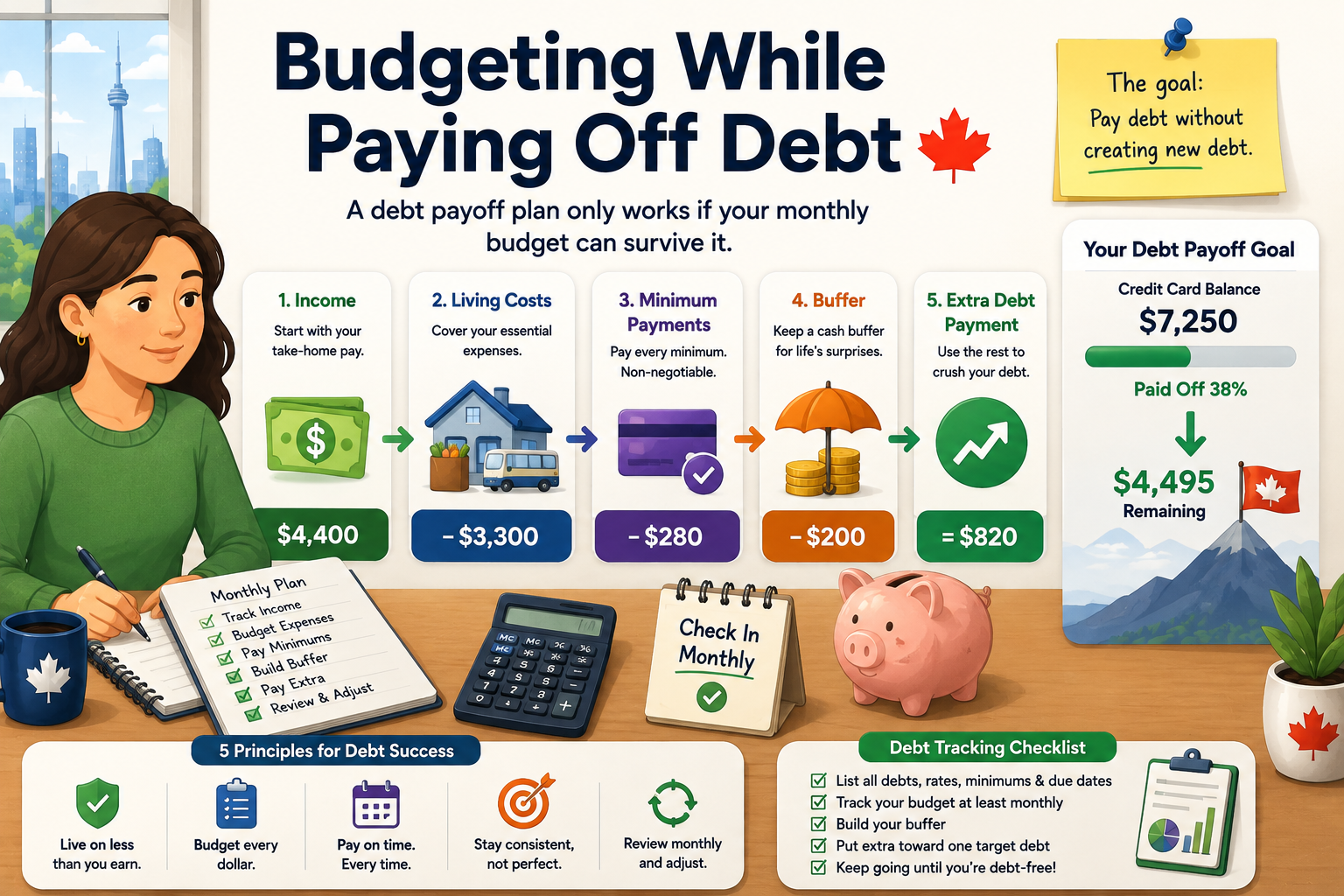
A practical order looks like this:
- Cover essential living expenses.
- Make every required minimum debt payment.
- Leave enough cash for predictable irregular expenses and an appropriate emergency buffer.
- Send the remaining surplus toward your target debt.
- Review the plan every month.
Which debt receives that extra payment is a separate question.
For that, see Debt Payoff Strategies in Canada and Debt Avalanche vs. Debt Snowball.
Start with one rule: credit isn't income
A credit card limit tells you how much the lender is willing to let you borrow.
It does not tell you how much you can afford to spend.
FCAC's guidance on using credit cards responsibly makes the distinction clear: credit-card spending still needs to fit inside your regular household budget.
Suppose your monthly income is:
$4,500
and your credit card has:
$15,000 available credit
Your spending capacity is not:
$19,500
The $15,000 is borrowing capacity.
Every grocery purchase, restaurant bill or tank of gas charged to the card still has to be paid from current or future household income.
This becomes especially important when you're aggressively paying off debt.
If you send too much cash toward the balance and then rely on the card to make it through the rest of the month, the debt-payoff plan is working against itself.
Step 1: Build the budget before choosing the extra payment
Don't begin with:
“I want to put $1,000 a month toward debt.”
Begin with:
“How much can my budget reliably produce for debt?”
Write down your monthly take-home income.
Then subtract:
- housing
- groceries
- utilities
- transportation
- insurance
- childcare
- essential medical costs
- other necessary household expenses
- minimum payments on every debt
- realistic irregular expenses
- any emergency savings you're deliberately maintaining
What remains is your available surplus.
That's the amount you can decide how to use.
If you need help building the underlying budget first, start with How to Budget in Canada.
A complete example
Here's a fictional monthly budget.
It isn't meant to represent an average Canadian household. The purpose is simply to show how the calculation works.
Monthly income
| Amount | |
|---|---|
| Take-home income | $4,400 |
Living expenses
| Expense | Amount |
|---|---|
| Rent | $1,650 |
| Groceries | $600 |
| Utilities | $180 |
| Phone + internet | $140 |
| Transportation | $300 |
| Insurance | $130 |
| Household / personal essentials | $300 |
| Total living expenses | $3,300 |
Required debt payments
| Debt | Minimum |
|---|---|
| Credit card | $120 |
| Line of credit | $80 |
| Personal loan | $80 |
| Total minimum payments | $280 |
Now calculate:
$4,400 income − $3,300 living expenses − $280 minimums = $820
That $820 is the starting point for the next decision.
You might decide to send the full amount toward debt.
Or perhaps your financial situation requires part of it for an emergency buffer or a known irregular expense.
The important thing is that the number came after the budget.
It wasn't picked because $820 sounded aggressive enough.
Step 2: Treat every minimum payment as non-negotiable
When using either the debt avalanche or debt snowball, you don't stop paying the other debts.
You continue making at least the required minimum on every debt.
Then the extra payment goes toward one target.
Suppose you have:
| Debt | Balance | Rate | Minimum |
|---|---|---|---|
| Credit card | $7,000 | 20.99% | $210 |
| Line of credit | $12,000 | 9.5% | $100 |
| Personal loan | $5,000 | 7.0% | $160 |
If the budget produces an extra:
$700
you still pay:
$210 + $100 + $160
in required payments.
Then you direct the additional $700 to the debt you're targeting.
If you're using the avalanche method, that would normally mean the highest-interest debt.
If you're using the snowball method, it would normally mean the smallest balance.
But the budget determines the $700.
The payoff method determines where it goes.
Past-due debts need attention first
Before optimizing between avalanche and snowball, check whether anything is already overdue.
FCAC recommends considering past-due accounts before selecting your normal payoff order.
That's because late accounts can cause additional problems:
- late charges
- increased interest costs
- damage to your credit history
- loss of promotional rates
- collection activity
So your first debt priority may simply be:
Get everything current.
After that, you can optimize the payoff sequence.
Step 3: Don't make the debt payment so aggressive that the budget breaks
This is where a lot of debt plans fail.
Suppose the budget appears to leave:
$1,200
You decide every dollar should go toward the credit card.
Then:
- the car needs a $450 repair
- an annual insurance bill arrives
- groceries run $150 over plan
Now you're:
$600 short
and the credit card comes back out.
Instead of steadily reducing debt, you're moving the balance down and back up.
FCAC specifically recommends choosing a repayment schedule that is reasonable and affordable. A shorter schedule reduces interest but creates higher required cash flow; an overly aggressive schedule can increase the risk of missed payments.
The fastest mathematical payoff schedule isn't necessarily the fastest schedule you'll actually complete.
Build a budget that can survive an ordinary bad month
There's an important difference between:
maximum possible debt payment
and:
sustainable debt payment
Suppose your best month leaves $1,000.
But normal variation looks like:
- Month 1: $1,000 surplus
- Month 2: $750 surplus
- Month 3: $900 surplus
- Month 4: $600 surplus
Promising yourself:
$1,000 every month
almost guarantees that some months will fail.
A more sustainable plan might establish a reliable base payment and then send additional money when it's genuinely available.
For example:
Base extra payment: $600
Then in a strong month with $1,000 available:
**$600 planned extra
- $400 additional extra = $1,000 toward the target**
That gives the plan some flexibility without abandoning aggressive repayment.
Step 4: Account for irregular expenses before calling money “extra”
Your monthly bills aren't your entire cost of living.
You may also have predictable costs such as:
- vehicle maintenance
- winter tires
- annual insurance
- gifts
- school expenses
- veterinary care
- home maintenance
- annual memberships
- professional fees
These are not necessarily emergencies.
If you know they'll happen eventually, they belong somewhere in the budget.
Suppose predictable irregular expenses total roughly:
$2,400 per year
You could budget:
$200 per month
toward them.
Without that $200, your spreadsheet may claim you can afford an extra $1,000 debt payment.
With it, the sustainable number is:
$800
The second budget may look slower.
But when the car needs maintenance, you don't have to reverse months of progress by putting the repair back on the card.
Step 5: Keep some protection against new debt
One of the hardest questions is:
Should I build emergency savings while I still have debt?
There isn't one percentage that works for everyone.
The trade-off is real.
High-interest debt is expensive.
But having no accessible savings can mean that the next unexpected expense simply becomes new high-interest debt.
FCAC recommends building emergency savings specifically because it can help people avoid expensive borrowing and becoming trapped in a debt cycle.
That doesn't mean you must fully fund three to six months of expenses before paying anything extra toward debt.
It means your debt plan should consider what happens when something unexpected occurs.
A small buffer can matter
Suppose you have:
- $8,000 credit-card debt
- $0 savings
- $900 monthly surplus
Putting the full:
$900
toward the card every month is mathematically aggressive.
But one $700 emergency may put you right back on the card.
Depending on your circumstances, you might instead temporarily divide some surplus between:
- accessible emergency savings
- extra debt repayment
Once the buffer reaches a level you're comfortable with, more of the surplus can move toward debt.
There is no universal dollar amount.
The right level depends on things such as:
- income stability
- number of household earners
- dependants
- vehicle reliability
- insurance
- housing situation
- access to other resources
For the savings side of that decision, see How to Build an Emergency Fund in Canada.
Emergency fund and irregular expenses are not the same thing
Keeping these separate helps enormously.
Irregular but predictable
Examples:
- annual insurance
- Christmas
- scheduled vehicle maintenance
- school supplies
Budget for these.
Emergency
Examples:
- unexpected job loss
- urgent veterinary bill
- sudden major repair
- unexpected health-related income interruption
Use emergency savings for these.
If every non-monthly bill is treated as an emergency, the emergency fund will constantly be depleted.
If every non-monthly bill is ignored, the credit card will constantly return.
Step 6: Understand how credit-card purchases and payments appear in the budget
This is another common source of confusion.
Suppose you buy:
$150 groceries
with your credit card.
Your budget should record:
Groceries: $150
Later, you transfer $150 from chequing to the credit card.
That payment isn't another grocery expense.
Otherwise you would record:
$150 purchase + $150 payment = $300 spending
when you actually bought $150 of groceries.
The card payment settles the liability created by the original purchase.
Interest and fees are different.
Those are additional costs.
If you are carrying a balance from earlier months, your debt payment can contain both:
- interest cost
- principal repayment
Keeping those concepts separate makes it much easier to see whether household spending is actually falling.
Step 7: Know exactly what you owe
Before deciding how aggressively to repay debt, make one list.
For every balance, record:
- creditor
- balance
- interest rate
- minimum payment
- due date
- whether the interest rate is fixed or variable
- whether early repayment has any restrictions
For example:
| Debt | Balance | Rate | Minimum | Due |
|---|---|---|---|---|
| Visa | $7,250 | 20.99% | $220 | 12th |
| LOC | $11,400 | 9.25% variable | $95 | 18th |
| Personal loan | $6,800 | 6.9% | $210 | 27th |
Use the rates shown on your own agreements and statements.
Don't base your payoff plan on a generic “average Canadian credit-card rate.”
Your actual cost is what matters.
Credit-card minimums are a floor, not a strategy
If you can't pay the full balance, making at least the required minimum protects you from some of the immediate consequences of missing a payment.
But paying only the minimum can dramatically increase the time and interest required to eliminate the debt.
FCAC's credit-card examples show that even modest increases above the minimum can significantly reduce repayment time and interest.
The specific minimum-payment formula depends on your card agreement and applicable provincial requirements.
For Quebec residents, minimum credit-card payments have been at least 5% of the balance since August 1, 2025.
Always use the minimum shown on your actual statement rather than estimating it yourself.
Lines of credit need special attention
A line of credit can feel easier to manage because the required payment may be relatively small.
But FCAC notes that the minimum payment on many lines of credit is usually equal to the monthly interest.
If you only pay the interest:
the principal doesn't go away
That can create a debt that remains open indefinitely.
Suppose:
LOC balance: $15,000
and the required payment mostly covers interest.
Making the minimum may keep the account current.
It does not necessarily create meaningful progress.
Include the minimum in your budget, then decide whether the LOC should receive additional principal payments based on your debt strategy.
What about lower-interest loans?
Not every debt needs the same urgency.
A fixed personal loan or auto loan may already have a repayment schedule that steadily reduces principal.
A credit card at a much higher rate may be costing substantially more for each dollar owed.
That's why looking at:
- balance
- interest rate
- minimum
- repayment structure
together matters.
Again, this article answers:
How much extra can I pay?
The next article answers:
Which balance should receive it?
See Debt Payoff Strategies in Canada.
What if the budget is already negative?
Sometimes there isn't an extra payment to optimize.
Suppose:
Take-home income: $4,000 Living expenses + minimums: $4,250
You're already:
$250 short
before any extra debt repayment.
At that point, the priority isn't choosing avalanche versus snowball.
It's closing the cash-flow gap.
Look at:
- discretionary spending
- subscriptions
- housing costs
- transportation
- insurance
- telecom
- income opportunities
- debt minimums
- interest rates
Some changes are easier than others.
And some budgets simply cannot be fixed through another $20 of subscription cuts.
If minimum payments themselves have become unaffordable, act before payments are missed.
Contact creditors before the situation gets worse
FCAC recommends contacting creditors if you're having difficulty making payments.
Depending on the creditor and your circumstances, options may include:
- a lower interest rate
- a longer repayment period and lower required payment
- consolidation into another lending product
Each option has trade-offs.
A longer repayment period can reduce monthly pressure but increase total interest.
Debt consolidation can reduce rates and simplify payments, but only if the new borrowing is actually cheaper and doesn't become room to accumulate more debt.
Don't wait until several payments have already been missed before asking what options exist.
Debt consolidation isn't automatically debt reduction
Suppose you have:
- three credit-card balances
- three payment dates
- three interest rates
A consolidation loan could replace those with:
- one balance
- one payment
- one interest rate
That's administratively easier.
It may also reduce interest if the new rate is lower.
But imagine you consolidate the cards and then begin using the newly available card limits again.
Now you have:
consolidation loan + new card balances
instead of solving the original problem.
Consolidation works best when paired with a budget that prevents the debt from simply rebuilding.
When credit counselling may be worth considering
If you're struggling to make payments or the budget can't realistically support the debt, you don't have to solve everything alone.
FCAC says speaking with a credit counsellor by itself does not affect your credit score.
A credit counsellor may help with:
- reviewing your budget
- understanding the debt
- considering repayment options
- establishing a debt management plan where appropriate
A debt management plan is generally an informal arrangement proposed to creditors.
It may:
- combine qualifying debts into one monthly payment
- reduce or sometimes eliminate interest
- require repayment of the full principal
Not every creditor has to accept the proposal, and fees can apply.
Before signing anything, understand:
- what debts are included
- what fees you'll pay
- what happens to interest
- how long repayment takes
- what happens if a creditor refuses
- whether the plan actually saves money
FCAC recommends researching the agency and its reputation rather than assuming every company advertising “debt relief” offers the same service.
More serious insolvency options such as consumer proposals and bankruptcy are different legal processes administered through Licensed Insolvency Trustees.
What happens when a debt disappears from the budget?
This is one of the most powerful moments in the process.
Suppose you've been paying:
$650/month
toward a credit card.
You finally pay it off.
That does not mean you suddenly have:
$650/month to spend
unless that's what you deliberately choose.
You've freed $650 of cash flow.
Now assign it.
If other debt remains:
Roll some or all of the payment into the next debt.
If the debts are finished:
Redirect it toward emergency savings, investing or another goal.
FCAC specifically suggests using the money from a completed loan payment to strengthen emergency savings.
You've already proven the household can live without that money.
That's what makes redirecting it so effective.
A practical debt-budgeting system
You can reduce the entire article to this monthly process.
1. Start with take-home income
Use what actually reaches the household.
2. Cover essential living expenses
Use realistic numbers, not aspirational ones.
3. Budget irregular expenses
Don't let predictable costs become new debt.
4. Pay every required minimum
Get overdue accounts current where possible.
5. Maintain an appropriate cash buffer
Enough to prevent ordinary surprises from immediately requiring more borrowing.
6. Calculate the real surplus
Income − living expenses − irregular expenses − minimums − planned buffer = extra available
7. Send the extra to one target debt
Use your chosen repayment strategy.
8. Review actual spending
If the plan repeatedly produces new card charges, the extra payment is probably too aggressive or the underlying budget is wrong.
9. Increase payments when cash flow improves
Raises, bonuses, reduced expenses and paid-off debts can all accelerate the plan.
That's a debt budget you can actually live with.
How Finnomia approaches debt planning
Finnomia is the Canadian personal-finance platform behind this blog.
Budgeting and debt planning are intentionally connected because a payoff strategy only works when the underlying cash flow supports it.
Finnomia can bring together:
- connected and manual accounts
- transactions
- spending categories
- monthly budgets
- recurring bills
- financial goals
- debts
Advanced users can then use the Debt Freedom Planner to model repayment strategies.
Debt Freedom Planner
You can compare approaches including:
- debt avalanche
- debt snowball
- hybrid repayment ordering
and model:
- extra monthly payments
- dated lump-sum payments
- payoff timelines
- payment allocation
- milestones
- saved scenarios
The goal is to answer two different questions from the same financial picture:
What can my budget afford?
and
What happens if I put that amount toward my debts?
That distinction matters.
A calculator that says you could be debt-free in 22 months isn't useful if the payment required to make it happen breaks your monthly budget.
Connected debt and cash flow
Finnomia also lets you see debt alongside:
- spending
- budgets
- account balances
- net worth
- goals
rather than treating debt payoff as an isolated calculator.
Financial connections are read-only.
Finnomia currently uses Plaid and is adding Flinks as a second provider to improve Canadian institution coverage and reliability.
Finnomia cannot move your money and doesn't store your banking password.
The budgeting and Debt Freedom Planner functionality described here is already live.
Sustainable beats aggressive
The goal isn't to produce the biggest possible debt payment this month.
It's to produce a payment you can keep making.
A good debt budget should let you:
- cover the household
- make every minimum
- handle predictable expenses
- absorb reasonable surprises
- avoid creating new debt
- consistently send extra money toward the target
Then repeat.
Month after month.
If the budget can reliably produce $700 toward debt, that $700 is valuable.
Sending $1,200 once and then borrowing $500 back isn't automatically better.
The winning debt plan isn't the most aggressive one you can write down.
It's the one that makes the balances keep moving in the right direction.
Next, decide where that extra payment should go with Debt Payoff Strategies in Canada.
Frequently asked questions
How much of my income should go toward debt?
There is no single percentage that works for every household.
Start with take-home income, realistic living expenses, every required minimum, predictable irregular expenses and an appropriate cash buffer.
What remains determines how much extra your current budget can sustainably put toward debt.
Should I save money while paying off debt?
It can make sense to maintain accessible emergency savings while paying down debt because having no buffer can force you to borrow again when an unexpected expense occurs.
How aggressively you divide extra cash between debt and savings depends on interest rates, income stability, household circumstances and available savings.
Should I pay debt or build a full emergency fund first?
You don't necessarily have to fully fund three to six months of expenses before making extra debt payments.
A practical approach can involve building an initial buffer while paying debt, then adjusting the balance between savings and repayment as your financial position improves.
Should I pay more than the minimum?
If your budget allows it, paying above the minimum can reduce repayment time and interest.
Keep paying the required minimum on every debt while directing the extra amount according to your payoff strategy.
Which debt should I pay first?
Two common approaches are:
- highest interest rate first — debt avalanche
- lowest balance first — debt snowball
Past-due accounts may need attention before either strategy.
See Debt Payoff Strategies in Canada for the full comparison.
Should credit-card payments count as expenses in my budget?
The underlying purchases should generally be categorized as expenses when they occur.
Paying the card later shouldn't count those purchases a second time.
Interest and fees are separate expenses.
Should I stop using my credit card while paying it off?
If continued card use is causing the balance to rise or making it difficult to tell whether you're actually making progress, temporarily reducing or stopping new card spending may help.
FCAC specifically identifies a growing balance and consistently carrying balances as warning signs of overspending.
Is debt consolidation a good idea?
It can be helpful if it genuinely lowers interest costs or makes payments more manageable.
But consolidation doesn't fix overspending by itself, and extending repayment can increase total interest even when the monthly payment falls.
When should I talk to a credit counsellor?
Consider getting help if you're struggling to make minimum payments, regularly missing bills, using new borrowing to make existing payments or finding that the budget cannot realistically cover your debts.
Speaking to a credit counsellor itself does not affect your credit score.
This article was reviewed in August 2026 and provides general information, not personalized financial, credit, legal or insolvency advice. Interest rates, minimum-payment rules and creditor options vary by account and province. Confirm your balances, rates, minimum payments and due dates on your own statements and agreements.