
On this page
- The short answer: which debt should you pay first?
- First, know what you're actually dealing with
- Strategy 1: Debt avalanche
- Why the avalanche saves interest
- Strategy 2: Debt snowball
- Why the snowball can work
- Avalanche vs. snowball: a worked example
- Which strategy should you choose?
- Strategy 3: A hybrid approach
- Past-due accounts can override both strategies
- High-cost short-term debt deserves urgent attention
- Cash advances are different from normal credit-card purchases
- Promotional rates can change the normal order
- Variable-rate debt can move in the ranking
- Why lines of credit can linger forever
- Credit cards have the opposite problem: expensive revolving debt
- Personal loans are often more predictable
- What should you do with a lump sum?
- Roll finished payments into the next debt
- Don't forget the emergency buffer
- Should you consolidate debt?
- Balance transfers can help—but only with a deadline
- When the mathematically best strategy isn't enough
- When you need more than a payoff strategy
- Talk to creditors early
- Credit counselling is different from debt settlement
- Consumer proposals and bankruptcy are different again
- A practical debt-payoff decision tree
- How Finnomia's Debt Freedom Planner approaches the problem
- The best payoff strategy is one you'll complete
- Frequently asked questions
You've found an extra $500 in the monthly budget.
Now comes the next decision:
Which debt gets it?
Maybe you have:
- a credit card at a high interest rate
- a line of credit with a larger balance
- a smaller personal loan
- a promotional balance transfer
- several debts at once
There are two well-known approaches.
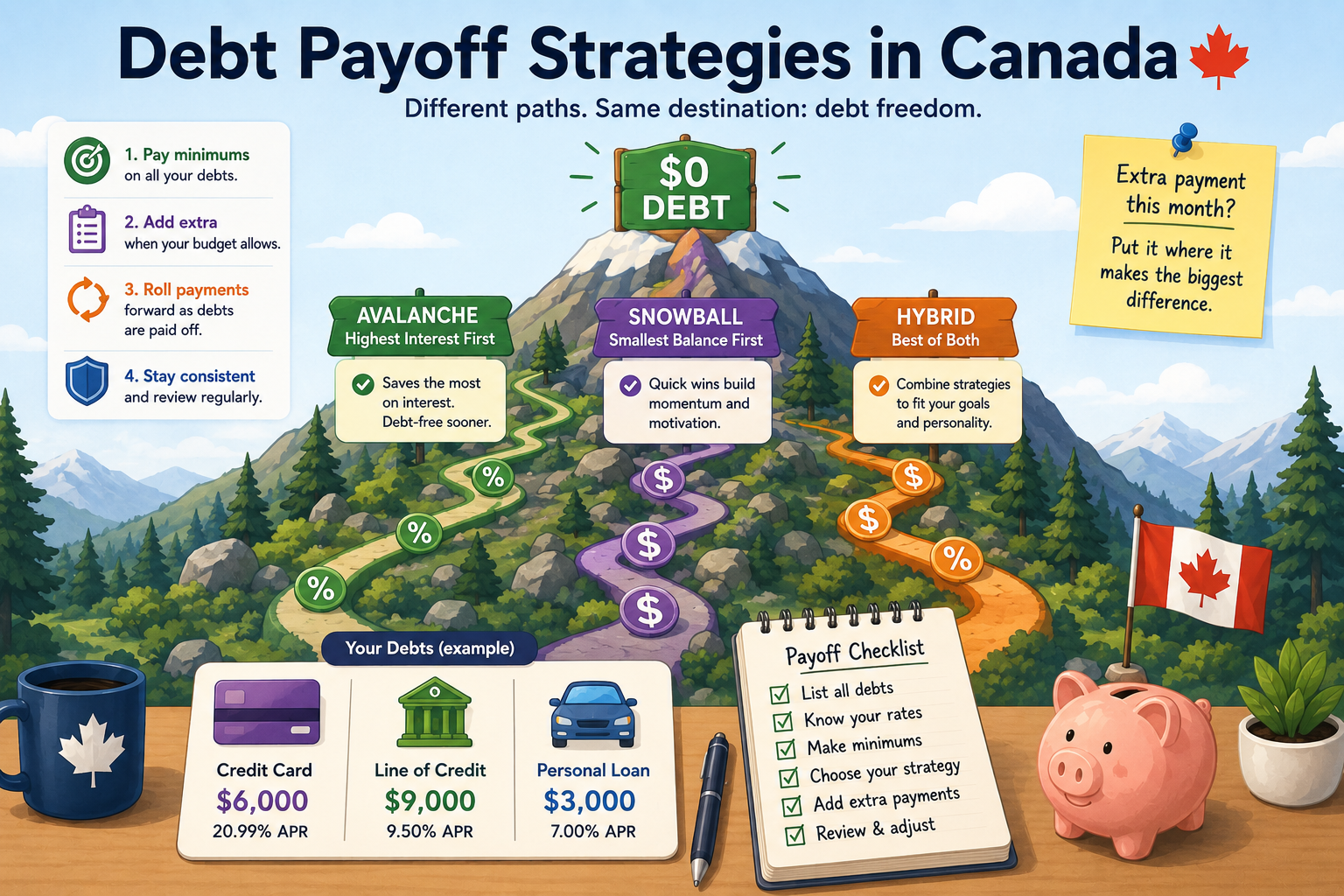
Debt avalanche: target the highest interest rate first.
Debt snowball: target the smallest balance first.
The avalanche generally wins mathematically because expensive debt disappears sooner.
The snowball can win behaviourally because eliminating an account quickly creates visible progress.
But real debt payoff is slightly more complicated than choosing one of those two words.
Before either strategy:
- Get past-due accounts under control.
- Make the required minimum payment on every debt.
- Make sure the monthly budget can actually sustain the extra payment.
- Then decide which balance receives the extra.
The goal isn't to find the strategy with the best name.
It's to make your debts keep moving toward zero.
The short answer: which debt should you pay first?
A useful starting order is:
1. Deal with past-due accounts
If an account is already overdue, address it before optimizing your avalanche or snowball.
Late payments can lead to:
- extra charges
- higher interest costs
- lost promotional rates
- damage to your credit history
- collection activity
Getting everything current gives you a stable starting point.
2. Make every minimum payment
Don't stop paying one debt to attack another.
Continue making at least the required minimum on every account.
3. Look for unusually expensive or time-sensitive debt
Before mechanically sorting everything by today's rate, look for:
- payday or other high-cost credit
- credit-card cash advances
- promotional rates that are about to expire
- variable-rate debt that has become significantly more expensive
Those details may affect your practical order.
4. Choose highest interest or lowest balance
Once the basics are covered:
Highest interest first usually minimizes interest.
Lowest balance first usually produces the fastest account-level wins.
5. Roll finished payments forward
When one debt reaches zero, don't let its monthly payment disappear into spending.
Add that payment to the next debt.
That's what creates the acceleration.
First, know what you're actually dealing with
Make one debt list.
For every account, record:
| Debt | Balance | Interest rate | Minimum | Due date | Notes |
|---|---|---|---|---|---|
| Credit card | $6,000 | 20.99% | $180 | 12th | Revolving |
| Line of credit | $9,000 | 9.5% variable | $80 | 18th | Minimum may mostly cover interest |
| Personal loan | $3,000 | 7.0% | $100 | 27th | Fixed instalment |
Use your own statements and agreements.
Don't fill missing rates with a supposed “typical Canadian” number.
What matters is your rate.
Then determine how much extra your budget can sustainably provide.
Suppose that's:
$500 per month
That $500 is the amount whose destination we're choosing.
If you haven't calculated it yet, start with How to Budget While Paying Off Debt in Canada.
Strategy 1: Debt avalanche
The debt avalanche targets the highest interest rate first.
Using our example:
| Debt | Balance | Rate |
|---|---|---|
| Credit card | $6,000 | 20.99% |
| Line of credit | $9,000 | 9.5% |
| Personal loan | $3,000 | 7.0% |
The avalanche order is:
- Credit card
- Line of credit
- Personal loan
You continue making minimums on all three.
Then the entire extra $500 goes toward the credit card.
So initially:
Credit card: $180 minimum + $500 extra = $680
Line of credit: $80 minimum
Personal loan: $100 minimum
When the credit card reaches zero, the money that had been going there moves to the next target.
The repayment starts to accelerate.
Why the avalanche saves interest
Interest is the price you're paying to keep each balance.
A dollar left sitting at 20.99% generally costs more than a dollar left sitting at 7%.
So if you can eliminate one of those dollars today, the higher-rate dollar is normally the more expensive one to leave behind.
FCAC describes the same approach as paying debts with the highest interest rate first and says it results in paying less interest and becoming debt-free sooner.
That's the mathematical case for avalanche.
Strategy 2: Debt snowball
The snowball ignores interest rates when selecting the first target.
Instead, it attacks the smallest balance.
Our debts are:
| Debt | Balance |
|---|---|
| Personal loan | $3,000 |
| Credit card | $6,000 |
| Line of credit | $9,000 |
The snowball order is:
- Personal loan
- Credit card
- Line of credit
Again, every debt receives its minimum.
But the extra $500 initially goes toward the $3,000 personal loan.
Why deliberately attack a 7% loan before a 20.99% credit card?
Because the first balance disappears much faster.
That creates an early win.
Why the snowball can work
Debt payoff isn't performed by a spreadsheet.
It's performed by a person who has to continue following the plan.
Eliminating an account can mean:
- one less minimum payment
- one less due date
- one less statement
- visible evidence that the strategy is working
FCAC acknowledges this trade-off in its lowest-balance-first approach: visible progress can help you remain committed, although the strategy may cost more over time.
That's the behavioural case for snowball.
Avalanche vs. snowball: a worked example
Let's keep the same fictional debts:
| Debt | Starting balance | APR | Minimum |
|---|---|---|---|
| Credit card | $6,000 | 20.99% | $180 |
| Line of credit | $9,000 | 9.5% | $80 |
| Personal loan | $3,000 | 7.0% | $100 |
Extra available each month:
$500
Assume for illustration:
- no new borrowing
- rates remain unchanged
- interest is approximated monthly
- minimum payments remain fixed for the example
- payments from eliminated debts roll forward
Avalanche
Approximate payoff milestones:
- Credit card: month 10
- Line of credit: month 23
- Personal loan: month 24
Approximate total interest:
$2,016
Snowball
Approximate payoff milestones:
- Personal loan: month 6
- Credit card: month 13
- Line of credit: month 24
Approximate total interest:
$2,342
In this illustration, both approaches finish at roughly the same time because the same overall amount is being paid.
But avalanche saves approximately:
$326 in interest
Snowball provides its first complete payoff about:
four months earlier
That's the trade-off in one example.
The numbers will change substantially with your own:
- balances
- rates
- minimums
- payment amount
- daily interest calculations
The point isn't the $326.
It's that:
Avalanche optimizes interest. Snowball optimizes early visible wins.
Which strategy should you choose?
Choose avalanche if:
- reducing interest is your main priority
- you like mathematical optimization
- high-rate debt is costing you heavily
- seeing accounts remain open doesn't bother you
- you're confident you'll stick with the plan
Choose snowball if:
- motivation has been the main challenge
- several small balances are creating stress
- eliminating accounts quickly would simplify your finances
- previous mathematically optimal plans haven't lasted
Neither strategy works if you abandon it.
A slightly more expensive strategy you complete can be much better than a mathematically perfect strategy you stop after three months.
Strategy 3: A hybrid approach
You don't actually have to remain ideologically loyal to avalanche or snowball.
A hybrid strategy can use both ideas.
Suppose you have:
- $700 store card at 12%
- $8,000 credit card at 22%
- $15,000 line of credit at 10%
Pure avalanche says:
22% card first
Pure snowball says:
$700 store card first
A hybrid approach might decide:
Eliminate the $700 balance quickly, then switch immediately to highest-interest-first.
You get:
- an early account closure
- simpler monthly administration
- then a mathematically efficient payoff order
That can be completely reasonable.
The important thing is that you know why you're deviating from the pure strategy.
Past-due accounts can override both strategies
Suppose the lowest-balance debt is current.
The highest-interest debt is current.
But a third account is already past due.
The normal payoff order may need to wait.
FCAC recommends considering past-due accounts before choosing between highest-interest and lowest-balance strategies.
An overdue account can create consequences beyond its headline interest rate.
Get the plan stable first.
Then optimize it.
High-cost short-term debt deserves urgent attention
Payday loans and similar high-cost credit don't fit neatly beside an ordinary personal loan.
FCAC describes payday lending as extremely expensive compared with other borrowing.
In provinces with regulated payday-loan fees, the maximum borrowing cost is generally $14 per $100 borrowed.
Because repayment periods are very short, the effective cost can be enormous.
If high-cost short-term borrowing is already in the debt stack, the priority may be less:
“Should I snowball or avalanche?”
and more:
“How do I stop this debt from rolling into another expensive borrowing cycle?”
Avoid taking another payday loan simply to repay the first.
If the budget can't absorb repayment, contact the lender or consider reputable debt counselling.
Cash advances are different from normal credit-card purchases
Credit-card cash advances deserve special attention because they generally:
- have no interest-free grace period
- begin charging interest immediately
- may carry a higher rate than purchases
- may include a transaction fee
So two dollars sitting on the same credit card may even be subject to different rates.
That matters because your issuer determines how payments are allocated among different rate portions of the card balance.
Federally regulated issuers can apply payments above the minimum either:
- toward the highest-rate portion
- proportionally across balances
Check your cardholder agreement.
Don't assume an extra payment is automatically eliminating the exact portion of the balance you intended.
Promotional rates can change the normal order
Suppose you have:
Card A: $5,000 at 19.99%
Card B: $8,000 at 0% promotional interest for four more months, then 22.99%
A simple avalanche sorted by today's rates says:
Card A first
That may still be appropriate.
But the promotional deadline is now part of the decision.
Ask:
- When does the promotional rate expire?
- What does the rate become?
- Can the promotional balance realistically be eliminated before then?
- What happens if you miss a payment?
- Are there transfer fees?
- Does the promotional rate apply to new purchases?
A temporary 0% rate isn't permanent cheap debt.
FCAC notes that promotional balance-transfer rates typically last for a limited period and may be lost if you miss a payment.
Put the expiry date in your debt plan.
Variable-rate debt can move in the ranking
Lines of credit commonly have variable interest rates.
Suppose:
Credit card: 14.99%
LOC: 10%
Avalanche targets the card.
But if the LOC rate later rises significantly, the ranking may change.
That's why a debt strategy shouldn't be created once and forgotten.
Review rates periodically.
Particularly watch:
- lines of credit
- variable personal loans
- promotional credit products
If the cost changes, the payoff order can change too.
Why lines of credit can linger forever
Lines of credit create a different psychological problem.
FCAC says the minimum payment on a personal line of credit is usually equal to the monthly interest.
If you only pay the interest:
the principal never disappears
Suppose the line of credit remains at:
$15,000
You make every required payment.
You never miss a due date.
But after years of paying, you may still owe roughly the same principal if the payments only covered interest and you kept re-borrowing.
That's why a line of credit needs an explicit principal-reduction plan.
Minimum payment isn't the same thing as payoff strategy.
Credit cards have the opposite problem: expensive revolving debt
Credit cards typically charge substantially more interest than lines of credit.
They also restore available credit as you repay the balance.
That means you can make progress and then quietly reverse it:
Balance: $6,000 → $4,500 → $5,300
because new purchases were added.
If you're carrying expensive revolving debt, track two numbers:
- repayment
- new borrowing
A $1,000 payment combined with $700 of new spending is only:
$300 of net balance reduction
before interest.
That's one reason the monthly budget has to support the debt plan.
Personal loans are often more predictable
Personal loans generally have:
- a fixed borrowed amount
- a defined term
- regular instalment payments
That means principal is usually already being amortized.
So if you have:
- a 21% revolving card
- a 9% LOC with interest-heavy minimums
- a 6% personal loan already amortizing on schedule
the personal loan may reasonably sit later in an avalanche plan.
But check the agreement before making large extra payments.
Some loans may have:
- prepayment rules
- fees
- other restrictions
Don't assume every loan behaves identically.
What should you do with a lump sum?
Suppose you receive:
- a bonus
- tax refund
- gift
- sale proceeds
- another one-time amount
and decide that some of it is available for debt.
You have the same fundamental choice.
Avalanche approach
Apply the lump sum to the highest-rate target.
Snowball approach
Use it to eliminate one or more small balances.
Strategic approach
Ask whether the lump sum could:
- eliminate an entire monthly payment
- remove a particularly expensive debt
- get a promotional balance paid before expiry
- reduce a variable-rate debt that has become risky
A $5,000 lump sum can have more value than simply reducing the headline balance.
It can change the structure of your monthly cash flow.
Roll finished payments into the next debt
This is where debt payoff begins to feel faster.
Suppose you currently pay:
$300/month
to Debt A.
Debt A reaches zero.
Your budget just freed:
$300/month
Don't automatically absorb it into lifestyle spending.
Add it to Debt B.
If Debt B previously received:
$500/month
it can now receive:
$800/month
When Debt B disappears, roll that entire amount forward again.
That's the “snowball” effect that happens under either repayment strategy.
Even avalanche payments grow as debts disappear.
Don't forget the emergency buffer
An aggressive debt plan can fail if every unexpected expense creates new borrowing.
FCAC recommends emergency savings as protection against having to rely on expensive credit when something unexpected happens.
That doesn't mean you need a fully funded multi-month emergency reserve before paying high-interest debt.
It means the payoff strategy should account for the possibility that:
- the car breaks
- income is interrupted
- an urgent expense appears
If one routine surprise destroys the payment plan, the plan may be too fragile.
For the broader trade-off, see HISA vs. TFSA for an Emergency Fund.
Should you consolidate debt?
Debt consolidation means replacing several debts with one new debt.
Potential benefits:
- fewer payments
- simpler administration
- potentially lower interest
But consolidation is only an improvement if the new structure is actually better.
FCAC warns that a longer repayment period can produce more total interest, even when the monthly payment falls.
And if the new loan pays off several credit cards but you start using those cards again, you can end up with:
consolidation loan + new credit-card debt
That's worse.
Before consolidating, compare:
- new interest rate
- fees
- term
- monthly payment
- total repayment cost
- whether old credit remains available
- whether your spending problem has actually been addressed
A lower payment isn't automatically a cheaper debt.
Balance transfers can help—but only with a deadline
A balance-transfer card may offer a low or even 0% promotional interest rate.
That can create a useful window for aggressive repayment.
But calculate the entire deal:
**Balance transferred
- transfer fee
- minimum payments
- promotional period
- post-promotion rate**
Then ask:
Can I realistically eliminate the balance before the promotion ends?
If not, calculate what remains when the higher rate begins.
Also check what happens if you miss a payment.
Some promotions can disappear.
A promotional rate is a tool.
It isn't a debt-payoff strategy by itself.
When the mathematically best strategy isn't enough
Suppose avalanche is clearly cheaper.
You've tried it three times.
Each time, you lose motivation because the highest-rate balance is enormous and nothing disappears for a year.
Meanwhile you have two $500 debts you could eliminate quickly.
At that point, insisting on pure avalanche because a spreadsheet says it's optimal may be counterproductive.
A hybrid could be:
- eliminate the two tiny balances
- switch to avalanche
- never look back
The additional interest may be a reasonable price for turning a plan you repeatedly abandon into one you actually follow.
Debt payoff is optimization under human behaviour, not in a vacuum.
When you need more than a payoff strategy
Avalanche versus snowball assumes something important:
Your budget can cover all required payments and produce at least some extra money.
If that's no longer true, the problem has changed.
Signs include:
- minimum payments are becoming unaffordable
- accounts are repeatedly overdue
- you're borrowing to make debt payments
- you're using one credit product to pay another
- collection activity has started
- the balances continue growing despite regular payments
At that point, changing the payoff order may not be enough.
Talk to creditors early
FCAC recommends contacting creditors when you're having difficulty repaying debt.
Depending on the circumstances, a creditor may offer:
- a lower interest rate
- longer repayment
- a lower required payment
- consolidation
Every option has trade-offs.
Extending the term can improve monthly cash flow while increasing total interest.
But asking what options exist before payments are missed is generally more useful than waiting until the situation deteriorates.
Credit counselling is different from debt settlement
A reputable credit counsellor can help you:
- review your budget
- understand repayment options
- potentially establish a debt management plan
FCAC describes a debt management plan as an informal proposal to creditors that can combine qualifying debts into one monthly payment.
Depending on creditor agreements, interest may sometimes be reduced or eliminated, but you will usually repay the full debt principal.
Creditors are not required to accept the plan.
Fees may also apply.
Be cautious with companies promising to make debt disappear quickly.
FCAC continues to warn about debt-settlement companies charging high fees, encouraging payment delays or adding new high-cost loans without actually solving the original debt.
Consumer proposals and bankruptcy are different again
If your debt problem is more serious, a Licensed Insolvency Trustee can explain formal options under Canada's insolvency system.
A consumer proposal and bankruptcy are legal processes.
They are not advanced versions of avalanche or snowball.
If you've reached that stage, individualized professional guidance is more appropriate than trying to optimize debt order from a blog article.
A practical debt-payoff decision tree
Here's the whole strategy.
Is anything past due?
Yes: get past-due accounts under control first.
No: continue.
Can you make every minimum?
No: contact creditors and consider professional debt help.
Yes: continue.
Do you have high-cost short-term debt?
Yes: prioritize stopping that cycle.
No: continue.
Is a promotional rate expiring soon?
Yes: calculate the consequences of the expiry.
No: continue.
Is minimizing interest your priority?
Yes: use highest-interest-first / avalanche.
Is staying motivated the bigger problem?
Yes: consider lowest-balance-first / snowball.
Do you want both?
Use a hybrid intentionally.
Then:
roll every finished payment into the next balance.
How Finnomia's Debt Freedom Planner approaches the problem
Finnomia is the Canadian personal-finance platform behind this blog.
The Debt Freedom Planner is designed to model the exact trade-offs described above using your debt balances rather than generic examples.
Advanced users can build and compare:
- avalanche strategies
- snowball strategies
- hybrid payoff orders
and include:
- required minimum payments
- additional monthly payments
- one-time lump-sum payments
- manually added debts
- payoff timelines
- payment allocation
- payoff milestones
- saved scenarios
You can also save a debt-payoff plan as an advanced financial goal.
Why scenario comparison matters
Suppose you can afford:
$750 extra per month
You could model:
Scenario A — Avalanche
highest-rate debt first
Scenario B — Snowball
smallest balance first
Scenario C — Hybrid
eliminate one small balance, then switch to avalanche
Then compare:
- debt-free date
- interest paid
- when each account reaches zero
- how payment amounts roll forward
That turns the decision from:
“Which strategy sounds better?”
into:
“What does each strategy do to my actual debts?”
Lump sums
You can also model one-time payments.
For example:
$3,000 bonus in December
can be added to a scenario without pretending you'll have an extra $250 every month.
That's useful because recurring extra payments and one-time cash aren't the same thing.
Budget first, strategy second
Finnomia also connects the payoff plan with the broader financial picture:
- transactions
- budgets
- recurring bills
- goals
- debts
- net worth
The important sequence remains:
Budget determines what you can pay.
Debt strategy determines where it goes.
Financial connections are read-only.
Finnomia currently uses Plaid and is adding Flinks as a second connectivity provider to improve Canadian institution coverage and reliability.
Finnomia cannot move your money and doesn't store your banking password.
The Debt Freedom Planner functionality described above is already live.
You can also use Finnomia's free debt-payoff calculator to compare scenarios.
The best payoff strategy is one you'll complete
If all you care about is minimizing interest, the answer is usually straightforward:
Pay the highest-interest debt first.
If motivation is the reason previous plans have failed, the smallest balance may deserve more weight.
If reality doesn't fit either perfectly, use a hybrid.
But whatever you choose:
- get overdue accounts current
- make every minimum
- stop adding unnecessary new debt
- use a payment your budget can sustain
- review changing rates
- watch promotional deadlines
- roll finished payments forward
The strategy doesn't need to be clever.
It needs to keep working.
Because the most important debt milestone isn't:
“I selected avalanche.”
It's:
$0 remaining.
Next, see how your payment amount and strategy translate into an actual date in How Long Until I'm Debt-Free?.
Frequently asked questions
What is the best debt payoff strategy in Canada?
If your goal is minimizing interest, paying the highest-interest debt first is generally the most efficient strategy.
If early account-level wins help you remain motivated, paying the smallest balance first may be more sustainable.
What is the debt avalanche method?
The debt avalanche means making minimum payments on all debts while directing extra money toward the debt with the highest interest rate.
When that debt is eliminated, roll its payment into the next-highest-rate debt.
What is the debt snowball method?
The debt snowball means making all required minimum payments while directing extra money toward the smallest balance.
Once that account reaches zero, roll the payment into the next-smallest debt.
Does the Government of Canada recommend avalanche or snowball?
FCAC describes two corresponding strategies: paying the highest-interest debt first or the lowest-balance debt first.
It says highest-interest-first reduces interest and helps you become debt-free sooner, while lowest-balance-first can provide faster visible progress but may cost more over time.
Should I pay past-due debt before using avalanche or snowball?
FCAC recommends considering past-due accounts before selecting the normal payoff order.
Getting overdue accounts current may help prevent additional charges, credit damage and collection activity.
Should I pay a credit card or line of credit first?
Compare the actual interest rates and terms.
Credit cards often have higher rates, while line-of-credit rates are commonly variable and minimum payments may largely or entirely cover interest.
Under a pure avalanche strategy, the higher current rate receives the extra payment.
Should I pay the smallest debt even if it has a lower interest rate?
You can.
That's the debt-snowball approach.
It may cost more interest than highest-interest-first, but eliminating a small debt quickly can simplify your finances and help some people remain motivated.
What happens when I pay off one debt?
Keep making the same overall debt payment if your budget allows.
Redirect the payment from the finished debt toward the next balance.
That's what accelerates the payoff process.
Should I use a lump sum to pay debt?
If the money is genuinely available for debt repayment, a lump sum can reduce principal immediately.
Where it should go depends on your strategy, interest rates, promotional deadlines, cash-flow needs and other priorities.
Is debt consolidation a payoff strategy?
Not by itself.
Consolidation restructures several debts into another debt.
It may reduce interest or simplify payments, but the debt still has to be repaid and a longer term may increase total interest.
When should I get professional debt help?
Consider contacting creditors or a reputable credit counsellor when minimum payments are becoming unaffordable, accounts are repeatedly overdue or you're borrowing new money simply to service existing debt.
This article was reviewed in August 2026 and provides general information, not personalized financial, credit, legal or insolvency advice. Interest rates, minimum-payment requirements, promotional terms and creditor options vary. Confirm the current terms of your own debts before choosing a repayment strategy.