
On this page
- The short answer: what determines your debt-free date?
- Start with your real balances—not a national average
- Your monthly payment matters enormously
- What another $100, $250 or $500 per month can do
- Sustainable matters more than maximum
- Why an extra payment changes more than this month's balance
- Interest rate can matter as much as balance
- Payoff order matters when you have multiple debts
- Rolling payments forward is what creates acceleration
- A line of credit can create a misleading payoff date
- Credit-card minimum-only timelines can be deceptive too
- New purchases move the debt-free date backwards
- A new purchase is especially expensive on a carried credit-card balance
- Variable interest rates make the date move
- Promotional rates create another moving deadline
- Lump sums can move the finish line dramatically
- When should you apply a lump sum?
- A bonus today can be worth more than the same bonus later
- What happens when your monthly payment increases?
- The same applies when your payment temporarily falls
- Minimum payments may change too
- Debt-free isn't necessarily the same as mortgage-free
- A debt-free date should include milestones
- Recalculate at least when something material changes
- What if your projected date feels impossibly far away?
- What if you can't make the minimum payments?
- How to calculate your own debt-free date
- Using Finnomia's debt-payoff calculator
- Finnomia's Debt Freedom Planner goes further
- Debt planning works better when connected to the budget
- Your debt-free date is a target, not destiny
- Frequently asked questions
You owe $18,000.
When will it be gone?
Unfortunately, the balance alone can't answer that question.
Two people can both owe $18,000 and have completely different debt-free dates because one is paying $400 a month at 8% while the other is paying $850 a month across debts charging 7%, 10% and 21%.
Your payoff date depends on:
- how much you owe
- each debt's interest rate
- required minimum payments
- how much extra you pay
- which debt receives the extra
- whether rates change
- whether you make lump-sum payments
- whether you keep borrowing
That means your debt-free date isn't really a fixed date.
It's a scenario.
Change the payment and the date changes.
Change the interest rate and it changes again.
Add another purchase to the card and it moves further away.
The most useful question is therefore:
If I keep paying this amount under these assumptions, when should the balance reach $0?
You can run your own balances through Finnomia's free debt-payoff calculator.
But understanding what moves the date is just as important as seeing the result.
The short answer: what determines your debt-free date?
For a single debt, the main variables are:
Balance + interest rate + payment amount + new borrowing
For several debts, add:
payoff order + how payments roll forward
A useful debt-payoff projection therefore needs at least:
| Input | Why it matters |
|---|---|
| Current balance | How much principal remains |
| Interest rate | How quickly interest is being added |
| Minimum payment | What must be paid regardless of strategy |
| Extra payment | What accelerates principal repayment |
| Payoff order | Which debt gets the extra first |
| Rate type | Variable rates can change |
| New charges | New borrowing moves the finish line |
| Lump sums | One-time payments can move the date forward |
If one of those changes, recalculate.
Start with your real balances—not a national average
There is no useful national answer to:
“How long does it take a Canadian to become debt-free?”
A household carrying:
$3,000 at 7%
is solving a very different problem from someone carrying:
$25,000 across cards and lines of credit at 8% to 22%
Start with your own statements.
For every debt, write down:
- current balance
- annual interest rate
- required minimum
- due date
- whether the rate is fixed or variable
- whether any promotional rate has an expiry date
For example:
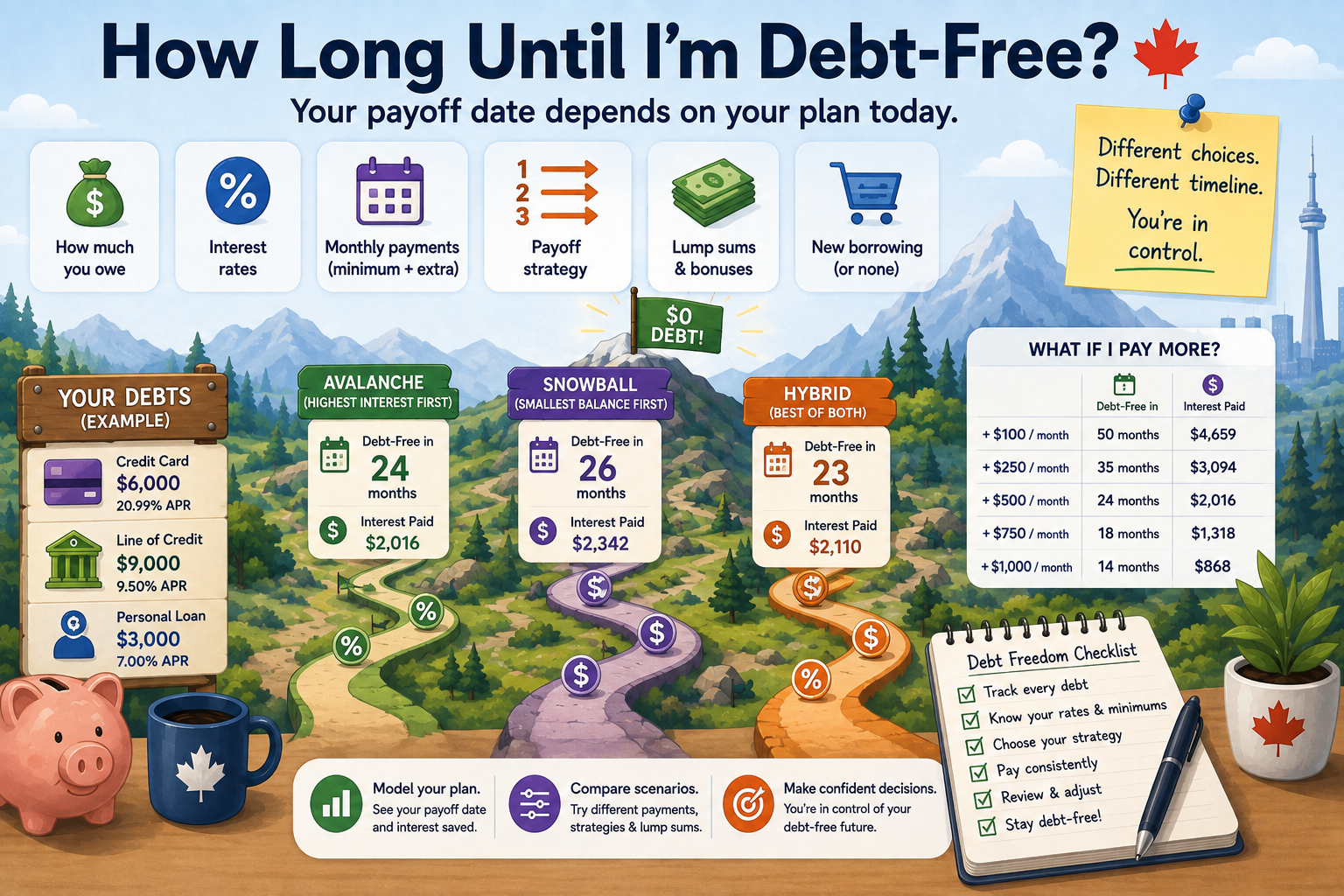
| Debt | Balance | Rate | Minimum |
|---|---|---|---|
| Credit card | $6,000 | 20.99% | $180 |
| Line of credit | $9,000 | 9.5% variable | $80 |
| Personal loan | $3,000 | 7.0% | $100 |
| Total | $18,000 | $360 |
Now we can start asking useful questions.
Your monthly payment matters enormously
FCAC provides a simple credit-card example showing just how much payment size can move the result.
Its example uses:
- starting balance: $2,000
- interest rate: 18%
- no new purchases
Paying $60 per month
Time to pay off:
3 years, 11 months
Interest:
$793
Total paid:
$2,793
Paying $160 per month
Time to pay off:
1 year, 2 months
Interest:
$231
Total paid:
$2,231
An additional:
$100/month
cuts approximately:
2 years and 9 months
from FCAC's example and avoids:
$562
of interest.
That's why even relatively modest extra payments can matter.
The extra money doesn't just reduce the balance.
It also reduces the amount that future interest gets calculated against.
What another $100, $250 or $500 per month can do
Let's return to our fictional Canadian debt stack:
| Debt | Balance | APR | Minimum |
|---|---|---|---|
| Credit card | $6,000 | 20.99% | $180 |
| Line of credit | $9,000 | 9.5% | $80 |
| Personal loan | $3,000 | 7.0% | $100 |
Total debt:
$18,000
Total starting minimum payments:
$360/month
For this illustration, assume:
- highest-interest debt is paid first
- rates stay unchanged
- no new borrowing occurs
- monthly interest is approximated
- the same total debt-payment budget continues after a debt is eliminated
- freed payments roll into the next debt
These are illustrative calculations, not lender quotes.
| Extra each month | Total monthly debt budget | Approx. debt-free time | Approx. interest |
|---|---|---|---|
| $0 extra | $360 | 71 months | $7,210 |
| +$100 | $460 | 50 months | $4,659 |
| +$250 | $610 | 35 months | $3,094 |
| +$500 | $860 | 24 months | $2,016 |
Look at the difference between the first and last rows.
Same starting debt:
$18,000
But increasing the monthly debt budget from:
$360 → $860
moves the illustrative payoff from almost:
6 years
to roughly:
2 years
and cuts thousands of dollars of modeled interest.
That's the number worth experimenting with.
Not:
“How long does debt normally take?”
But:
“What happens to my date if I can sustainably find another $100, $250 or $500?”
Sustainable matters more than maximum
There's an important catch.
Suppose the calculator says:
$1,200/month gets you debt-free in 17 months.
That result is useless if your budget can only reliably support:
$700/month
and the remaining $500 ends up back on a credit card every month.
Your payoff date should be based on a payment you can actually maintain.
A realistic 24-month plan can be better than an imaginary 17-month plan that collapses after six weeks.
That's why the debt timeline comes after the budget.
If you haven't established the sustainable payment yet, start with How to Budget While Paying Off Debt.
Why an extra payment changes more than this month's balance
Suppose you owe:
$10,000
and pay an extra:
$500
You don't only remove $500 from the eventual amount you have to repay.
You also reduce the principal on which future interest is calculated.
So the benefit compounds.
The earlier a meaningful extra payment happens, the longer it has to reduce future interest.
That's why:
$500 today
can be more valuable than:
$500 shortly before the debt would have disappeared anyway.
Interest rate can matter as much as balance
Imagine two debts:
Debt A
$5,000 at 21%
Debt B
$8,000 at 7%
Debt B is larger.
But Debt A is much more expensive for every dollar left unpaid.
That's why the debt avalanche directs extra payments toward the highest interest rate first.
FCAC describes this strategy as paying the highest-interest debt first and notes that it can reduce interest and help you become debt-free sooner.
If minimizing interest is the priority, the payoff date shouldn't be calculated from balance alone.
Rate matters.
For the complete strategy comparison, see Debt Payoff Strategies in Canada.
Payoff order matters when you have multiple debts
Suppose you have:
- Credit card: $6,000 at 20.99%
- LOC: $9,000 at 9.5%
- Personal loan: $3,000 at 7%
Avalanche order
- 20.99% credit card
- 9.5% LOC
- 7% personal loan
Snowball order
- $3,000 personal loan
- $6,000 credit card
- $9,000 LOC
The total amount you put toward debt may be identical.
But the sequence changes:
- which account disappears first
- how much interest accumulates
- when minimum payments are freed
- the psychological experience of the plan
Highest-interest-first usually wins mathematically.
Smallest-balance-first can produce earlier visible wins.
If you want the detailed comparison, see Debt Avalanche vs. Debt Snowball in Canada.
Rolling payments forward is what creates acceleration
This is one of the most important assumptions in a multi-debt payoff calculation.
Suppose you pay:
$680/month
toward your target credit card.
Eventually the card reaches:
$0
You now have $680 of monthly cash flow available.
If you reduce your debt budget by $680 and start spending it elsewhere, the rest of the debts continue on roughly their old schedules.
Instead, roll the payment forward.
If the next debt had previously received:
$80/month
it can now receive:
$760/month
The next debt disappears much faster.
Then that entire payment rolls forward again.
That's why multi-debt repayment tends to accelerate as accounts hit zero.
The money freed by each finished debt becomes fuel for the next one.
A line of credit can create a misleading payoff date
Lines of credit deserve special attention.
FCAC notes that the required payment on many LOCs is usually approximately the monthly interest.
That means a line of credit can behave like this:
Balance: $15,000
You make every required payment.
You're never late.
Years pass.
Balance:
still close to $15,000
if the payments mostly covered interest and you continued borrowing.
A minimum payment is not necessarily a principal-repayment plan.
Example
Suppose your LOC generates:
$110 of interest
this month.
Required payment:
$110
You make the payment.
Principal reduction:
$0
At that payment level, the answer to:
“How many months until this reaches zero?”
isn't:
“a very large number.”
It's:
There is no payoff trajectory until principal starts coming down.
Any useful debt calculator needs to model actual principal repayment, not merely whether the account is current.
Credit-card minimum-only timelines can be deceptive too
Credit-card minimum payments often decline as the balance declines.
That keeps the required payment manageable.
It can also stretch repayment dramatically.
FCAC requires federally regulated credit-card issuers to show on statements how long it would take to repay the current balance if you made only minimum payments.
Look at that number.
It can be eye-opening.
Then compare it with:
- minimum + $50
- minimum + $100
- minimum + $250
The difference may be measured in years.
New purchases move the debt-free date backwards
This sounds obvious, but it's one of the most important modelling assumptions.
Suppose the calculator says:
Debt-free in 28 months
based on:
$700/month
of repayment.
But every month you add:
$300
of new purchases to the same revolving debt.
Your effective progress is closer to:
$400 before interest
than $700.
The calculated date no longer describes reality.
When modelling revolving debt, ask:
Am I assuming no new borrowing?
If the answer is yes, the actual plan needs to make that assumption realistic.
This is why the monthly budget and debt timeline cannot really be separated.
A new purchase is especially expensive on a carried credit-card balance
If you normally pay a credit card in full, purchases can benefit from the card's interest-free grace period.
But when you're carrying a balance, the interest mechanics can become much less forgiving.
FCAC advises trying to pay the statement balance by the due date and notes that if you don't pay the balance, interest increases the cost of purchases.
Cash advances are even less forgiving because they generally don't receive the normal interest-free grace period.
If you're trying to establish an accurate debt-free date, reducing new revolving borrowing matters just as much as making larger payments.
Variable interest rates make the date move
A fixed-rate loan is relatively straightforward to model.
A line of credit with a variable rate isn't.
Suppose your LOC is:
$12,000 at 8%
and your calculator estimates a particular payoff date.
Later, the rate becomes:
10%
More of each payment now goes toward interest.
Less reaches principal.
The debt-free date moves later unless you increase the payment.
The reverse can also happen if rates fall.
For variable-rate debts, treat the payoff date as:
current projection based on today's rate
not a guarantee.
Recalculate when the rate changes.
Promotional rates create another moving deadline
Suppose you've transferred:
$8,000
to a card offering a promotional rate for:
12 months
The calculator needs at least two phases:
During the promotion
Lower interest rate.
After the promotion
Regular rate.
If the remaining balance at month 12 is:
$3,500
and the rate jumps substantially, the remaining timeline may look very different.
So record:
- promotional rate
- expiry date
- regular rate afterward
- transfer fee
- conditions that could cause you to lose the promotion
A temporary low rate isn't a permanent characteristic of the debt.
Lump sums can move the finish line dramatically
Monthly payments aren't the only way to accelerate repayment.
You may receive:
- work bonus
- tax refund
- gift
- asset-sale proceeds
- other one-time cash
Suppose your debt plan assumes:
$700/month
Then in December you decide to make a:
$3,000 lump-sum payment
That doesn't mean your monthly payment has permanently become:
$950
They're different scenarios.
The model should show:
$700 recurring monthly payment
plus:
$3,000 one-time payment in December
That's a much more honest projection.
When should you apply a lump sum?
If you're following avalanche:
Apply it to the highest-rate target.
If you're following snowball:
Apply it to the smallest-balance target.
But there may also be strategic reasons to consider:
- eliminating an entire monthly payment
- paying a promotional balance before its rate expires
- reducing variable-rate exposure
The point is to model what the lump sum actually changes.
A bonus today can be worth more than the same bonus later
Imagine two identical:
$2,000
lump sums.
One arrives in month 2.
The other arrives in month 20.
The earlier payment usually saves more interest because it reduces principal for more of the remaining payoff period.
So when a calculator allows dated lump sums, the date matters—not only the amount.
What happens when your monthly payment increases?
One of the most useful things to model is future cash flow.
Suppose today you can afford:
$500 extra
But six months from now:
- a car loan ends
- childcare changes
- income increases
- another debt disappears
and you can afford:
$800 extra
Your debt plan should be able to reflect that.
The most realistic payoff schedule is rarely:
exactly the same payment forever
Life changes.
The projection should change with it.
The same applies when your payment temporarily falls
Maybe you're paying:
$900/month
toward debt.
Then:
- parental leave begins
- hours are reduced
- insurance increases
- another necessary expense appears
and the sustainable payment becomes:
$500
That doesn't mean the plan failed.
Update it.
The new debt-free date is information—not punishment.
A financial forecast is useful precisely because you can change the assumptions.
Minimum payments may change too
Credit-card minimums can change as balances change.
Variable-rate LOC payments can change as rates move.
Personal loans may have fixed scheduled payments.
That's another reason simple:
balance ÷ monthly payment
math doesn't accurately calculate a debt-free date.
For example:
$10,000 debt ÷ $500 payment = 20 months
ignores interest entirely.
The actual result is longer if interest continues accumulating.
A useful payoff calculation models both:
interest being added
and
payments being subtracted
over time.
Debt-free isn't necessarily the same as mortgage-free
When people say:
“I want to be debt-free.”
they don't always mean the same thing.
One person means:
- no credit cards
- no LOC
- no consumer loans
but still has a mortgage.
Another means:
$0 debt of any kind
including the mortgage.
Decide what the goal means before calculating the date.
You may want separate milestones such as:
- credit-card-free
- consumer-debt-free
- non-mortgage-debt-free
- completely debt-free
Those intermediate milestones can make a long financial plan feel much more concrete.
A debt-free date should include milestones
A single finish date can feel very far away.
Instead of only showing:
October 2029 — debt free
also track:
March 2027 — Credit Card A reaches $0
January 2028 — LOC reaches $0
October 2029 — final debt reaches $0
Now you can see progress before the finish line.
This is particularly useful in a multi-year plan.
Recalculate at least when something material changes
You don't need to rerun a debt projection every morning.
But recalculate when:
- an interest rate changes
- a promotional rate expires
- a debt reaches zero
- your available monthly payment changes
- you make a lump-sum payment
- you add new debt
- a minimum payment changes materially
A debt-free date is only useful when its assumptions still resemble your real finances.
What if your projected date feels impossibly far away?
First, don't interpret the date as a verdict.
It's a mathematical result from your current inputs.
That means there are only a handful of ways it changes:
Increase the payment
Even another $50 or $100 may matter over a long payoff period.
Reduce the interest rate
Possibilities may include:
- negotiating with a creditor
- refinancing
- lower-rate consolidation
- an appropriate balance transfer
Compare all fees and terms.
Reduce new borrowing
Prevent balances from rebuilding while you're paying them.
Add lump sums
Use occasional additional cash when appropriate.
Change the payoff order
Higher-interest-first can reduce total interest.
Increase income or reduce expenses
That can create more recurring payment capacity.
The calculator isn't telling you:
“You're stuck until 2031.”
It's telling you:
“Under today's assumptions, this is where the path leads.”
Change the inputs and you change the path.
What if you can't make the minimum payments?
Then calculating the perfect debt-free date isn't the first priority.
FCAC recommends contacting creditors if you're having difficulty making payments.
Depending on your situation, creditors may discuss options such as:
- reduced interest
- extending repayment
- lower monthly payments
- consolidation
Those options can affect both the monthly cash flow and the total interest cost.
If your debts have become difficult to manage, a reputable credit counsellor may also help you review the situation.
Simply speaking with a credit counsellor does not itself affect your credit score.
More serious debt problems may require guidance from a Licensed Insolvency Trustee rather than another payoff spreadsheet.
How to calculate your own debt-free date
You can do it manually, in a spreadsheet or with a calculator.
At minimum, gather:
For every debt
- balance
- APR
- minimum payment
- fixed or variable rate
- promotional-rate expiry if applicable
For the overall plan
- extra monthly payment
- payoff strategy
- lump-sum payments and dates
- whether payments roll forward
- whether new borrowing is assumed
Then compare scenarios.
For example:
Scenario A
Current payments only.
Scenario B
+$100/month.
Scenario C
+$250/month.
Scenario D
+$500/month.
Scenario E
+$250/month plus a $3,000 December lump sum.
Now the question becomes:
Which scenario gives me a meaningful improvement while still fitting my budget?
That's much more useful than calculating one date once.
Using Finnomia's debt-payoff calculator
Finnomia has a free debt-payoff calculator designed to help Canadians model their own balances.
Enter each debt's:
- current balance
- interest rate
- minimum payment
Then add the extra amount you can realistically afford.
You can compare approaches such as:
- highest-interest-first / avalanche
- lowest-balance-first / snowball
The output is based on your debts rather than a national average.
Finnomia's Debt Freedom Planner goes further
Finnomia is the Canadian personal-finance platform behind this blog.
Advanced users can use the Debt Freedom Planner to build more detailed payoff scenarios.
It supports:
- avalanche
- snowball
- hybrid ordering
- extra monthly payments
- dated lump-sum payments
- manual debts
- payoff timelines
- payment allocation
- milestones
- saved scenarios
That means you could compare:
Scenario A
$500 extra/month — avalanche
Scenario B
$500 extra/month — snowball
Scenario C
$750 extra/month beginning next January
Scenario D
$500/month + $5,000 bonus in March
Then compare:
- debt-free date
- payoff order
- milestones
- interest
- payment allocation
The goal isn't to make a perfect prediction.
It's to understand how different decisions change the trajectory.
Debt planning works better when connected to the budget
This is also why Finnomia doesn't treat debt payoff as completely separate from the rest of your financial life.
The platform can bring together:
- transactions
- budgets
- recurring bills
- debt
- goals
- net worth
- cash-flow forecasting
The sequence matters:
Your budget determines how much you can sustainably pay.
Your payoff strategy determines where that money goes.
Your debt forecast shows where those choices lead.
Finnomia currently uses Plaid for financial connectivity and is adding Flinks as a second provider to improve support and reliability across Canadian financial institutions.
Connections are read-only.
Finnomia cannot move money and doesn't store your banking password.
The Debt Freedom Planner described here is already live.
Your debt-free date is a target, not destiny
Suppose your current projection says:
32 months
That doesn't mean 32 months has been assigned to you.
Next month you may:
- increase the payment
- reduce an expense
- receive a bonus
- refinance a balance
- finish another debt
- experience a rate change
The date moves.
What matters is the direction.
A useful debt plan should show you:
where you are
where the current path leads
and
what happens if you change something
That's what turns:
“I hope I eventually get out of debt.”
into:
“At my current payment, I'm on track for this date—and here's what another $250 a month would do.”
Run your numbers with Finnomia's free debt-payoff calculator.
And if you're still deciding which debt should receive the extra payment first, start with Debt Payoff Strategies in Canada.
Frequently asked questions
How do I calculate how long it will take to become debt-free?
You need your balances, interest rates, minimum payments and the additional amount you plan to pay.
For multiple debts, the payoff order and whether you roll finished payments into the next debt also affect the result.
How much faster will an extra $100 per month pay off debt?
It depends on the balance and interest rate.
In FCAC's $2,000 credit-card example at an illustrative 18%, increasing the payment from $60 to $160 reduced the payoff period from 3 years 11 months to 1 year 2 months.
Your result can be very different.
Does paying more each month reduce interest?
Generally yes.
Paying principal sooner leaves a smaller balance on which future interest can accrue.
The effect depends on the debt's rate and repayment terms.
Should I use avalanche or snowball to become debt-free faster?
Highest-interest-first / avalanche generally minimizes interest and can produce the mathematically fastest payoff.
Smallest-balance-first / snowball may produce earlier account-level wins and help some people stay motivated.
Why isn't my line of credit balance going down?
FCAC notes that the required payment on many lines of credit is usually equal to approximately the monthly interest.
If you only cover interest, principal may not decline.
You need payments above the interest amount to create consistent principal reduction.
Does using my credit card while paying it off change my debt-free date?
Yes.
New purchases increase the balance and can materially extend the payoff timeline.
A calculation assuming no new borrowing only remains accurate if you stop adding debt.
What happens if my line-of-credit rate changes?
A higher rate generally increases interest and moves the projected payoff date later unless the payment also increases.
Recalculate variable-rate debts when rates change materially.
Should I use a tax refund or bonus to pay down debt?
A lump-sum payment can reduce principal immediately and may shorten the payoff period and reduce interest.
Whether that's the best use of the money depends on your other financial needs and priorities.
Should I count my mortgage in my debt-free date?
That depends on what “debt-free” means to you.
You can track separate milestones such as consumer-debt-free, non-mortgage-debt-free and completely debt-free.
Is the calculated debt-free date guaranteed?
No.
It's a projection based on assumptions about balances, interest rates, payments, payoff order and future borrowing.
Change the assumptions and the date changes.
This article was reviewed in August 2026 and provides general information, not personalized financial, credit or insolvency advice. Debt calculations are estimates; lenders may calculate interest and minimum payments differently. Confirm current balances, rates and payment requirements using your own statements and agreements.