
On this page
- Avalanche vs. snowball at a glance
- What FCAC actually recommends
- How the payment actually works
- Example 1: When the interest rates are fairly close
- What would you choose in that example?
- Example 2: When the interest-rate gap is large
- Why the rate gap matters so much
- Example 3: When snowball's motivation benefit is almost free
- What determines how different avalanche and snowball will be?
- The line-of-credit trap
- Avalanche becomes particularly compelling with very high-cost debt
- Snowball becomes particularly compelling when a tiny balance can disappear immediately
- You don't have to choose a pure strategy
- A practical hybrid example
- Promotional rates can override the simple ordering
- Variable rates can change the avalanche order
- A lump sum can change which strategy feels best
- The first $0 matters—but so does the last one
- Don't choose snowball because you think it's mathematically faster
- Don't choose avalanche if you know you won't follow it
- A decision framework
- When I'd favour avalanche
- When I'd favour snowball
- When I'd use a hybrid
- Run both scenarios instead of guessing
- How Finnomia's Debt Freedom Planner handles avalanche and snowball
- The point isn't to crown a universal winner
- Frequently asked questions
You have $300 of extra money available for debt this month.
Where should it go?
To the credit card charging the highest interest rate?
Or to the smallest balance you could eliminate quickly?
That is the difference between two of the most common debt-payoff strategies:
Debt avalanche: pay the highest-interest debt first.
Debt snowball: pay the smallest balance first.
The mathematical answer is usually straightforward:
Avalanche generally saves more interest.
The behavioural answer is more complicated:
Snowball can give you a visible win much sooner.
And sometimes the dollar difference between the strategies is surprisingly small.
Other times, choosing the smaller balance first can cost hundreds or thousands of dollars more.
So the useful question isn't simply:
“Is avalanche better than snowball?”
It's:
“How much would avalanche save me on my actual debts, and is that difference meaningful enough to change the strategy I'm most likely to stick with?”
That's what we'll compare.
Avalanche vs. snowball at a glance
| Debt avalanche | Debt snowball | |
|---|---|---|
| Target first | Highest interest rate | Smallest balance |
| Main goal | Minimize interest | Create quick wins |
| Minimums on other debts | Yes | Yes |
| Payment rolls forward | Yes | Yes |
| Usually lowest interest cost | Yes | No |
| Usually first account paid off sooner | Not necessarily | Yes |
| Best fit | Math/interest focused | Motivation/progress focused |
| Main risk | First win can take a long time | Can cost more interest |
Neither strategy changes the amount your monthly budget can afford.
That's determined separately.
If your budget produces:
$500/month of extra debt repayment
both strategies use that same $500.
They simply send it to different places.
For help calculating the sustainable payment first, see How to Budget While Paying Off Debt in Canada.
What FCAC actually recommends
The Financial Consumer Agency of Canada doesn't use the labels avalanche and snowball.
It describes the same two approaches more plainly:
- pay debts with the highest interest rates first
- pay debts with the lowest balances first
FCAC says highest-interest-first means you'll pay less interest and helps you become debt-free sooner.
It describes lowest-balance-first as an approach that can let you see progress quickly, which may help you stay committed, while warning that it may cost more over time.
There are also two important rules before either strategy:
Deal with past-due accounts first
If something is already overdue, getting it current can be more important than optimizing the payoff order.
Keep making minimum payments on every debt
Avalanche doesn't mean ignoring the small debts.
Snowball doesn't mean ignoring the expensive debts.
Every debt continues receiving at least its required minimum.
The extra payment goes to one target.
How the payment actually works
Suppose you have two debts.
Each has a:
$50 minimum payment
Your total monthly debt budget is:
$300
You first reserve the $50 minimum for the debt you aren't targeting.
That leaves:
$250
for the target debt.
So the month looks like:
Target debt: $250
Other debt: $50
Total:
$300
When the first debt reaches $0, the entire $300 can then attack the remaining debt.
That roll-forward is important.
The snowball effect of payments getting larger as accounts disappear happens with both strategies.
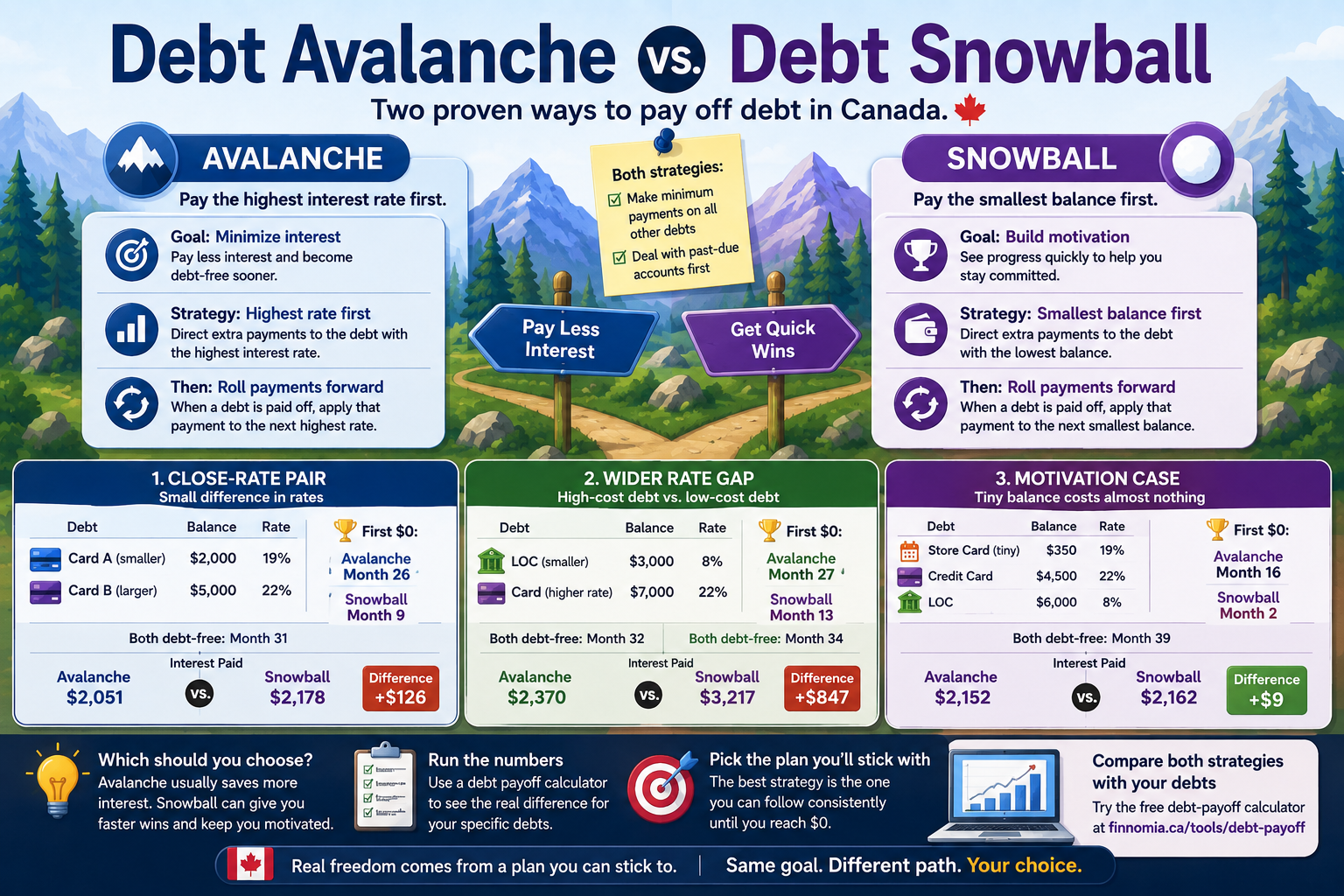
Example 1: When the interest rates are fairly close
Let's start with two fictional credit-card balances.
The 19% and 22% rates are based on rates FCAC has used in examples. They are not typical Canadian rates and aren't intended to represent your card.
Starting debts
| Balance | Rate | Minimum | |
|---|---|---|---|
| Card A | $2,000 | 19% | $50 |
| Card B | $5,000 | 22% | $50 |
Monthly debt budget:
$300
Assumptions:
- no new purchases
- no fees
- rates stay unchanged
- interest calculated monthly at APR ÷ 12 and rounded to cents
- freed payments roll immediately to the remaining debt
Avalanche
The highest rate is:
Card B at 22%
So:
- Card A receives $50
- Card B receives $250
Snowball
The smallest balance is:
Card A at $2,000
So:
- Card A receives $250
- Card B receives $50
Result
| Avalanche | Snowball | |
|---|---|---|
| First debt reaches $0 | Month 26 | Month 9 |
| Both debts reach $0 | Month 31 | Month 31 |
| Total modeled interest | $2,051.54 | $2,178.19 |
| Extra interest with snowball | — | $126.65 |
This example captures the trade-off extremely well.
Avalanche wins on interest
It saves:
$126.65
Snowball wins dramatically on the first milestone
You eliminate an entire account in:
9 months
instead of waiting:
26 months
for the first $0.
Both finish in the same month
Despite avalanche saving interest, both scenarios finish in:
31 months
under these particular assumptions.
That's important.
“Highest interest first is mathematically better” does not mean every debt stack will finish an entire year earlier.
Sometimes the advantage is mostly interest savings.
What would you choose in that example?
Suppose you've repeatedly struggled to stick with long debt-payoff plans.
Would paying:
$126.65 more
over roughly 2½ years be worth seeing your first account disappear:
17 months earlier?
For some people, yes.
For someone who cares almost exclusively about minimizing interest, no.
Neither answer is irrational.
The important thing is knowing what you're trading.
Example 2: When the interest-rate gap is large
Now change the debts.
Starting debts
| Balance | Rate | Minimum | |
|---|---|---|---|
| Line of credit | $3,000 | 8% | $50 |
| Credit card | $7,000 | 22% | $140 |
The 8% line-of-credit rate is purely illustrative, not a Canadian average.
Extra available each month:
$200
That gives a total monthly debt budget of:
$390
Avalanche
Target:
$7,000 card at 22%
Payments initially:
- Credit card: $340
- LOC: $50
Snowball
Target:
$3,000 LOC at 8%
Payments initially:
- LOC: $250
- Credit card: $140
Result
| Avalanche | Snowball | |
|---|---|---|
| First debt reaches $0 | Month 27 | Month 13 |
| Both debts reach $0 | Month 32 | Month 34 |
| Total modeled interest | $2,370.46 | $3,217.19 |
| Additional snowball interest | — | $846.73 |
Now the decision looks different.
Snowball still gives you the first win much sooner:
Month 13 vs. month 27
But the cost is much larger.
Snowball produces approximately:
$846.73 more interest
and keeps the household in debt about:
two months longer
under these assumptions.
The larger the rate difference becomes, the harder it is to ignore the avalanche advantage.
Why the rate gap matters so much
Snowball effectively says:
“I'm willing to leave the expensive debt alone temporarily because eliminating this smaller debt will help me stay motivated.”
The cost of doing that depends on how expensive the ignored debt is.
Leaving:
$5,000 at 22%
while attacking:
$2,000 at 19%
is one thing.
Leaving:
$7,000 at 22%
while attacking:
$3,000 at 8%
is very different.
The bigger the interest-rate gap:
the larger the potential cost of choosing balance over rate.
That's why you should run your own numbers rather than adopting avalanche or snowball as an identity.
Example 3: When snowball's motivation benefit is almost free
Now consider three fictional debts.
| Balance | Rate | Minimum | |
|---|---|---|---|
| Store card | $350 | 19% | $25 |
| Credit card | $4,500 | 22% | $90 |
| Line of credit | $6,000 | 8% | $50 |
Extra available each month:
$175
Again, 19% and 22% are example rates and 8% is illustrative.
Avalanche
The 22% card receives the extra first.
The tiny $350 store card keeps receiving its $25 minimum.
Snowball
The $350 store card receives the extra first.
Result
| Avalanche | Snowball | |
|---|---|---|
| First debt reaches $0 | Month 16 | Month 2 |
| All debts reach $0 | Month 39 | Month 39 |
| Total modeled interest | $2,152.42 | $2,161.83 |
| Additional snowball interest | — | $9.41 |
This is the opposite of our wider-gap example.
Under these assumptions, snowball gets you an entire account payoff:
14 months earlier
and costs only:
$9.41 more
in total interest.
Both strategies finish all the debt in:
39 months
If eliminating that $350 account immediately would make the plan feel simpler and keep you engaged, paying $9.41 for that behavioural benefit could be completely reasonable.
That's why the answer isn't always:
“Avalanche. End of discussion.”
What determines how different avalanche and snowball will be?
Several factors drive the result.
1. The interest-rate gap
This is usually the biggest factor.
If your debts are:
- 20.99%
- 19.99%
- 18.99%
snowball may not cost dramatically more.
If they're:
- 22%
- 10%
- 6%
ignoring the 22% balance becomes much more expensive.
2. The difference in balances
If your smallest balance is tiny, snowball may eliminate it almost immediately.
That may only delay avalanche by a month or two.
If your “smallest” debt is still $10,000, the motivational benefit may take much longer to appear.
3. Your extra monthly payment
A large extra payment compresses the entire schedule.
When you're throwing:
$2,000 extra each month
at relatively modest balances, the difference between strategies may shrink because everything disappears quickly.
With only:
$100 extra
the payoff order can matter for much longer.
4. Minimum payments
Minimum-payment rules affect how much each non-target debt changes while you attack another account.
A balance can potentially decline slowly—or even grow—if the minimum is close to or below the interest being added.
5. Whether you keep borrowing
No payoff strategy can overcome continual new borrowing indefinitely.
If you pay:
$700
toward the target but add:
$500
of new purchases to revolving credit, your actual progress looks very different.
The line-of-credit trap
A line of credit deserves particular attention in either strategy.
FCAC notes that the required payment on many LOCs is usually approximately equal to the monthly interest.
That can mean:
Minimum payment made
but:
very little or no principal reduction
If the LOC is not currently your target, make sure the payment you're assuming actually prevents the balance from growing.
And when it becomes the target, the payment needs to exceed the interest if you expect principal to decline.
Avalanche becomes particularly compelling with very high-cost debt
Suppose one debt is dramatically more expensive than everything else.
For example:
- very high-rate credit-card debt
- a cash advance
- high-cost short-term borrowing
At some point, the mathematical penalty for ignoring that debt becomes difficult to justify merely for an early $0 elsewhere.
That doesn't mean motivation stops mattering.
It means the price of the motivational strategy has increased.
That's exactly why calculating the difference is useful.
Snowball becomes particularly compelling when a tiny balance can disappear immediately
Consider:
- $250 store card
- $8,000 card
- $12,000 LOC
Suppose the small balance can be gone next payday.
You might reasonably decide:
“I'll eliminate this one first and then immediately switch to highest-interest-first.”
That's not pure snowball.
It's a hybrid.
And it may give you most of the behavioural benefit with very little mathematical cost.
You don't have to choose a pure strategy
Real personal finance doesn't require ideological purity.
A hybrid strategy can be:
- eliminate one or two very small balances
- switch to highest-interest-first
- remain on avalanche afterward
Or perhaps you prioritize:
- a promotional balance before its rate expires
- then the highest interest rate
- then the remaining small balances
The important thing is having a reason for changing the order.
Don't randomly redirect the extra payment every month based on whichever debt feels annoying that day.
A practical hybrid example
Imagine:
- Store card: $400 at 12%
- Credit card: $8,000 at 22%
- LOC: $14,000 at 9%
Pure avalanche:
22% card first
Pure snowball:
$400 card first
Hybrid:
Kill the $400 balance quickly, then attack the 22% card.
If the $400 balance can disappear in one month, you've:
- removed one account
- removed one minimum payment
- gained an immediate win
without leaving the expensive 22% card untouched for very long.
That's the kind of trade-off worth modelling.
Promotional rates can override the simple ordering
Suppose you have:
Card A
$5,000 at 20%
Card B
$7,000 at 0% for four more months, then 23%
Today's avalanche order says:
Card A first
But Card B has a deadline.
You should understand:
- when the promotion ends
- what the rate becomes
- whether the remaining balance can be eliminated beforehand
- what actions could cancel the promotional rate
A debt isn't always described by one interest rate forever.
Your payoff strategy needs to reflect that.
Variable rates can change the avalanche order
Lines of credit commonly have variable rates.
Suppose your original order is:
- Credit card — 17%
- LOC — 10%
- Loan — 7%
Later, the LOC changes to:
18%
A true avalanche strategy would now reconsider the order.
Don't create a repayment plan once and assume the rate ranking will remain unchanged for several years.
Review variable-rate debt periodically.
A lump sum can change which strategy feels best
Suppose you unexpectedly have:
$4,000
available for debt.
Avalanche might say:
Put all $4,000 against the highest-rate balance.
Snowball might say:
Eliminate two small balances completely.
Both can create meaningful benefits.
The useful questions are:
- How much interest does each option save?
- Which monthly payments disappear?
- Does a promotional deadline matter?
- How much does each choice change the debt-free date?
- Which plan are you more likely to maintain afterward?
A lump sum can change the structure of the debt stack, not just lower the total.
The first $0 matters—but so does the last one
Debt payoff has at least two kinds of milestones.
First-win milestone
When does the first account reach $0?
Snowball is designed to improve this.
Final milestone
When does all targeted debt reach $0?
Avalanche often performs better here, especially when rates differ significantly.
The mistake is assuming one of those milestones is automatically the only one that matters.
If seeing a first account disappear motivates you to keep going, that's valuable.
If paying another $800 of interest would frustrate you more than waiting for that milestone, that's valuable information too.
Don't choose snowball because you think it's mathematically faster
Snowball's argument is not:
“Smallest balance first always gets you completely debt-free sooner.”
It doesn't.
Its advantage is that the first account often disappears earlier.
FCAC's own description focuses on the motivation created by seeing progress quickly.
That's the useful reason to choose it.
Don't choose avalanche if you know you won't follow it
Likewise, don't choose avalanche only because a spreadsheet tells you the interest number is lower if you've repeatedly abandoned the approach.
Suppose:
Avalanche interest: $4,000
Snowball interest: $4,250
If avalanche saves:
$250
but you repeatedly stop making extra payments six months into the plan, the theoretical savings aren't being realized.
Behaviour is part of financial planning.
The best mathematical strategy only produces the mathematical result if you actually execute it.
A decision framework
Here's how I'd choose between them.
Step 1: Get everything current
Address past-due accounts first.
Step 2: Make every minimum
Neither method works by skipping required payments.
Step 3: Calculate your sustainable extra payment
Don't invent an aggressive payment the budget can't support.
Step 4: Compare the actual numbers
Model:
- avalanche payoff date
- snowball payoff date
- total interest under each
- first account payoff under each
Step 5: Look at the difference
If avalanche saves:
$2,000
that's a meaningful trade-off.
If it saves:
$20
the behavioural decision may matter more.
Step 6: Choose the strategy you'll keep following
Then stop switching constantly.
Let the plan work.
When I'd favour avalanche
Avalanche deserves particularly strong consideration when:
- the interest-rate differences are large
- you have expensive credit-card debt
- your highest-rate balance is significant
- minimizing interest is your primary goal
- you don't need early wins to stay motivated
- you enjoy seeing mathematically optimized progress
The bigger the rate spread, the stronger the case.
When I'd favour snowball
Snowball can be reasonable when:
- you have several very small balances
- eliminating accounts would simplify your life
- motivation has been the main obstacle
- the interest-rate differences are relatively small
- the calculated extra interest is modest
- previous avalanche attempts haven't lasted
You're effectively choosing to pay a potential motivation premium.
Calculate that premium before deciding whether it's worth it.
When I'd use a hybrid
I'd seriously consider a hybrid when:
- one tiny balance could disappear immediately
- the highest-rate debt is also very expensive
- a promotional deadline changes the normal order
- you want an early win without staying on snowball permanently
For many people, this is the practical middle ground.
Run both scenarios instead of guessing
You don't have to make this decision philosophically.
Use your actual:
- balances
- interest rates
- minimum payments
- extra monthly amount
and calculate both.
Finnomia's free debt-payoff calculator lets you compare the payoff approaches using your own numbers.
Look at:
- total interest
- debt-free date
- payoff order
- when the first debt disappears
Then decide whether the difference matters to you.
How Finnomia's Debt Freedom Planner handles avalanche and snowball
Finnomia is the Canadian personal-finance platform behind this blog.
Advanced users can use the Debt Freedom Planner to create and compare different payoff scenarios.
It supports:
- avalanche
- snowball
- hybrid payoff ordering
- additional monthly payments
- dated lump-sum payments
- manually added debts
- payoff timelines
- payment allocations
- milestones
- saved scenarios
That means you can model:
Scenario A
Avalanche — $500 extra/month
Scenario B
Snowball — $500 extra/month
Scenario C
Hybrid — smallest debt first, then avalanche
and compare the results directly.
The point isn't to crown a universal winner
Avalanche does have a mathematical advantage.
When everything else is equal, paying higher-interest debt earlier generally reduces interest.
But that doesn't automatically make snowball a mistake.
Our three examples show why.
Close-rate example
Snowball:
- first win 17 months earlier
- same final payoff month
- approximately $126.65 more interest
Wide-rate-gap example
Snowball:
- first win 14 months earlier
- final payoff two months later
- approximately $846.73 more interest
Motivation example
Snowball:
- first win 14 months earlier
- same final payoff month
- approximately $9.41 more interest
Those are three very different trade-offs.
The right question isn't:
“Which method wins on the internet?”
It's:
“What does each method do to my debts?”
If the avalanche saves a meaningful amount and you're comfortable following it, use it.
If snowball costs almost nothing more and an early victory will keep you engaged, that's a legitimate choice.
And if neither pure strategy quite fits, build a deliberate hybrid.
Whatever you choose:
make every minimum, keep the extra payment sustainable, roll finished payments forward, and keep moving toward $0.
You can compare the two approaches using Finnomia's free debt-payoff calculator.
Frequently asked questions
Is avalanche or snowball better?
Avalanche is generally better mathematically because targeting the highest interest rate first reduces interest costs.
Snowball may be better behaviourally for someone who benefits from paying off small accounts quickly.
The size of the difference depends on your actual debts.
What is the debt avalanche?
Debt avalanche means making minimum payments on every debt while directing extra money toward the debt with the highest interest rate.
When it reaches zero, roll that payment into the next-highest-rate debt.
What is the debt snowball?
Debt snowball means making every minimum payment while directing extra money toward the smallest balance.
Once that debt reaches zero, roll the payment into the next-smallest balance.
Does the Government of Canada use the terms avalanche and snowball?
FCAC describes the underlying approaches as highest-interest-first and lowest-balance-first.
The avalanche and snowball names are commonly used labels for those strategies.
Does avalanche always pay off all debts sooner?
Not necessarily by a whole number of months in every scenario.
Highest-interest-first generally reduces interest and FCAC says it helps you become debt-free sooner, but two specific payment schedules can sometimes reach their final $0 in the same month while avalanche still saves interest.
Does snowball always cost much more?
No.
It depends heavily on the balances, rates and payment amount.
In one illustrative example in this article, snowball cost only $9.41 more while producing the first account payoff 14 months earlier.
In another, it cost $846.73 more.
Can I combine avalanche and snowball?
Yes.
A hybrid strategy might eliminate one very small balance first and then switch to highest-interest-first.
The important thing is to understand why you're changing the payoff order.
What if one account is past due?
FCAC recommends considering past-due accounts before choosing the regular highest-interest or lowest-balance order.
Should I still make minimum payments on the other debts?
Yes.
Continue making at least the required minimum payment on every debt regardless of which payoff strategy you're using.
What if my interest rate changes?
Recalculate.
A change in a variable interest rate can change the avalanche order and alter the interest advantage between strategies.
Should I use avalanche if I have a line of credit?
Use the actual interest rate.
If the LOC has the highest rate, avalanche would target it.
If another debt has a higher rate, the other debt comes first.
Also remember that minimum LOC payments may primarily cover interest rather than reduce principal.
This article was reviewed in August 2026 and provides general information, not personalized financial, credit or insolvency advice. The payoff examples are illustrative calculations using stated assumptions, not lender quotes or Canadian averages. Confirm your balances, interest rates, minimum payments and repayment terms using your own agreements and statements.