
On this page
Old Age Security is Canada’s residency-based public pension for seniors 65 and older. It’s funded from general tax revenue — not from your work contributions. This page is what OAS is, who qualifies, the July to September 2026 maximums, how deferral to 70 works, and — especially — which income year can claw back which payment period.
It is not a full clawback sequencing playbook. It is not Canada Pension Plan contribution math. It is not “how much do I need to retire.”
What OAS is
OAS is a monthly pension you can receive from age 65 if you meet residency and legal-status rules. The payments are taxable income. Unlike the Canada Pension Plan (earnings-based), OAS is based on age and how long you’ve lived in Canada after 18.
Most people are automatically enrolled near age 64 if Service Canada has enough information. If you don’t get a letter about a month after your 64th birthday, you apply. GIS is a separate, income-tested top-up — covered briefly later.
Who qualifies
You generally need to be 65 or older, plus:
- Living in Canada: Canadian citizen or legal resident when approved, and at least 10 years of residence in Canada after age 18.
- Living outside Canada: been a citizen or legal resident the day before you left, and at least 20 years of residence in Canada after 18.
A full pension generally needs 40 years of residence after 18. A partial pension is years ÷ 40 (minimum 10 in Canada, or 20 if you live abroad). Twenty years of residence → 50% of the full maximum. Once payments start, extra years lived don’t raise that rate.
You don’t need a Canadian work history. You can still be working. Higher income can still trigger the recovery tax. International social-security agreements can help in some cases — see canada.ca; this page doesn't teach country-by-country rules.
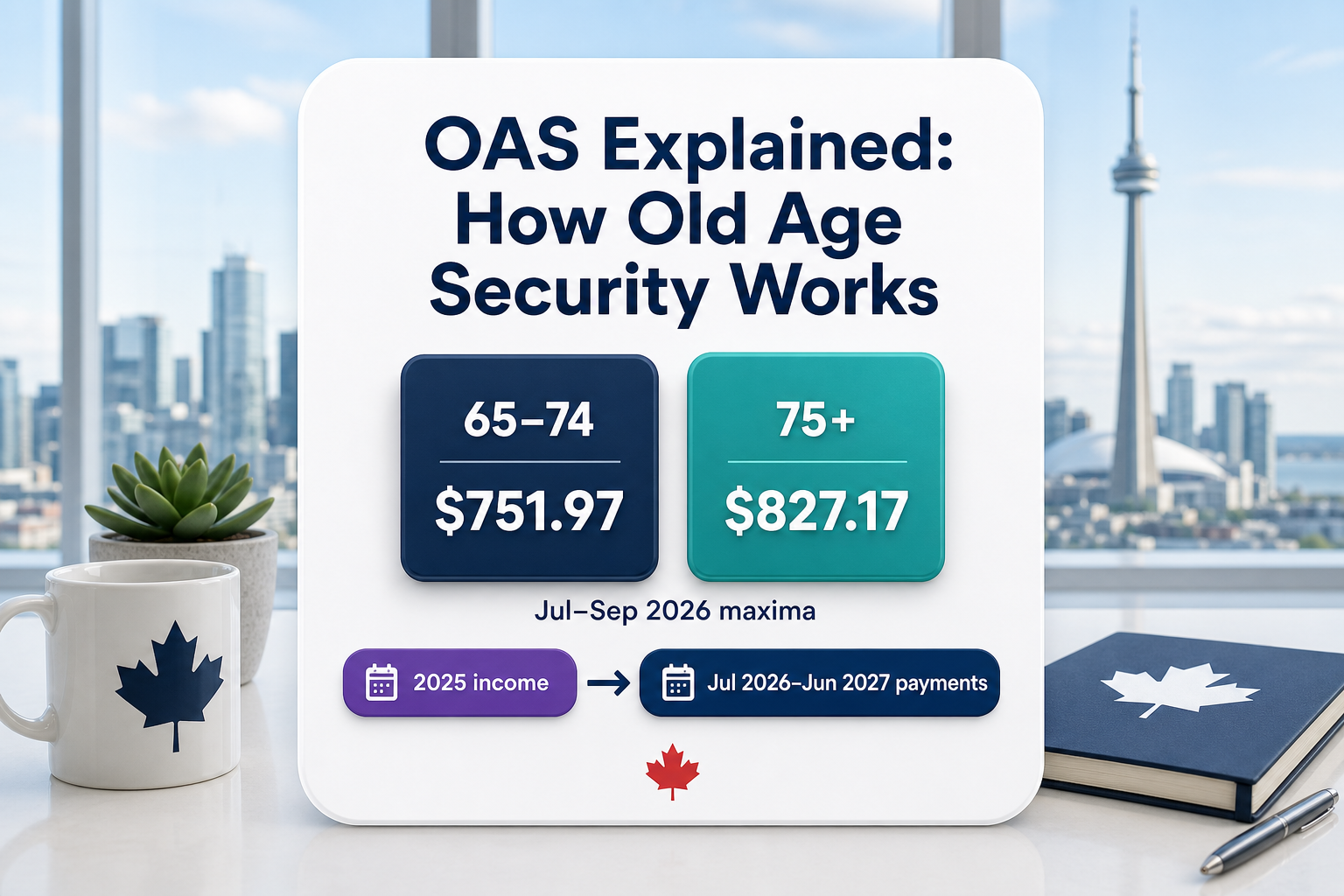
Jul–Sep 2026 amounts
Stamp the quarter. These are maximums, not a guaranteed cheque. Your amount depends on residence years, start age (deferral), and income (recovery tax). Partial-pension recipients shouldn’t treat the full-pension table as theirs — use Service Canada’s estimator or contact them.
| Ages | Maximum monthly OAS · Jul–Sep 2026 |
|---|---|
| 65–74 | $751.97 |
| 75+ | $827.17 |
The 75+ rate is a permanent 10% increase (from July 2022). It starts automatically the month after your 75th birthday and does not reduce GIS.
Amounts are indexed quarterly to CPI (January, April, July, October). They don’t fall if CPI falls. The latest bump for Jul–Sep 2026 was +1.2%. A further +1.4% is announced for Oct–Dec 2026 — percent only until that quarter’s dollar table is published.
Deferral to 70
You can start at 65 or delay up to 70. Each month after 65 adds +0.6% (+7.2% per year) → +36% at 70. There’s no advantage waiting past 70.
Official Jul–Sep 2026 maximum illustrations (full pension × factor):
| Start age | Maximum monthly · Jul–Sep 2026 |
|---|---|
| 65 | $751.97 |
| 66 | $806.11 |
| 67 | $860.25 |
| 68 | $914.40 |
| 69 | $968.54 |
| 70 | $1,022.68 |
$751.97 × 1.36 = $1,022.68. These are maximum × factor — not a personal partial-pension quote.
CPP early/late factors are different (CPP can start at 60; the late uplift isn’t the same +0.6%/month rule). Don’t mix the two tables.
Official tip: don’t delay OAS if you’re GIS-eligible or already over 70. You can’t get GIS without OAS. Your spouse can’t get the Allowance while you defer. GIS and Allowance amounts don’t rise to make up for a delayed start.
If you’re already over 65 and didn’t choose to defer, you may get up to 11 months before you apply. Months inside a chosen deferral period aren’t paid retroactively. Auto-enrollment tends to start you; delaying is an active choice through My Service Canada Account or the paper form.
Clawback: which income year, which payment period
“OAS clawback” is the official OAS pension recovery tax. You repay 15% of net income above the threshold, up to the OAS you received (full clawback at the published maximum-income lines).
Stamp both labels every time:
| Recovery tax / payment period | Income year that triggers it | Minimum threshold | Full clawback (65–74) | Full clawback (75+) |
|---|---|---|---|---|
| Jul 2025 – Jun 2026 | 2024 | $90,997 | $148,451 | $154,196 |
| Jul 2026 – Jun 2027 | 2025 | $93,454 | $152,062 | $157,923 |
| Jul 2027 – Jun 2028 | 2026 | $95,323 | $155,109¹ | $161,088¹ |
¹ On the recovery-tax page, Jan–Sep of the current tax year these maxima are estimates based on max OAS; finals land Oct–Dec. The worked example below uses the final path: 2025 income → Jul 2026–Jun 2027.
Filing vs withholding:
- You receive OAS through the year (T4A(OAS) / income statement each February).
- On your 2025 return (filed spring 2026), if net income before adjustments (line 23400) exceeds $93,454, calculate repayment and enter it on lines 23500 and 42200.
- That repayment relates to the Jul 2026 – Jun 2027 recovery period — not a vague “2026 threshold on 2025 cheques.”
- Going forward, CRA/Service Canada withholds an estimated recovery tax from monthly OAS (annual amount ÷ 12) starting July after the income year — you’ll get an Advisory Letter. canada.ca’s example: $981.90 annual → about $82/month from July 2026.
- Amounts already withheld show in box 22 of T4A(OAS); claim them on line 43700 (don’t put box 22 on line 23200).
Plain version of the lag: last year’s income shapes next July–June’s withholdings. That’s why mixing a “2025 threshold” with a “2026 OAS amount” confuses people.
Net income for the test includes pensions, EI, salaries, rent, RRSP withdrawals, taxable interest, dividends, gains, and similar. It does not include OAS itself, GIS, Allowance, Allowance for the Survivor, RDSP, or the GST/HST credit. The OAS recovery tax looks at your net world income — not combined spouse income (GIS can use combined income where the rules say so). Non-residents have a separate recovery path; see the recovery-tax page.
Taxable registered withdrawals can push you over the line. TFSA withdrawal rules explain tax-free withdrawals as a pointer — not a multi-year sequencing playbook. Account priority lives on TFSA vs RRSP vs FHSA.
Blake’s clawback (2025 income → Jul 2026–Jun 2027)
The figures below are an illustrative example, not an average Canadian senior and not a My Service Canada Account quote.
Blake lives in Regina, turns 65 in mid-2026, and receives the full OAS pension (40+ years residence). Not a GIS household. 2025 net income for recovery = $100,000. Threshold for income year 2025 = $93,454. Recovery period = July 2026 – June 2027.
| Step | Math | Result |
|---|---|---|
| Income above threshold | $100,000 − $93,454 | $6,546 |
| Annual repayment (15%) | $6,546 × 0.15 | $981.90 |
| Approx. monthly withholding from Jul 2026 | $981.90 ÷ 12 | ~$81.83 (canada.ca rounds the example to ~$82/mo) |
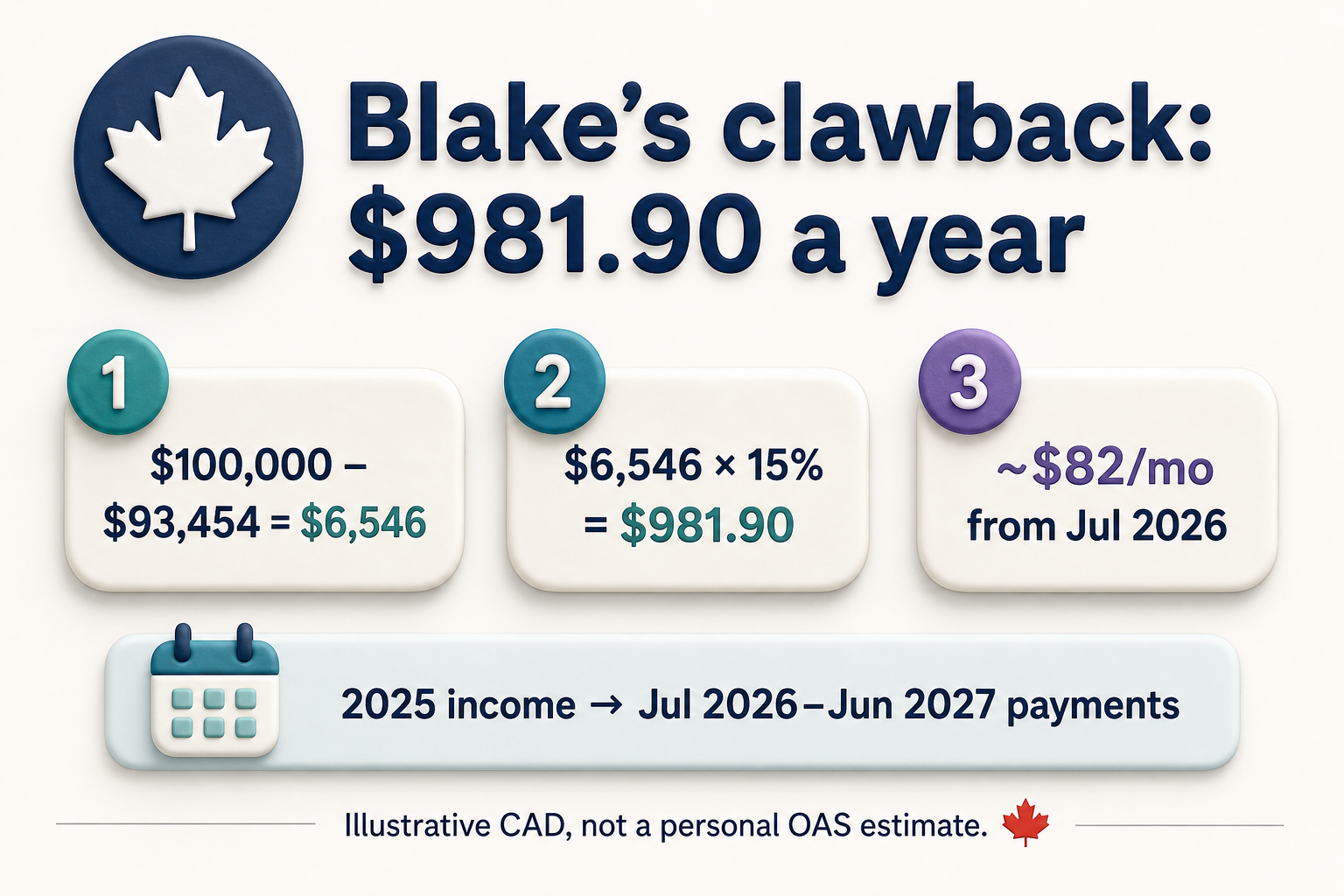
On the 2025 return, Blake enters the repayment on lines 23500 and 42200. Withholdings start July 2026 for that recovery period; later box 22 → line 43700.
The $93,454 figure is a 2025 income-year threshold. It governs recovery against Jul 2026–Jun 2027 payments. It is not “the 2026 OAS amount,” and it isn’t interchangeable with the 2026 income-year threshold ($95,323, which maps to Jul 2027–Jun 2028).
Other forks (no second named person):
- 2025 income ≤ $93,454 → $0 recovery for Jul 2026–Jun 2027.
- 2025 income at or above the full-clawback lines ($152,062 ages 65–74 / $157,923 ages 75+) → the entire OAS for that recovery period is repayable (cite the official maxima).
- Partial pension at 20/40 years: base cheque before deferral/clawback = $375.99/mo at Jul–Sep 2026 full-max rates ($751.97 × 0.5); recovery still applies to what you actually receive.
GIS in brief
The Guaranteed Income Supplement is a monthly tax-free top-up if you receive OAS, are 65+, live in Canada as a citizen or legal resident, have income below the marital-status thresholds, and aren’t under sponsorship.
Jul–Sep 2026 maxima (payments page): single, widowed, or divorced up to $1,123.17/mo if income is under $22,800; if your spouse is also on full OAS, up to $676.09 each if combined income is under $30,096. Other spouse situations are on the same table.
GIS is recalculated each July from prior-calendar-year net income. File your taxes (or report income) so it doesn’t stop or drop — Service Canada looks to 2025 taxes for ongoing GIS this cycle.
Again: don’t defer OAS if you’re GIS-eligible. No OAS means no GIS for that period. Allowance and Allowance for the Survivor (ages 60–64) exist too — Jul–Sep 2026 maxima up to $1,428.06 and $1,702.34 — named here only; not a full tutorial.
Apply, delay, estimate
Most people get an auto-enroll letter around their 64th birthday. No letter about a month after that birthday → contact Service Canada or apply. Delay or change your start date in My Service Canada Account or with form ISP-3550. The OAS Benefits Estimator on the payments page is the official personal scenario tool.
OAS is a floor
Public pensions don’t replace a full retirement plan. Funding the gap sits on How Much Should You Save Each Month?. Tax-free vs taxable withdrawal context is TFSA Withdrawal Rules and TFSA vs RRSP vs FHSA. Cash-flow hygiene is How to Budget in Canada. Once a savings amount exists, How to Automate Savings Goals in Canada is the PAC. Liquidity before optimizing retirement is How Much Emergency Fund Do I Need in Canada?.
See OAS beside the rest of the picture
Finnomia’s Retirement Planner builds nest-egg and public-pension estimates, including OAS — not advice. It tracks those scenarios; it doesn’t hold accounts or move money. If you want that sitting next to your other numbers, start a 14-day free trial.
How much is OAS in Jul–Sep 2026?
Up to $751.97 a month at ages 65–74, and up to $827.17 at 75+ — those are maximums for July to September 2026, not a guaranteed cheque.
Will I lose OAS to the clawback?
You repay 15% of net income above the threshold for the matching recovery period. For 2025 income, the threshold is $93,454, and it applies to Jul 2026–Jun 2027 payments — not “this year’s OAS amount” mixed with “this year’s tax return” in one blur.
Should I delay OAS to 70?
Deferral adds +0.6% per month after 65 (+36% at 70). If you’re GIS-eligible, Service Canada’s guidance is not to wait — you can’t get GIS without OAS.
This article was published in September 2026 and is general information, not personalized tax, legal, or retirement advice. Confirm current amounts, thresholds, and your own estimate on canada.ca, CRA, and My Service Canada Account. Quarterly OAS amounts and recovery thresholds change.