
On this page
A month can still fail on a Wednesday even when the categories add up. You already know why — cash flow versus budget is the definition. This page is how to build a dated running-balance forecast so you see that Wednesday early.
There is no official Canadian horizon. 30, 60, or 90 days are options. Longer shows more PADs and guesses more on groceries. Start with 30 if this is the first sheet. Extend once the short window is honest.
Start with cleared, not "available"
The opening number is the cleared balance you could spend today if holds released tomorrow's pending deposits. Pending deposits and authorization holds are not spendable rows until they clear. Banks label this differently; the idea is the same.
Forecast the account that pays the PADs — usually chequing. A transfer to savings is an outflow on that forecast. Don't fold TFSA market value into the running cash line.
Build the sheet
Columns: Date | Description | In (+) | Out (−) | Running balance. Optional type: income, PAD, card payment, variable, transfer.
Add dated income from pay stubs or deposit history. If you are paid every two weeks, each deposit is just a dated row — How to Budget When You're Paid Biweekly is the 26-pay operating system, not this page.
Add dated outflows: rent or mortgage, insurance, utilities, phone, known PADs, scheduled card payments. FCAC: a PAD leaves on the agreement's schedule. Variable-amount PADs get 10 days' written notice unless you waived it, so hydro or insurance belongs as a dated estimate you update when the notice arrives.
Planned variable (groceries, fuel, discretionary): a weekly lump or a daily average for the horizon. Mark it planned, not last month's actual.
Known annual bills enter as dated lines once you know them. The 12-month inventory is How to Budget for Expenses That Don't Happen Every Month; named pots are sinking funds. Don't rebuild either here.
Running balance: previous balance + in − out. Sort by date. Circle the lowest projected day in the horizon. That line is the job. A failed PAD can still cost money; the forecast's job is to see the day early. How much to keep in chequing as an operating balance is a different article.
Federal low-balance e-alerts default to $100. Raise the threshold toward the zone that makes you uncomfortable, so the bank warns you before the lowest day, not after. An alert is a backstop, not the sheet.
Casey's 30 days
The figures below are an illustrative example, not an average Canadian household.
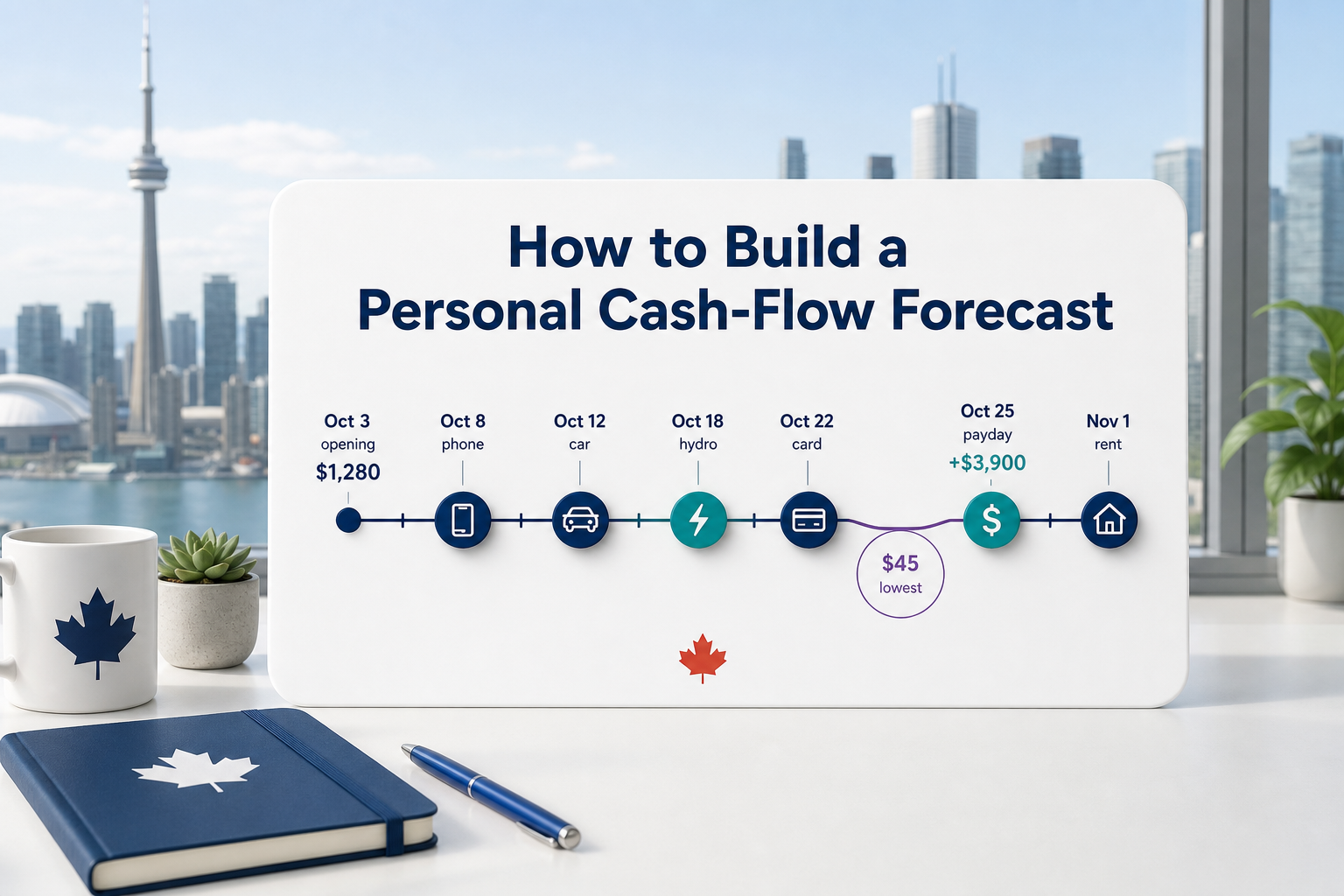
Casey is paid monthly on the 25th, net $3,900. The forecast starts October 3 with cleared chequing of $1,280, and runs 30 days through November 1.
Fixed outflows before payday: phone and internet $145 on October 8; car insurance $210 on October 12; hydro estimate $110 on October 18; credit-card payment $350 on October 22. Planned variable $140 a week for three weeks before payday = $420. Next income +$3,900 on October 25. Rent PAD $1,750 on November 1.
| Date | Event | Running balance |
|---|---|---|
| Oct 3 | Opening cleared | $1,280 |
| Oct 8 | −$145 phone | $1,135 |
| Oct 12 | −$210 car | $925 |
| Oct 18 | −$110 hydro | $815 |
| Oct 22 | −$350 card | $465 |
| Oct 3–24 variable | −$420 | $45 (lowest before payday) |
| Oct 25 | +$3,900 pay | $3,945 |
| Nov 1 | −$1,750 rent | $2,195 |
$1,280 − $145 − $210 − $110 − $350 − $420 = $45. Then $45 + $3,900 = $3,945. Then $3,945 − $1,750 = $2,195.
The $420 is three weekly $140 rows on the sheet. The table combines them at the lowest day so the before-payday floor is one number.
Change one date before you cut the plan
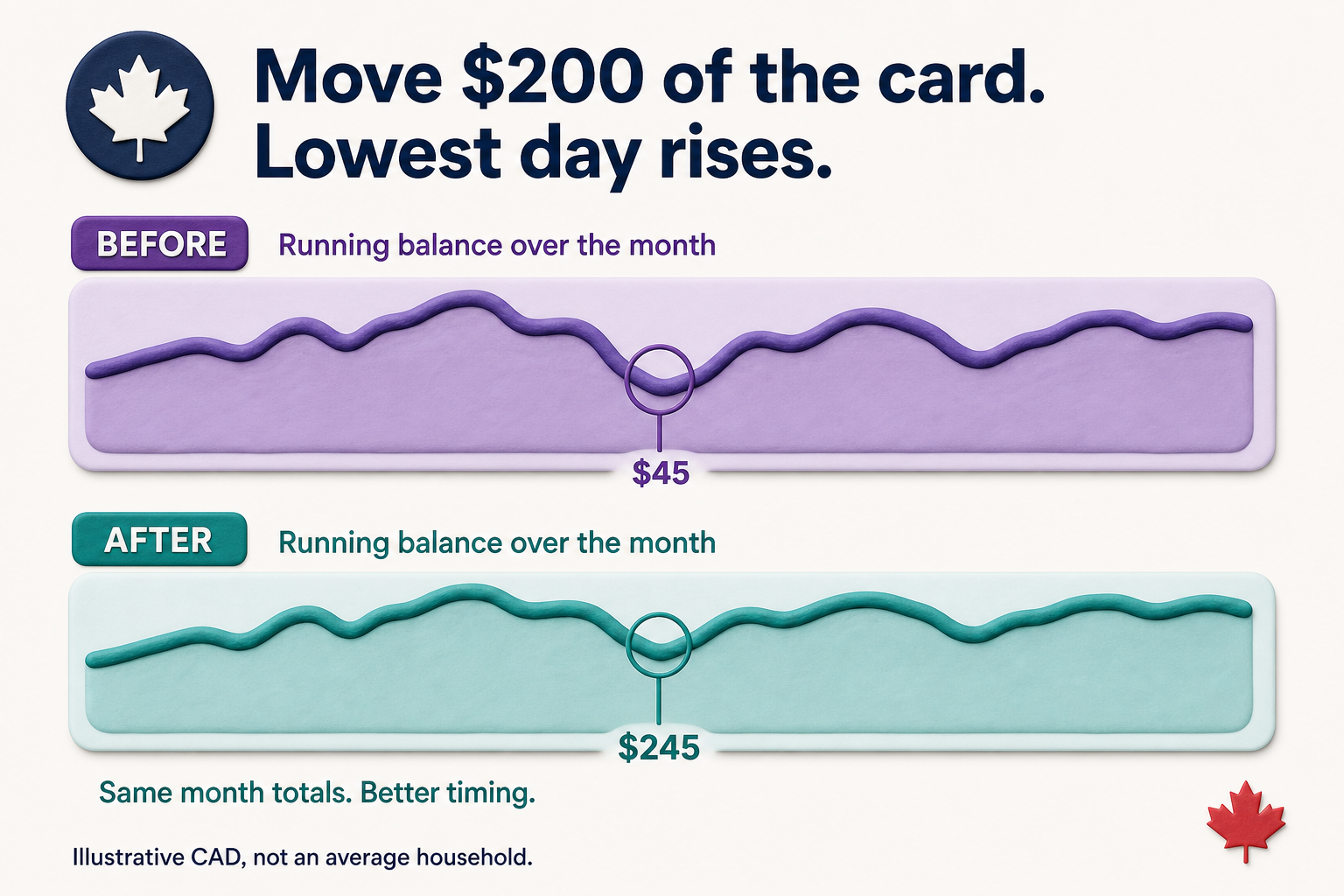
Move $200 of the card payment to October 27, after payday. Before-payday outflows drop by $200. The lowest day becomes $245 instead of $45. Same month totals; better timing. Prefer a timing fix before you cut a category plan that already works on paper.
If the amount arriving changes from month to month, that is irregular income, not a date map.
Reconcile every week
Replace planned rows with actuals for the days that have passed. Extend the horizon by the same number of days so it stays a rolling 30 (or 60, or 90). Large recurring misses belong in the plan — FCAC's month-end compare. One-offs stay notes. The 20-minute monthly money review is the ritual; this sheet is what you glance at inside it.
A first monthly budget, if you still need the steps, is How to Budget in Canada.
See the lowest day before it hits
Finnomia's cash-flow forecast shows dated bills against pay so the lowest day is visible before it hits. It tracks those dates; it doesn't hold accounts or move money. If you want that 30-day strip in one place, start a 14-day free trial.
What is a personal cash-flow forecast?
A dated list of money in and money out, with a running chequing balance, so you can see the lowest day before it arrives. It is not a second budget.
How far ahead should I forecast?
There is no official Canadian horizon. Start with 30 days. Use 60 or 90 once the short window matches reality.
Should I start from the available balance in the app?
Start from cleared. Pending deposits and holds are not spendable until they clear.
This article was published in September 2026 and is general information, not personalized financial advice. Use your own cleared balances, PAD dates and pay dates. PAD rules and e-alert defaults can vary by institution.