
On this page
A monthly budget can add up and still bounce rent on the 1st. Insurance follows on the 3rd. The first paycheque of the month doesn't land until the 9th. The categories were fine. The calendar was not.
That gap is cash flow, not a budget that is “too big.”
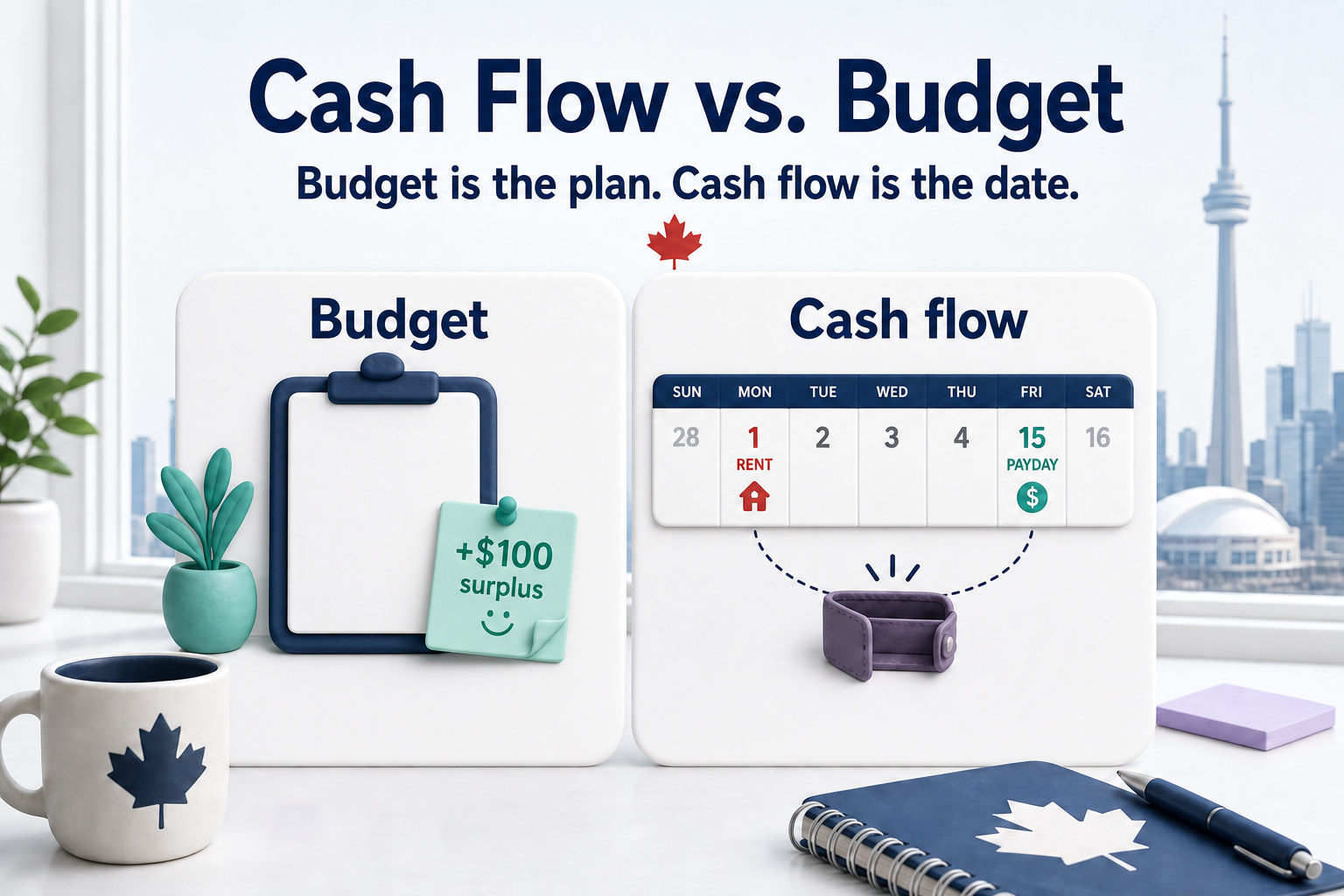
A budget answers what the money is for this month. Cash flow answers when it actually sits in chequing. If the plan already works on paper, cutting groceries won't fix a payment that hits eight days before payday.
Budget is the plan. Cash flow is the date.
The Financial Consumer Agency of Canada describes a budget as “a plan that helps you manage your money.” It helps you figure out how much money you get, spend and save. You compare that plan with what actually happened and adjust the figures that keep missing.
That is the monthly what: categories, totals, and whether the month as a whole is sustainable. The how-to lives in How to Budget in Canada. Use that for the steps. This article is only the timing problem.
Cash flow is narrower. It is cash in the account on the morning a pre-authorized debit leaves. It is not accrual accounting, and it is not a small-business 13-week forecast. For a household, it is simply: will this PAD clear today?
| Budget | Cash flow | |
|---|---|---|
| Question | What is this month’s money for? | Is the cash there on the due date? |
| Time grain | The month as a whole | Specific days |
| Looks at | Categories and totals | Pay dates vs. bill dates |
| Success | Plan matches the month | Payments clear when they are due |
| Failure | Spending exceeds the plan | NSF, a bounced PAD, or overdraft interest on a month that still balances |
You can fail cash flow while passing the budget. That is the distinction.
A month that works on paper and still runs short
The figures below are an illustrative example, not an average Canadian household.
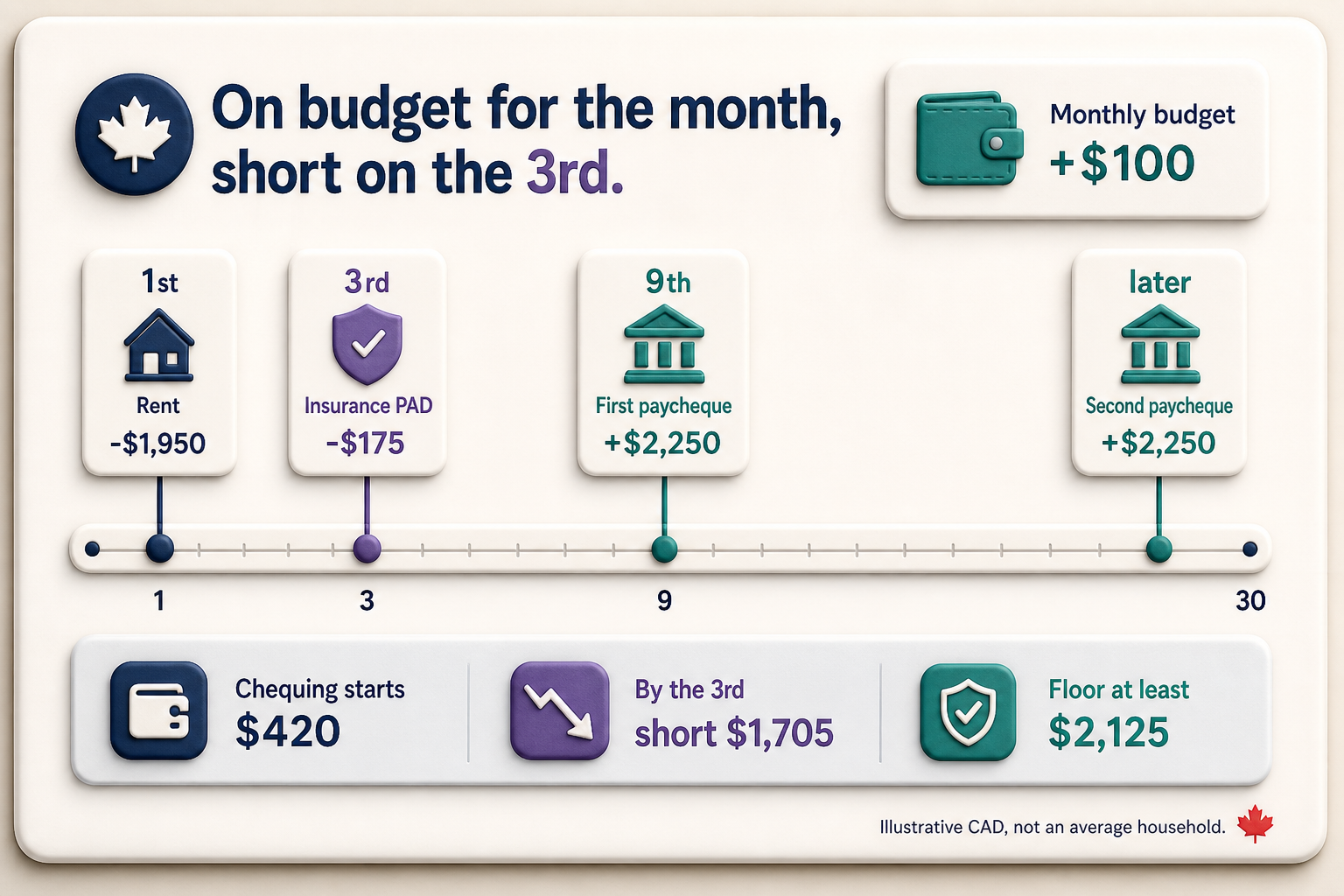
The monthly plan is $4,400. Two paycheques of $2,250 arrive during the month, so $4,500 comes in. On paper there is a $100 surplus.
Rent of $1,950 is due on the 1st. An insurance PAD of $175 leaves on the 3rd. The first paycheque doesn't arrive until the 9th. Chequing starts the month at $420.
The 1st already fails: $1,950 rent against $420. By the 3rd the account needs $2,125 and still has only that $420. It is short $1,705. A later paycheque will make the month look fine. It doesn't help the 1st or the 3rd.
The useful move is not to shrink a plan that already has room. It is to stop treating the leftover on the 30th as fully spendable or fully sweepable. If this household had kept a chequing floor of at least $2,125 instead of moving the surplus out at month-end, rent on the 1st and insurance on the 3rd would both have cleared. Same categories. The cash was already in the month. It just wasn't in chequing on those dates.
That is a buffer for a known gap, not a tutorial in calling the landlord to move rent. And it isn't a reason to cut a category plan that already balances.
Why this is so common here
A lot of Canadian housing and insurance leaves early in the month, often on the 1st. Pay doesn't always arrive on the same calendar. Many people are paid every two weeks, so some months contain an extra paycheque. That extra cheque is real. It doesn't make every month interchangeable, and it doesn't close the gap on the 1st.
Variable income is a different problem: the amount arriving changes. How to Budget With Irregular Income is the page for that. Here the paycheques can be the same size every time and you can still overdraft, because the bills are clustered before payday.
Predictable bills that don't hit every month still belong in the monthly plan. Annualizing them, naming sinking funds, and sizing an emergency reserve are separate jobs. How much to keep as true emergency savings is How Much Emergency Fund Do I Need in Canada?.
A chequing floor is not an emergency fund
Keep enough in chequing to cover the worst gap between pay dates and the PADs that land first. That money has a job: the 1st of the month, not a surprise.
An emergency fund is for costs you didn't put on the calendar. Mixing the two is how the “emergency” account pays rent every month and then is empty when something actually unexpected happens. If you are still building that reserve, Finnomia’s free Emergency Fund Calculator turns essential monthly costs into a target. Don't use the chequing floor as a substitute for it.
Automatic transfers on payday are useful only if they don't empty chequing before rent leaves. If a savings sweep is what makes the 1st bounce, the transfer is the cash-flow problem. Automating Savings Goals covers the habit; the constraint here is the date.
NSF and overdraft are different costs
A declined PAD and an overdraft are not the same fee.
As of March 12, 2026, federally regulated banks and federal credit unions may charge at most $10 for an NSF on a personal deposit account. They can't charge a second NSF on the same account within two business days, and they can't charge NSF if the overdraft is under $10. The old $45–$48 NSF range is what those fees often looked like before the cap. It isn't the current federal rule. Provincial credit unions can still set different fees, and business accounts are outside this cap.
Overdraft protection is a separate product. FCAC says the monthly fee is usually around $5, or a pay-per-use fee of at most $5, with interest usually around 21–22%. Those figures are “usually around,” not your bank’s exact tariff. Overdraft can stop a PAD from bouncing. It is a short-term backstop, not a cash-flow system.
Low-balance alerts are the cheaper habit. The federal default for that alert is $100; you can raise it, lower it, or opt out. Set it high enough that you get a warning before the early-month PADs, not after they bounce.
This month, map the dates
You don't need a new budgeting method for this.
Write down the dates money arrives and the dates PADs and rent leave. Mark the worst gap. Keep a chequing floor that covers that gap, and turn on an alert before the account gets there. Then compare the month’s totals with the plan the way you already should: FCAC’s advice is still to review the budget against actuals monthly. For the savings-rate math once the timing is stable, use How Much Should You Save Each Month?.
If you are paid every two weeks, the extra paycheque some months is a separate decision from the gap on the 1st. Don't spend it in your head before it arrives, and don't assume it will always land in time for rent.
Can a balanced budget still overdraft?
Yes. The month can work as a set of totals while rent on the 1st hits an account that isn't funded until the 9th. Fix the dates and the chequing floor before you cut a plan that already balances.
See the “when,” not only the totals
Connected transactions, confirmed bills, and cash-flow forecasting make it visible that a month can be fine in total and still be short on Wednesday. That is the job here: the dates, not another category plan.
Finnomia currently uses Plaid for account connectivity and is adding Flinks as a second provider. Connections are read-only: Finnomia can't move your money and doesn't store your banking password. The production experience is the web app. Native iOS and Android apps are in internal beta, with broader availability targeted for the end of September 2026.
If the timing gap is what you keep missing, start a 14-day free trial and look at the next 30 days of bills against pay dates, not only the category totals.
This article was published in September 2026 and is general information, not personalized financial advice. NSF and overdraft fees depend on the institution and account type. Confirm your bank’s current tariff and use your own pay dates, PAD dates and balances.