
On this page
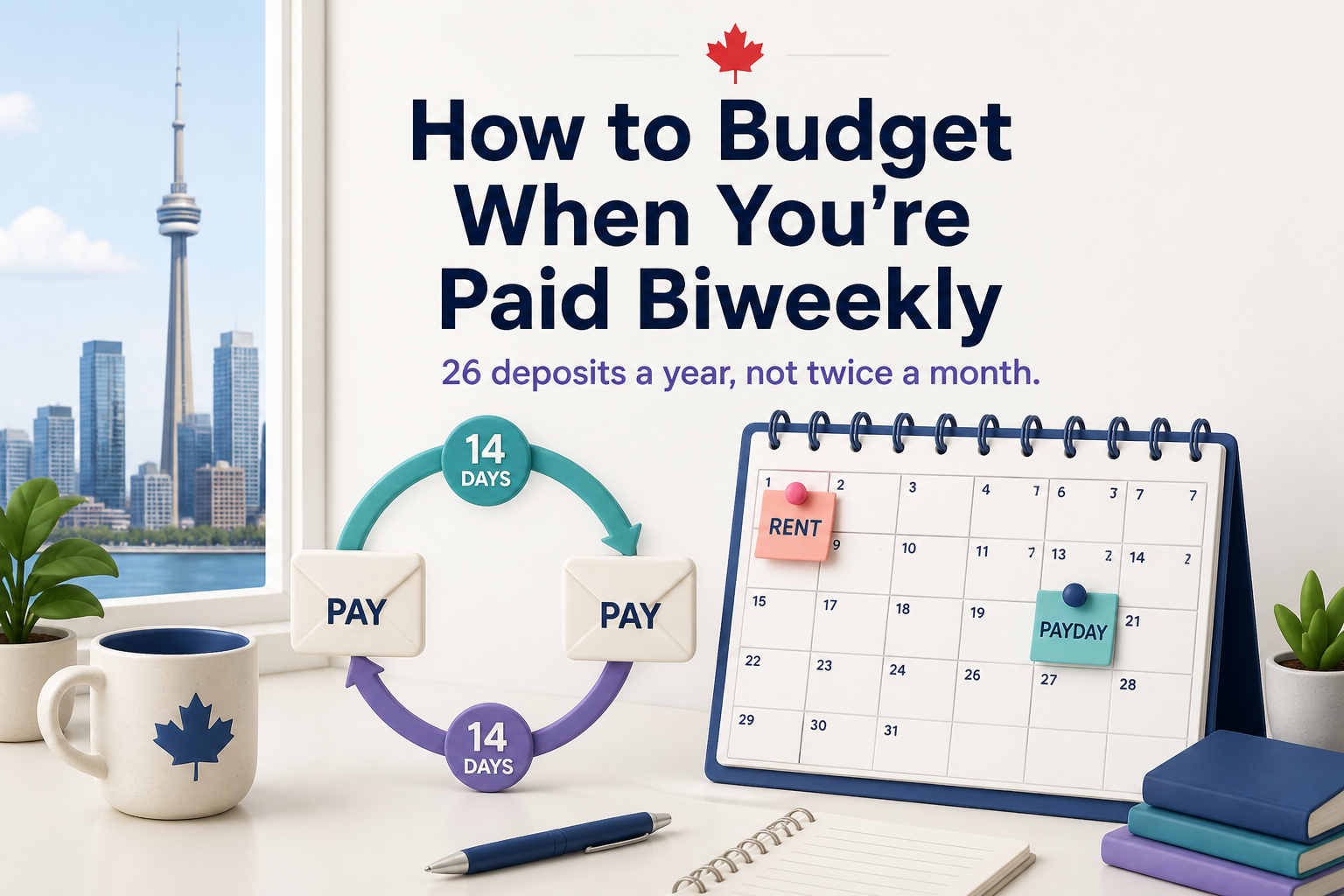
Paid every two weeks is not paid twice a month.
A biweekly paycheque arrives every 14 days. That is 26 deposits in a normal year, sometimes 27. Twice-a-month pay is 24. Two of your months will usually contain a third deposit. Which months those are depends on the weekday you get paid — there is no national 2026 calendar of “extra-pay months.”
If you take one net paycheque, multiply by two, and call that your monthly income, you are budgeting for 24 pays. The other two (or three) deposits still have to live somewhere, and rent on the 1st still does not wait for the second cheque.
The how-to for building a budget lives in How to Budget in Canada. This page is how to run a month on 26 deposits: the calendar math, the two-cheque month, and which bills attach to which paycheque.
Biweekly is not semi-monthly
| Biweekly | Semi-monthly | |
|---|---|---|
| Rhythm | Every 14 days | Two fixed dates (often the 15th and last day) |
| Deposits per year | 26, sometimes 27 | 24 |
| Pay dates | Drift through the calendar | Same dates each month |
| Third deposit | Two months usually have one | None |
Semi-monthly lines up with monthly rent more often, because a cheque tends to land near month-end. Biweekly does not. A Friday payday in January will not still be sitting on the 1st and the 15th in June.
Provincial employment standards say how often an employer must pay. They do not tell you how to turn 14 days of net pay into a month of bills.
Don't multiply by two
Two methods both work. They answer different questions.
A. Live on two cheques. In a normal month, plan as if only two paycheques will arrive. When a third cheque shows up, treat it as extra. What to do with that extra cheque is a separate decision. Don't spend it in your head during a two-cheque month.
B. Convert to a true monthly average. Net pay × 26 ÷ 12. That number is what the year actually pays you, smoothed. Use it when you need a monthly savings rate or a housing-cost ratio. Do not pretend it is sitting in chequing on the 1st.
The figures below are an illustrative example, not an average Canadian paycheque.
Net pay: $2,100 every two weeks.
- Year: $2,100 × 26 = $54,600
- True monthly average: $54,600 ÷ 12 = $4,550
- Two-cheque month: $4,200 in
- Three-cheque month: $6,300 in
If this household budgets every month as $4,550, a two-cheque month is $350 short of that average — only $4,200 arrives. The months with a third cheque are what make the year equal $4,550. If it budgets every month as $4,200, the year is understated by $4,200 (two extra cheques × $2,100). Pick a method and stick to it. Mixing them is how the monthly plan and the account balance stop matching.
For a savings number once the calendar is stable, use How Much Should You Save Each Month?. If the amount arriving changes from month to month, that is irregular income, not a 14-day cycle.
Assign bills to the cheque that lands first
List the dates money arrives. List the dates rent and PADs leave. Attach each bill to the paycheque that is already in the account before that payment goes out. Give groceries and fuel a per-cheque cap, not a monthly hope dumped into the first week.
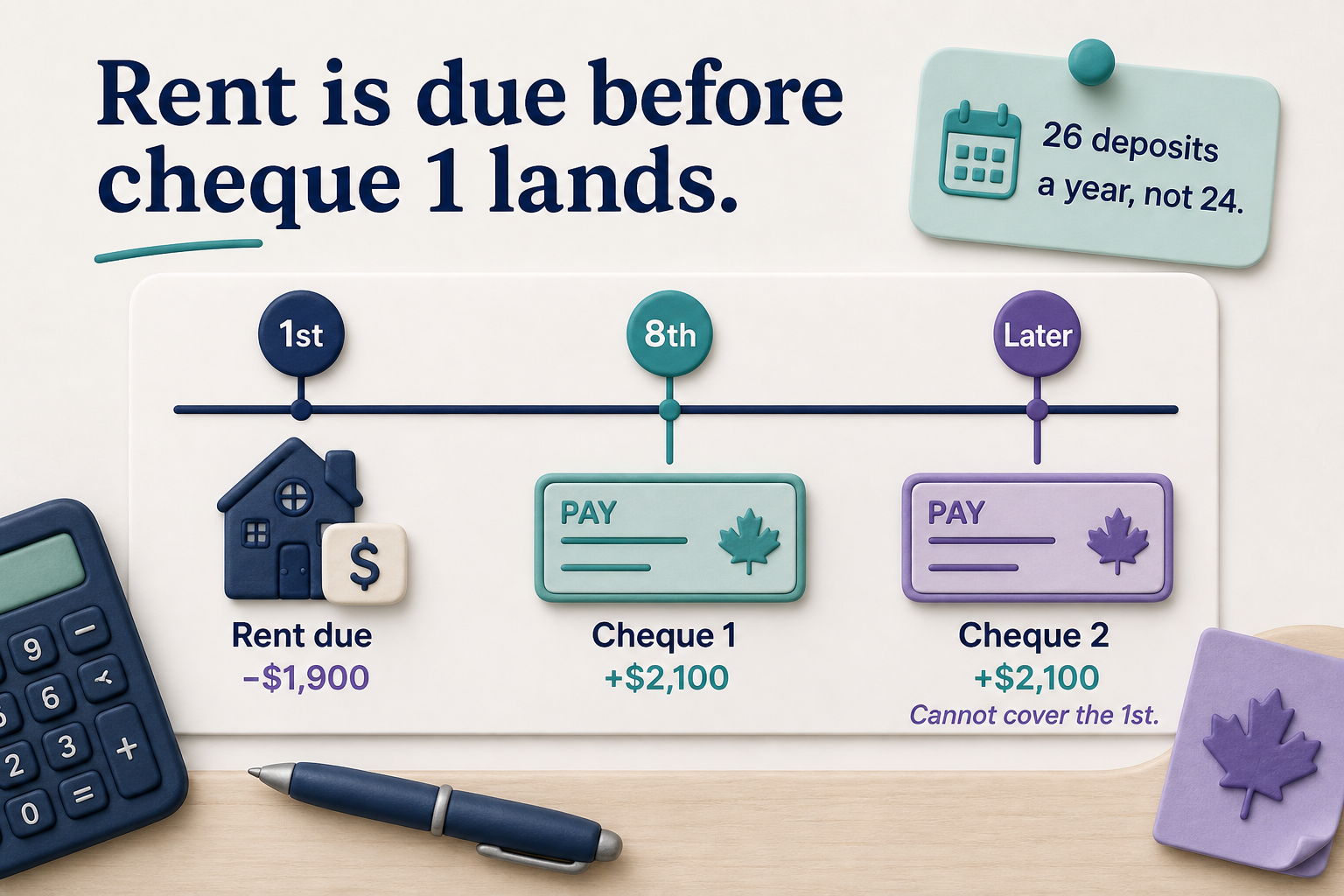
Dividing rent in half and putting $950 on each cheque only works if half the rent is actually payable from the second cheque. Usually it isn't. Rent of $1,900 due the 1st, with the first paycheque of the month landing on the 8th, is due before cheque 1 of this month arrives. Cheque 2 cannot cover the 1st. That is a timing gap, not a category problem — cash flow versus budget is the page for the chequing floor. Here it is only the assignment rule: the bill belongs to the deposit that precedes it, which may be last month's second cheque.
Same example, variable spending: groceries at $300 per cheque, not $600/month wished into the week rent already took $1,900.
The extra cheque is real. It is not this month's grocery float.
Twenty-six is larger than 24. That is why two months contain a third deposit. Don't spend it before it arrives, and don't write a job list for it here. What to do with a third paycheque is a separate decision.
Payday savings transfers are still useful if they don't empty chequing before rent leaves. If the sweep is what makes the 1st bounce, the automation is the cash-flow problem. Automating Savings Goals covers the habit; the constraint is still the date.
The Canadian budget categories list is the labels. This page is the calendar those labels sit on.
See the next two pay dates against the next PADs
Recurring bills and a cash-flow forecast make the mismatch visible: a two-cheque month, rent on the 1st, payday on the 8th. That is easier to spot on a 30-day view than in a monthly category total.
Finnomia currently uses Plaid for account connectivity and is adding Flinks as a second provider. Connections are read-only: Finnomia can't move your money and doesn't store your banking password. The production experience is the web app.
If you want those dates in one place, start a 30-day free trial.
Is biweekly the same as twice a month?
No. Biweekly is every 14 days (26 or 27 deposits a year). Twice a month is semi-monthly (24). The extra deposits are why some months have three paycheques.
Can I just multiply my paycheque by two?
Not if you want a monthly number that matches the year. $2,100 × 2 is a two-cheque month, not the $4,550 average from $2,100 × 26 ÷ 12. Either plan on two cheques and treat the third as extra, or use the annual average — don't mix them.
Which months have three paycheques?
Whichever months contain three of your paydays. It is not a national list, and it is not always March and August.
This article was published in September 2026 and is general information, not personalized financial advice. Pay dates, PAD dates and net pay come from your own records. Confirm them before you set a chequing floor or an automatic transfer.