
On this page
The third paycheque in a month is not a raise, overtime, or a bonus. It is the same net pay landing in a month that happens to contain three of your paydays.
Biweekly pay normally means 26 deposits a year, so two months contain a third — How to Budget When You're Paid Biweekly is that calendar. This page is only what to do with the extra deposit.
If the monthly plan already runs on two paycheques, the third one is uncommitted. Decide the job before it hits the account. Leaving it unnamed in chequing is how it becomes restaurants.
Give it a job before it lands
The figures below are an illustrative example, not an average Canadian household.
Sam is paid every other Thursday. Net pay is $1,800.
- Two-paycheque month: $3,600 in
- Three-paycheque month: $5,400 in
- Third deposit: $1,800
Sam’s monthly plan is already $3,550 — the two-paycheque method. A car-loan PAD on the 20th and hydro on the 22nd are assigned to the first two Thursdays. The third Thursday’s $1,800 has no job yet.
That $1,800 is not overtime. If a deposit is larger because of extra hours, only the usual $1,800 is the calendar extra. A work bonus is a different problem.
A useful order — not a law
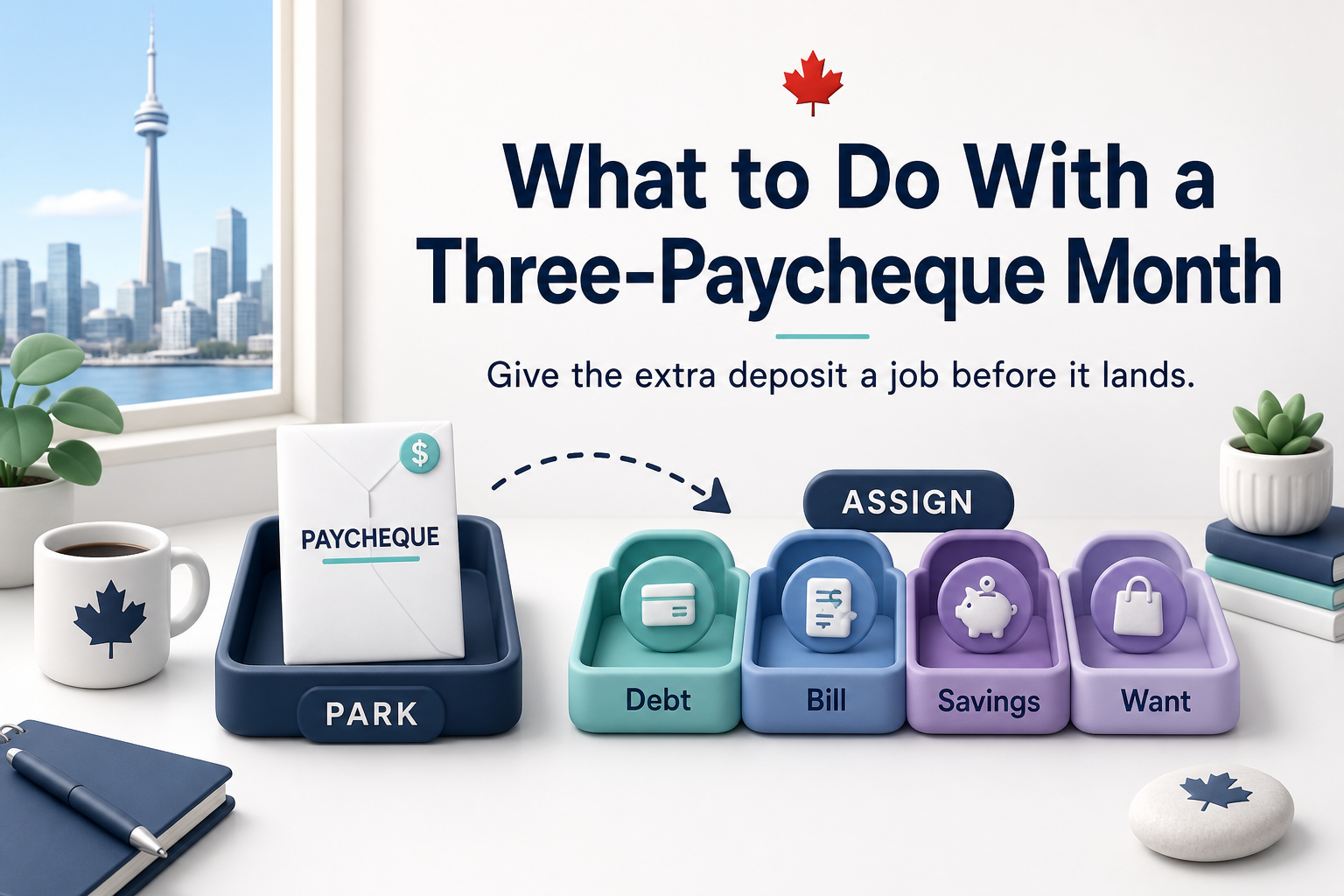
Work down the list until the $1,800 is assigned. Skip any row that does not apply.
1. Catch-up. If two-paycheque months still bounce, the extra deposit can fund the gap. That is a timing problem, not an allocation puzzle — cash flow versus budget. Sam’s 20th and 22nd already clear, so this row is skipped.
2. Extra principal on high-interest revolving debt. Make every minimum as usual. Send extra to the expensive card. Which balance comes first is Debt Payoff Strategies in Canada; this page does not retell avalanche versus snowball. The budget that has to survive the other ten months is How to Budget While Paying Off Debt.
3. A named near-term bill you already know is coming. Winter tires, property tax, a dental bill — label it. How to annualize a year of those costs, and how to run named sinking funds, are separate jobs.
4. Emergency cash or a registered contribution. An emergency fund is for costs you did not put on the calendar; How Much Emergency Fund Do I Need in Canada? is the sizing page. TFSA, RRSP, or FHSA is a savings label here, not a which-account essay — TFSA vs. RRSP vs. FHSA.
5. A planned want, labelled. Leftover is not the default. If something fun gets a slice, name it in advance. Commentator splits such as “10–15% fun” are not a rule.
A named split in advance is enough. Sam, for example, could send $1,000 extra to a card at 19.99% (that rate is illustrative, not a typical-bank figure), $500 to a TFSA, and $300 to a labelled weekend. That is $1,800. It is one household’s choice, not a template.
Move it the day it lands
A decision that stays in chequing until month-end is not a decision. Transfer, extra payment, or contribution on the Thursday the third deposit arrives. Automating that one deposit — not every payday sweep — is the useful habit. Automating Savings Goals is the broader payday transfer; here the point is that this deposit already has a name.
Do not spend the third paycheque in your head during a two-paycheque month. It has not arrived.
See the third Thursday coming
A 30-day view of recurring bills against pay dates makes the extra deposit visible while there is still time to assign it. If you want that calendar in one place, start a 14-day free trial.
Is a three-paycheque month extra income?
No. It is the same employment income on a month that contains three paydays. It is not a bonus and not a raise.
Which months have three paycheques in 2026?
Whichever months contain three of your paydays. There is no national list.
Should I treat it as fun money?
Only the slice you labelled in advance. The default job is catch-up, expensive debt, a named bill, or savings — then a planned want if anything is left.
This article was published in September 2026 and is general information, not personalized financial or tax advice. Interest rates, contribution room and due dates come from your own statements. Confirm them before you move the deposit.