
On this page
A budget that only looks at this month is missing a year of bills you already know about. Auto insurance, winter tires, property tax, dental, holiday gifts — they are on last year’s statements. They are not surprises. They just do not hit every pay cycle.
Search usually calls these irregular expenses. That phrase is easy to mix up with irregular income, which is when the amount arriving changes. How to Budget With Irregular Income is that problem. This page is the known costs that skip months.
Some budgeting methods call them “true expenses.” That is method slang, not an FCAC term. The job is the same: find them, add them, and give them a monthly number.
Pull twelve months, not thirty days
A 30-day export will miss last June’s tire swap. FCAC’s first budget can start with one or two months of stubs, bills and statements. This job needs a year.
Go through chequing, credit cards, and the bills calendar for the last 12 months. Mark every cost that did not show up in most months but was still a known bill.
Skip anything that is unused. Skip rent and groceries if they already have a monthly line. You are hunting the ones a monthly-only plan pretends are optional.
A Canadian checklist — skip the rows you do not use
- Annual or semi-annual auto, home, or tenant insurance
- Property tax, if you pay it yourself (skip it if it is already in the mortgage payment; instalment schedules vary)
- Licence-plate renewal
- Winter tires and the two seasonal swaps
- Heating oil, or a winter hydro spike you can see in last year’s bills
- Professional dues
- Annual subscriptions
- Dental, glasses, and paramedical the public plan does not cover
- Back-to-school costs
- Summer-camp lumps
- Holiday gifts and travel you already take
- Pet annual checkup (not an emergency vet visit)
- Routine car and home maintenance
That is not a second copy of the Canadian budget categories list. It is the subset that skips months.
A sudden engine failure is not on this list. How Much Emergency Fund Do I Need in Canada? is the page for costs you could not reasonably put on the calendar.
Two formulas
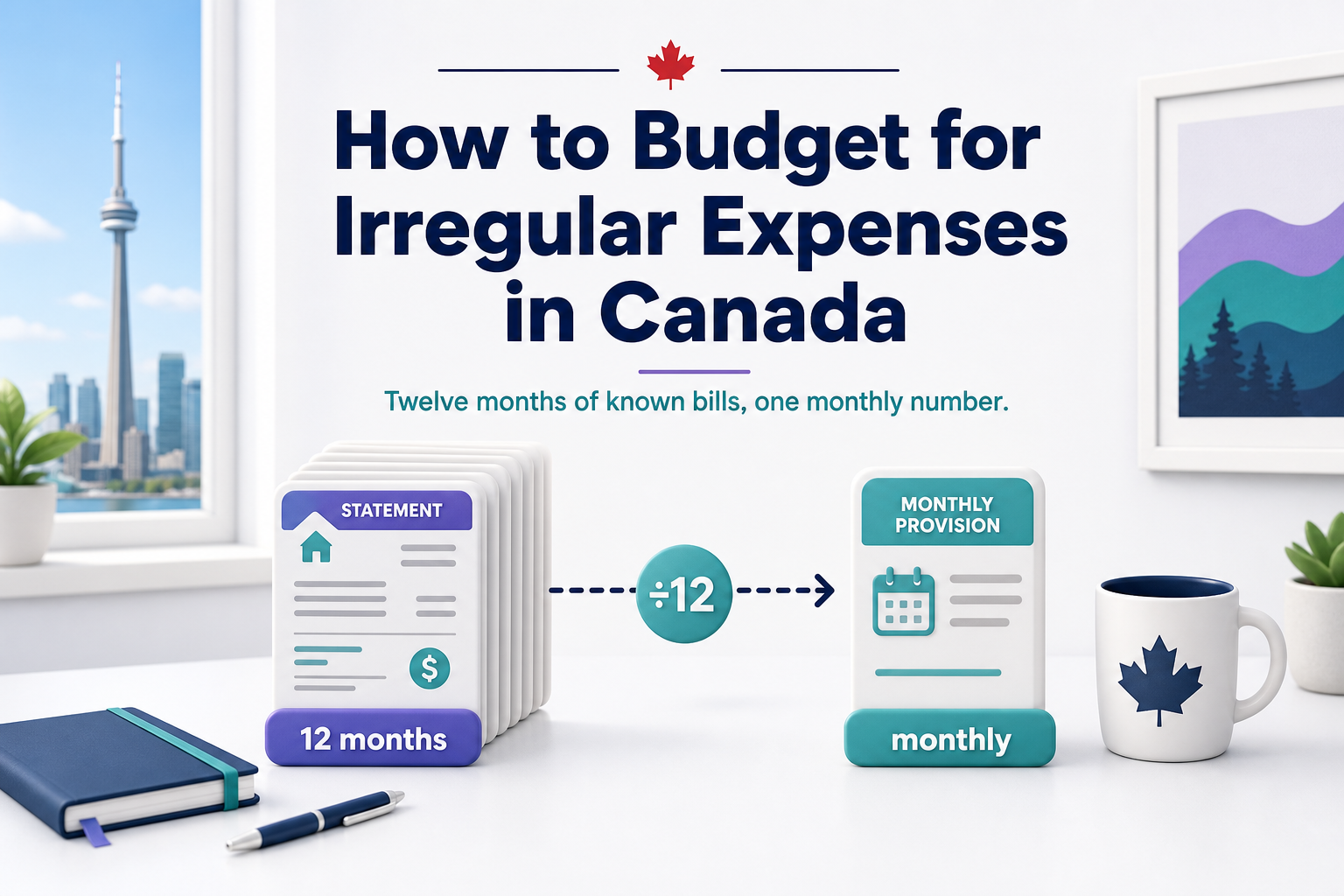
Annual ÷ 12. Last year’s total for that item, divided by twelve, is this year’s monthly provision.
Catch-up. If the bill is close and the pot is empty, amount still needed ÷ months remaining. After that bill is paid, revert to ÷ 12.
Semi-annual bills: each invoice ÷ months until the next one, or (amount × 2) ÷ 12. Same math.
One provision line is enough at this stage. Where that cash actually lives — a named sinking fund — is a separate job. Do not add 20% “just in case,” and do not treat 1–2% of income as a rule. Use last year’s numbers.
If the monthly total does not fit, cut a cost or fully fund the three largest known bills first. Pretending October insurance is not coming is not a plan.
Priya’s year, turned into $340 a month
The figures below are an illustrative example, not typical Canadian premiums, and not an average household.
Priya is a renter, paid monthly on the 15th. She does this audit in June.
| Item | When it hit | Last 12 months | ÷ 12 |
|---|---|---|---|
| Auto insurance (lump) | October | $1,560 | $130 |
| Tenant insurance | March | $240 | $20 |
| Winter tires + two swaps | Oct / Apr | $480 | $40 |
| Dental (not fully covered) | ~2 visits | $360 | $30 |
| Gifts | Nov–Dec + birthdays | $720 | $60 |
| Car maintenance | twice a year | $480 | $40 |
| Professional dues | January | $240 | $20 |
| Total | $4,080 | $340 |
$4,080 ÷ 12 = $340. The monthly column adds to $340 as well.
Catch-up on one bill: October auto insurance is $1,560, the pot is $0 in June, and four months remain. $1,560 ÷ 4 = $390 a month until October — that $390 is instead of the $130 insurance line ($210 + $390 = $600), not $390 on top of $340. After the invoice is paid, that line drops back to $130. The other rows stay on their ÷12 amounts. That is not a national due-date calendar — it is Priya’s October.
If $600 does not fit this summer, she still has a choice: cut a line, or fund insurance, tires, and gifts first and let smaller rows wait. The year still contains those bills.
For a first monthly plan, How to Budget in Canada is the steps. For what remains after living costs and this provision, How Much Should You Save Each Month? is the savings-capacity page — do not rebuild that math here. Where Is My Money Going? is the audit if last year’s totals will not reconcile.
See last year’s lumps on a calendar
Twelve months of transactions and a bills calendar make the annual items visible before they hit. If you want that year in one place, start a 30-day free trial.
What are irregular expenses?
Known costs that do not hit every month — insurance, tires, property tax, dental, gifts. They are not the same as irregular income, and they are not emergencies.
How do I budget for them?
Add last year’s amounts and divide by 12. If a bill is close and you have not saved yet, divide what is still needed by the months left, then go back to ÷ 12.
Is this an emergency fund?
No. An emergency fund is for costs you did not put on the calendar. These bills were already on last year’s statements.
This article was published in September 2026 and is general information, not personalized financial advice. Use your own statements for amounts and due dates. Insurance premiums and tax instalments vary.