
On this page
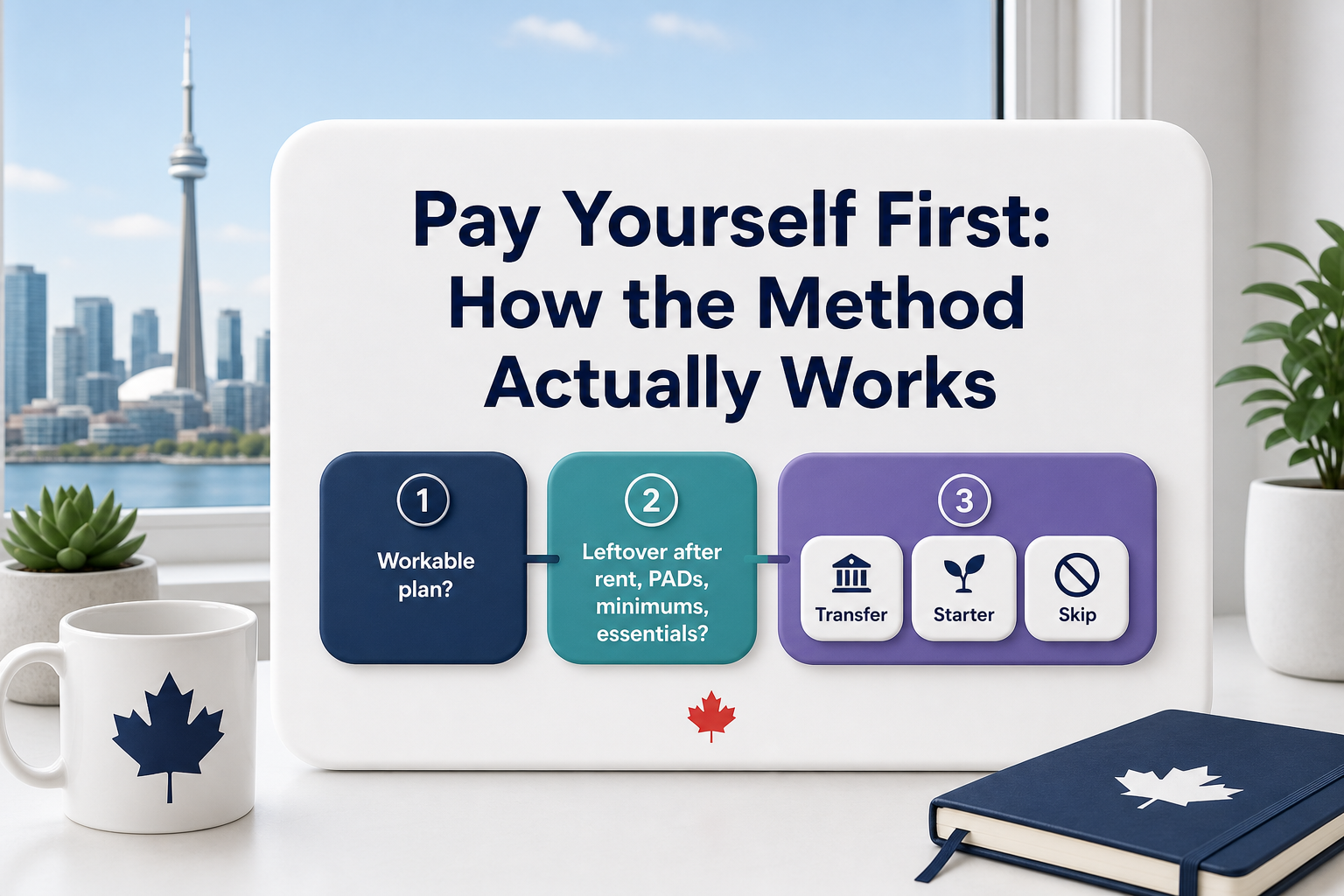
Paying yourself first is a behavioural rule, not a percentage and not a bank-app walkthrough. Savings is treated like a bill in the plan, so leftover spending cannot eat it. The job here is to make that rule safe on the calendar.
This isn't a first budget — that's How to Budget in Canada. If you don't yet have a sustainable dollar amount, that's How Much Should You Save Each Month?. If the leftover test already passed and you need the bank instruction, that's How to Automate Savings Goals in Canada.
What the method is
The Office of the Superintendent of Bankruptcy describes it as automatically directing specified savings from the paycheque, by a payroll split or a bank automatic transfer, so you reach the target instead of skipping it. FCAC treats saving as any other bill: put aside a set amount every paycheque, then set up an automatic transfer. "Say 10% of take-home" is an example they use, not this article's rate.
You may set the transfer on the days you get paid so it leaves as soon as the paycheque is deposited. That is optional. There is no official Canadian leftover-buffer dollar, and no official "PAC the day after payday" rule.
This works best when paycheques are consistent. If they are not, start with irregular income.
A workable plan first
The monthly picture already covers housing, utilities, groceries, required transport, insurance, and at least the minimum on every debt, plus a savings line that is a dollar amount you can name. If the plan doesn't close, don't install a transfer to "create" leftover. That is how it bounces.
First in the plan vs literally first
First in the plan: the savings dollars are committed before discretionary is treated as spendable. Rent, PADs, and minimums remain committed bills. This is the rule even if the bank instruction is dated later in the same payday window.
Literally first: the money leaves chequing the same day the paycheque lands, or never hits chequing because payroll split it. Literal-first is fine only if the leftover test passes. If rent or a PAD shares that window, literal-first of an unsafe amount is an NSF, not discipline.
A payroll split still has to leave enough in the spending account for same-window PADs. Waiting a few days doesn't save an unsafe amount.
This payday's leftover
Cleared chequing before this deposit + this paycheque − committed bills that still leave before the next pay (rent or mortgage, insurance, phone, hydro, debt minimums, other known PADs) − remaining essential variable until the next pay (groceries, required transport, medicine) = this payday's leftover.
Starter transfer is at most that leftover, minus a small timing buffer this household chooses. If the planned savings line is larger than leftover, the starter is the leftover (or skip), not the monthly line.
Monthly leftover is not this payday's leftover. A balanced month can still fail a Tuesday transfer — cash flow versus budget if the totals work and a date still fails.
If this pay is short
If this cycle's leftover is smaller than the planned transfer: reduce or skip this cycle. Don't reverse last cycle's transfer unless it is a true emergency — emergency fund is the later rebuild, not a 3–6 month tutorial here. Don't put the "savings" on a credit card to keep the streak. Restore the planned amount next cycle after re-running the test.
If leftover is negative, this is not a savings problem. Essentials or minimums are uncoverable. Stop. That is How to Budget While Paying Off Debt in Canada, not a tighter PAC.
Step-up
After three consecutive pay cycles where unused leftover after the transfer still sits in chequing (not spent, not needed for a known upcoming PAD), raise by a small dollar amount and re-run the leftover test. FCAC: consider increasing the automatic transfer as your pay increases; when a loan finishes, redirect the payment already in the budget. Recalculating the sustainable monthly number is a different page. The three-cycle test here is whether the transfer collided.
What counts
Counts: a transfer to savings or a HISA (including an emergency fund you already chose); a TFSA, RRSP, FHSA, or RESP contribution — which account is a separate page; an extra payment above the debt minimum; a transfer into a sinking pot for a bill already in the plan (sinking funds if you still need to name the pot).
Does not count: the debt minimum (that is a committed bill); paying the credit-card statement of this month's groceries (already-spent money — How to Categorize Spending Without Double-Counting if the labels are the mess); employer pension or group RRSP already withheld on the stub (already happened; don't PAC it again from chequing).
Run it on the next payday
- Is there a workable plan with a named dollar amount?
- What is this payday's leftover after rent, PADs, minimums, and essentials?
- If leftover is at least the planned transfer, schedule it the same day or after same-window essentials — whichever still clears rent and PADs.
- If leftover is positive but smaller than planned, starter = leftover minus this household's timing buffer, or skip.
- If leftover is zero or negative, stop. Not a PAC problem.
- Verify on the next statement that the transfer left, and that rent and PADs still cleared.
The later glance that leftover sat unused is the 20-minute monthly money review.
Avery's first Tuesday
The figures below are an illustrative example, not an average Canadian household.
Avery lives in Regina and is paid every other Tuesday, net $2,280 — a 14-day cycle, not a 26-pay tutorial (How to Budget When You're Paid Biweekly is the operating system). Two-pay November: Tuesday, November 3 and Tuesday, November 17, 2026. Rent PAD $1,650 on the 4th (November 4 is a Wednesday). Opening cleared Tuesday morning before the November 3 deposit: $245. Planned savings already in the monthly plan: $360 a month, $180 per pay. That number is given. It is not 10%.
November already closes on paper
| Line | Monthly |
|---|---|
| Two paycheques ($2,280 × 2) | $4,560 |
| Rent | $1,650 |
| Car insurance | $218 |
| Phone + internet | $118 |
| Hydro | $102 |
| Credit-card minimum | $85 |
| Groceries | $480 |
| Fuel | $160 |
| Pharmacy / household | $40 |
| Discretionary | $320 |
| Planned savings | $360 |
| Spoken-for | $3,533 |
| Monthly leftover (timing buffer, not extra PAC) | $1,027 |
$1,650 + $218 + $118 + $102 + $85 + $480 + $160 + $40 + $320 + $360 = $3,533. $4,560 − $3,533 = $1,027.
The $1,027 is real and mostly lives after the second Tuesday. It is not $1,027 sitting beside the November 3 deposit.
Committed still unpaid before November 17
| Date | Bill | Amount |
|---|---|---|
| Nov 4 (Wednesday) | Rent PAD | $1,650 |
| Nov 6 (Friday) | Car insurance PAD | $218 |
| Nov 10 (Tuesday) | Phone + internet PAD | $118 |
| Nov 12 (Thursday) | Credit-card minimum | $85 |
| Committed | $2,071 |
$1,650 + $218 + $118 + $85 = $2,071.
Remaining essential variable November 3–16: groceries $240 + fuel $80 + pharmacy $20 = $340.
Leftover this payday: $245 + $2,280 − $2,071 − $340 = $114.
Planned $180 is larger than $114. Same-day $180 fails the test, even though the month has $1,027 leftover on paper.
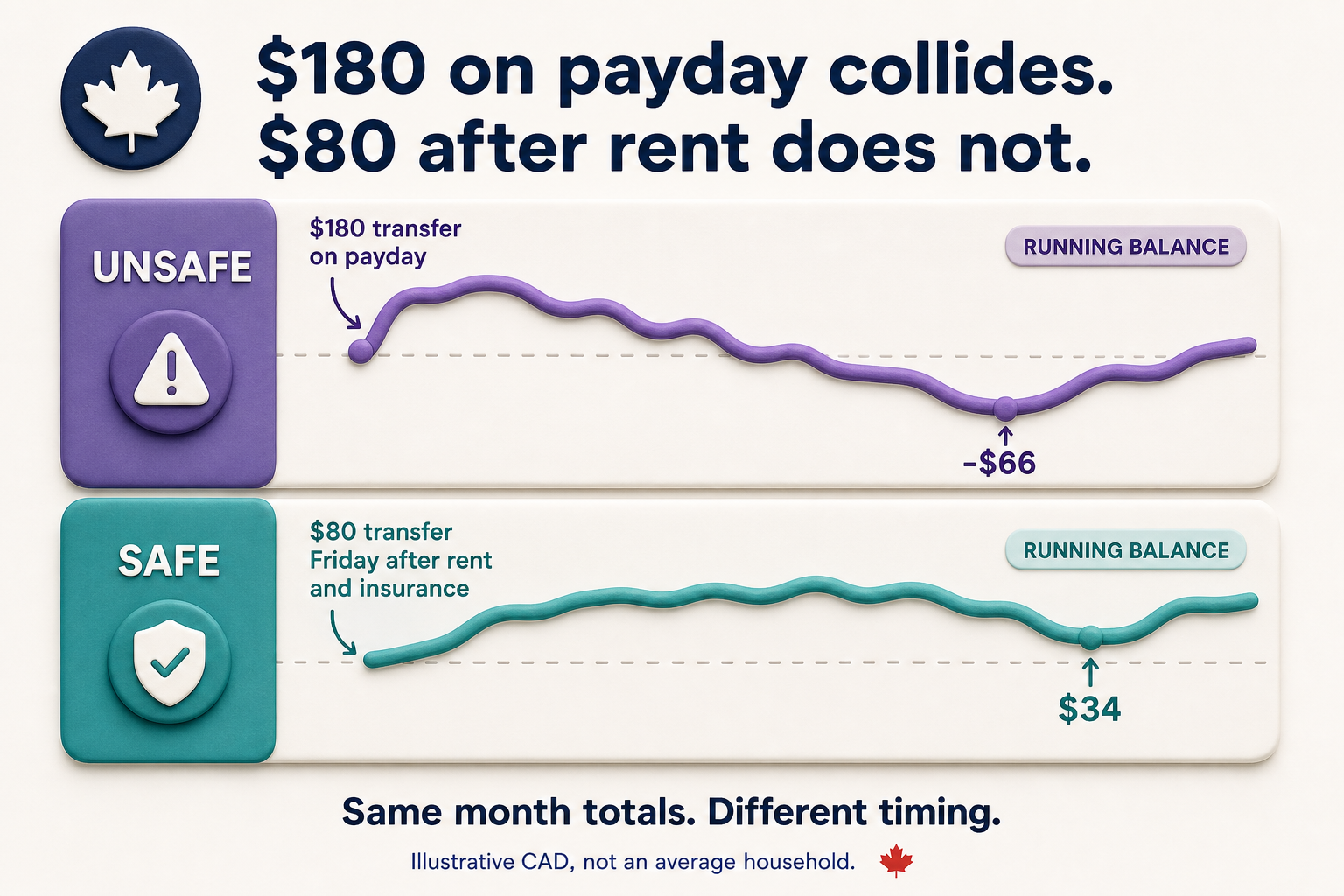
Unsafe: literal-first $180 on Tuesday, November 3
| Date | Event | Running balance |
|---|---|---|
| Nov 3 | Opening cleared + pay $245 + $2,280 | $2,525 |
| Nov 3 | −$180 PAC | $2,345 |
| Nov 3–4 | −$85 essentials | $2,260 |
| Nov 4 | −$1,650 rent | $610 |
| Nov 6 | −$218 insurance | $392 |
| Nov 6–9 | −$85 essentials | $307 |
| Nov 10 | −$118 phone | $189 |
| Nov 10–11 | −$50 essentials | $139 |
| Nov 12 | −$85 card minimum | $54 |
| Nov 12–16 | −$120 essentials | −$66 |
$2,525 − $180 − $85 − $1,650 − $218 − $85 − $118 − $50 − $85 − $120 = −$66. Collision. Waiting until Friday, November 6 and still sending $180 also lands at −$66. The amount fails, not only the hour.
Safe: first in the plan; starter $80 on Friday, November 6 after rent and insurance
| Date | Event | Running balance |
|---|---|---|
| Nov 3 | Opening cleared + pay | $2,525 |
| Nov 3–4 | −$85 essentials | $2,440 |
| Nov 4 | −$1,650 rent | $790 |
| Nov 6 | −$218 insurance | $572 |
| Nov 6 | −$80 starter PAC | $492 |
| Nov 6–9 | −$85 essentials | $407 |
| Nov 10 | −$118 phone | $289 |
| Nov 10–11 | −$50 essentials | $239 |
| Nov 12 | −$85 card minimum | $154 |
| Nov 12–16 | −$120 essentials | $34 |
$2,525 − $85 − $1,650 − $218 − $80 − $85 − $118 − $50 − $85 − $120 = $34. Same as leftover $114 − $80. Lowest before next payday is $34, not negative.
Avery's November 3 transfer is $80, not $180. The $360 monthly line is still the plan. This payday cannot carry half of it.
November 17: opening $34 + $2,280 = $2,314. Hydro $102 on Tuesday, November 24 plus remaining essentials $340 = $442 must-cover. Leftover $1,872. Catch-up $280 ($360 − $80) fits. Next rent is Friday, December 4; next pay is Tuesday, December 1. Re-run the same test. Don't assume November's second-window leftover is still there on December 1. A later month on this cycle can have a third Tuesday — What to Do With a Three-Paycheque Month owns that allocation.
If opening cleared had been $171 instead of $245, leftover = $40. Skip the $80 this cycle. Keep the $40 as timing cash. Don't reverse October's transfer. Don't put $80 on a card. If leftover were negative, stop.
What Avery counts: the $80 (and later $280) to savings, a HISA, or a registered account already chosen. An extra $20 above the $85 card minimum would also count. The $85 itself does not. The group RRSP already off the stub does not get PAC'd again.
If $34 still sits unused across three consecutive pays, raise by a small dollar amount and re-test.
See the leftover before you ask the bank
Finnomia tracks pay dates, upcoming bills, and remaining category budgets so the leftover is a number. It doesn't hold accounts or move money. If you want that payday picture in one place, start a 14-day free trial.
What does pay yourself first mean in Canada?
Treat a named savings amount like a bill in the plan, then move it automatically by payroll split or a bank transfer — only after this payday's leftover can cover rent, PADs, and minimums.
Should the transfer leave the same day as payday?
Only if the leftover test passes. "First in the plan" can mean the dollars are committed even if the instruction is dated after same-window bills.
What if this paycheque cannot carry the usual amount?
Reduce or skip this cycle. Don't reverse last cycle's transfer to keep a streak, and don't put the savings on a card.
This article was published in September 2026 and is general information, not personalized financial advice. Use your own cleared balances, PAD dates, and pay dates. Automatic-transfer timing and fees depend on the institution.