
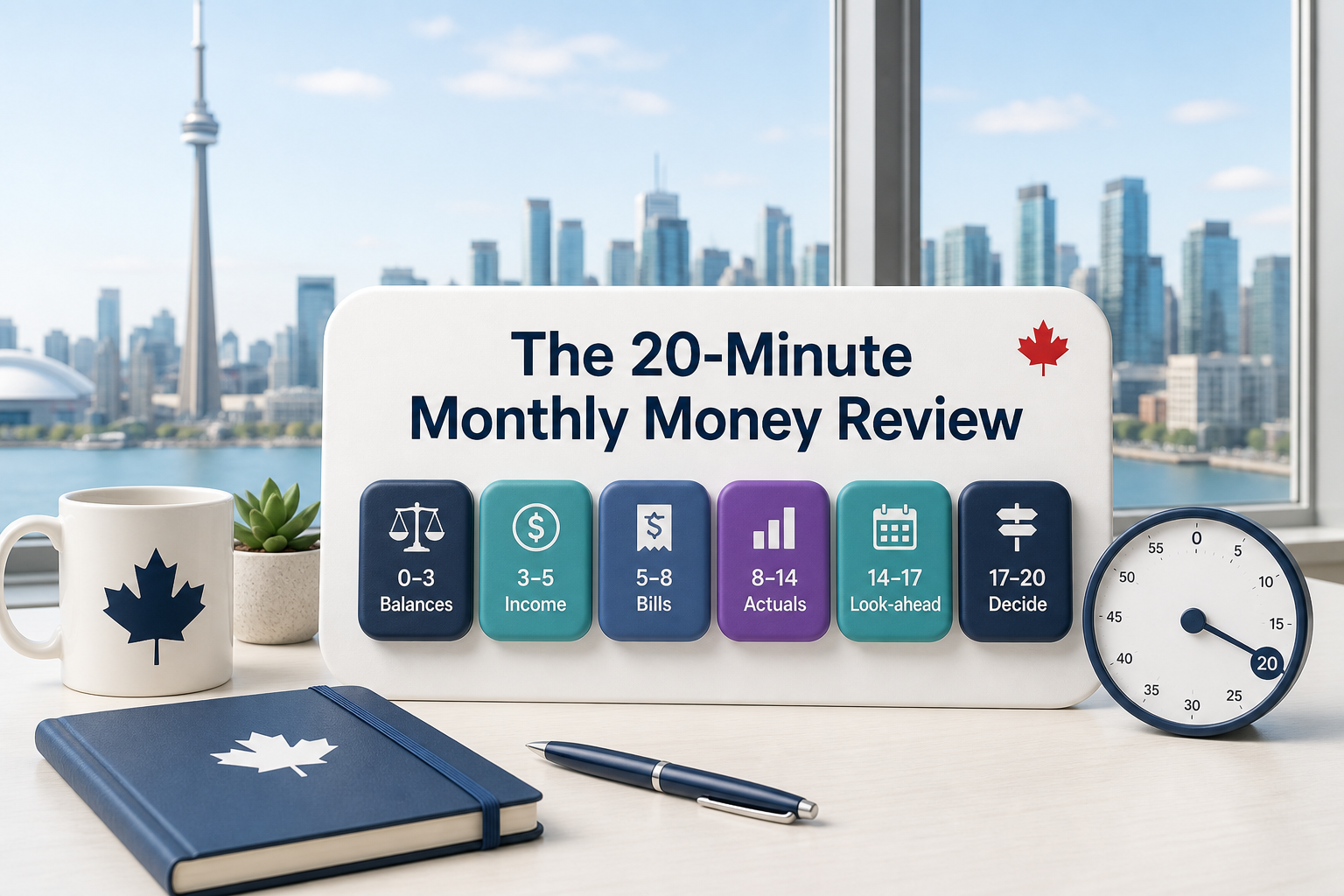
On this page
A budget you never compare to the month is a list of intentions. FCAC's advice is to look at actuals when the month ends, and to change the figures when a miss keeps repeating. Put the same 20-minute agenda on the calendar and run it.
Pick a slot and keep it: the last days of the month, or the first weekend. Not both. This isn't a first budget — that's How to Budget in Canada. And it isn't a couples meeting; if two people share the books, Budgeting with a partner or roommate in Canada is the together version.
Set a 20-minute timer.
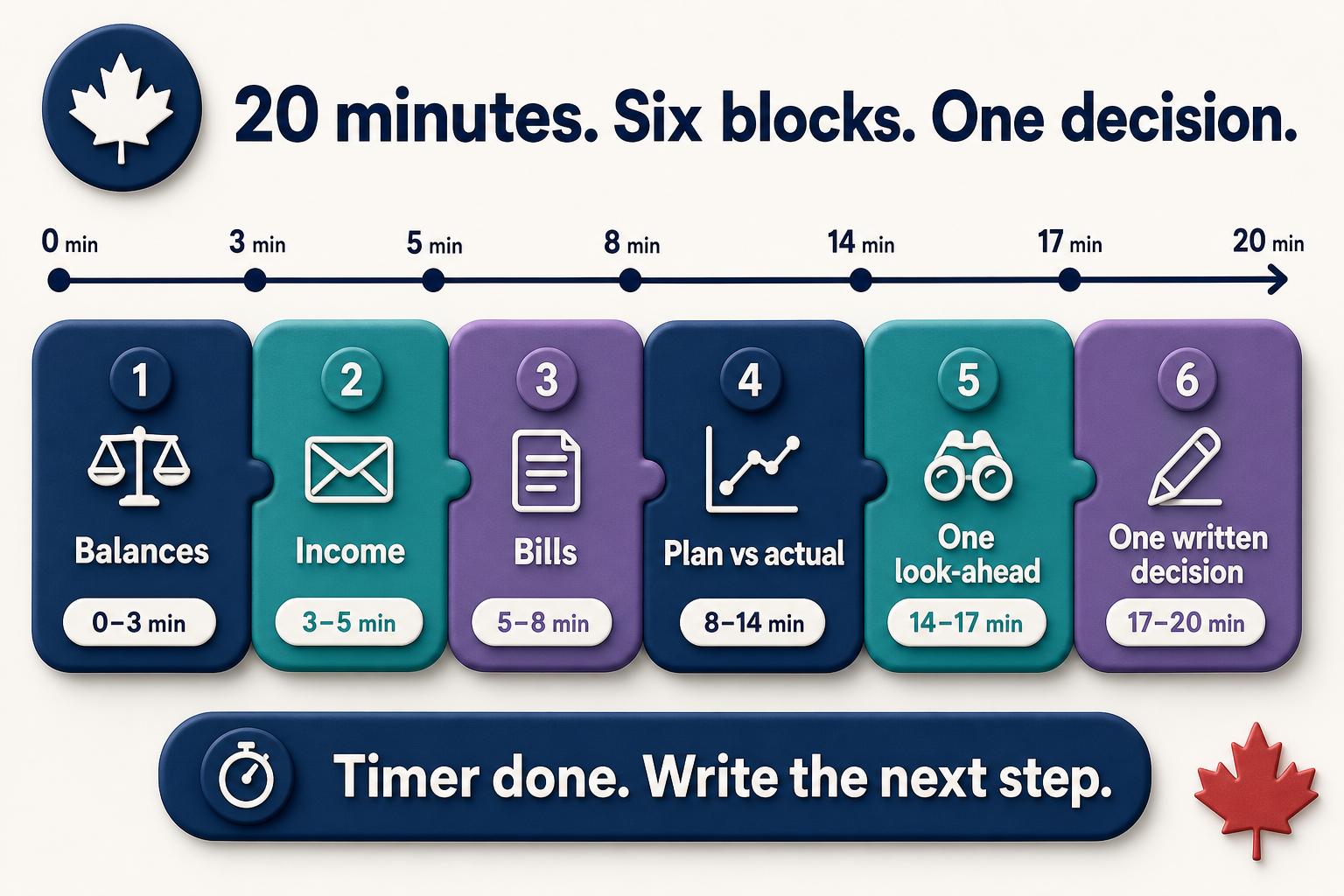
0–3 minutes — balances
Open chequing, credit cards, and any labelled savings. You're checking that the numbers on the screen match last month's ending picture, not valuing a TFSA.
3–5 minutes — income that landed
Write down net pay and other cash that actually arrived. Not the salary on the offer letter.
5–8 minutes — bills, next 30 days
Scan PADs, rent, and cards due in the next month. If two large withdrawals sit on the same week, note the collision. Don't rebuild the cash-flow calendar here — flag the dates.
8–14 minutes — plan versus actual
Pick two or three categories, not twenty.
The figures below are an illustrative example, not an average Canadian household.
Riley's month:
| Plan | Actual | Diff | |
|---|---|---|---|
| Groceries | $520 | $610 | −$90 |
| Dining | $200 | $90 | +$110 |
FCAC's test: was the miss unusual this month, or does it happen every month? Recurring → change the plan. One-off → leave it.
Riley's groceries have now been over for a third month. Next month's grocery line goes to $580. Dining was quiet, not a new lifestyle — leave $200.
Credit cards: count the purchase when you spend. Riley's card shows $310 of those groceries. Paying $310 from chequing is a transfer, not another $310 of food. Interest and fees are expenses.
Glance at PADs for a new or raised subscription. You're not running a cancel-athon in these 20 minutes.
14–17 minutes — one irregular look-ahead
Name one known bill that is coming and is not in this month's plan. Riley's plate renewal is $180 in seven weeks. Split it across six transfers: $180 ÷ 6 = $30 this payday. How to inventory a whole year is How to Budget for Expenses That Don't Happen Every Month; where that $30 lives is sinking funds. Don't annualize the rest of the calendar here.
17–20 minutes — one written decision
Riley writes: raise groceries to $580; send $30 this payday toward plates. A review with no next step is a chat.
Out of scope for these 20 minutes: net worth, rebalancing, emergency-fund sizing, tax, and mediating a household argument. If the totals won't reconcile at all, that's a spending audit, not this loop.
If the written decision is an automatic transfer, Automating Savings Goals is the habit. Then stop. The timer is done.
Keep the 20 minutes off the CSV
Transactions, budgets, bills, and goals in one view mean the clock is spent on the miss and the decision, not on exporting four files. Finnomia tracks those; it doesn't hold deposits or move money. If you want that sitting in one place next month, start a 14-day free trial.
How often should I review my budget?
FCAC says to compare the plan with actuals at month-end, and to set a reminder. This agenda is monthly. Don't turn it into a weekly meeting.
What if I go over in a category?
Ask whether it was unusual or likely to repeat. Recurring misses belong in next month's plan. A one-off doesn't.
Do I need a partner for this?
Not for this loop. A shared household can run the same 20 minutes; the dedicated together meeting is a separate page.
This article was published in September 2026 and is general information, not personalized financial advice. Use your own statements for balances, due dates and category totals.