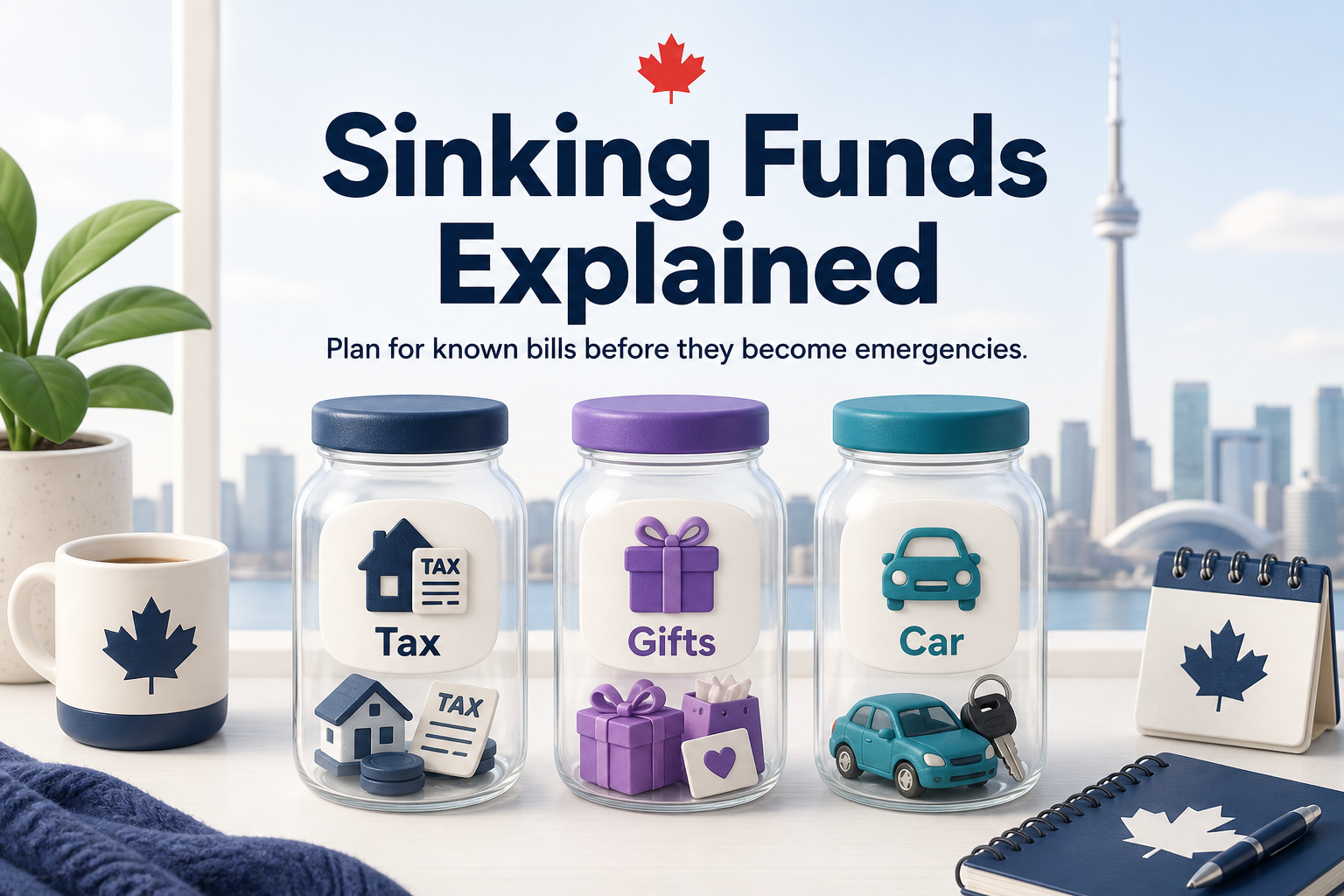
A sinking fund is money you set aside on purpose for a known future cost — property tax, insurance, winter tires, holiday gifts. It has a label and a target date. It is not a credit card, and it is not the emergency fund.
The 12-month inventory that produces the dollar amounts is How to Budget for Expenses That Don't Happen Every Month. This page is how to name the pots, park them somewhere safe, and automate the transfer.
Three pots, not fifteen
The formula is simple: amount still needed ÷ months until you need it. After a recurring bill is paid, refill at that annual amount ÷ 12. A one-off pot can close.
Start with three. Combine related costs (car = tires + plates + routine maintenance). Add a fourth only when a separate label would change a decision. There is no official Canadian count of 3–7 funds; three is a habit that people actually fund.
Useful Canadian starters, not a law:
- Property tax you pay yourself (skip the row if the mortgage already collects it)
- Annual insurance
- A winter or seasonal bill you already take
- A want you already take, labelled
Skip unused rows. A sudden furnace failure does not belong here.
Morgan’s three pots
The figures below are an illustrative example, not typical property tax, and not an average household.
Morgan is a homeowner. No payday weekday is required for this math.
| Pot | Target | Months | Contribution |
| --- | --- | ---: | ---: |
| Property tax (next lump) | $2,400 | 8 | $300 |
| Holiday gifts | $900 | 6 | $150 |
| Car (tires + routine maintenance) | $600 | 12 | $50 |
| This month | | | $500 |
$2,400 ÷ 8 = $300. $900 ÷ 6 = $150. $600 ÷ 12 = $50. $300 + $150 + $50 = $500.
If the mortgage already collects property tax, skip that row. The monthly total is then $200. After December, the gifts pot can refill at $900 ÷ 12 = $75, or it can close until next fall.
Where the money lives
Park it off chequing so the next PAD cannot spend it. A high-interest savings account, or labelled sub-accounts at a bank that offers them, is the usual home. Tangerine Spaces and EQ Bank nicknames are one way to label a pot; they are not a product ranking.
Do not keep this year’s car repairs in equities, or in a HISA ETF. Eligible HISA deposits at a CDIC member may be covered; HISA ETFs and HISA mutual funds are not CDIC-protected. Credit-union deposits sit under provincial insurers, not CDIC.
CDIC coverage, in one beat: eligible deposits are insured up to $100,000 in principal and interest, per insured category, per member institution. A consultation has talked about raising that ceiling. The law in force is still $100,000.
A TFSA is a tax wrapper, not a product. Cash inside a TFSA can work for a near-term pot; stocks inside a TFSA are still stocks. Where to keep emergency cash is HISA vs. TFSA for an Emergency Fund — do not rebuild that page here. An RRSP is the wrong wrapper for a bill you will pay this year: the withdrawal is taxable, and the room does not come back the way TFSA room does.
A GIC can match a dated lump you will not need early. It is a poor willpower tool for car repairs.
Automate the transfer on payday — one PAD per pot, or one transfer you split. Automating Savings Goals is the broader habit. Finnomia does not hold the HISA and cannot move the money.
This is not the emergency fund
A sinking fund is for a bill you can name and date. An emergency fund is for a shock you did not put on the calendar. Christmas is not an emergency. A job loss is. Mixing them is how the “emergency” account pays for gifts every December and is empty in January. Sizing the emergency reserve is How Much Emergency Fund Do I Need in Canada?.
For the first monthly plan, How to Budget in Canada is the steps. 50/30/20 and zero-based can sit on top of the same pots; they do not replace the labels.
Name the goal, pick a date
Finnomia can track a named goal with a target and a date so the $300 property-tax transfer is a line you review, not a mental note. If you want those three pots sitting next to the bills they are for, start a 30-day free trial.
What is a sinking fund?
Money set aside on purpose for a known future cost, with a label and a date. It is not an emergency fund and not a credit card.
How many sinking funds should I have?
Start with three. Combine related costs. Add another only when seeing that number separately would change a decision.
Where should I keep sinking funds in Canada?
Usually a HISA or labelled sub-account, off chequing, in cash you can reach this year. Not the emergency fund, not a HISA ETF, and not an RRSP for a bill due this year.
This article was published in September 2026 and is general information, not personalized financial advice. Deposit insurance, account features and tax treatment depend on the institution and the product. Confirm current CDIC or provincial coverage and your own due dates before you park the money.