
On this page
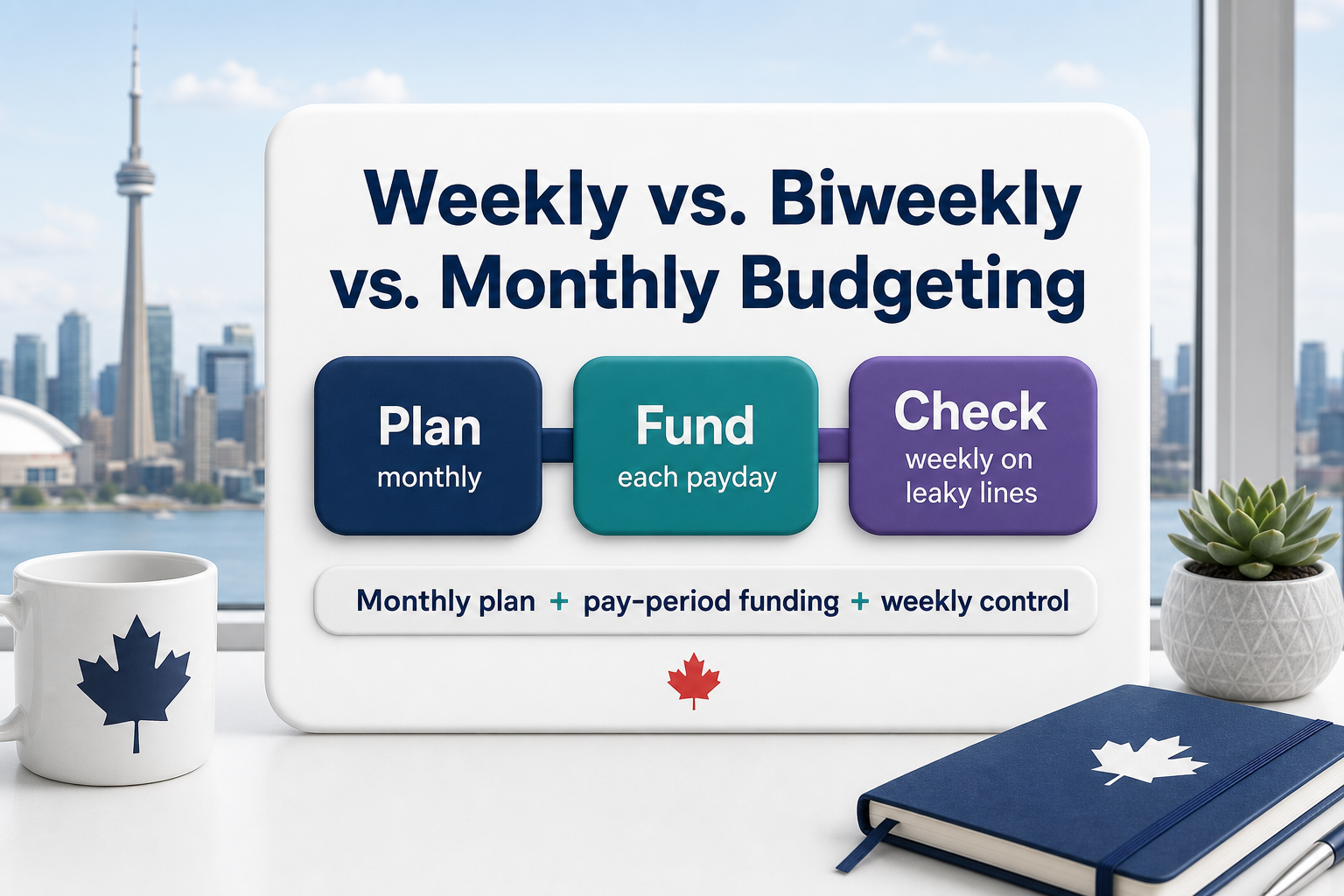
Weekly vs monthly is the wrong fork if it means picking one clock for everything. Rent is monthly. Groceries leak by the week. Paycheques arrive on their own calendar. The job is to choose three cadences so payday is a funding event, not a full rebuild.
This isn't a first budget — that's How to Budget in Canada. If you're paid every two weeks, How to Budget When You're Paid Biweekly is the operating system, not this page. The timed month-end agenda is the 20-minute monthly money review.
There is no official Canadian “best” budget frequency, and no official monthly ÷ 4.
Three clocks, not one
Plan period — the totals you will compare to actuals. Default monthly. FCAC compares plan vs actual at the end of each month. OSB: create at the beginning of the month, review at the end. Most Canadian bills live here.
Funding / allocation — when this paycheque is given jobs: bills that still leave before the next pay, plus this period’s flexible cash. Frequency follows pay, not the plan. Don't rewrite rent, hydro, or the grocery line every Wednesday.
Control / check — how often you look at remaining flexible caps. OSB: weekly recording is less overwhelming than a dump on the 31st. FCAC still wants the monthly actual-vs-plan test.
Payday funds the plan that already exists. A Wednesday deposit is not a new budget. New job, new rent, or a category that has been wrong for three months (FCAC: likely each month), change the monthly plan.
If the month still balances on paper and a date fails, that's cash flow versus budget, not a new rhythm.
Pick the hybrid from two facts
| Income timing | Flexible-spend volatility | Plan | Fund | Control |
|---|---|---|---|---|
| Monthly pay, bills aligned, spending steady | Low | Monthly | That payday | Month-end; optional weekly glance |
| Weekly or every-other-week pay, bills monthly | Medium | Monthly | Each pay period | Weekly glance on 2–3 flexible lines |
| Any pay; broke by week three every month | High (groceries / dining / fuel) | Monthly | Pay period | Weekly caps on the leaky lines only |
| Amount changes (gig / commission / hours) | High | Monthly lean baseline | When money lands | Weekly control |
If the amount arriving changes, that's irregular income, not a weekly plan that pretends hours are stable.
The hybrid most readers need: monthly plan + pay-period funding + weekly control on flexible categories.
Monthly-paid and steady: monthly plan, fund on payday, month-end compare, skip weekly caps. Variable hours: lean monthly plan, fund when pay lands, weekly flexible control.
Don't week-ify rent
Fixed (plan monthly; pay on the due date): rent or mortgage PAD, insurance, phone, hydro, debt minimums, planned savings line. A weekly “rent number” doesn't make the 7th cheaper.
Flexible (plan monthly; steer weekly): groceries, fuel, dining — the two or three lines that actually blow the month. Not all twenty categories. Labels if you need them: budget categories.
Irregular / non-monthly: still a monthly provision in the plan — How to Budget for Expenses That Don't Happen Every Month. Named pots are sinking funds. Not a weekly cap, and not set up here.
If the savings number isn't named yet, that's How Much Should You Save Each Month?. The bank instruction is How to Automate Savings Goals in Canada.
Annual ÷ 52, not monthly ÷ 4
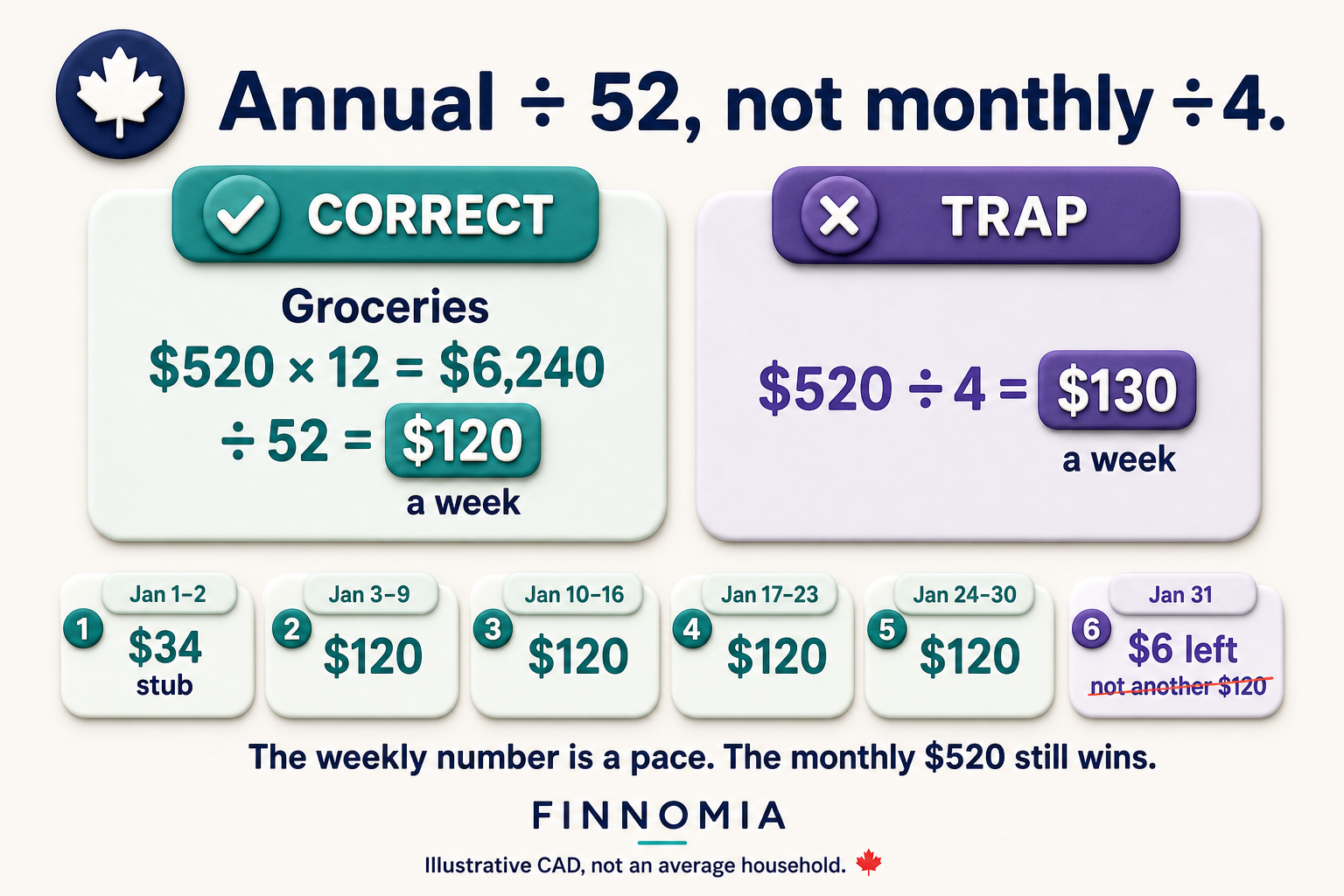
Weekly steering cap = (monthly flexible line × 12) ÷ 52.
That is annual ÷ 52. Monthly ÷ 4 overstates by about 8%. Monthly ÷ 4.3 is 52/12 by another name — write the annual step so it foots. Monthly ÷ 2 is a pay-period split, not this conversion.
Partial weeks and five Sundays
A calendar month is not four weeks and not five equal weeks. Five × the weekly cap overshoots the monthly referee; four × undershoots. The weekly number is a pace. The monthly total still wins.
Don't treat a fifth payday, fifth Sunday, or the 31st as bonus grocery money. Prorate a stub (days/7 × weekly cap) or spend from remaining monthly. Don't drop a full cap on two days.
When to switch
Tighten (add weekly caps): a flexible line blows by week three, two or three months running — not after one party. Caps on the leaky lines only.
Loosen (drop to monthly plan + optional glance): three consecutive months inside the monthly line with unused weekly leftover. Stop the appointments that aren't earning their keep.
Don't switch because a one-off month was weird (FCAC: unusual vs likely each month) or because a date bounced. Give a new rhythm two or three months before judging it.
Harper’s January
The figures below are an illustrative example, not an average Canadian household.
Harper lives in Red Deer and is paid every other Wednesday, net $1,890. Two-pay January 2027: Wednesday, January 6 and Wednesday, January 20. Next pay Wednesday, February 3. Rent PAD $1,425 on the 7th (January 7 is a Thursday). Weekly glance: Sunday evening. January 2027 Sundays: 3, 10, 17, 24, 31 (five). February 2027 Sundays: 7, 14, 21, 28 (four). Planned savings already in the monthly plan: $280. That number is given.
January already closes on paper
| Line | Monthly | Clock |
|---|---|---|
| Two paycheques ($1,890 × 2) | $3,780 | Fund |
| Rent | $1,425 | Fixed / monthly |
| Car insurance | $196 | Fixed / monthly |
| Phone + internet | $109 | Fixed / monthly |
| Hydro | $94 | Fixed / monthly |
| Credit-card minimum | $55 | Fixed / monthly |
| Groceries | $520 | Flexible |
| Fuel | $208 | Flexible |
| Dining / coffee | $156 | Flexible |
| Other discretionary | $80 | Monthly (not week-ified) |
| Planned savings | $280 | Fixed in the plan |
| Spoken-for | $3,123 | |
| Monthly leftover (timing buffer, not extra grocery) | $657 |
$1,425 + $196 + $109 + $94 + $55 + $520 + $208 + $156 + $80 + $280 = $3,123. $3,780 − $3,123 = $657.
Harper does not rewrite this table on January 6 or January 20. Those deposits fund it. A later month on this cycle can have a third Wednesday — What to Do With a Three-Paycheque Month is that allocation, not this page.
Flexible conversion (annual ÷ 52, not monthly ÷ 4)
| Flexible line | Monthly | × 12 | ÷ 52 weekly | Monthly ÷ 4 (trap) |
|---|---|---|---|---|
| Groceries | $520 | $6,240 | $120 | $130 |
| Fuel | $208 | $2,496 | $48 | $52 |
| Dining | $156 | $1,872 | $36 | $39 |
| Three-line total | $884 | $10,608 | $204 | $221 |
$520 × 12 = $6,240. $6,240 ÷ 52 = $120. $208 × 12 = $2,496. $2,496 ÷ 52 = $48. $156 × 12 = $1,872. $1,872 ÷ 52 = $36. $120 + $48 + $36 = $204. $130 + $52 + $39 = $221. Trap extra $17 a week × 52 = $884 a year — another full month of these three lines, from ÷4 alone.
Treat January as five grocery weeks at the ÷4 cap: $130 × 5 = $650. $650 − $520 = $130 over the monthly referee. Dining $39 × 5 = $195 vs $156 (+$39). The month “had a weekly budget” and still missed.
Five × the honest $120 with no monthly referee: $600. $600 − $520 = $80 over. The fifth Sunday (January 31) is not a fifth grocery budget.
Safe: monthly referee + weekly pace + stub honesty
| Window | Days in January | Grocery release | Running vs $520 |
|---|---|---|---|
| Fri Jan 1 – Sat Jan 2 (stub before first Sunday) | 2 | $34 (2/7 × $120) | $34 |
| Sun Jan 3 – Sat Jan 9 | 7 | $120 | $154 |
| Sun Jan 10 – Sat Jan 16 | 7 | $120 | $274 |
| Sun Jan 17 – Sat Jan 23 | 7 | $120 | $394 |
| Sun Jan 24 – Sat Jan 30 | 7 | $120 | $514 |
| Sun Jan 31 (1 day in January) | 1 | $6 left ($520 − $514), not another $120 | $520 |
2/7 × $120 = $34. $34 + $120 + $120 + $120 + $120 = $514. $520 − $514 = $6 for January 31.
Sunday, January 10 glance: groceries $148 in the January 3–9 week vs $120 pace. Over by $28. Remaining monthly groceries $520 − $148 = $372. Next week’s steering cap $92 ($120 − $28), not a new plan. $148 + $92 = $240 after two weeks, same as 2 × $120.
February has four Sundays. 4 × $120 = $480, $40 under the $520 monthly line if they stop at four caps. That $40 is the other side of January’s five-Sunday pressure — the year still foots at $6,240. Inside February the referee is still $520, not $480.
If groceries finish inside $520 for three months with leftover weekly unused, drop the Sunday cap and keep the monthly plan + month-end compare. If week-three dining blows again, restore a weekly cap on dining only. Don't week-ify rent because dining leaked.
See remaining by the week and by the month
Finnomia tracks remaining category budgets and upcoming bills so weekly remaining and month remaining are both visible. It doesn't hold accounts or move money. If you want those two clocks in one place, start a 14-day free trial.
Should I budget weekly or monthly?
Plan monthly. Fund on payday. Steer leaky flexible lines weekly. Rent stays monthly.
How do I convert a monthly grocery line to a weekly cap?
(Monthly × 12) ÷ 52. Not monthly ÷ 4.
What if the month has five Sundays?
The weekly number is a pace. The monthly total still wins. Don't spend a fifth full cap.
This article was reviewed in September 2026 and is general information, not personalized financial advice. Use your own pay dates, PAD dates, and category totals. There is no official Canadian budget frequency.