
On this page
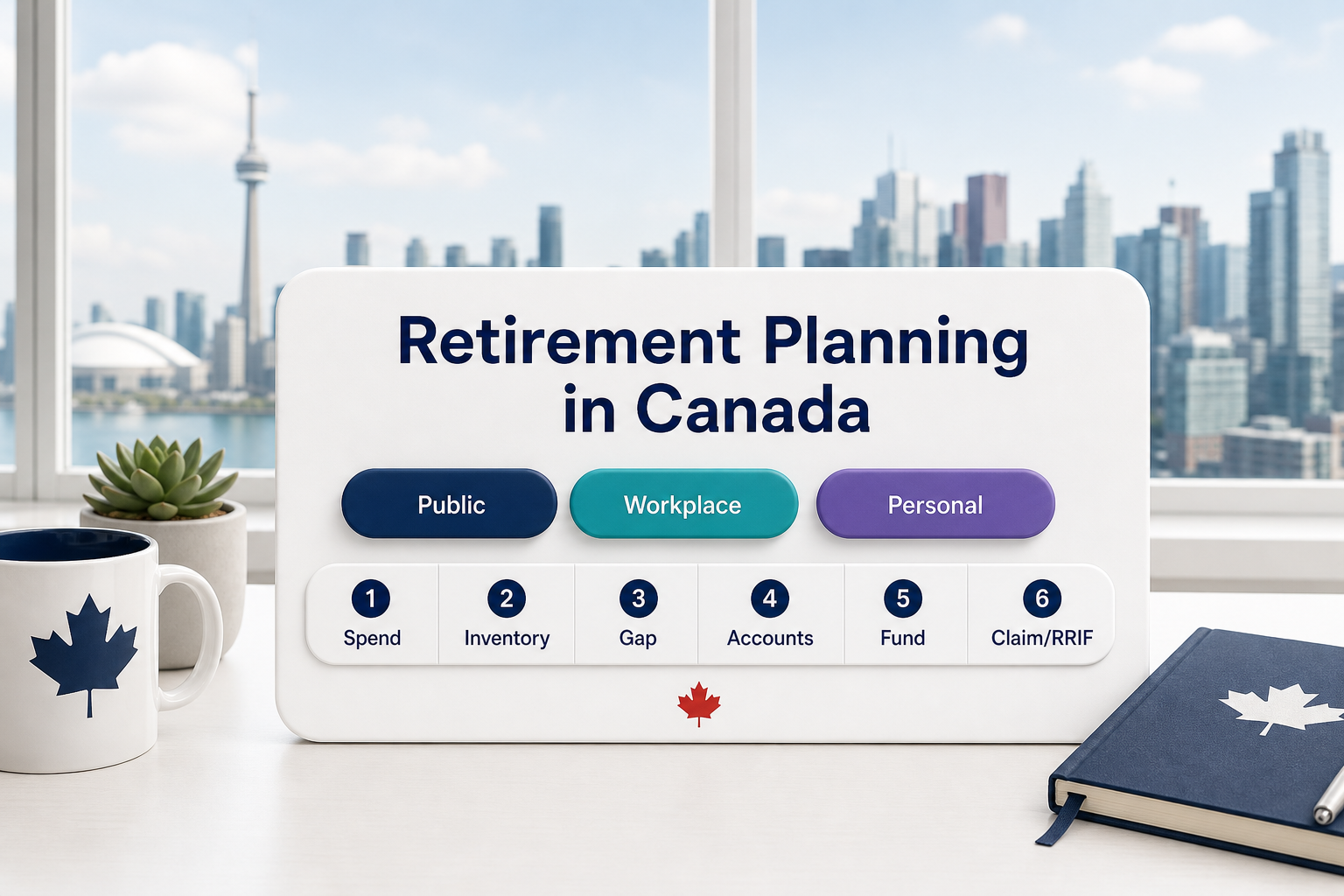
Retirement planning in Canada is a system map plus a repeatable process — not a single CAD number and not a blog rule that everyone should delay CPP to 70. Service Canada frames the main sources as public pensions, a workplace pension (if you have one), and personal savings and investments. Public pensions alone aren’t meant to cover a full lifestyle.
This URL is the hub: map the sources, walk the process, point to program and math depth elsewhere, then close on Retirement Planner estimates. It is not a CPP tutorial. It is not an OAS clawback essay. It is not a 25× nest-egg lesson.
The Canadian map (three pillars)
| Pillar | What it is | Map labels (2026) |
|---|---|---|
| Government / public | OAS (residency and age — not your contributions) + CPP (earnings-related). Quebec work usually means the Québec Pension Plan (QPP) instead of CPP for that work; the plans coordinate if you worked in both. GIS is an income-tested top-up for low-income OAS recipients — named here only. | CPP max at 65 $1,507.65/mo (Jan 2026); average new at 65 $877.01/mo (Apr 2026). Most get less than max. Early/late factors −36% at 60 / +42% at 70. OAS Jul–Sep 2026: $751.97 (65–74) / $827.17 (75+). OAS deferral +0.6%/mo → +36% at 70 (official deferred max $1,022.68 on the Jul–Sep 2026 full amount). Recovery tax exists above income thresholds — pointer only. |
| Workplace | DB, DC, group RRSP, DPSP — learn your plan type and statement estimate. Don’t invent defined-benefit formulas. | Your statement |
| Personal | RRSP, TFSA, non-registered; FHSA if a first-home goal competes (FHSA rules — one clause). Which account to fund is TFSA vs RRSP vs FHSA — this hub doesn’t re-rank. | Your balances |
Six-step process
1. Estimate retirement spending. Prefer line-item spending in today’s dollars over a blind 60–70% replacement heuristic. Cash-flow hygiene: How to Budget in Canada.
2. Inventory guaranteed income. Pull a CPP estimate from My Service Canada Account; check OAS eligibility and the OAS Benefits Estimator; read your workplace statement; add any annuity or other reliable income. The Canadian Retirement Income Calculator combines sources into an estimate — estimates only.
3. Size the gap directionally. Spending minus guaranteed income. Turning that gap into a nest-egg target (for example a 25× / 4% rule of thumb) is a separate math job — use CRIC and MSCA for personal estimates, and keep the full waterfall off this hub.
4. Choose accounts. Once you know you’re saving toward the gap, TFSA vs RRSP vs FHSA and Contribution Limits Cheat Sheet own priority and limits — not this page.
5. Fund the gap. Whether cash flow can sustain the contribution is How Much Should You Save Each Month?. Once an amount exists, How to Automate Savings Goals in Canada is the PAC. Liquidity first: How Much Emergency Fund Do I Need in Canada?.
6. Plan claim ages and RRIF maturity (tease only). CPP can start between 60 and 70 (−36% / +42% vs age 65). OAS starts at 65 and can defer to 70 (+36%). By December 31 of the year you turn 71, an RRSP must be withdrawn, transferred to a RRIF, or used to buy an annuity. Program depth lives on canada.ca for now — factors, amounts, and RRIF deadlines are stamped above as map labels only.
Cameron’s process vignette (Halifax)
The figures below are an illustrative early-planning walk — not nest-egg formula depth, not advice, and not Cameron’s real MSCA quote.
Cameron is early-40s in Halifax, mid-career, with no workplace DB but a workplace DC statement estimate. Directional lifestyle target: $4,500 a month = $54,000 a year in today’s dollars.
| Step | Cameron’s illustration | Label |
|---|---|---|
| 1. Spending | $4,500/mo = $54,000/yr | Directional — rebuild from line items |
| 2a. CPP (placeholder) | $877.01/mo = $10,524.12/yr | Official average Apr 2026 — replace with MSCA |
| 2b. OAS (full max 65–74) | $751.97/mo = $9,023.64/yr | canada.ca OAS payments Jul–Sep 2026 |
| 2c. Workplace DC | $650/mo = $7,800/yr at ~65 | Statement estimate — not advice |
| 2d. Total guaranteed | $2,278.98/mo = $27,347.76/yr | Must foot |
| 3. Gap (directional) | $54,000 − $27,347.76 = $26,652.24/yr | Directional only — no 25× here |
| 4. Accounts | — | TFSA vs RRSP vs FHSA |
| 5. Fund the gap | — | How Much Should You Save Each Month? |
| 6. Claim / RRIF | — | canada.ca factors + Dec 31 year-71 |
$877.01 × 12 = $10,524.12. $751.97 × 12 = $9,023.64. $650 × 12 = $7,800. Sum = $27,347.76. Gap = $26,652.24.
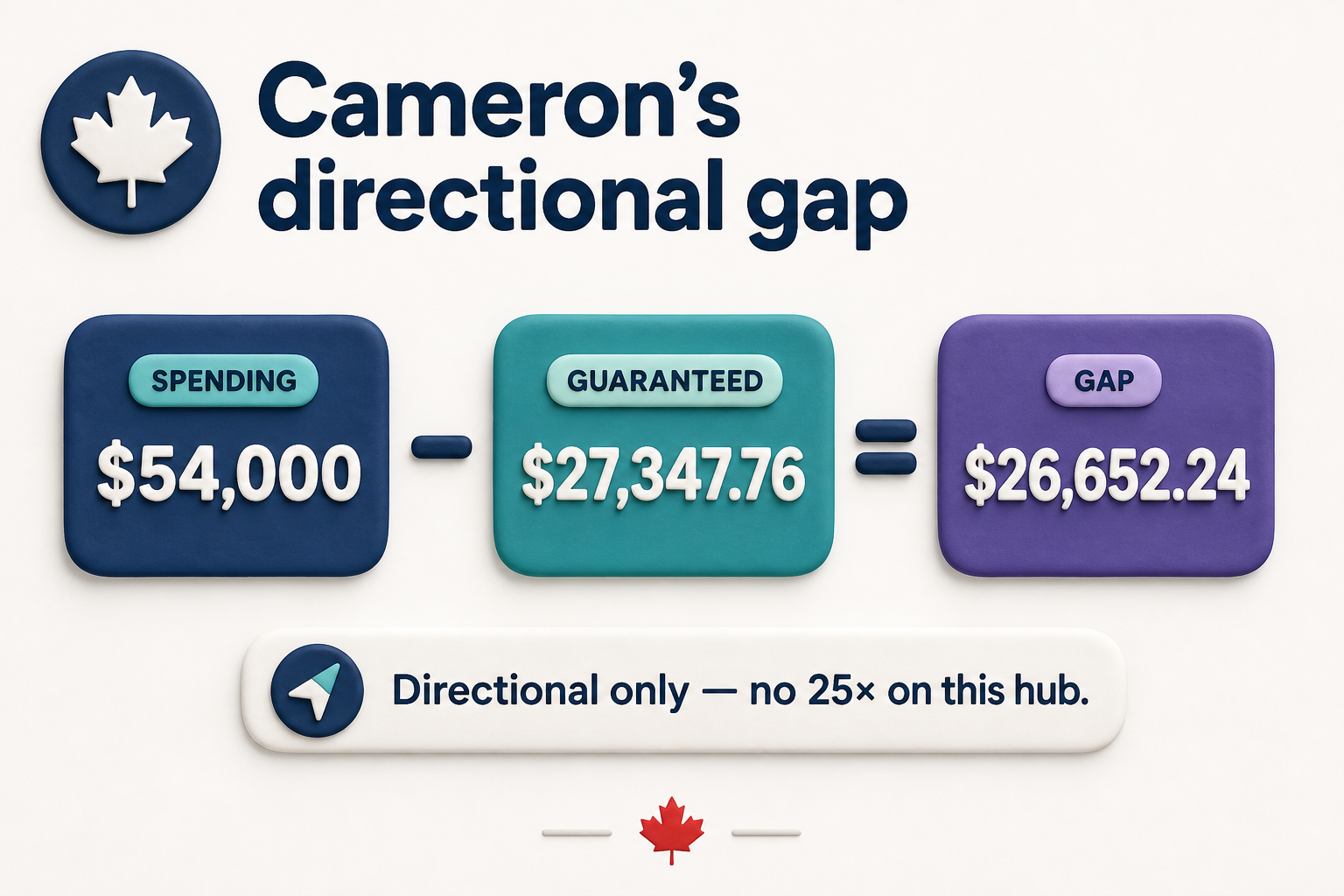
Turning that ~$26,652/year gap into a nest-egg target is a separate method page — this hub stops at the directional gap. Use CRIC and MSCA for personal estimates.
Other forks (no second named person): max CPP $1,507.65 + OAS $751.97 + DC $650 → guaranteed $2,909.62/mo → gap from $54k ≈ $19,085. No workplace (CPP avg + OAS only) → gap ≈ $34,452. Before OAS (CPP avg + DC only) → gap ≈ $35,676.
Tools
- My Service Canada Account — personal CPP estimates and contribution history
- OAS Benefits Estimator — official personal OAS scenarios
- Canadian Retirement Income Calculator — multi-source estimates only
- Finnomia Retirement Planner via Start trial — nest-egg / CPP / OAS / claim-age scenario estimates, not advice
No separate Finnomia /tools/retirement URL on this pass.
See the map beside your numbers
Finnomia’s Retirement Planner builds nest-egg projections, CPP and OAS inputs, claim-age comparisons, and saved scenarios — estimates, not advice. It tracks those scenarios; it doesn’t hold accounts or move money. If you want the map sitting next to your other numbers, start a 14-day free trial.
What are the three sources of retirement income in Canada?
Public pensions (OAS and CPP, or QPP in Quebec), workplace pensions if you have them, and personal savings (RRSP, TFSA, and other). Service Canada’s sources-of-income page is the official map.
What’s the first step in retirement planning?
Estimate what you’ll spend, then inventory guaranteed income so you can see the gap. Don’t start with a survey “$1.7 million” headline.
When must an RRSP become a RRIF?
By December 31 of the year you turn 71, you must withdraw, transfer to a RRIF, or buy an annuity. Factor tables and spouse-age elections are a separate CRA rules topic — not this hub.
This article was published in September 2026 and is general information, not personalized tax, legal, or retirement advice. Confirm current amounts and your own estimates on canada.ca, CRA, My Service Canada Account, and Retraite Québec where applicable.