
On this page
- TFSA limit for 2026: $7,000
- RRSP limit for 2026: up to $33,810
- FHSA limit for 2026: $8,000
- What withdrawals do to room
- Over-contribution rules at a glance
- Worked room examples
- Contributions, deductions and balances
- Multiple accounts do not multiply the limit
- Important calendar differences
- Direct transfers versus withdrawals
- What records to keep
- Contribution-room FAQ
- Planning contributions across all three accounts
- Before the final contribution of the year
- The safest way to use this cheat sheet
2026 TFSA, RRSP and FHSA Contribution Limits
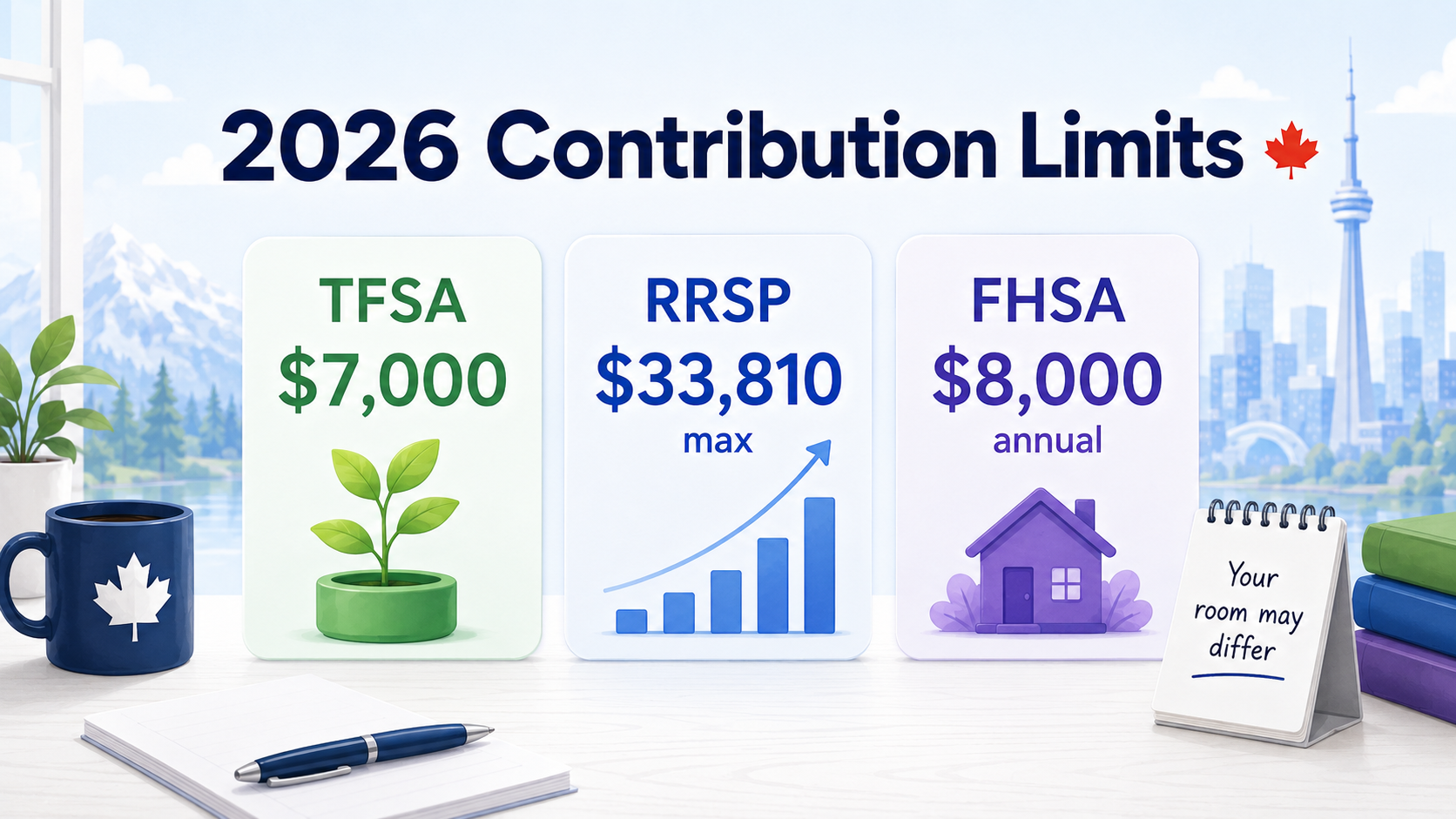
The headline limits for 2026 are $7,000 for a TFSA, $33,810 for an RRSP and $8,000 for an FHSA. Those figures are starting points—not necessarily the amount you personally can contribute.
| Account | 2026 headline limit | Carry-forward | Lifetime limit |
|---|---|---|---|
| TFSA | $7,000 annual dollar limit | All unused room | None |
| RRSP | Lesser of 18% of prior-year earned income and $33,810, adjusted for pension items | Unused deduction room | None |
| FHSA | $8,000 annual participation room | Up to $8,000 | $40,000 |
CRA has also announced a 2027 RRSP dollar limit of $35,390. Your personal 2027 RRSP room will still depend on the normal formula.
TFSA limit for 2026: $7,000
Your available TFSA room is generally:
unused room from previous years + the 2026 dollar limit + withdrawals made in 2025 − contributions already made in 2026
Room begins accumulating for years when you are at least 18 and a Canadian resident for tax purposes. Opening multiple TFSAs does not multiply your room; all accounts share one limit.
A 2026 withdrawal does not create new room during 2026. It is added back on January 1, 2027. Read what happens when you withdraw from a TFSA before replacing money in the same year.
RRSP limit for 2026: up to $33,810
The $33,810 figure is a ceiling. New room is generally the lesser of 18% of your 2025 earned income and $33,810, adjusted for pension adjustments, past service pension adjustments and pension adjustment reversals, plus unused room carried forward.
Example: with $80,000 of 2025 earned income, no pension adjustment and no unused room, the new room would be:
$80,000 × 18% = $14,400
Use the RRSP deduction limit on your latest Notice of Assessment, Notice of Reassessment, Form T1028 or CRA account—not the $33,810 headline.
Contributions made in the first 60 days of 2027 may be eligible for the 2026 tax year. Confirm CRA’s published deadline when filing. For the difference between contributing, deducting and receiving a refund, see RRSP deduction vs refund planning.
FHSA limit for 2026: $8,000
FHSA participation room starts only when you open your first FHSA. The annual amount is $8,000, unused room carry-forward is capped at $8,000, and lifetime contributions are capped at $40,000.
FHSA contributions follow the calendar year. A contribution in January 2027 cannot be deducted for 2026.
What withdrawals do to room
| Account | Normal withdrawal treatment | Does room return? |
|---|---|---|
| TFSA | Generally tax-free | Yes, next January 1 |
| RRSP | Generally taxable income | No |
| FHSA | Qualifying home withdrawal is tax-free; other withdrawals generally taxable | No |
Over-contribution rules at a glance
| Account | General excess tax | Cushion? |
|---|---|---|
| TFSA | 1% per month | No |
| RRSP | 1% per month above the permitted excess | $2,000 lifetime cushion for eligible adults, but it is not deductible room |
| FHSA | 1% per month | No |
Do not intentionally use an excess-contribution cushion as a strategy. If you discover excess money, review the appropriate CRA return and remove or designate the excess as required.
Worked room examples
TFSA
Priya ended 2025 with $2,500 of unused room and withdrew $8,000 during 2025. Her starting room for 2026 is:
$2,500 unused + $8,000 prior-year withdrawal + $7,000 annual limit = $17,500
If she contributes $10,000 in 2026, $7,500 remains. A withdrawal made during 2026 will not increase that figure until January 1, 2027.
RRSP
Marc earned $95,000 in 2025, has $6,000 of unused room and a $7,500 pension adjustment. Ignoring other pension adjustments, his estimated new calculation is:
$6,000 + ($95,000 × 18%) − $7,500 = $15,600
Because individual calculations can include other adjustments, Marc should still use the figure CRA reports rather than treating this illustration as his final limit.
FHSA
Leila opened an FHSA in 2025 and contributed $2,000. Up to $6,000 of unused 2025 participation room can carry into 2026. With $8,000 of new room, she could have $14,000 available for 2026, subject to transfers, other contributions and the $40,000 lifetime limit.
Contributions, deductions and balances
These three numbers are easy to confuse:
- Contribution room is capacity to add money.
- A deduction reduces taxable income when the rules permit it.
- Account balance is the current value of cash and investments.
A TFSA contribution creates no deduction. An RRSP or FHSA contribution can use room now while its deduction is claimed later. Investment growth can make a balance much larger than cumulative contributions without creating or consuming room.
Multiple accounts do not multiply the limit
Annual and personal limits apply across all accounts of the same type:
- two TFSAs share one TFSA room total;
- several RRSPs share one deduction limit; and
- several FHSAs share one participation-room and lifetime total.
This is especially important when accounts are spread across banks, brokerages and employer plans. No single institution necessarily sees the whole picture.
Important calendar differences
| Question | TFSA | RRSP | FHSA |
|---|---|---|---|
| Room generally follows | Calendar year | Prior-year earned income and tax-year rules | Calendar year after opening |
| First 60 days can apply to prior year? | No | Yes | No |
| Prior-year withdrawal affects new room? | Yes | No | No |
| Can an eligible deduction be deferred? | Not applicable | Yes | Yes |
Direct transfers versus withdrawals
Direct transfers often preserve registered status, but the room result depends on the accounts involved.
- TFSA to TFSA: direct transfer generally has no room effect.
- RRSP to RRSP: direct transfer generally has no room effect.
- FHSA to FHSA: direct transfer generally has no room effect.
- RRSP to FHSA: uses FHSA room, produces no new deduction and does not restore RRSP room.
- FHSA to RRSP/RRIF: can generally be direct without using RRSP room.
Withdrawing to chequing and depositing again is not a substitute for a direct transfer. It may create taxable income, consume room or cause an excess contribution.
What records to keep
Retain contribution and withdrawal confirmations, transfer records, year-end slips, Schedule 7 or Schedule 15 information, and Notices of Assessment or Reassessment. CRA portals can lag behind current-year transactions, especially for TFSAs.
Contribution-room FAQ
Does investment growth reduce room?
No. Growth inside a registered account generally affects the balance, not contribution room.
Does an investment loss create room?
No. A market loss is not a withdrawal.
Can I use my spouse’s room?
Registered-account room is individual. Spousal RRSP contributions use the contributor’s deduction limit; the account belongs to the spouse or common-law partner. FHSAs and TFSAs are also individual accounts.
Which number should I trust?
Use your own current-year transaction records together with CRA’s most recent assessment information. When the two appear inconsistent, reconcile the timing before contributing.
Do employer plans affect RRSP room?
They can. A pension adjustment generally reflects benefits earned under a registered pension plan or deferred profit-sharing plan and reduces the following year’s RRSP calculation. A pension adjustment reversal or past service pension adjustment can also affect room. This is why 18% of earned income is not a complete calculation for many employees.
Is the RRSP $2,000 cushion extra room?
No. It may protect an eligible adult from the 1% monthly excess tax on a limited amount, but it is not deductible room. Using it deliberately can complicate future contributions and records.
Does a January FHSA contribution apply to the previous year?
No. FHSA contributions follow the calendar year. The RRSP first-60-days rule does not apply.
Can I contribute securities instead of cash?
Registered accounts may accept in-kind contributions of qualified investments. The fair market value generally counts as the contribution amount, and moving property from a non-registered account can create a taxable disposition. An accrued loss may be denied under superficial-loss rules when property is contributed to a registered account. Confirm the value and tax consequences before transferring.
Planning contributions across all three accounts
Room tells you what is permitted, not what should be funded first. A practical priority decision considers:
- employer matching;
- eligibility for an FHSA and the home-buying timeline;
- current and expected tax brackets;
- need for flexible access;
- high-interest debt;
- emergency savings; and
- investment horizon.
A person saving for a first home may prioritize an FHSA because it combines a deduction with a qualifying tax-free withdrawal. Someone who needs flexible access may favour a TFSA. An RRSP may become more valuable with an employer match or a higher marginal tax rate. The limits table is an input to that decision, not the decision itself.
Before the final contribution of the year
- Reconcile every institution and employer plan.
- Confirm whether pending transfers will be reported this year.
- Leave room for automated contributions that have not yet posted.
- Check the fair market value of any in-kind contribution.
- Save proof of the transaction date and amount.
- Turn off or redirect recurring deposits before the room is exhausted.
The safest way to use this cheat sheet
- Use the table to understand the annual rules.
- Get your TFSA contributions and withdrawals from your own records.
- Take your RRSP limit from your NOA or T1028.
- Reconcile FHSA contributions, transfers and carry-forward on Schedule 15.
- Check every account at every institution before contributing.
Finnomia can show TFSA, RRSP and FHSA balances together and lets users maintain contribution-room figures, but it does not connect to CRA or certify room.
Official references: CRA registered-plan limits, TFSA contribution room and FHSA participation.
This is a general 2026 reference, not a calculation of your personal room.