
On this page
- How an RRSP deduction can affect tax
- How 2026 RRSP room is built
- When claiming the deduction later may help
- Unused room and unused contributions are not the same
- The first-60-days rule
- Withdrawals do not restore RRSP room
- Watch the over-contribution rule
- A practical RRSP planning sequence
- Claim now or later: a fuller example
- Refund planning without the refund myth
- What should you do with the refund?
- Spousal RRSP planning
- HBP contributions and the 89-day rule
- Borrowing to contribute
- Age 71 does not erase unused deductions
- RRSP planning checklist
RRSP Contribution, Deduction and Refund: What Is the Difference?
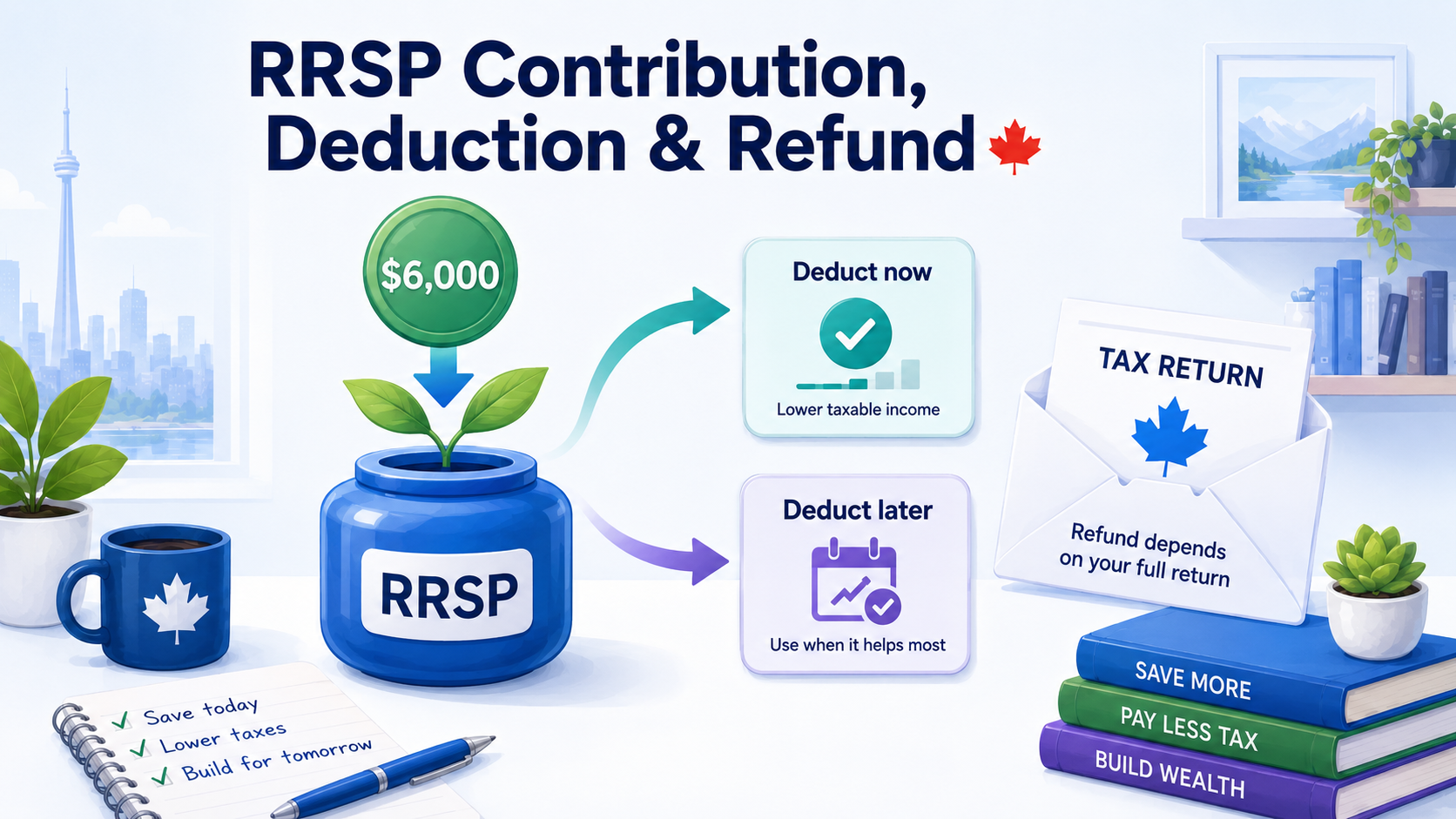
Putting money into an RRSP, claiming an RRSP deduction and receiving a tax refund are three different events.
- Contribution: money goes into the RRSP.
- Deduction: you choose how much of eligible contributions to claim on Line 20800.
- Refund: the final result after CRA calculates your entire return, including income, deductions, credits and tax already paid.
You can contribute now and claim the deduction later. That flexibility can be valuable if you expect your taxable income—and marginal tax rate—to rise.
How an RRSP deduction can affect tax
An RRSP deduction reduces taxable income. The tax effect depends on where the deduction lands across your federal and provincial tax brackets.
For a simplified federal-only illustration, suppose a $6,000 deduction falls entirely within one 2026 federal bracket:
| Federal marginal rate | Simplified federal tax reduction |
|---|---|
| 20.5% | $6,000 × 20.5% = $1,230 |
| 26% | $6,000 × 26% = $1,560 |
This is not a refund quote. Provincial tax, credits and amounts already withheld also affect the return. A deduction may reduce tax payable without producing a cash refund if too little tax was paid during the year.
How 2026 RRSP room is built
The 2026 RRSP dollar limit is $33,810, but your own limit is generally based on:
- unused deduction room from previous years;
- the lesser of 18% of 2025 earned income and $33,810;
- minus a pension adjustment or net past service pension adjustment; and
- plus any pension adjustment reversal.
Check your latest Notice of Assessment, Notice of Reassessment, Form T1028 or CRA account. The national dollar limit is not permission to contribute that amount.
When claiming the deduction later may help
Deferring can be reasonable when:
- you are temporarily in a low-income year;
- you expect a large salary increase soon;
- parental leave, school or a career transition reduced current income; or
- a full deduction would push taxable income into a range where the remaining claim produces relatively little tax savings.
You still report the contribution on Schedule 7. It becomes an unused contribution available to deduct later.
Deferral is not automatically best. Claiming now can improve cash flow, and money received sooner can be saved, invested or used to reduce expensive debt. Compare the value of a later deduction with the value of using the tax savings now.
Unused room and unused contributions are not the same
| Term | Meaning |
|---|---|
| Unused deduction room | Capacity available for a contribution and future deduction |
| Unused contribution | Money already contributed but not yet deducted |
You can have lots of unused room with no money contributed, or unused contributions already inside the RRSP with little room remaining. Do not make another deposit until you know which number you are looking at.
The first-60-days rule
RRSP contributions made in the first 60 days of a year must be reported and may be deducted for the previous tax year or carried forward. CRA will publish the exact 2027 deadline for contributions eligible for the 2026 tax year; confirm it on the official RRSP important dates page.
This rule does not apply to an FHSA. FHSA contributions follow the calendar year.
Withdrawals do not restore RRSP room
A normal RRSP withdrawal is generally taxable income. The financial institution withholds part of the amount, but the withholding is only a prepayment; your final tax depends on your return.
Unlike a TFSA withdrawal, an RRSP withdrawal does not restore contribution room. HBP and Lifelong Learning Plan withdrawals can avoid immediate income inclusion when their conditions are met, but repayments are not new deductible contributions.
Watch the over-contribution rule
RRSP excess contributions can trigger a 1% monthly tax. Eligible adults generally have a $2,000 lifetime cushion above their deduction limit, but that amount is not deductible room. File Form T1-OVP when required.
A practical RRSP planning sequence
- Confirm your deduction limit.
- Decide how much cash you can contribute without weakening your emergency fund.
- Estimate the tax effect of claiming all, part or none this year.
- Choose what to deduct on Line 20800.
- Give any refund a job before it arrives—invest it, fund a goal or pay down costly debt.
Claim now or later: a fuller example
Suppose Erin contributes $12,000 in 2026 and has enough deduction limit. She is deciding between claiming it all in 2026 or carrying some forward because she expects significantly higher income in 2027.
Three approaches are possible:
| Approach | 2026 deduction | Carried forward | Planning effect |
|---|---|---|---|
| Claim all | $12,000 | $0 | Maximizes the current deduction |
| Split | $6,000 | $6,000 | Uses some current value and preserves flexibility |
| Defer all | $0 | $12,000 | Keeps the full deduction for a later return |
The best choice cannot be determined from federal brackets alone. Provincial brackets, income-tested benefits and credits, pension adjustments, other deductions and the time value of receiving tax savings now all matter.
Deferring also creates execution risk: tax rules, income or personal plans can change. Do not give up a useful deduction today solely because a higher-income year seems possible.
Refund planning without the refund myth
A refund is not a bonus paid by the RRSP. It usually means tax withheld or instalments paid during the year exceeded the final tax calculation.
For example, an RRSP deduction may reduce final tax by $3,000:
- If payroll withholding otherwise matched the original tax bill, the filer might receive roughly $3,000 more as a refund.
- If the filer was already $2,000 short on tax, the same deduction might produce only a $1,000 refund.
- If the deduction also changes income-tested credits or benefits, the overall result may be different again.
Focus on total after-tax wealth, not the size of the cheque from CRA.
What should you do with the refund?
Decide before filing. Common uses include:
- contributing it to a TFSA, RRSP or FHSA when room permits;
- adding it to an emergency fund;
- paying down high-interest debt;
- funding a predictable annual expense; or
- splitting it across more than one priority.
Re-contributing an RRSP-generated refund can strengthen long-term savings, but it is still a new contribution that requires room.
Spousal RRSP planning
A contribution to a spouse or common-law partner’s spousal RRSP uses the contributor’s RRSP deduction limit, and the contributor claims the deduction. The account holder owns the plan.
Spousal RRSPs can help balance retirement assets between partners, but withdrawals may be attributed back to the contributor when contributions were made in the withdrawal year or either of the two preceding calendar years. HBP and LLP withdrawals have special treatment. Review the timing before using a spousal RRSP for near-term access.
HBP contributions and the 89-day rule
The Home Buyers’ Plan can permit an eligible withdrawal of up to $60,000. However, an RRSP contribution made in the 89-day period before an HBP withdrawal may not be fully deductible if the account would not retain enough value after the withdrawal.
This prevents a simple contribute-deduct-withdraw sequence from always producing the expected result. If a home purchase is close, coordinate new RRSP contributions with HBP timing and compare an FHSA where eligible.
Borrowing to contribute
An RRSP loan can bring a deduction forward, but interest on money borrowed to contribute is not deductible. The loan payment also reduces future cash flow.
Before borrowing, compare:
- the expected tax reduction;
- the loan’s interest and repayment term;
- whether the refund will be applied to the loan;
- existing high-interest debt; and
- the risk of needing the RRSP money before retirement.
Borrowing solely to create a larger refund can leave you with less flexibility and another required payment.
Age 71 does not erase unused deductions
December 31 of the year you turn 71 is generally the deadline to contribute to your own RRSP. By then, the plan normally needs to be withdrawn, transferred to a RRIF or used to purchase an annuity. You may still deduct eligible unused contributions in a later year, up to your deduction limit.
If your spouse or common-law partner is younger, you may be able to contribute to their spousal RRSP until the end of the year they turn 71, provided you have deduction room.
RRSP planning checklist
- Confirm the deduction limit, not just the annual dollar ceiling.
- Separate unused room from unused contributions.
- Compare claiming now, claiming part and deferring.
- Estimate federal, provincial and benefit effects.
- Check HBP, spousal and age-related timing.
- Assign any refund before it arrives.
- Keep Schedule 7 and contribution receipts with the plan.
Finnomia can bring RRSP holdings, transactions, net worth and user-maintained room into one picture. It does not calculate official CRA room or promise a refund.
For account selection, see TFSA vs RRSP vs FHSA. For annual numbers, use the 2026 contribution limits cheat sheet.
This article is general information, not tax advice. Tax-bracket planning can be more complex when benefits and credits change with family net income.