
On this page
- Who can open an FHSA?
- Open the account to start building room
- Contributions and deductions are separate decisions
- The qualifying withdrawal test
- FHSA and the Home Buyers’ Plan can work together
- What if you never buy a home?
- Avoid these common FHSA mistakes
- How the two first-time home buyer tests differ
- Worked contribution and deduction example
- Couples can each use an FHSA
- What investments can an FHSA hold?
- Timing the qualifying withdrawal
- FHSA transfer examples
- FHSA checklist before making an offer
- FHSA FAQ
FHSA Rules for First-Time Home Buyers in Canada
A First Home Savings Account gives eligible Canadians an unusually valuable combination: contributions are generally tax-deductible, investments can grow tax-free, and a qualifying withdrawal for a first home is tax-free and does not need to be repaid.
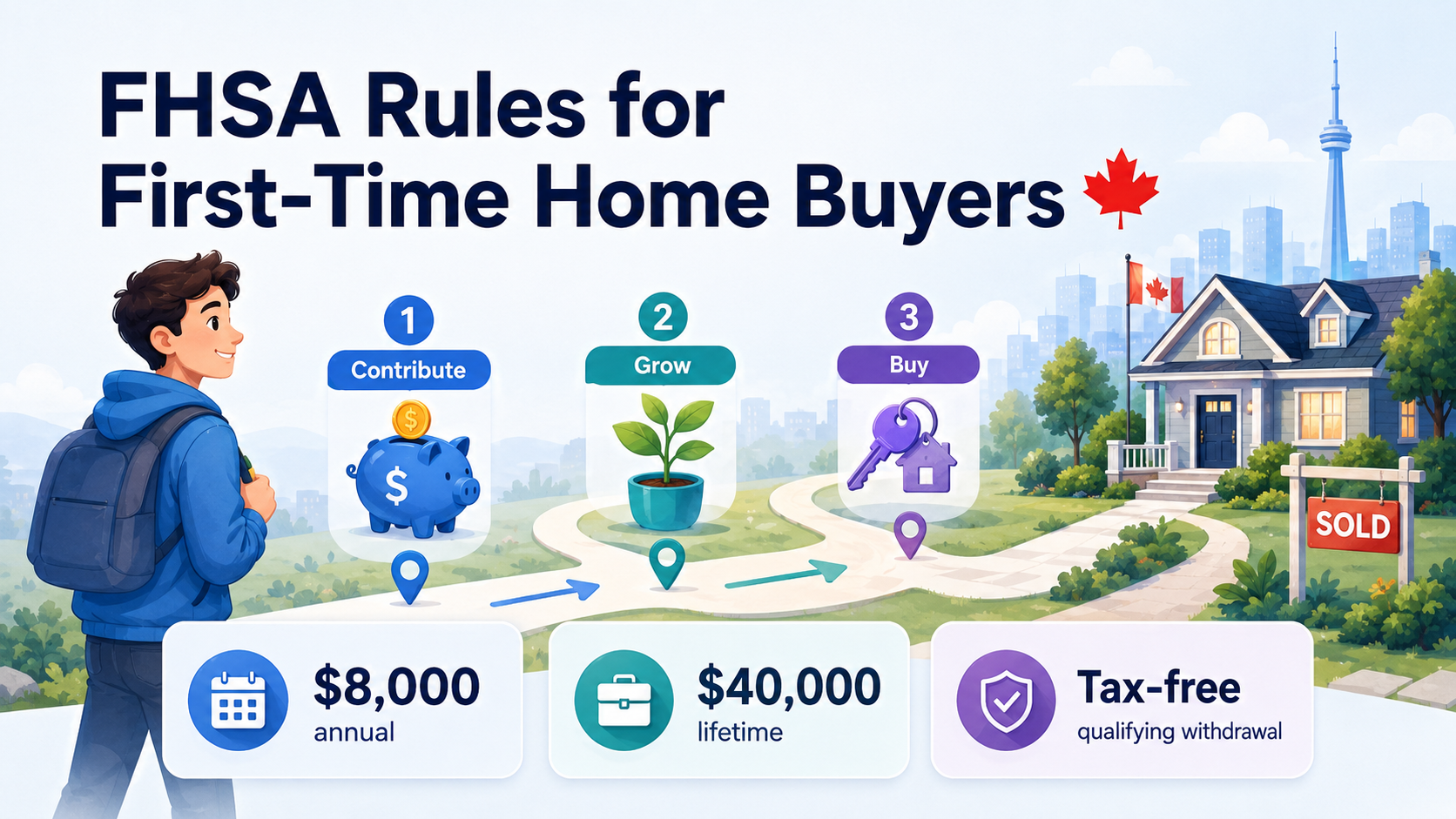
For 2026, opening an FHSA gives you up to $8,000 of participation room, subject to a $40,000 lifetime limit. Room does not begin accumulating until you open your first FHSA.
Who can open an FHSA?
To open an FHSA, you must generally be:
- a resident of Canada;
- at least 18, or the age of majority where you live;
- 71 or younger at the end of the year; and
- a first-time home buyer under the FHSA opening test.
For the opening test, you generally must not have lived in a qualifying home that you or your spouse or common-law partner owned during the current calendar year before opening the account or the previous four calendar years. CRA’s FHSA opening rules cover special situations and exact definitions.
Open the account to start building room
FHSA room is not retroactive. If you are eligible in 2026 but wait until 2028 to open an account, you do not receive room for 2026 and 2027.
After opening, unused participation room can carry forward, but only up to $8,000. That means the most participation room you will normally have available in one year is $16,000.
| Situation | Available room |
|---|---|
| Open first FHSA in 2026 | $8,000 |
| Contribute $3,000 in 2026 | $5,000 unused |
| New room added in 2027 | $8,000 |
| Total available in 2027 | $13,000 |
The lifetime contribution limit remains $40,000.
Contributions and deductions are separate decisions
FHSA contributions made from January 1 through December 31 can be deducted for that year or carried forward and deducted in a later year. Unlike RRSPs, FHSAs do not use a first-60-days lookback.
You can therefore contribute when you have the cash but save the deduction for a future year when your marginal tax rate may be higher. Report your FHSA activity on Schedule 15 even if you defer the deduction.
An RRSP-to-FHSA transfer is different. A direct transfer uses FHSA participation room but does not produce a new deduction and does not restore RRSP room.
The qualifying withdrawal test
Opening an FHSA and making a qualifying withdrawal use related but distinct tests. To make a qualifying withdrawal, you must meet CRA’s conditions at the time of withdrawal, including:
- being a first-time home buyer under the withdrawal test;
- having a written agreement to buy or build a qualifying home in Canada;
- intending to occupy it as your principal residence within one year; and
- completing the acquisition or construction within the required period.
The home generally must be acquired or built before October 1 of the year after the withdrawal. Use Form RC725 to request a qualifying withdrawal and confirm the exact conditions in CRA’s FHSA withdrawal guidance.
A qualifying withdrawal is tax-free, does not need to be repaid and does not restore FHSA room.
FHSA and the Home Buyers’ Plan can work together
If you meet both sets of rules, you can use an FHSA qualifying withdrawal and an RRSP Home Buyers’ Plan withdrawal for the same home. The HBP currently permits up to $60,000 from an RRSP and must generally be repaid over time; the FHSA withdrawal has no repayment requirement.
What if you never buy a home?
You can generally make a direct transfer from an FHSA to your RRSP or RRIF without immediate tax and without using RRSP contribution room. This can make the FHSA useful even if your plans change.
Your maximum FHSA participation period ends on December 31 of the earliest of:
- the 15th anniversary of opening your first FHSA;
- the year you turn 71; or
- the year after your first qualifying withdrawal.
After the participation period ends, remaining property normally needs to be transferred to an RRSP/RRIF or withdrawn as taxable income.
Avoid these common FHSA mistakes
- Waiting to open: room starts only after the first account is opened.
- Assuming all unused room carries forward: the carry-forward is capped at $8,000.
- Using an ordinary withdrawal for a transfer: arrange direct institution-to-institution transfers.
- Contributing after a qualifying withdrawal: later contributions are not deductible.
- Treating $8,000 as personal room: prior contributions, transfers and carry-forward affect your number.
Excess FHSA amounts are generally subject to a 1% monthly tax. There is no RRSP-style $2,000 cushion.
How the two first-time home buyer tests differ
The opening test looks at whether you lived in a home owned by you or your spouse or common-law partner during the relevant period. The qualifying-withdrawal test focuses on whether you lived in a home that you owned during its lookback period. That distinction can matter after a relationship change or when one partner already owns a home.
Do not rely on the phrase “first-time buyer” alone. Use the test for the action you are taking—opening or withdrawing—and confirm the precise dates and ownership facts with CRA.
Worked contribution and deduction example
Noah opens his first FHSA in September 2026 and contributes $5,000. He receives $8,000 of participation room for 2026, leaving $3,000 unused.
In 2027:
- $8,000 of new room is added;
- the $3,000 unused amount carries forward;
- Noah can contribute up to $11,000 in 2027; and
- his lifetime contributions after doing so would total $16,000.
Noah could claim the $5,000 contribution on his 2026 return, defer all of it, or claim part and carry the remainder forward. Deferring the deduction does not restore participation room because the cash is already in the account.
Couples can each use an FHSA
If both partners are eligible, each can open and contribute to an individual FHSA. There is no joint FHSA. Each person has their own participation room, deductions, holdings and qualifying-withdrawal paperwork.
Two eligible partners could ultimately contribute up to $40,000 each over their lifetimes and use qualifying withdrawals toward the same home. Eligibility and maximum participation periods remain individual, so one partner’s dates do not automatically match the other’s.
Money given to a spouse or common-law partner to contribute to their own FHSA generally does not invoke the usual spousal attribution rules for income earned in the account, but the contribution and deduction belong to the FHSA holder. Confirm unusual arrangements with a tax professional.
What investments can an FHSA hold?
An FHSA can generally hold the same broad kinds of qualified investments as a TFSA or RRSP, depending on the issuer: cash, guaranteed investment certificates, mutual funds, exchange-traded funds, bonds and publicly traded securities.
Match the investment risk to the expected home-buying date. A buyer planning to use the money within one or two years may prioritize stability and liquidity. Someone with a longer, flexible timeline may accept more market risk. Tax advantages do not protect the account from investment losses.
Timing the qualifying withdrawal
Coordinate the FHSA withdrawal with your purchase agreement, deposit, closing date and any HBP withdrawal. A qualifying withdrawal can be made in one amount or several amounts, but each request must satisfy the rules.
After the first qualifying withdrawal, the FHSA’s maximum participation period ends on December 31 of the following year. Contributions made after the first qualifying withdrawal are not deductible, even if unused participation room appears to remain.
FHSA transfer examples
| Move | Immediate tax? | Uses destination room? | New deduction? |
|---|---|---|---|
| FHSA to another FHSA, direct | Generally no | No, if properly direct | No |
| RRSP to FHSA, direct | Generally no | Yes, uses FHSA room | No |
| FHSA to RRSP/RRIF, direct | Generally no | No RRSP room required | No |
| FHSA withdrawal, then RRSP deposit | Withdrawal generally taxable unless qualifying | RRSP deposit uses RRSP room | Potential RRSP deduction if otherwise eligible |
The word direct matters. Ask the receiving institution to initiate the appropriate transfer form rather than moving the money through chequing.
FHSA checklist before making an offer
- Confirm both partners’ current eligibility.
- Check each FHSA’s contributions, transfers and lifetime total.
- Review the asset mix and settlement time.
- Understand the qualifying-withdrawal deadline and Form RC725.
- Coordinate FHSA, HBP and non-registered cash.
- Decide where any unused FHSA money will go after the purchase.
FHSA FAQ
Can I open an FHSA if my spouse owns a home?
Possibly, but the opening test considers whether you lived in a qualifying home owned by you or your spouse or common-law partner during the relevant period. The exact living and ownership history matters.
Does withdrawing restore FHSA room?
No. A qualifying withdrawal does not restore participation room. A non-qualifying withdrawal is generally taxable and also does not work like a TFSA withdrawal add-back.
Can parents contribute directly to a child’s FHSA?
The FHSA holder must make or receive contributions within their participation room, and the holder claims any deduction. A parent can generally gift cash for the holder to contribute, but should not expect the deduction personally.
Can I use an FHSA for a rental property?
A qualifying withdrawal requires an intention to occupy the qualifying home as your principal residence within the required period. A property acquired only as a rental would not normally meet that condition.
What if the purchase does not close?
The tax result depends on whether all qualifying-withdrawal conditions were actually met and what happens to the funds. Contact the issuer and obtain tax advice promptly rather than redepositing the money on the assumption that the transaction will reverse automatically.
Finnomia supports FHSA balances and user-maintained contribution-room tracking alongside cash, investments, debt and home-buying goals. It does not receive official contribution-room data from CRA.
Compare the account with alternatives in TFSA vs RRSP vs FHSA, or check the current numbers in the contribution limits cheat sheet.
This article provides general information. FHSA eligibility can turn on dates, ownership and living arrangements, so verify your circumstances with current CRA guidance.
Featured image
Concept: A friendly Canadian first-time buyer stands between a house key and a three-step path: “Contribute,” “Grow,” “Buy.” Three clean cards show $8,000 annual, $40,000 lifetime and tax-free qualifying withdrawal, with a subtle maple leaf.