
On this page
- Why universal numbers fail
- Step 1 — Spending
- Step 2 — Guaranteed income (inputs only)
- Step 3 — Portfolio gap
- Step 4 — Nest egg rule of thumb
- Step 5 — Savings-rate bridge
- Drew’s example (Winnipeg)
- Taxes, clawback, and early retirement (pointers)
- Pull your own numbers
- See the gap beside the rest of the picture
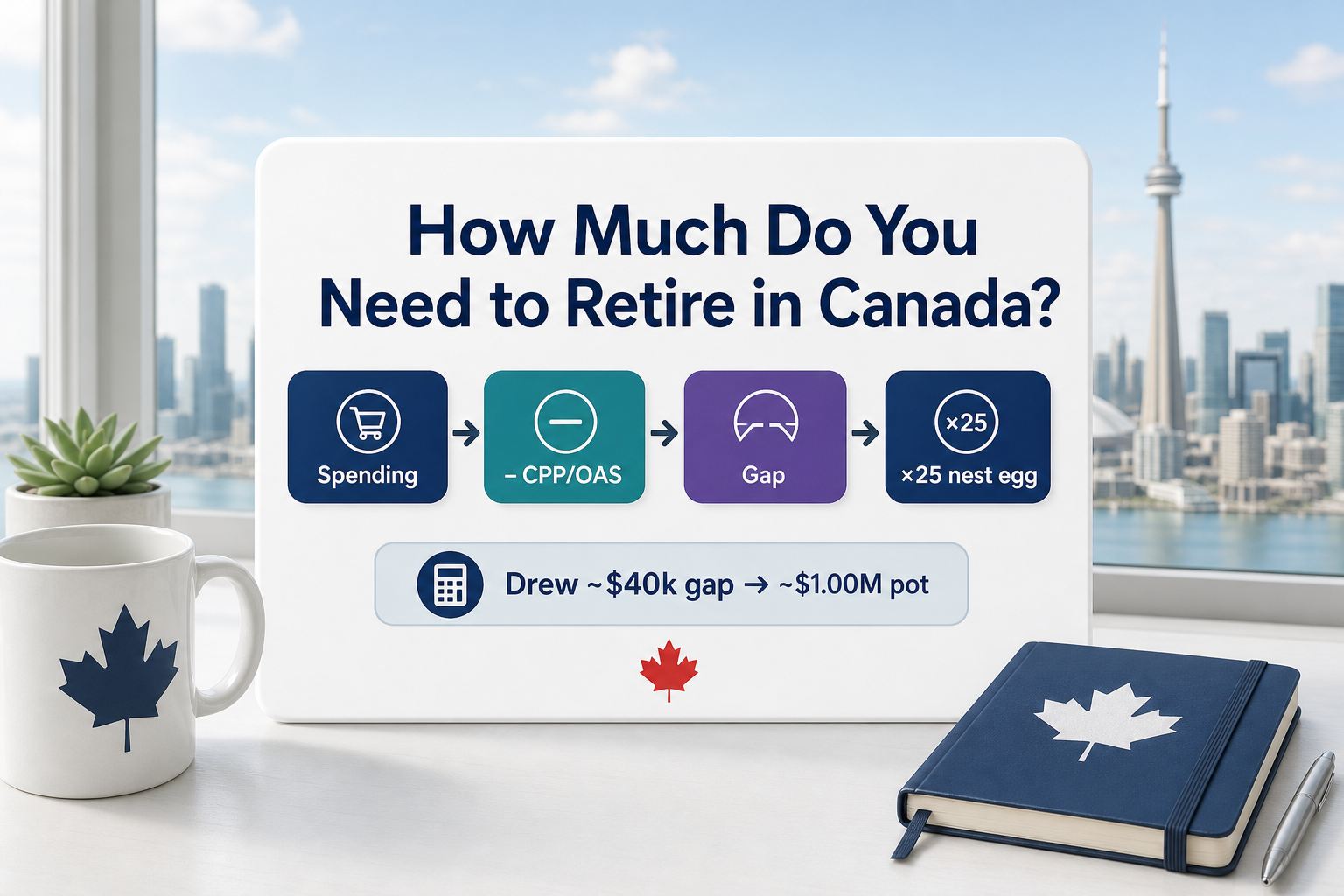
There is no single Canadian retirement number. Survey headlines — couples “need” about $1.7 million, or everyone needs $1 million — measure belief or averages, not your spending or your CPP and OAS. The useful job is a method: estimate retirement spending, subtract guaranteed income, size the portfolio gap, then translate that into a savings path.
This page is that waterfall. It is not a monthly cash-flow surplus tutorial. It is not which registered account wins. It is not a CPP or OAS program course.
Why universal numbers fail
Lifestyle, housing (owned vs rent), location, health, workplace pensions, claim ages, and taxes differ. A $1 million portfolio next to paid-off housing and near-max public pensions is a different story than the same $1 million with rent and below-average CPP. If you see bank-style survey figures in headlines, treat them as folklore averages — not your target.
A 70–80% of pre-retirement income replacement rate is a starting heuristic, not a budget. Prefer a line-item retirement spending estimate. Cash-flow skill for building that estimate lives on How to Budget in Canada.
Step 1 — Spending
Build an annual (or monthly × 12) retirement spending figure in today’s dollars: housing (mortgage vs rent vs condo fees), food, transport, insurance, health and dental gaps, travel, gifts, and a tax buffer if withdrawals will be taxable. This article’s worked example stays in today’s dollars; real planning adjusts for CPI.
Step 2 — Guaranteed income (inputs only)
Subtract income you can reasonably count on.
CPP. Prefer your My Service Canada Account estimate. Official context: maximum at 65 is $1,507.65 a month (January 2026); average for new retirement benefits at 65 is $877.01 a month (April 2026). Most people get less than the maximum. Starting earlier or later changes the cheque (−0.6% per month early to −36% at 60; +0.7% per month late to +42% at 70) — one sensitivity input, not a claim-age essay. Quebec contributors generally use the Québec Pension Plan, not CPP; amounts and rules differ.
OAS. For July to September 2026, full maxima are $751.97 a month at ages 65–74 and $827.17 a month at 75+ (permanent 10% top-up). Partial pension if you have fewer than 40 years of residence after 18. Deferral adds +0.6% per month up to +36% at 70. Recovery tax exists above income thresholds — see canada.ca’s OAS recovery-tax page; this page doesn’t teach sequencing.
Workplace pension, annuity, or other reliable income. Subtract what you actually have. Don’t invent defined-benefit formulas.
Here the CPP and OAS figures are planning inputs stamped from canada.ca — not a program tutorial.
Step 3 — Portfolio gap
Annual gap = annual spending − annual guaranteed income.
That gap is what investments (TFSA, RRSP, non-registered, and other) must support — before choosing which account.
Step 4 — Nest egg rule of thumb
A common planning shorthand: portfolio ≈ annual gap ÷ 0.04 (or × 25) — the 4% rule as a rough, assumption-heavy first-year withdrawal rate for a multi-decade retirement. Treat it as a rule of thumb, not a guarantee. Caveats include sequence-of-returns risk, longevity, fees, taxes, and the fact that Canada’s public-pension floor is already subtracted in the gap. A 3% rate implies a larger pot. Early retirement before CPP and OAS start ages needs a larger pot or a bridge plan — registered drawdown also has CRA rules later; this page doesn’t teach RRIF factors.
Step 5 — Savings-rate bridge
Given years to retirement, your current invested balance, and an illustrative real-return assumption, estimate the monthly (or annual) contribution needed to reach the nest egg. Stop before cash-flow capacity math — How Much Should You Save Each Month? owns whether surplus can sustain that number. Where contributions go is TFSA vs RRSP vs FHSA.
Drew’s example (Winnipeg)
The figures below are an illustrative planning example — not advice, not Drew’s real MSCA quote, and not a survey target.
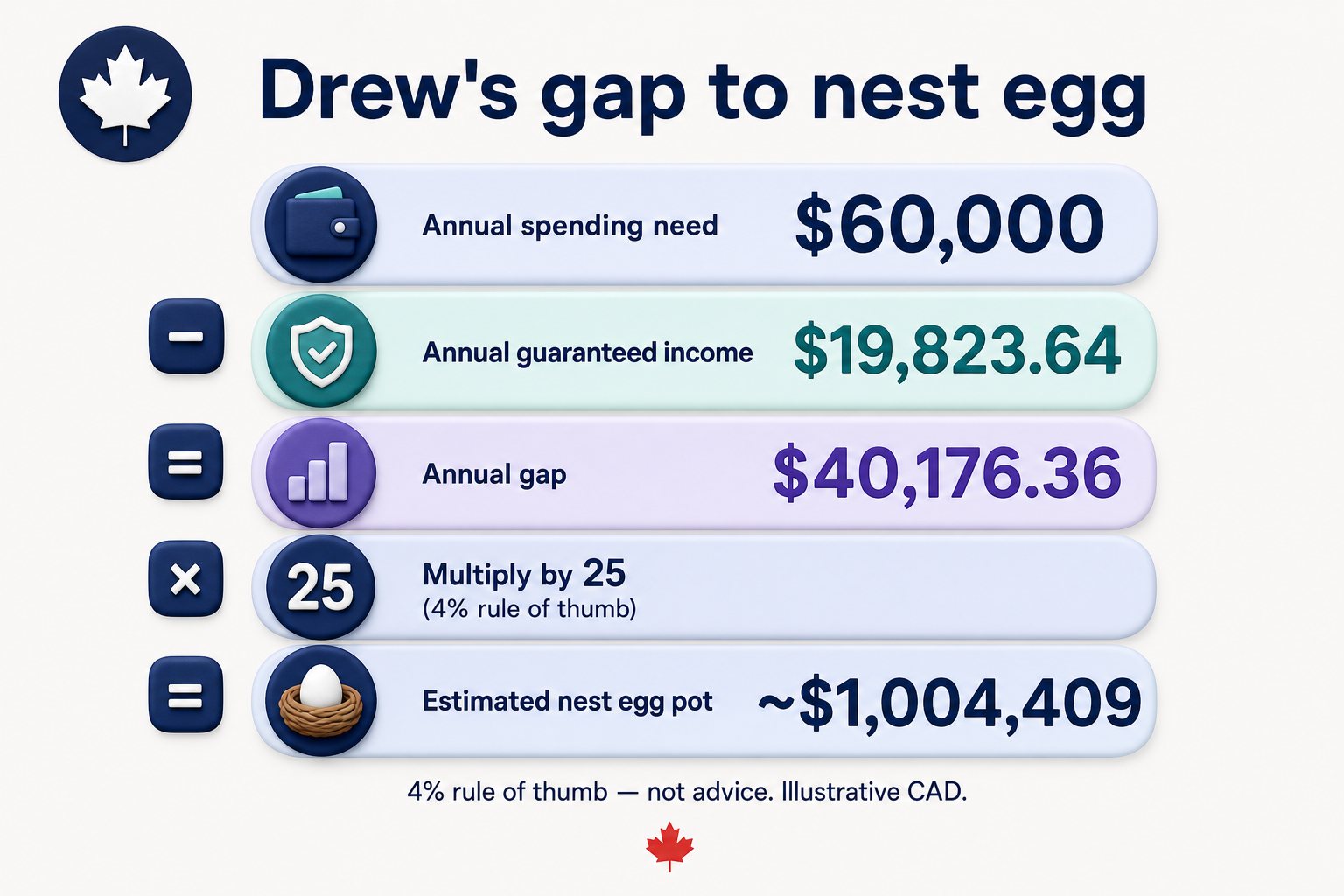
Drew is mid-50s in Winnipeg, aiming toward retirement around age 65, with no workplace pension in this illustration. Desired retirement spending: $5,000 a month in today’s dollars = $60,000 a year.
| Source | Monthly | Annual | Label |
|---|---|---|---|
| CPP (labelled personal estimate) | $900 | $10,800 | Between official average $877.01 (Apr 2026) and max $1,507.65 (Jan 2026) — replace with MSCA |
| OAS (full max, ages 65–74) | $751.97 | $9,023.64 | canada.ca OAS payments Jul–Sep 2026 |
| Workplace pension | $0 | $0 | Illustration |
| Total guaranteed | $1,651.97 | $19,823.64 |
$900 × 12 = $10,800. $751.97 × 12 = $9,023.64. Sum = $19,823.64.
Annual gap = $60,000 − $19,823.64 = $40,176.36.
Rough nest egg = $40,176.36 ÷ 0.04 = $1,004,409 (same as × 25). Label: 4% rule of thumb in today’s dollars — not advice.
Savings bridge (stated assumptions): current invested balance $350,000; 12 years to about age 65; 5% annual real return (illustrative constant — not a forecast); end-of-month contributions.
- Future value of current balance: $350,000 × (1.05)^12 ≈ $628,550
- Still needed from contributions: $1,004,409 − $628,550 ≈ $375,859
- Required monthly contribution ≈ $1,910
Whether Drew’s cash flow can sustain about $1,910 a month is owned by How Much Should You Save Each Month? — this page doesn’t reteach surplus math. Once an amount exists, How to Automate Savings Goals in Canada is the PAC.
Other forks (no second named person):
- Official average CPP $877.01 + OAS $751.97 → guaranteed $1,628.98/mo → gap from $60k ≈ $40,452 → 25× ≈ $1,011,306
- Max CPP $1,507.65 + OAS $751.97 → guaranteed $2,259.62/mo → gap ≈ $32,885 → 25× ≈ $822,114
- CPP only at $900 (before OAS): gap $49,200 → 25× = $1,230,000
- 3% withdrawal on Drew’s $40,176.36 gap → nest egg ≈ $1,339,212
- Early retire with $60,000 spending and no public pensions yet: 25× = $1,500,000 (bridge years until CPP/OAS)
- 70% of $85,000 pre-retirement income → $59,500 spending heuristic — still rebuild from line items
Taxes, clawback, and early retirement (pointers)
Taxable RRSP/RRIF withdrawals vs tax-free TFSA withdrawals change net spending power and can affect OAS recovery tax. See canada.ca recovery-tax; tax-free withdrawal context is TFSA Withdrawal Rules. GIS exists for low-income OAS recipients — delaying OAS can be harmful if you’re GIS-eligible (official colour only; not a GIS tutorial).
Retiring before 60 or 65 means years with little or no CPP/OAS — the gap (and nest egg) jumps unless other income fills it. Multipliers of 25–30× total spending show up for early retirees on the open web — label those as rough and assumption-heavy.
Liquidity before optimizing the nest egg is How Much Emergency Fund Do I Need in Canada?. Contribution limits overview: Contribution Limits Cheat Sheet.
Pull your own numbers
Use My Service Canada Account for personal CPP estimates, the Canadian Retirement Income Calculator for multi-source estimates (estimates only), and Finnomia’s Retirement Planner via trial for nest-egg / CPP / OAS / claim-age scenario estimates — not advice.
See the gap beside the rest of the picture
Finnomia’s Retirement Planner builds nest-egg and public-pension estimates — not advice. It tracks those scenarios; it doesn’t hold accounts or move money. If you want that sitting next to your other numbers, start a 14-day free trial.
How much do I need to retire in Canada?
There isn’t one CAD answer. Estimate spending, subtract CPP, OAS, and other guaranteed income, then size a portfolio for the gap (often roughly 25 × annual gap as a rule of thumb). Replace every input with your own MSCA and budget figures.
Is $1 million enough to retire in Canada?
Sometimes — if spending is modest and public pensions (and housing) cover a large share. Sometimes not. Run the gap method; don’t stop at a round headline.
What about the 4% rule?
It’s a rough first-year withdrawal shorthand (portfolio ≈ gap ÷ 0.04). It is not a guarantee and not a Canada.ca figure. Label assumptions and stress-test.
This article was published in September 2026 and is general information, not personalized tax, legal, or retirement advice. Confirm current CPP and OAS amounts on canada.ca and your own estimates in My Service Canada Account. Nest-egg math is illustrative.