
On this page
- What a RRIF is
- Deadline and three options at 71
- No minimum in the conversion year
- How the minimum is calculated
- Spouse or common-law partner age election
- Lane’s example (Fredericton)
- Withdraw more than the minimum
- Tax and withholding
- Opening a RRIF before 71
- OAS clawback pointer
- Accumulation sits elsewhere
- See drawdown beside the rest of the picture
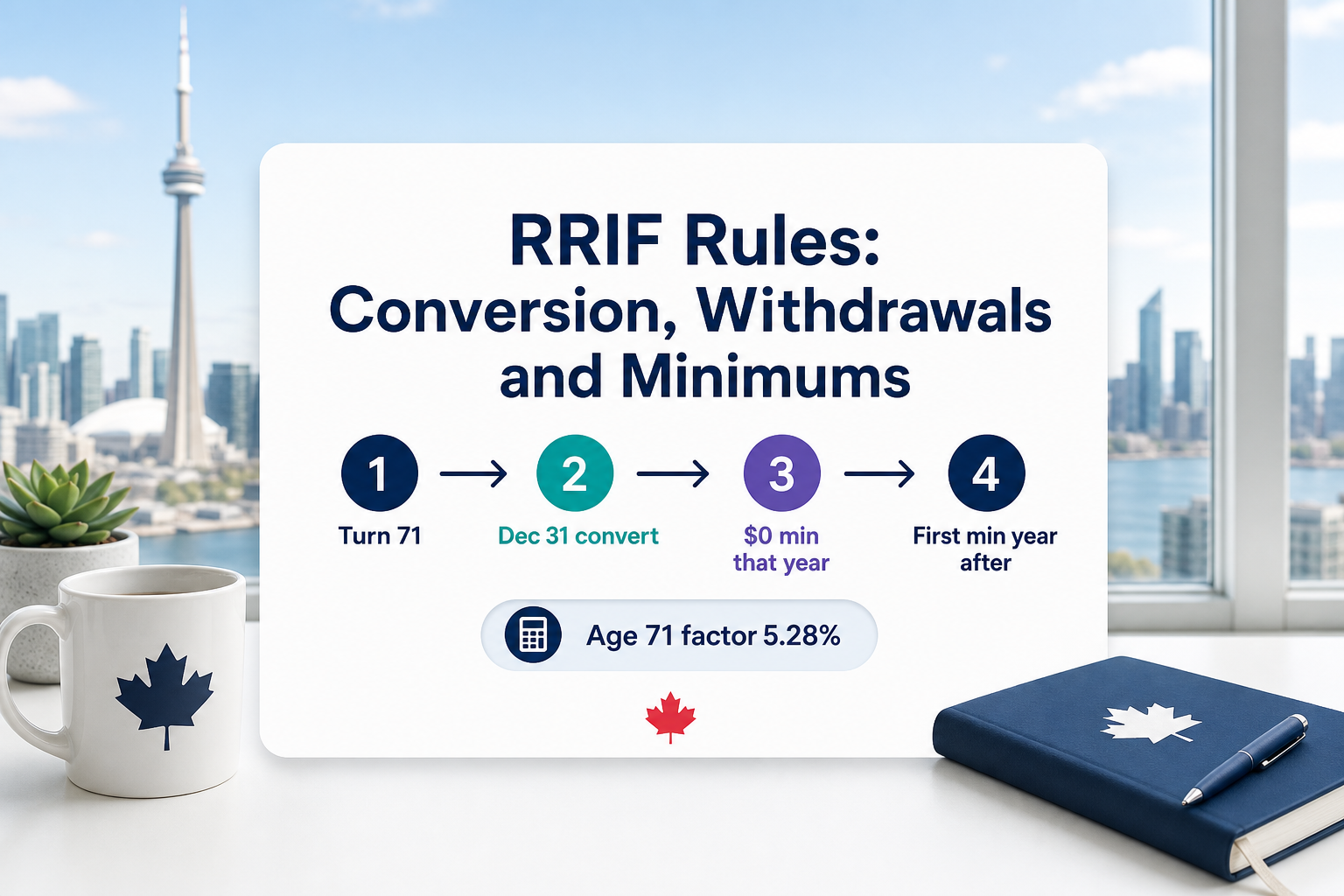
An RRSP can’t stay an RRSP forever. By December 31 of the year you turn 71, you must withdraw, transfer to a RRIF, or buy an annuity. Most people choose a registered retirement income fund so the money can stay invested while CRA rules force a minimum annual withdrawal starting the year after the RRIF is opened.
This page is the rules: deadline, timing, factors, spouse age, and tax pointers. It is not how much you need to retire. It is not TFSA room. It is not a full OAS clawback playbook.
What a RRIF is
A RRIF holds property transferred from an RRSP (or other eligible transfers). You must be paid at least a yearly minimum starting the year after setup. You can take more, not less. The payout period is for life. Investments can continue inside the RRIF; withdrawals are generally fully taxable when received.
Deadline and three options at 71
In the year you turn 71, for your own RRSPs you must choose one of three paths:
- Withdraw the funds (issuer withholds tax on the cash withdrawal).
- Transfer to a RRIF (no tax withheld on the transfer itself; tax applies when income is received later).
- Purchase an annuity (same transfer treatment — tax when income is received).
Locked-in plans (LIRA → LIF/LRIF and similar) follow pension-standards rules — check with the applicable regulator or issuer; this page doesn't teach provincial LIF maxima.
You can still contribute to an RRSP only until the end of the year you turn 71. Contribution and deduction timing live on RRSP Deduction and Refund Planning — not here.
No minimum in the conversion year
Starting in the year after you establish a RRIF, you must be paid the yearly minimum. The calendar year you open the RRIF has no CRA minimum. Any payment taken in the opening year is treated as above the minimum for withholding purposes.
How the minimum is calculated
Base: fair market value of property in the RRIF at the start of the year (January 1) × the prescribed factor.
Age used: your age in whole years at the beginning of the year — or your spouse’s or common-law partner’s age if you elected that at setup.
Age 70 or younger: factor = 1 ÷ (90 − age). Examples: age 65 → 4.00%; age 70 → 5.00%.
Age 71 or older (all other RRIFs — the default modern column): CRA’s Chart – Prescribed factors. Key rows:
| Age (Jan 1) | Factor (all other RRIFs) |
|---|---|
| 71 | 0.0528 (5.28%) |
| 72 | 0.0540 |
| 75 | 0.0582 |
| 80 | 0.0682 |
| 85 | 0.0851 |
| 90 | 0.1192 |
| 95 or older | 0.2000 (20%) |
CRA’s chart also has “Qualifying RRIFs” and pre-March 1986 columns (age 71 qualifying is 0.0526 vs all-other 0.0528). Most people opening a RRIF now use all other RRIFs — check the chart for your carrier’s classification.
Spouse or common-law partner age election
You may elect to base the minimum on your spouse’s or common-law partner’s age. Make the election on the original RRIF application, before any payments. Once made, you can’t change it. A younger spouse age means a lower factor and a lower minimum — useful when you want to leave more invested. Treat that as an irrevocable planning choice, not a yearly toggle.
Lane’s example (Fredericton)
The figures below are an illustrative example. The $400,000 balance is for the minimum formula — not a nest-egg target and not advice.
Lane turns 71 on 15 March 2026, holds a non-locked-in RRSP, and converts the full balance to a new RRIF in December 2026 (before the Dec 31, 2026 deadline). Lane’s spouse turns 65 on 1 June 2026 — so on 1 January 2027 the spouse is 65. Illustrative RRIF FMV on 1 January 2027: $400,000.
| Date | Event | CRA minimum? |
|---|---|---|
| 2026 (year Lane turns 71) | Must convert / annuity / withdraw by 31 Dec 2026 | — |
| Dec 2026 | RRIF opened | $0 minimum in 2026 |
| 1 Jan 2027 | Lane’s age in whole years = 71 | First minimum year |
| During 2027 | Carrier pays ≥ minimum (any schedule) | Must meet annual minimum |
Own-age minimum (2027): factor at 71 = 0.0528.
$400,000 × 0.0528 = $21,120.
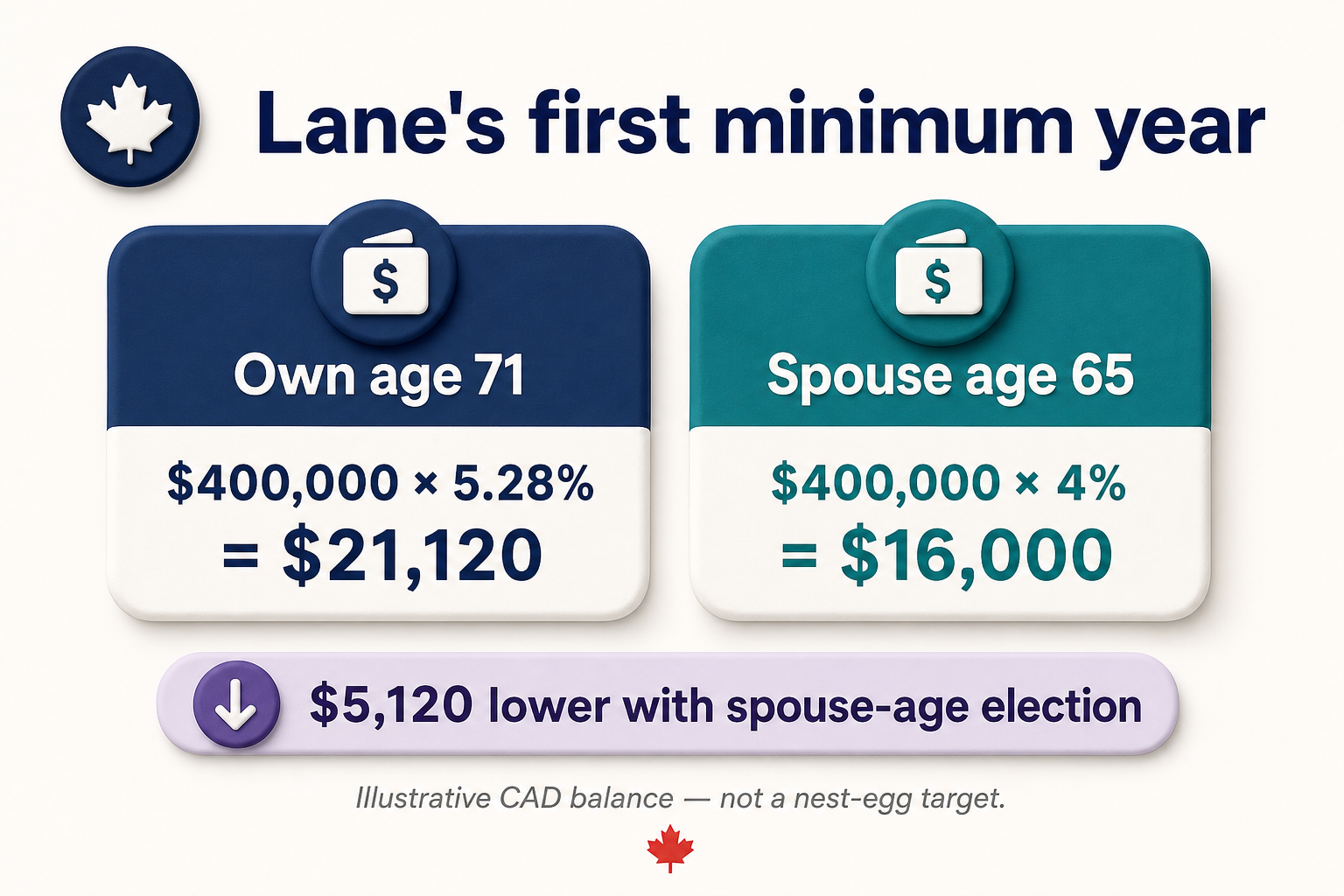
Spouse-age election (made on the original application, before any payment): age 65 → factor 1 ÷ (90 − 65) = 0.04.
$400,000 × 0.04 = $16,000.
That’s $5,120 lower than the own-age minimum ($21,120 − $16,000).
Same $400,000 at other ages (unlabelled forks): age 65 → $16,000; 70 → $20,000; 75 (0.0582) → $23,280; 80 (0.0682) → $27,280; 95+ (0.20) → $80,000.
Withdraw more than the minimum
You can withdraw more than the minimum in any year after opening; you can’t take less than the minimum once the opening year is over. Monthly, quarterly, or annual schedules are a carrier choice — the annual minimum still must be met.
Tax and withholding
RRIF payments are taxable and reported on a T4RIF (often line 11500 if you were 65+ on Dec 31, or received due to a spouse/common-law partner’s death; otherwise often line 13000 — follow the slip and CRA receiving-income page).
- No income tax withheld on the minimum amount.
- Amounts above the minimum use lump-sum rates: 10% (5% Quebec) up to $5,000; 20% (10% Quebec) on amounts over $5,000 up to $15,000; 30% (15% Quebec) over $15,000. These are estimates — you may still owe tax at year-end. You can request extra withholding on a TD1.
Example: Lane withdraws $30,000 in 2027 when the own-age minimum is $21,120. Excess = $8,880. At 20% on that excess band (resident of Canada outside Quebec) → $1,776 withheld on the excess; no withholding on the $21,120 minimum. Withholding ≠ final tax. An excess of only $4,000 would withhold 10% = $400 on the excess.
RRIF income can qualify for the pension income amount if you were 65 or older on Dec 31 (or received it due to a spouse/common-law partner’s death). Eligible pension income may support pension income splitting from age 65 — pointer only; not a splitting tutorial.
Opening a RRIF before 71
You may open a RRIF before 71 (same minimum rules from the year after opening). A common motive is access to the pension-income credit or splitting from 65. That isn’t a rule that everyone should convert at 65.
OAS clawback pointer
RRIF withdrawals raise taxable income and can push you toward or further into the OAS recovery tax. See canada.ca’s OAS recovery-tax page for current thresholds — this page doesn’t teach a multi-year meltdown sequence. TFSA withdrawals aren’t taxable; account priority is TFSA vs RRSP vs FHSA.
Accumulation sits elsewhere
Contribution limits and room live on Contribution Limits Cheat Sheet and the RRSP deduction page above. A RRIF balance is still an asset on Registered Accounts and Net Worth. Cash-flow hygiene is How to Budget in Canada; liquidity before optimizing drawdown is How Much Emergency Fund Do I Need in Canada?.
See drawdown beside the rest of the picture
Finnomia’s Retirement Planner builds nest-egg, public-pension, claim-age, and drawdown estimates — not advice. It tracks those scenarios; it doesn’t hold accounts or move money. If you want that sitting next to your other numbers, start a 14-day free trial.
When must I convert my RRSP to a RRIF?
By December 31 of the year you turn 71, you must withdraw, transfer to a RRIF, or buy an annuity. Most people transfer to a RRIF.
Is there a minimum withdrawal in the year I open the RRIF?
No. The first required CRA minimum is the calendar year after you open the RRIF. Age for the factor is your age (or elected spouse age) on January 1.
What is the RRIF factor at age 71?
For all other RRIFs (the modern default), 0.0528 (5.28%). On a $400,000 Jan 1 balance, that’s a $21,120 minimum.
This article was published in September 2026 and is general information, not personalized tax, legal, or retirement advice. Confirm current factors, deadlines, and your own minimum with CRA and your RRIF carrier. Prescribed factors and withholding rules can change.