
On this page
- What counts toward net worth?
- Balance, contribution room and cash are different
- Your TFSA balance counts toward net worth
- Your RRSP balance also counts toward net worth
- Standard net worth vs. after-tax net worth
- RRSP contribution room is not an asset either
- Your FHSA balance counts too
- A LIRA is an asset even though the money is locked in
- RESPs deserve their own label
- What about pensions?
- Home and mortgage should appear together in total net worth
- A Canadian household example
- Keep account ownership clear in a household view
- Be careful with spousal RRSPs
- Don't double-count money moved through the Home Buyers' Plan
- Transfers between registered accounts don't create wealth either
- Don't double-count credit-card purchases and balances
- CAD and USD accounts need one reporting currency
- How often should you calculate net worth?
- What should stay beside the net-worth number?
- How Finnomia handles registered accounts and net worth
- The number isn't useful if the ingredients are wrong
- Frequently asked questions
Your TFSA has a balance.
Your RRSP has a balance.
CRA tells you that you have contribution room.
And your chequing account contains money you can spend this afternoon.
Those numbers may all appear on the same financial dashboard.
They are not the same kind of number.
That's one of the easiest ways to get a misleading picture of your finances.
For Canadian registered accounts, remember this distinction:
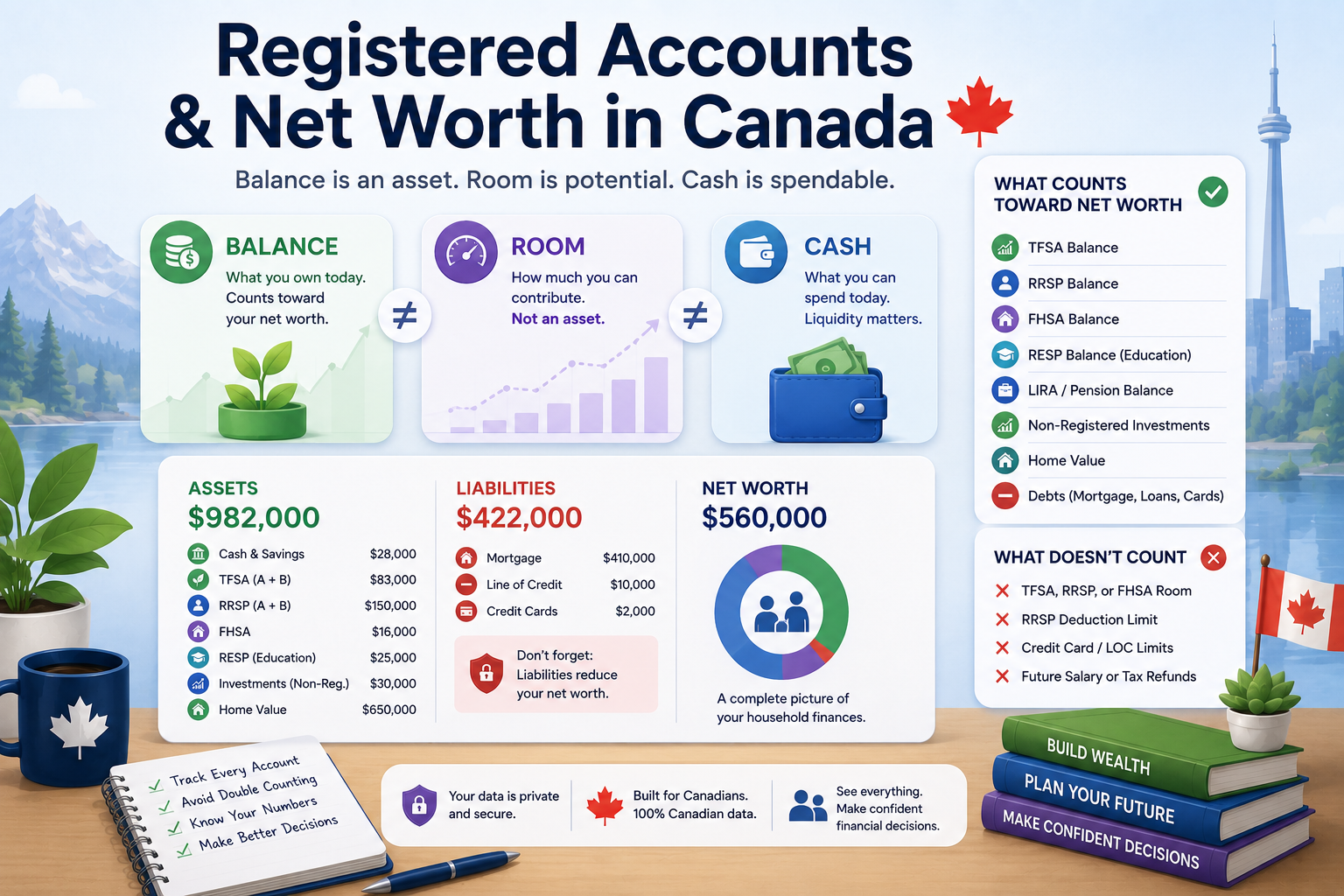
Balance = what the account is worth today. Room = how much additional money you may be able to contribute. Liquidity = how easily you can actually use the money.
Only the first one normally belongs in a net-worth calculation.
What counts toward net worth?
Net worth is fundamentally:
Assets − liabilities = net worth
An asset is something of financial value that you own or control.
A liability is something you owe.
For Canadians, a household net-worth statement might include:
| Item | Include in net worth? | Why |
|---|---|---|
| Chequing and savings | Yes | Financial assets |
| TFSA balance | Yes | Current value of assets inside the TFSA |
| RRSP balance | Yes | Current value of assets inside the RRSP |
| FHSA balance | Yes | Current value of assets inside the FHSA |
| LIRA balance | Yes | Retirement asset, although withdrawals are restricted |
| Non-registered investments | Yes | Financial assets |
| RESP | Usually shown in a household view, with an education designation | Has financial value, but contributions, grants and earnings have different rules |
| Home | Yes, if calculating total net worth | Asset at a reasonable current value |
| Credit-card balance | Yes — as a liability | Amount owed |
| Line of credit | Yes — as a liability | Amount owed, not the available limit |
| Mortgage | Yes — as a liability | Outstanding debt |
| TFSA contribution room | No | Capacity to contribute, not an asset |
| RRSP deduction limit | No | Tax/contribution capacity, not money |
| FHSA participation room | No | Capacity to contribute, not money |
| Credit-card limit | No | Borrowing capacity, not an asset |
| Unused line of credit | No | Borrowing capacity, not money |
The rule is simpler than it sometimes sounds:
Count what you own. Subtract what you owe. Don't add financial capacity as though it were already money.
Balance, contribution room and cash are different
Suppose your financial picture includes:
- TFSA balance: $60,000
- unused TFSA contribution room: $12,000
- chequing: $5,000
You do not have:
$77,000 of assets
because $12,000 of TFSA room isn't an asset.
Your relevant assets in this example are:
$60,000 TFSA + $5,000 cash = $65,000
The $12,000 tells you something useful:
You may have capacity to contribute another $12,000.
That's valuable information for planning.
It simply isn't part of net worth.
The same distinction applies to RRSP and FHSA room.
Your TFSA balance counts toward net worth
A TFSA is an account structure, not a separate category outside your financial life.
If your TFSA contains:
$42,000
of cash and investments, the current market value of those assets is generally part of your net worth.
Whether the original contributions were:
- $20,000
- $30,000
- $42,000
doesn't change the current asset value.
If $30,000 of contributions grew to $42,000, you now have a $42,000 asset.
TFSA room is not part of net worth
Suppose the same person also has:
$15,000 of unused TFSA contribution room
Don't add it:
$42,000 + $15,000 = $57,000
That $15,000 isn't money sitting somewhere.
It's contribution capacity.
We cover that calculation separately in TFSA Contribution Room Explained.
TFSA withdrawals are comparatively flexible
TFSA withdrawals are generally tax-free.
That makes the balance relatively straightforward when thinking about after-tax spending power.
But remember that a withdrawal doesn't restore contribution room immediately.
A withdrawal made during 2026 generally becomes new contribution room on January 1, 2027.
Liquidity and contribution room are separate questions even inside the same account.
Your RRSP balance also counts toward net worth
This is where people often hesitate.
Suppose you have:
$100,000 in an RRSP
Does the entire $100,000 count toward net worth even though a future withdrawal will generally be taxable?
For a conventional balance-sheet view, I would show:
RRSP: $100,000
as the asset.
That's the current market value of the account.
But I'd also remember that:
$100,000 of RRSP assets is not the same thing as $100,000 of TFSA assets if your goal is after-tax spending.
A normal RRSP withdrawal is generally taxable income.
That doesn't mean you should arbitrarily subtract 30% from every RRSP on your net-worth statement.
Your eventual tax consequences depend on things such as:
- how much you withdraw
- other taxable income
- province of residence
- tax rates at the time
- retirement-income sources
- deductions and credits
- withdrawal timing
There isn't one correct Canadian “RRSP haircut.”
Standard net worth vs. after-tax net worth
If future taxes matter to your planning, consider maintaining two different views rather than quietly changing the definition of one.
Standard net worth
Use current account values:
Assets − liabilities
For example:
RRSP: $100,000
Estimated after-tax or spendable net worth
For longer-term retirement planning, you might create a second calculation that estimates future taxes on taxable accounts and liabilities.
That can be useful.
But it depends on assumptions.
Label it clearly:
Estimated after-tax net worth
rather than presenting an assumed future tax bill as though it were a liability owed today.
This becomes especially useful in retirement planning, where the mix of:
- TFSA
- RRSP/RRIF
- non-registered investments
- CPP
- OAS
- pensions
can affect how much of a headline net-worth number eventually becomes spendable income.
RRSP contribution room is not an asset either
Suppose your latest Notice of Assessment says you have:
$25,000 of RRSP deduction limit
and your RRSP is worth:
$100,000
Your net-worth asset is still:
$100,000
not:
$125,000
The $25,000 tells you something about future contribution and deduction capacity.
It's not money you already own.
That distinction is the same one we made with the TFSA.
Your FHSA balance counts too
Suppose you're saving for a first home and your FHSA contains:
$22,000
That's an asset.
If you eventually meet the conditions for a qualifying FHSA withdrawal, the money can generally be withdrawn tax-free toward the home and doesn't have to be repaid.
If you don't meet the qualifying conditions, withdrawal treatment is different.
Either way, the current balance exists today, so it belongs in the asset picture.
Unused FHSA participation room does not.
What happens after you buy the home?
This is where double-counting becomes easy.
Suppose your FHSA contains:
$30,000
Then you make a qualifying withdrawal and use the entire $30,000 toward the home purchase.
Before the withdrawal:
FHSA: $30,000
After the withdrawal:
FHSA: $0
Those same dollars may now form part of the equity in your home.
You don't keep:
FHSA $30,000 + home value
as though both still exist.
Money moved.
Your net-worth statement needs to move with it.
A LIRA is an asset even though the money is locked in
A Locked-In Retirement Account can feel less like an asset because access to the money is restricted.
But restriction doesn't mean the account has no financial value.
If your LIRA is worth:
$85,000
that $85,000 can be included as a retirement asset in your net-worth calculation.
Just don't confuse:
net-worth value
with:
money available to spend today
Those are different characteristics.
This is another reason “balance” and “cash” shouldn't be used interchangeably.
RESPs deserve their own label
RESPs are slightly different from an individual TFSA, RRSP or FHSA.
An RESP involves:
- a subscriber
- one or more beneficiaries
- the subscriber's contributions
- potentially government education incentives
- investment earnings
CRA says control of the subscriber's contributions remains with the subscriber. Contributions may generally be returned tax-free, while grants and accumulated earnings follow separate payment and tax rules.
That makes an RESP useful to show in a household financial picture, but I would label it clearly:
RESP — education-designated
rather than treating the entire account like ordinary cash or retirement savings.
For example:
RESP: $35,000 — Education
That tells you the household has a meaningful financial asset earmarked toward education without implying:
“We have another unrestricted $35,000 available for retirement.”
Consistency matters more than finding one supposedly universal accounting convention.
If you include RESP balances in household net worth, keep using that methodology over time so changes in the number remain meaningful.
What about pensions?
This depends on the type of pension.
Defined-contribution pension
If your statement gives you a current account balance, the treatment is relatively straightforward.
That balance represents a retirement asset and can reasonably be shown alongside things such as:
- RRSP
- LIRA
- TFSA
Defined-benefit pension
A defined-benefit pension is harder.
It promises future income based on the plan's rules rather than simply giving you an investment account with an obvious current balance.
You could attempt to calculate a present value for that future income.
But unless you actually have a reliable plan-provided value or know how you're valuing the pension, you can easily introduce a large invented number into your net worth.
A practical approach is often to track the defined-benefit pension separately:
Defined-benefit pension: future retirement-income source
Then incorporate the expected pension income into your retirement plan rather than guessing at today's asset value.
If your pension administrator provides a meaningful commuted or transfer value and you're deliberately using that measure, that's a different calculation.
The important part is to document the methodology.
Home and mortgage should appear together in total net worth
This is another common source of misleading numbers.
Suppose:
- Home: $700,000
- Mortgage: $450,000
For a total net-worth statement:
Home asset: +$700,000 Mortgage liability: −$450,000
Net contribution:
+$250,000
That's your approximate home equity under those assumptions.
What doesn't make sense for total net worth is:
Home: excluded Mortgage: −$450,000
and then treating the result as though it represents your entire financial position.
You can absolutely create another metric that excludes housing.
For example:
- financial net worth
- investable assets
- liquid assets
- retirement assets
But define the metric.
Don't mix parts of different calculations and call the result total net worth.
A Canadian household example
Consider this fictional household.
Assets
| Asset | Value |
|---|---|
| Chequing | $8,000 |
| Emergency savings | $20,000 |
| TFSA — Partner A | $48,000 |
| TFSA — Partner B | $35,000 |
| RRSP — Partner A | $92,000 |
| RRSP — Partner B | $58,000 |
| FHSA — Partner B | $16,000 |
| RESP — education-designated | $25,000 |
| Non-registered investments | $30,000 |
| Home | $650,000 |
| Total assets | $982,000 |
Liabilities
| Liability | Balance |
|---|---|
| Credit cards | $2,000 |
| Line of credit | $10,000 |
| Mortgage | $410,000 |
| Total liabilities | $422,000 |
Net worth
$982,000 − $422,000 = $560,000
Now suppose they also have:
- $14,000 of unused TFSA room
- $22,000 of RRSP deduction room
- $8,000 of unused FHSA participation room
- $30,000 of available credit on their credit cards
None of those numbers gets added to the $560,000.
They matter for planning.
They aren't assets.
Keep account ownership clear in a household view
Two people can share a financial picture without jointly owning every account.
That's particularly important with registered accounts.
For example:
- Partner A's TFSA belongs to Partner A
- Partner B's TFSA belongs to Partner B
- Partner A's RRSP belongs to Partner A
- Partner B's FHSA belongs to Partner B
A household net-worth dashboard can show all four accounts.
That doesn't merge their legal ownership.
This matters for planning because:
shared visibility ≠ shared ownership
A household may reasonably want to know:
“Our TFSAs total $83,000.”
while still preserving:
“$48,000 belongs to A and $35,000 belongs to B.”
Both views can be useful.
For more on the access side, see Household Finances Without Shared Passwords.
Be careful with spousal RRSPs
Spousal RRSPs create another ownership/contribution distinction.
One spouse may make contributions and use their own RRSP deduction room.
But the other spouse is the annuitant of the spousal RRSP.
For household net worth, the important rule is:
Count the account once.
Don't list the same spousal RRSP as:
- an asset belonging to the contributor
- and an asset belonging to the annuitant
and then combine both personal statements.
That's double-counting.
A household dashboard should preserve enough account ownership information to prevent that.
Don't double-count money moved through the Home Buyers' Plan
The same principle applies to the RRSP Home Buyers' Plan.
Suppose:
RRSP before HBP withdrawal: $100,000
You withdraw:
$40,000
for the home purchase.
The RRSP is now approximately:
$60,000
before market movement or other transactions.
The $40,000 did not duplicate itself.
It's no longer sitting inside the RRSP.
It moved toward:
- the down payment
- closing cash
- ultimately, home equity
Your financial statement should show where the money is now.
Don't keep the old $100,000 RRSP balance and then add the $40,000 to the home.
Transfers between registered accounts don't create wealth either
Suppose you transfer:
$8,000 RRSP → FHSA
using the applicable direct-transfer rules.
Before:
- RRSP: $100,000
- FHSA: $0
After:
- RRSP: $92,000
- FHSA: $8,000
Ignoring market changes, total registered assets remain:
$100,000
You changed where the asset lives.
You didn't create another $8,000 of net worth.
The same principle applies to eligible direct transfers in the other direction.
Don't double-count credit-card purchases and balances
Here's another subtle one.
Suppose you buy:
$1,000 of household expenses
on a credit card.
That $1,000 matters for your budget and cash flow.
At the same time, the unpaid card balance is now a:
$1,000 liability
on your net-worth statement.
Those are two different financial views.
You aren't supposed to subtract the $1,000 twice from net worth because it also appeared in the monthly spending report.
Budgeting measures flows.
Net worth measures balances at a point in time.
Keeping those concepts separate prevents a lot of confusing dashboards.
CAD and USD accounts need one reporting currency
Many Canadian households own U.S. assets.
For example:
- USD cash
- U.S.-listed stocks or ETFs
- a USD brokerage account
If your net worth is being reported in CAD, those values need to be converted consistently.
Don't add:
$100,000 CAD
and:
$25,000 USD
and call the result:
$125,000 CAD
The currency has to be normalized first.
The exchange rate will move over time, so some change in CAD net worth can occur even when the underlying USD asset hasn't changed in U.S.-dollar terms.
For the broader household calculation, see CAD Net Worth: Cash + TFSA/RRSP Together.
How often should you calculate net worth?
There isn't much value in watching it move every hour.
For many people:
monthly
is a useful rhythm.
It's frequent enough to see:
- debt declining
- investments growing or falling
- savings accumulating
- large purchases
- home or account changes
without turning normal market volatility into a daily scorecard.
Quarterly can also be perfectly reasonable.
Consistency matters more than frequency.
Use roughly the same methodology each time so the trend actually means something.
What should stay beside the net-worth number?
A single net-worth total can hide useful differences.
I'd keep at least these additional numbers visible:
Cash
How much is readily available?
Investments
How much is invested?
Registered vs. non-registered
Where are the assets held?
Debt
What do you owe, and where?
Contribution room
Not part of net worth, but useful beside the registered accounts for planning the next contribution.
Goals
What is the money actually meant to accomplish?
Two households can both have:
$500,000 net worth
while having completely different financial situations.
One could have:
- $450,000 of home equity
- $20,000 investments
- very little cash
The other could have:
- $300,000 investments
- $150,000 cash
- no home
The headline total is useful.
The composition often matters more for the next decision.
How Finnomia handles registered accounts and net worth
Finnomia is the Canadian personal-finance platform behind this blog.
Advanced users can bring their broader financial picture together across:
- bank accounts
- credit cards
- debts
- TFSA
- RRSP
- FHSA
- RESP
- LIRA
- non-registered investments
- manual assets and liabilities
Connected investment accounts can include holdings and investment transactions where supported.
Net worth can then be viewed historically rather than requiring a manual snapshot each month.
Registered accounts stay identifiable
Finnomia treats Canadian registered accounts as Canadian account types rather than forcing everything into a generic investment category.
That makes it possible to distinguish:
- account balance
- account type
- investment holdings
- contribution-room information you maintain
without treating unused room as an asset.
Official contribution room should still be confirmed using your own records and the appropriate CRA information.
Finnomia doesn't pull official contribution room directly from CRA.
CAD and USD
Finnomia can present:
- CAD
- USD
- combined values
and uses Bank of Canada exchange-rate data when combining currencies into a CAD financial picture.
That avoids simply adding different currencies together.
Household net worth
Family members can maintain separate user identities while viewing an appropriate shared household financial picture.
That allows individual registered accounts to remain identifiable while still answering:
“What does our household own and owe altogether?”
Privacy and account connections
Financial connections are read-only.
Finnomia currently uses Plaid and is adding Flinks as a second connectivity provider to improve Canadian institution coverage and reliability.
Finnomia cannot move your money and doesn't store your bank password.
The investment, registered-account, household and net-worth functionality described here is already live.
You can also use Finnomia's free net-worth calculator.
The number isn't useful if the ingredients are wrong
Net worth is simple arithmetic.
The difficult part is deciding what each number actually represents.
A TFSA balance is an asset.
TFSA contribution room isn't.
An RRSP balance is an asset.
It also has future tax considerations.
An FHSA balance is an asset.
Unused FHSA room isn't.
A LIRA can be an asset even though you can't spend it today.
An RESP can belong in a household financial picture while still being clearly earmarked for education.
A mortgage is a liability.
If you're calculating total net worth, the home on the other side belongs in the picture too.
Once those distinctions are clear, the calculation becomes much more useful.
You're no longer looking at a collection of account balances.
You're looking at:
what you own, what you owe, where the money sits, and what each part of it can actually do.
If you want to track those pieces together rather than maintaining the calculation manually, you can start a 30-day Finnomia trial.
Frequently asked questions
Does a TFSA count toward net worth?
Yes.
The current value of the cash and investments inside your TFSA is an asset and can be included in net worth.
Unused TFSA contribution room is not an asset.
Does an RRSP count toward net worth?
Yes.
The current value of your RRSP is generally included as an asset in a standard net-worth calculation.
Regular future RRSP withdrawals are generally taxable, so you may also choose to maintain a separate estimated after-tax view for retirement planning.
Should I subtract tax from my RRSP when calculating net worth?
Not necessarily.
For a standard balance-sheet calculation, using the current RRSP market value keeps the methodology simple and observable.
If you want an after-tax estimate, calculate it separately and clearly label the assumptions rather than applying an arbitrary tax percentage to the main net-worth figure.
Does an FHSA count toward net worth?
Yes.
The current FHSA balance represents a financial asset.
Unused FHSA participation room does not.
Does TFSA or RRSP contribution room count as net worth?
No.
Contribution room is capacity to make future registered contributions.
It isn't money you currently own.
Does an RESP count toward household net worth?
An RESP can reasonably be shown in a household financial view, but it should be clearly identified as education-designated.
RESP contributions, government incentives and investment earnings have different withdrawal and tax rules, so the balance should not automatically be treated as unrestricted household cash.
Does a LIRA count toward net worth?
Yes.
A LIRA has financial value and can be included as a retirement asset even though access to the money is restricted by pension rules.
Should I include my pension in net worth?
For a defined-contribution pension with an observable account balance, including the current balance is relatively straightforward.
A defined-benefit pension is more complicated because it promises future income rather than necessarily providing a current account value.
Unless you have a reliable current valuation and a consistent methodology, tracking the expected pension separately from net worth may be clearer.
Should I include my house and mortgage?
For total net worth, include both consistently:
- home as an asset
- outstanding mortgage as a liability
If you're creating a different metric such as liquid or investable net worth, clearly define what that metric includes rather than calling it total net worth.
This article was reviewed in August 2026 and provides general information, not personalized tax, accounting, investment or financial advice. Registered-account, pension and tax rules can change. Use current account values and official records when calculating your financial position.