
On this page
- Shared finances don't have to mean shared accounts
- First understand four different kinds of financial sharing
- Joint bank accounts: shared access comes with shared responsibility
- A household-only joint account can be a useful middle ground
- Authorized credit-card users are not joint borrowers
- One household can include all of these at once
- Never share your online-banking password just to make budgeting easier
- Shared visibility is different from shared credentials
- Consumer-driven banking is changing how financial data can be shared
- Privacy matters even when the bank connection is read-only
- How Finnomia handles household access
- A better way to think about household finances
- Shared money doesn't require shared passwords
Two paycheques land in two chequing accounts.
Rent leaves one account. Groceries go on the other's credit card. Hydro is in one person's name. The internet bill belongs to the other.
Eventually someone says:
“Just give me your banking password so I can see everything.”
Don't.
A shared household budget does not require shared online-banking credentials.
In fact, the Financial Consumer Agency of Canada tells consumers not to share their PIN, password, or security-question answers with anyone — including a spouse, partner or family member.
The useful question isn't:
Who should hold the login?
It's:
What financial information does each person need to see, and what access or responsibility should come with it?
Those are different questions.
A Canadian household can use separate accounts, joint accounts, authorized credit cards and shared budgeting tools in different combinations. The important thing is understanding the difference between visibility, access, ownership and legal responsibility.
Shared finances don't have to mean shared accounts
Couples often talk about “combining finances” as though there's one switch:
separate → joint
Real households are usually more complicated.
You might have:
- two personal chequing accounts
- one joint household account
- separate credit cards
- a joint mortgage
- individual TFSAs
- individual RRSPs
- household bills paid from different accounts
- shared savings goals
- one household budget tying the picture together
That's still a shared financial system.
The Financial Consumer Agency of Canada's guidance for couples describes three common approaches:
- pooling income and expenses through a joint account
- keeping personal accounts while using a joint account for household expenses
- keeping accounts separate and dividing shared costs between them
FCAC also suggests deciding how much each person contributes — for example, 50/50 or different percentages based on income — and how the arrangement would change if the household temporarily dropped to one income.
None of those models requires one person to log into the other's online banking.
First understand four different kinds of financial sharing
A lot of confusion disappears once you separate these concepts.
| Arrangement | What is shared? | Who can transact? | Who is financially responsible? |
|---|---|---|---|
| Separate bank accounts | Nothing at the bank-account level | Each account owner | Each account owner |
| Joint bank account | Ownership/access to the account | Both account holders | Both can have responsibility associated with the account |
| Authorized credit-card user | Permission to use the primary holder's credit card | Primary holder + authorized user | Primary cardholder is responsible for the balance |
| Joint borrower / co-borrower | Credit agreement | Both borrowers | Both are responsible for the debt |
| Shared household-budget view | Financial visibility inside budgeting software | Depends on the software permissions | Does not by itself change ownership or legal responsibility for the underlying accounts |
That last distinction matters.
Seeing your partner's TFSA balance in a household financial dashboard does not make the TFSA jointly owned.
Seeing a shared mortgage in a budgeting app doesn't determine who is legally responsible for it.
And seeing transactions from a household account shouldn't require knowing the other person's bank password.
Joint bank accounts: shared access comes with shared responsibility
A joint chequing or savings account can be useful when both people regularly contribute toward the same household expenses.
For example:
- rent or mortgage
- utilities
- groceries
- insurance
- property taxes
- household subscriptions
Both people can contribute money to the account, and shared bills can come from one place.
But a joint account isn't merely a budgeting convenience.
According to FCAC's joint-account guidance, joint account holders share access to the account and are also responsible for transactions made by the other account holder.
If the account has overdraft protection, for example, all holders may be responsible for the resulting debt.
That means opening a joint account is a financial decision, not just an easier way to see grocery spending.
Before opening one, understand:
- who can withdraw money
- whether either person can transact independently
- overdraft rules
- fees
- how the institution handles disputes
- what happens if one account holder dies
FCAC specifically recommends asking the institution about survivor access because the outcome can depend on the account and applicable provincial rules.
A household-only joint account can be a useful middle ground
Many couples don't want either extreme.
They don't want every dollar completely separate.
They also don't want every dollar completely combined.
A household account can sit between the two.
Imagine two people who each keep their own:
- chequing
- credit card
- TFSA
- RRSP
- personal spending
They also maintain one joint chequing account.
Each pay period, both transfer an agreed amount into it.
The account covers:
- housing
- utilities
- insurance
- groceries
- other agreed household expenses
Now the household has a clear operating account while each person retains personal accounts.
The household budget can then sit above both layers:
Personal finances + shared finances = household picture
For many couples, that's more useful than assuming everything has to be either completely separate or completely merged.
If you're trying to decide how much each person should contribute, see our guide to budgeting with a partner or roommate in Canada.
Authorized credit-card users are not joint borrowers
Credit cards introduce another distinction that is easy to miss.
Suppose Alex has a credit card and adds Sam as an authorized user.
Sam receives a card linked to Alex's account and can make purchases.
But according to FCAC's joint credit-card guidance:
- the credit-card account belongs to the primary cardholder
- the primary cardholder is responsible for paying the balance
- purchases made by the authorized user appear on the primary cardholder's statement
- the authorized user's purchases don't build the authorized user's credit history
That's different from being a co-borrower.
If two people jointly apply for credit as co-borrowers, they can both be responsible for the balance.
FCAC defines a joint borrower as someone who signs a mortgage, loan, credit-card or line-of-credit agreement with one or more other people. Joint borrowers are equally responsible for repaying the unpaid balance.
So:
Authorized user ≠ joint borrower.
And neither arrangement is the same thing as simply sharing a budget.
One household can include all of these at once
Consider this two-person household.
Joint chequing
Rent: $2,100
Both people contribute to the account and use it for household expenses.
Partner A's personal credit card
Groceries and gas: $340
The card belongs to Partner A.
Partner B's personal credit card
Pharmacy and transit: $215
The card belongs to Partner B.
Total household spending represented by those transactions:
$2,100 + $340 + $215 = $2,655
The household budget should be capable of recognizing that $2,655 came from three different accounts.
Nobody needs the other person's online-banking credentials to understand the household total.
That's the difference between combining accounts and combining information.
Never share your online-banking password just to make budgeting easier
FCAC's online-banking guidance is explicit:
“don't share your personal identification number (PIN), password or security questions and answers with anyone, not even family members”
That includes a spouse or partner.
FCAC warns that if you give someone your online-banking information, you may risk losing the protection against unauthorized transactions offered by your financial institution and may be responsible for unauthorized transactions on the account.
The exact protections and obligations depend on your institution's agreement, so check its terms.
But the practical budgeting rule is simple:
Don't solve a household-visibility problem by creating a banking-security problem.
A partner shouldn't need your bank password to see the grocery budget.
A roommate shouldn't need access to your chequing login to confirm that rent was paid.
And a financial app shouldn't require you to hand your password to another household member.
Shared visibility is different from shared credentials
This is where household budgeting software can be useful.
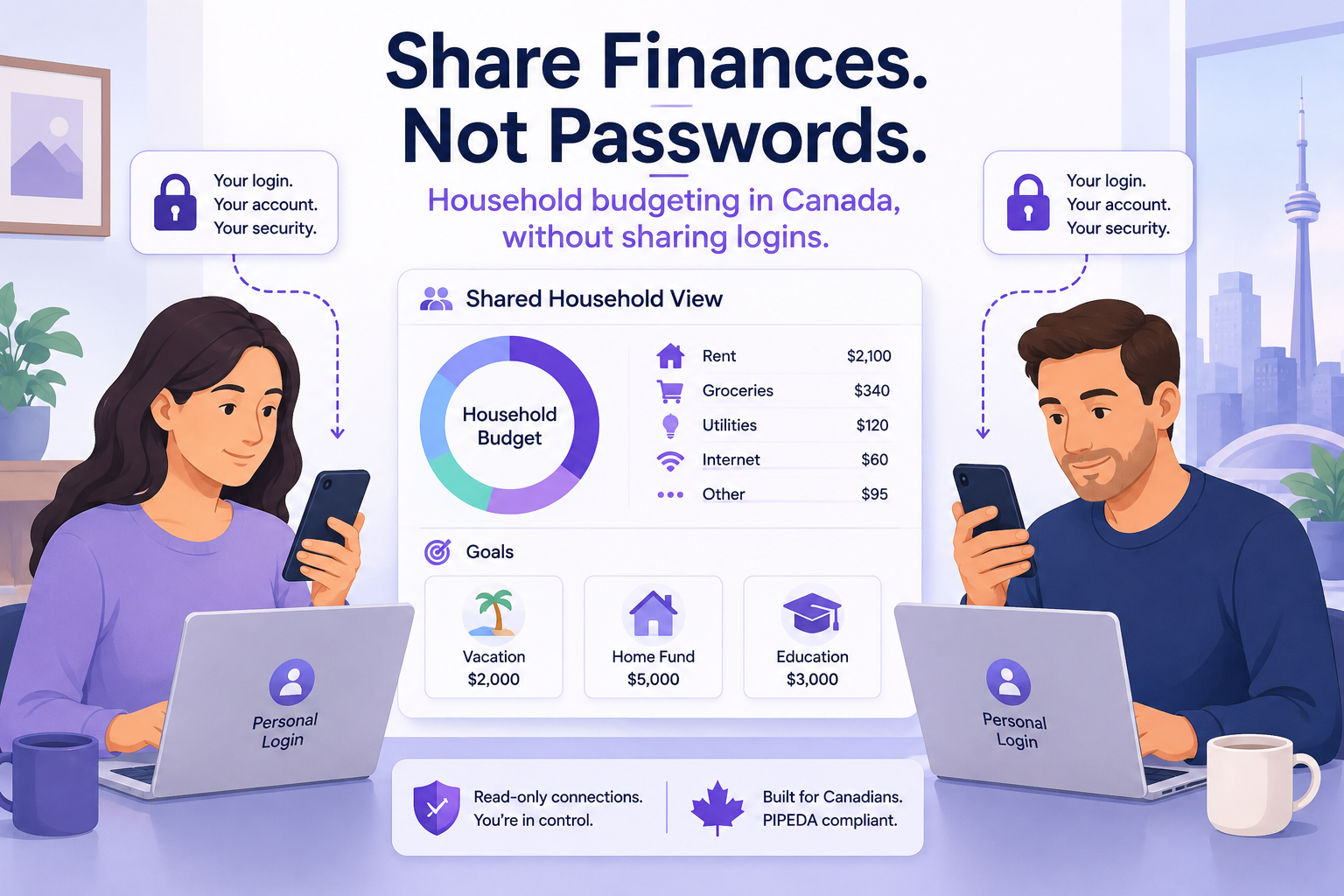
A well-designed multi-user financial tool can give two people access to a shared household picture while each person still has their own account and login.
That can allow household members to see relevant information such as:
- household transactions
- budgets
- recurring bills
- spending trends
- goals
- household net worth
without turning one person's identity into the household login.
There should also be a distinction between household information and personal information.
A couple may want a broad shared financial picture.
Roommates may only need visibility into:
- rent
- utilities
- groceries
- household supplies
They probably don't need access to each other's TFSA, salary, personal debt or shopping history.
Good household finance isn't about maximizing visibility.
It's about giving each person the appropriate visibility.
Consumer-driven banking is changing how financial data can be shared
Canada's financial-data-sharing system is also changing.
Historically, some financial aggregation services have relied on methods such as screen scraping, where credentials are used to access account information.
Canada is now implementing a formal consumer-driven banking framework intended to provide standardized, API-based financial-data sharing.
On June 26, 2026, the federal government pre-published proposed Consumer-Driven Banking Regulations.
The government says the framework is intended to allow Canadians to securely share financial data with approved service providers while giving consumers more control over that data.
Implementation is expected to occur in stages after the final regulations are published.
So Canada's consumer-driven banking framework is significantly further along than it was a few years ago, but it is not yet a universally available system that has replaced existing Canadian financial-data connections.
For consumers today, the practical questions remain:
- How does this application connect to my institution?
- What am I authorizing?
- Is the connection read-only?
- Who can see the resulting information?
- How can I revoke access?
- How does the company protect my financial data?
We go deeper into those questions in our Canadian bank-sync and privacy guide.
Privacy matters even when the bank connection is read-only
A read-only financial connection limits what an application can do with the bank account.
It doesn't make the financial information itself unimportant.
A household finance platform may contain an extremely detailed picture of:
- income
- spending
- debts
- investments
- financial institutions
- balances
- household behaviour
The Office of the Privacy Commissioner of Canada notes that financial information is generally considered sensitive.
For private-sector organizations subject to PIPEDA, the law's fair-information principles address areas including:
- accountability
- identifying purposes
- consent
- limiting collection
- limiting use and disclosure
- safeguards
- openness
- individual access
The OPC also states that personal information should be protected with safeguards appropriate to its sensitivity.
So when evaluating a household finance app, don't only ask:
“Can it connect to my bank?”
Also ask:
- Why is this data being collected?
- How is it used?
- Where is it stored?
- Who can access it?
- Can I remove access?
- Can I export my information?
- Can I delete the account?
- How does the company make money?
Those are reasonable questions for software that may know more about your household finances than almost any other service you use.
How Finnomia handles household access
Full disclosure: this article is published by Finnomia.
Finnomia's household model is built around separate user identities with a shared household financial view, rather than sharing one Finnomia or banking login.
The Family plan supports up to five household members.
Members can have roles such as:
- owner
- member
- viewer
Households can use:
- shared household views
- shared budgets
- household transactions
- bills and recurring expenses
- household goals
- Household and Personal views
That means two people can participate in the same household financial picture while still having separate Finnomia accounts.
The underlying bank connection remains read-only.
Finnomia cannot move money.
Core versus Family
If you're deciding between the individual and household experience, the distinction is straightforward:
| Core | Family | |
|---|---|---|
| Connected accounts | Up to 2 | Unlimited |
| Multiple household members | No | Up to 5 |
| Shared household view | No | Yes |
| Shared household budgets | No | Yes |
| Household / Personal views | No | Yes |
| Shared banking password required | No | No |
Family includes Finnomia's Advanced functionality, so the household picture can also incorporate broader financial information such as investments and net worth where appropriate.
Finnomia's Founder membership includes unlimited household members.
Canadian connectivity
Finnomia currently uses Plaid for financial connections and is adding Flinks as a second connectivity provider.
The goal is to improve coverage and reliability across Canadian banks, credit unions, credit cards, brokerages and investment institutions rather than relying permanently on a single data network.
Finnomia currently supports institutions including RBC, TD, Scotiabank, BMO, CIBC, National Bank, Tangerine, EQ Bank, Simplii, Wealthsimple and Questrade, along with many Canadian credit unions.
Financial connections are read-only.
Finnomia doesn't store your bank password and cannot move your money.
Privacy
Finnomia is subscription-funded rather than advertising-funded.
Financial data is hosted in AWS Canada and encrypted in transit and at rest.
Finnomia is designed around PIPEDA requirements, doesn't sell users' financial data to advertisers or data brokers, and allows users to export or delete their information.
The household functionality described above is already live.
A better way to think about household finances
Instead of asking:
“Should we combine our finances?”
break the decision into smaller questions.
What should be owned together?
Perhaps:
- household chequing
- mortgage
- particular savings
Or perhaps nothing.
What should each person remain responsible for?
Maybe:
- personal credit cards
- personal debt
- individual spending
- registered investment accounts
What should both people be able to see?
Potentially:
- household budget
- recurring bills
- grocery spending
- shared goals
- household net worth
What should remain personal?
That depends on the relationship and the household.
Roommates will generally keep far more information personal than spouses planning retirement together.
What credentials should be shared?
None.
Each person should use their own banking credentials and their own login to financial tools.
That separation lets you build a shared financial picture without weakening individual account security.
Shared money doesn't require shared passwords
A household is not one financial account.
It can include:
- individual accounts
- joint accounts
- authorized cards
- joint debt
- individual investments
- shared goals
- personal spending
The job of a household budget is to make sense of those pieces together.
It doesn't require turning one person's bank login into a household credential.
Share the financial picture you need to manage together.
Keep the credentials personal.
If you're working on the practical side — deciding what should be shared, how to split expenses, how groceries should work and how to create the household budget itself — read Budgeting With a Partner or Roommate in Canada.
And if you want one place where multiple household members can see budgets, bills, goals and the broader financial picture using separate logins, you can start a 30-day Finnomia trial.
This article was reviewed in August 2026 and provides general information, not legal or financial advice. Account ownership, liability, survivor rights and unauthorized-transaction protections depend on your financial products, agreements, institution and applicable law. Confirm the terms of your accounts directly with your financial institution.