
On this page
- 1. What information will the app receive?
- 2. Who connects to the financial institution?
- 3. Is access read-only?
- Read-only does not mean risk-free
- Credential-based and API-based connections
- 4. Is consent meaningful?
- 5. How is information protected and retained?
- PIPEDA’s ten principles in practical terms
- Service providers and accountability
- Data minimization choices for the user
- Disconnecting versus deleting
- Household access and privacy
- Incident and breach questions
- Questions to ask before choosing a bank-sync app
- 6. Can you access, correct and delete your information?
- Canada’s consumer-driven banking framework
- Finnomia’s bank-sync model
- Bank-sync checklist
Bank Sync Privacy in Canada: A PIPEDA Checklist
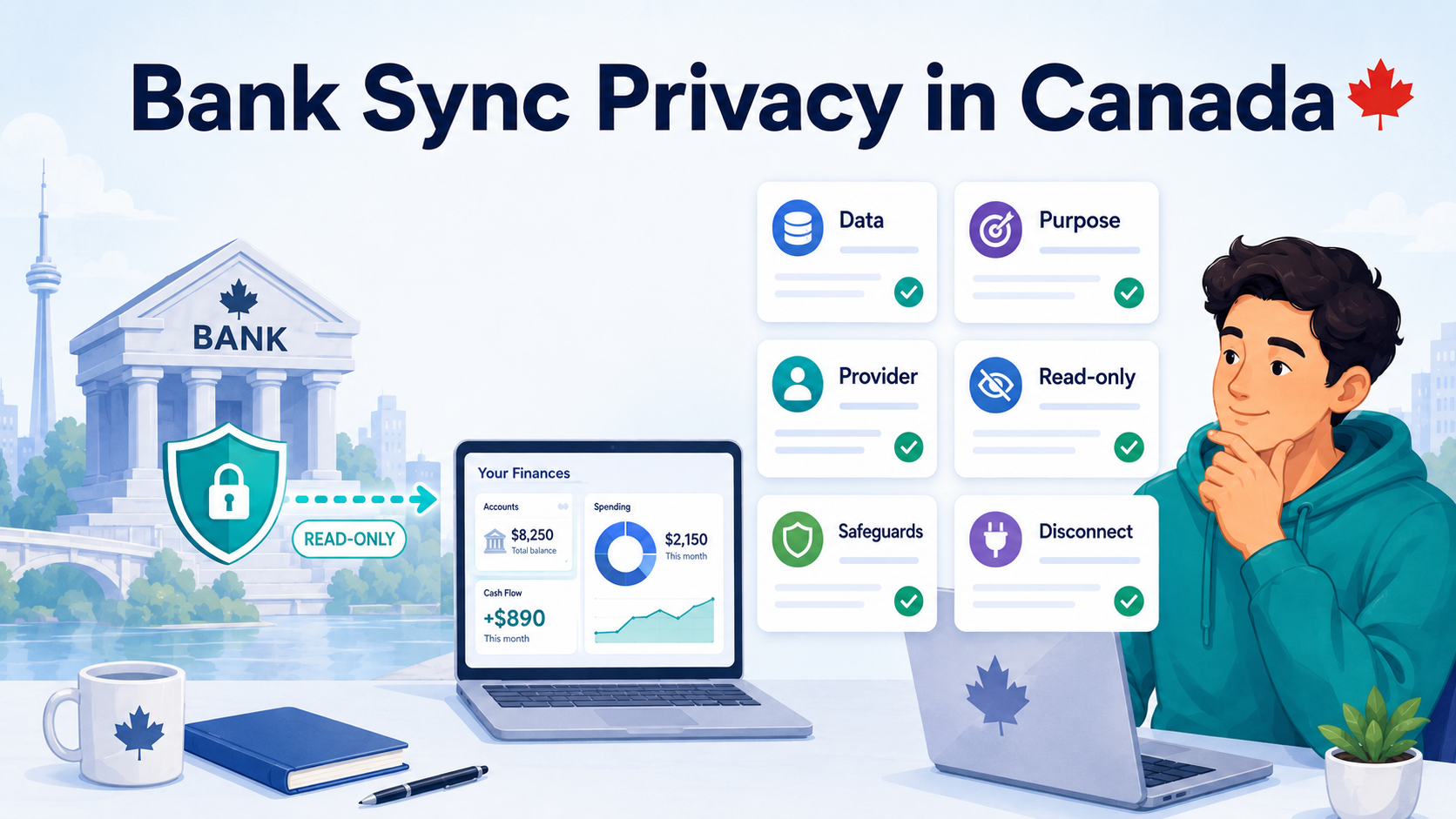
Before connecting a bank account to any financial app, you should be able to answer six questions: what data is collected, why it is needed, who processes it, what the app can do, how it is protected and how to disconnect or delete it.
PIPEDA provides a useful Canadian framework for evaluating those answers. It does not certify an app as safe, and a “PIPEDA compliant” badge is not a substitute for reading the privacy policy and connection screen.
1. What information will the app receive?
Bank-sync data may include:
- account names, types and balances;
- transaction descriptions, dates and amounts;
- investment holdings and transactions;
- institution and account identifiers; and
- connection status and technical metadata.
Look for a plain-language explanation of what is collected and which features need it. PIPEDA’s limiting-collection principle says organizations should collect only what is necessary for identified purposes.
2. Who connects to the financial institution?
Many apps use a specialized data aggregator rather than building a separate integration with every bank and credit union. The app should identify important service providers and explain their role.
Finnomia currently uses Plaid for financial connectivity and is adding Flinks as a second provider to improve coverage and reliability for Canadian institutions. Which provider is used may depend on the institution and connection route.
Finnomia does not store online-banking credentials. Credential entry and authentication occur in the connection provider’s flow or at the financial institution, depending on the connection.
3. Is access read-only?
Read-only means the connection is used to retrieve financial data and cannot initiate payments, transfer money or trade securities.
Finnomia’s financial connections are read-only. That limits what the application can do, but it does not make the financial data non-sensitive. Transaction history can reveal income, health payments, location patterns and personal relationships, so safeguards and access controls still matter.
Read-only does not mean risk-free
A read-only connection cannot move money, but an exposed financial history could still be harmful. It may reveal account balances, employers, recurring payments and behavioural patterns.
Evaluate read-only access as one control among several. Strong authentication, encryption, limited employee access, monitoring, retention rules and a clear breach-response process remain important.
Credential-based and API-based connections
The experience can vary by financial institution and provider. Some connections redirect you to the bank for authentication and token-based access. Others may require credentials within a provider-controlled connection flow because the institution does not offer an appropriate API.
The relevant questions are:
- Who receives the credentials, if credentials are required?
- Does the finance app itself ever receive or store them?
- Is multi-factor authentication supported?
- How is continued access authorized?
- Can access be revoked at the institution or provider?
Do not send banking credentials by email, chat or an ordinary support form. Use only the institution or connection provider’s designated authentication flow.
4. Is consent meaningful?
The Office of the Privacy Commissioner says valid consent requires that a person can reasonably understand the consequences of the collection, use or disclosure.
Before connecting, look for:
- the specific data categories requested;
- the purposes for using them;
- important third parties involved;
- meaningful risks or consequences;
- how long consent lasts; and
- how to withdraw it.
Avoid services that make broad, unrelated uses of financial data difficult to understand or refuse.
5. How is information protected and retained?
PIPEDA’s safeguards principle requires protection appropriate to the sensitivity of the information. A useful privacy and security review asks:
- Is data encrypted in transit and at rest?
- Is employee access limited and logged?
- Is multi-factor authentication available for the user account?
- Is there a breach-response process?
- How long is financial data retained?
- What happens after an account is disconnected or the app account is closed?
- Are subprocessors and cross-border processing explained?
Do not assume “Canadian app” means all data stays in Canada. Read the policy for the actual storage and processing arrangements.
PIPEDA’s ten principles in practical terms
| Principle | What it means for a financial app |
|---|---|
| Accountability | Someone is responsible for privacy practices and complaints |
| Identifying purposes | The app explains why it needs each type of data |
| Consent | The user can understand and agree to meaningful uses |
| Limiting collection | The app collects only what the identified purposes require |
| Limiting use, disclosure and retention | Data is not repurposed or kept indefinitely without justification |
| Accuracy | Information is kept sufficiently accurate for its use |
| Safeguards | Security matches the sensitivity of financial data |
| Openness | Policies and practices are available in understandable form |
| Individual access | A person can ask what information is held and how it is used |
| Challenging compliance | A person can raise a concern with the responsible organization |
This framework applies to the organization’s practices as a whole. It is not a one-time checkbox completed when an account is connected.
Service providers and accountability
Using an aggregator, cloud provider, analytics service or support platform does not eliminate the app’s responsibility to protect personal information under its control.
Look for disclosures that identify important categories of service provider, the purposes for which data is shared and any cross-border processing. A privacy policy does not need to publish a blueprint for attackers, but it should provide enough information for meaningful consent.
Data minimization choices for the user
Users can also reduce exposure:
- connect only the institutions needed for the desired features;
- disconnect dormant or duplicate connections;
- use strong, unique account passwords;
- enable multi-factor authentication where available;
- review authorized applications at the bank;
- avoid uploading unnecessary sensitive documents; and
- close unused app accounts rather than merely uninstalling the app.
Uninstalling an app usually does not delete the service account or previously collected data.
Disconnecting versus deleting
These actions can have different effects:
- Disconnecting stops or revokes future synchronization.
- Deleting an imported account may remove it from the app interface.
- Deleting the app account may trigger broader deletion or retention workflows.
- Revoking at the bank/provider can invalidate the connection token.
Ask what historical data remains after each step, what must be retained for legal or security reasons and how long deletion takes.
Household access and privacy
Shared finances do not require shared passwords. A household platform should support separate user identities and permissions.
Before inviting another person, understand:
- which accounts, transactions and goals they can see;
- whether personal views remain separate;
- who can add or remove members;
- what happens when someone leaves the household; and
- whether exports include another member’s data.
Finnomia supports household finances through separate user accounts. That is safer and more accountable than multiple people sharing one login.
Incident and breach questions
No service can promise that a breach is impossible. Useful signals include a documented response process, monitoring, notification procedures and a way to report suspicious activity.
If you believe a connection or account is compromised:
- disconnect or revoke the connection where available;
- secure the financial institution and app accounts;
- review recent transactions and authorized access;
- contact the relevant institution or service; and
- follow any provided breach or fraud instructions.
Read-only access does not replace normal account monitoring.
Questions to ask before choosing a bank-sync app
- Does the product explain its business model and data uses?
- Is the connection read-only?
- Which aggregators and subprocessors are involved?
- Does the app receive or store bank credentials?
- Can connections be revoked easily?
- How are exports, access requests and deletion handled?
- Are household members given separate identities?
- Is there a named privacy contact?
- Does marketing make claims that the detailed policy actually supports?
6. Can you access, correct and delete your information?
PIPEDA includes individual access and accuracy principles. The service should explain how to:
- see the personal information it holds;
- correct inaccurate profile information;
- disconnect a financial institution;
- withdraw consent;
- request deletion where applicable; and
- contact the privacy officer or make a complaint.
Disconnecting the bank feed and deleting previously imported data may be separate actions. Check both.
Canada’s consumer-driven banking framework
Canada is implementing a regulated consumer-driven banking framework, sometimes called open banking. In June 2026, the federal government pre-published regulations for the next implementation phase. The framework is intended to let consumers share financial data with approved providers through secure APIs and give them greater control.
That direction is important, but consumers should not assume every existing bank-sync connection is already operating under the final regulated framework. Ask how the connection works today.
See the Department of Finance’s consumer-driven banking implementation page and the OPC’s PIPEDA requirements in brief.
Finnomia’s bank-sync model
Finnomia uses read-only connections to bring transactions, accounts and investments into a broader financial picture that includes budgets, recurring bills, goals, debt planning, forecasting and net worth. It does not store banking credentials and does not connect to CRA for official contribution-room data.
If you do not want to connect an institution, evaluate whether manual tracking meets your needs. Privacy is not all-or-nothing; the right choice depends on the value of synchronization, the data requested and your comfort with the providers and controls involved.
Bank-sync checklist
- I know what data will be collected.
- I understand why each data category is needed.
- I know which provider connects to my institution.
- The connection is read-only if money movement is unnecessary.
- The service explains safeguards and important subprocessors.
- I know how to disconnect the feed.
- I know how to request access, correction and deletion.
- I know how to contact the privacy officer.
- I understand whether the connection uses the emerging regulated framework or another method.