
On this page
- TFSA contribution room in 2026
- TFSA annual limits from 2009 to 2026
- There is no fixed lifetime TFSA contribution cap
- When did your TFSA room start accumulating?
- If you turned 18 after 2009
- What if you couldn't open a TFSA until age 19?
- New Canadians don't receive room going back to age 18
- One person, one pool of TFSA room
- Investment gains don't use contribution room
- Withdrawals can create more room than you originally contributed
- The big TFSA mistake: withdrawing and recontributing in the same year
- Same-year recontribution can be fine if you already have room
- CRA My Account may not show what you can contribute today
- A simple way to track TFSA room yourself
- Finnomia's TFSA room calculator
- What happens if you over-contribute?
- What should you do if you over-contributed?
- Moving a TFSA between banks: use a direct transfer
- What if you're moving only part of a TFSA?
- Non-residents need to be particularly careful
- What happens to TFSA room when you become a non-resident?
- Can you give your spouse money for their TFSA?
- TFSA contributions follow the calendar year
- TFSA room isn't the same as TFSA value
- A practical 2026 TFSA checklist
- The most important TFSA rule
- Frequently asked questions
The TFSA contribution limit for 2026 is $7,000.
That does not mean $7,000 is necessarily the amount you can contribute.
Your actual TFSA contribution room may be:
- exactly $7,000
- less than $7,000
- $20,000
- $50,000
- more than $100,000
It depends on your history.
That's because TFSA contribution room is a running balance, not simply an annual limit.
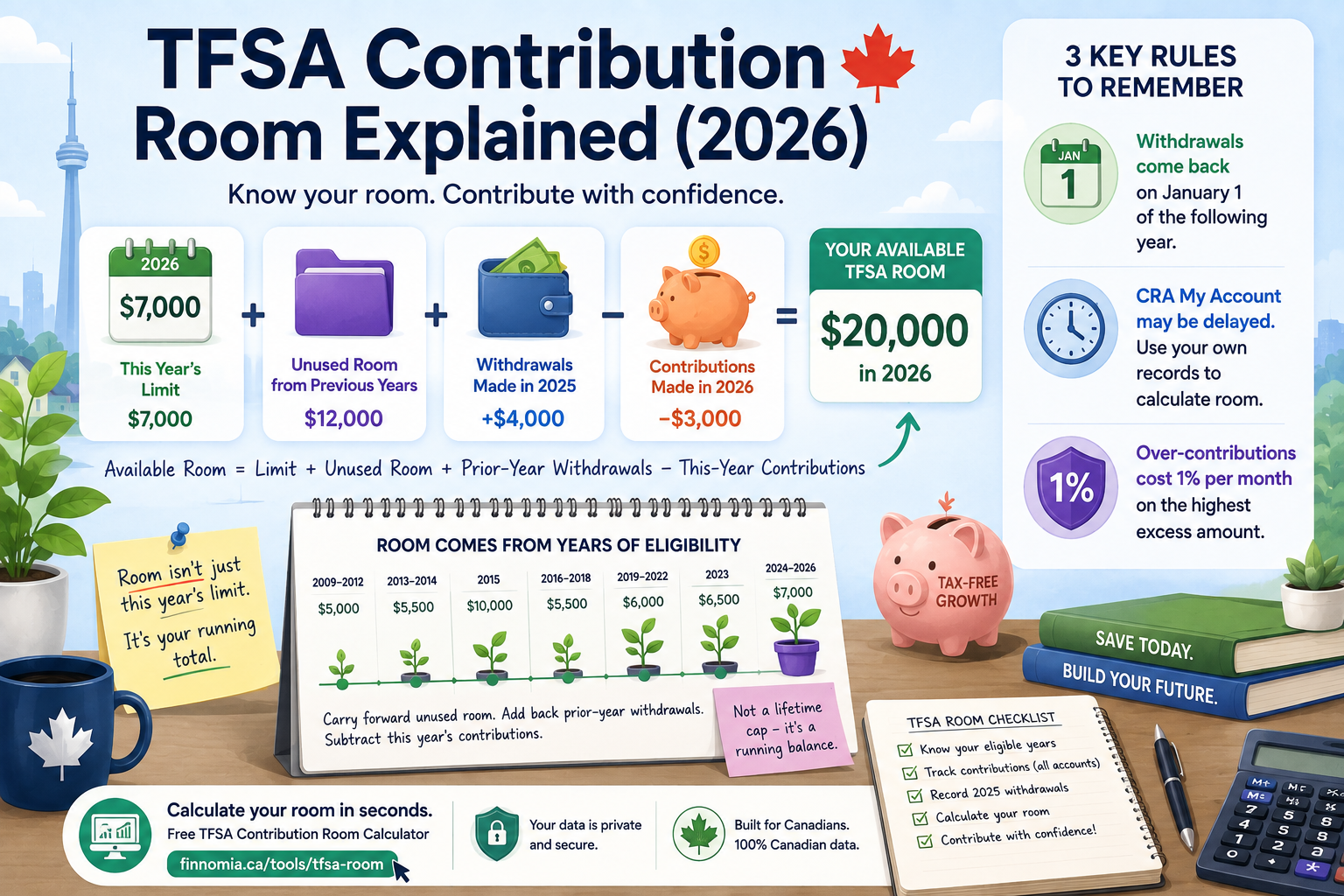
The basic calculation is:
**Unused room from previous years
- this year's TFSA limit
- withdrawals made last year − contributions made this year = available TFSA contribution room**
For 2026, the annual-limit part of that formula is $7,000.
The other three parts are personal to you.
TFSA contribution room in 2026
Here's the formula CRA uses:
2026 TFSA room =
unused contribution room from previous years
+ $7,000 2026 annual limit
+ TFSA withdrawals made in 2025
− TFSA contributions you've already made in 2026
That's the most important formula in this article.
A few examples make it much easier to understand.
Example 1: You used all your room before 2026
Suppose you entered 2026 with:
- $0 unused room
- no TFSA withdrawals in 2025
- no 2026 contributions yet
Your available room on January 1, 2026 is:
$0 + $7,000 + $0 = $7,000
Straightforward.
Example 2: You had $5,000 left over
Suppose you ended 2025 with $5,000 of unused room.
On January 1, 2026:
**$5,000 unused room
- $7,000 new room = $12,000 available**
CRA uses essentially this same example in its 2026 TFSA guidance.
Unused room doesn't disappear simply because December 31 passes.
Example 3: You also withdrew money last year
Suppose you had:
- $6,000 unused at the end of 2025
- a $4,000 TFSA withdrawal during 2025
Your January 1, 2026 contribution room would be:
**$6,000 unused room
- $7,000 2026 limit
- $4,000 2025 withdrawal = $17,000**
Then suppose you contribute $5,000 in February.
You'd have:
$17,000 − $5,000 = $12,000
of remaining 2026 room.
This is why looking only at the annual $7,000 limit can be misleading.
TFSA annual limits from 2009 to 2026
TFSA room began accumulating in 2009 for eligible Canadians.
CRA's annual dollar limits are:
| Years | Annual TFSA limit |
|---|---|
| 2009–2012 | $5,000 |
| 2013–2014 | $5,500 |
| 2015 | $10,000 |
| 2016–2018 | $5,500 |
| 2019–2022 | $6,000 |
| 2023 | $6,500 |
| 2024 | $7,000 |
| 2025 | $7,000 |
| 2026 | $7,000 |
The annual limit is indexed to inflation and rounded to the nearest $500.
If you were eligible for every year from 2009 through 2026, those annual limits add up to:
$109,000
But be careful with that number.
It is not a universal 2026 TFSA contribution limit.
It is simply the sum of the annual limits for someone who:
- was at least 18 in 2009
- was a Canadian resident for tax purposes throughout the entire period
- was eligible for each year's room
Your own room also has to account for everything you've contributed and withdrawn.
There is no fixed lifetime TFSA contribution cap
People sometimes talk about the $109,000 figure as though CRA has created a:
“2026 TFSA lifetime limit”
That's not really how the system works.
There isn't a fixed lifetime contribution cap comparable to the FHSA's $40,000 lifetime contribution limit.
Instead, TFSA room keeps evolving.
Every eligible year adds another annual dollar limit.
Unused room carries forward.
And withdrawals create new contribution room the following year.
Your contribution-room history is therefore personal.
When did your TFSA room start accumulating?
You generally begin accumulating TFSA room when you meet the eligibility conditions.
CRA requires someone opening a TFSA to:
- be a resident of Canada for income-tax purposes
- be at least 18
- have a valid Social Insurance Number
You don't need earned income.
That makes the TFSA very different from an RRSP, where new contribution room is generally tied to earned income.
If you turned 18 after 2009
Your room begins with the annual limit for the year you turned 18, assuming you were a Canadian resident for tax purposes.
For example, suppose you turned 18 in 2022 and have been a resident throughout.
Before accounting for any contributions or withdrawals, your annual limits would be:
| Year | Limit |
|---|---|
| 2022 | $6,000 |
| 2023 | $6,500 |
| 2024 | $7,000 |
| 2025 | $7,000 |
| 2026 | $7,000 |
| Total | $33,500 |
If you've never contributed, that could be your available room in 2026.
If you've already contributed $10,000 over those years and made no withdrawals, you'd have approximately:
$33,500 − $10,000 = $23,500
remaining.
Always apply your actual history.
What if you couldn't open a TFSA until age 19?
In some provinces and territories, you must be 19 to enter into the contract required to open a TFSA.
That doesn't necessarily cost you the room from the year you turned 18.
CRA says that after turning 19, you can open the TFSA and carry forward the contribution room you accumulated when you were 18.
So:
eligible for room at 18
and
able to open the account at 19
can both be true.
New Canadians don't receive room going back to age 18
This is an important exception.
Suppose you:
- are 35 years old
- move to Canada
- become a Canadian resident for tax purposes in 2026
You do not suddenly receive TFSA contribution room going back to 2009 or to the year you turned 18.
CRA says a new resident begins accumulating room in the year they become a resident, provided they're at least 18.
So if 2026 is your first eligible year:
2026 starting annual room = $7,000
not $109,000.
This is one of the easiest ways for someone new to Canada to accidentally over-contribute.
One person, one pool of TFSA room
You can have more than one TFSA.
Maybe you have:
- a TFSA savings account at a bank
- a TFSA investment account at Wealthsimple
- another TFSA at Questrade
That does not mean you have three contribution limits.
All of your TFSAs share the same personal contribution-room pool.
Suppose you have $7,000 available and contribute:
- $3,000 to Bank TFSA
- $2,000 to Brokerage TFSA
- $2,000 to another TFSA
You've used:
$7,000
of room.
Opening another TFSA doesn't create another $7,000.
That sounds obvious once you see it written down, but CRA specifically identifies contributions across multiple TFSAs as a common source of over-contributions.
Investment gains don't use contribution room
Suppose you contribute:
$20,000
to a TFSA.
Over several years, the investments grow to:
$35,000
That extra $15,000 of investment growth does not consume additional contribution room.
You contributed $20,000.
The investment growth happened inside the TFSA.
Likewise, if the investments fall in value, the loss doesn't create extra room.
Example
You contribute $10,000.
Your investments fall to $7,000.
Your TFSA contribution-room history still reflects the $10,000 contribution.
You don't receive $3,000 of extra room because the investment lost value.
This distinction becomes especially important when withdrawing money.
Withdrawals can create more room than you originally contributed
Suppose you contributed $20,000 over time.
The investments grew to $35,000.
Then you withdraw the entire:
$35,000
That withdrawal is generally tax-free.
And on January 1 of the following year, the $35,000 withdrawal is added to your available TFSA contribution room.
CRA adds back the amount you withdrew—not merely your original $20,000 contribution.
That's one of the TFSA's most valuable features.
But it leads directly to the TFSA's most common trap.
The big TFSA mistake: withdrawing and recontributing in the same year
This rule is worth memorizing:
A TFSA withdrawal does not create new contribution room until January 1 of the next calendar year.
Suppose you begin 2026 with exactly:
$7,000 of contribution room
In January, you contribute the full:
$7,000
You now have:
$0 room remaining
In June, you withdraw:
$5,000
You might reasonably think:
“I took $5,000 out, so I can put it back.”
Not yet.
Your 2026 contribution room is still:
$0
The $5,000 withdrawal will generally be added back on:
January 1, 2027
If you recontribute the full $5,000 in September 2026 without any other available room, you've created a $5,000 over-contribution.
The fact that the money originally came from the TFSA doesn't change that.
Same-year recontribution can be fine if you already have room
The rule isn't:
“Never recontribute a TFSA withdrawal in the same year.”
The actual issue is whether you have unused room.
Suppose you started 2026 with:
$20,000 of room
You contribute:
$5,000
leaving:
$15,000
Then you withdraw $5,000.
You still have the $15,000 of room that was already available.
So you could contribute $5,000 later that year without exceeding your available contribution room.
The withdrawal itself didn't create the room.
You already had it.
That's the distinction.
CRA My Account may not show what you can contribute today
This is another important rule.
Don't assume the TFSA contribution-room number you see in CRA My Account reflects every transaction you've recently made.
CRA says TFSA information is generally updated once per year in the spring after financial institutions report the previous year's transactions.
For 2026, CRA said 2025 records would be processed by April 2026.
But contributions you make during 2026 don't instantly update the contribution-room figure displayed in your CRA account.
That means this can happen:
- CRA shows $15,000 available.
- You contribute $8,000.
- CRA My Account may still show the old figure for some time.
- You forget about the contribution.
- You contribute again based on the displayed number.
CRA explicitly recommends using your own financial records to calculate available room.
Treat CRA My Account as useful supporting information—not a real-time TFSA ledger.
A simple way to track TFSA room yourself
You don't need a complicated system.
Keep a running record with four sections.
1. Starting room
What contribution room did you have at the beginning of the year?
2. Contributions
Record every TFSA contribution across all financial institutions.
| Date | Institution | Contribution |
|---|---|---|
| Jan. 15 | Bank | $2,000 |
| Mar. 8 | Brokerage | $1,500 |
| June 20 | Brokerage | $500 |
| Total | $4,000 |
3. Withdrawals
Track withdrawals too.
But don't immediately add them back to your current-year room.
Record them as:
Added back next January
4. Remaining room
Starting available room:
$12,000
minus current-year contributions:
$4,000
equals:
$8,000 remaining
Simple.
The important thing is that the record includes every TFSA you own.
Finnomia's TFSA room calculator
If you'd rather walk through the formula instead of maintaining the calculation manually, Finnomia has a free TFSA contribution-room calculator.
The calculator is designed around the same basic CRA logic:
- eligible annual limits
- unused room
- contributions
- withdrawals
- residency and eligibility history
It's a planning tool, not a replacement for CRA records or your financial-institution statements.
Your actual contribution history remains the source you should reconcile against before making a contribution.
What happens if you over-contribute?
If you contribute more than your available TFSA room, CRA generally charges a tax of:
1% per month
on the highest excess TFSA amount for each month the excess remains.
Unlike the RRSP rules, there is no general $2,000 excess-contribution cushion for a TFSA.
The tax can apply starting with the first excess dollar.
Example
Suppose your available room is:
$7,000
but you contribute:
$9,000
You have:
$2,000 excess
At 1%:
$2,000 × 1% = $20 per month
If the $2,000 excess remains for four months, the tax could be:
$80
under the basic excess-amount calculation.
The actual calculation depends on when contributions and withdrawals occurred.
What should you do if you over-contributed?
CRA's guidance is straightforward:
Withdraw the excess as soon as possible.
Don't wait for CRA to send you a notice while the monthly tax continues accumulating.
You may also need to file:
- Form RC243 — Tax-Free Savings Account Return
- the applicable excess-amount schedule
- any required payment
The TFSA return and payment are generally due by June 30 of the calendar year following the year to which the tax applies.
If you're unsure how to correct an excess contribution or calculate the tax, that's a good situation to get tax advice rather than guessing.
Moving a TFSA between banks: use a direct transfer
Suppose you have $50,000 in a TFSA at one institution and want to move it to another.
Don't automatically:
- withdraw $50,000
- deposit $50,000 into a new TFSA
If you don't already have $50,000 of unused contribution room, that second step can create a huge over-contribution.
Instead, ask the receiving institution to perform a direct TFSA transfer.
CRA says a properly completed direct TFSA-to-TFSA transfer doesn't affect your contribution room.
This is one of those situations where the paperwork may take longer than simply moving the cash yourself, but the tax treatment matters.
What if you're moving only part of a TFSA?
The same principle applies.
Financial institutions may support:
- full transfers
- partial transfers
- cash transfers
- in-kind transfers
The important part for contribution-room purposes is that the transfer occurs directly between the TFSA issuers.
A personal withdrawal followed by a new contribution is not the same thing.
Non-residents need to be particularly careful
If you become a non-resident of Canada, you can generally continue holding an existing TFSA.
But CRA says do not contribute while you're a non-resident.
Non-resident TFSA contributions can be subject to a separate:
1% monthly tax
for as long as the non-resident contribution remains in the account, subject to the applicable rules.
And if the contribution also exceeds your contribution room, CRA says the non-resident tax and excess-contribution tax can both apply.
If your residency status changes, don't assume the normal Canadian-resident contribution rules still apply.
What happens to TFSA room when you become a non-resident?
Your existing TFSA doesn't simply disappear.
You may continue holding it.
You may also generally make tax-free withdrawals from the Canadian TFSA.
Withdrawals can still generate contribution room for the following calendar year.
But while you're a non-resident, that doesn't mean you can immediately use that room without Canadian tax consequences.
CRA says not to make new TFSA contributions until you're a resident again.
Depending on where you move, the other country may also treat the TFSA differently for tax purposes.
Canadian TFSA tax treatment doesn't guarantee equivalent treatment abroad.
Can you give your spouse money for their TFSA?
TFSA contribution room belongs to the individual.
You cannot contribute your unused room to your spouse's TFSA.
But giving your spouse or common-law partner money so they can contribute to their own TFSA, within their own available contribution room, is a separate question.
The important contribution-room rule is:
Their TFSA uses their room.
Your TFSA uses yours.
A household doesn't have one combined TFSA limit.
For a broader look at managing accounts together without merging ownership, see Household Finances Without Shared Passwords.
TFSA contributions follow the calendar year
Unlike an RRSP, the TFSA doesn't have a first-60-days contribution period that can apply to the previous tax year.
2026 TFSA activity belongs to 2026.
You can contribute at any point during the calendar year as long as you have available room.
Unused room simply carries forward.
There isn't a December rush required to prevent unused TFSA room from disappearing.
It doesn't expire at year-end.
TFSA room isn't the same as TFSA value
This is another useful distinction.
Suppose your TFSA investments are worth:
$80,000
That doesn't tell us how much contribution room you have.
You might have:
- $0 room
- $7,000 room
- $30,000 room
depending on your history.
Likewise, seeing that someone else has a $200,000 TFSA doesn't mean they were allowed to contribute $200,000.
Investment growth inside the account can dramatically increase its value without using contribution room.
Account value and contribution room are two different numbers.
A practical 2026 TFSA checklist
Before making your next TFSA contribution:
1. Confirm which years you were eligible
Ask:
- When did I turn 18?
- When did I become a Canadian resident for tax purposes?
- Were there years I was a non-resident?
2. Add the annual limits for your eligible years
For 2026, add:
$7,000
3. Account for prior contributions
Include contributions made to every TFSA you own, not just the institution you're contributing to today.
4. Add withdrawals from 2025
Those withdrawals became new room on:
January 1, 2026
Do not add 2026 withdrawals yet.
5. Subtract everything you've already contributed in 2026
CRA My Account may not reflect those contributions immediately.
Use your own records.
6. Check before moving a TFSA
If moving between financial institutions, request a direct transfer rather than withdrawing and recontributing.
7. Leave yourself a margin if you're uncertain
There's little benefit in deliberately contributing right to the last dollar of an estimated figure if your records don't reconcile.
Confirm first.
The most important TFSA rule
Most TFSA mistakes come from thinking of contribution room as:
“Whatever CRA says my limit is this year.”
It isn't.
Your TFSA contribution room is a running history.
It reflects:
- when you became eligible
- every annual limit you earned
- unused room you've carried forward
- every contribution you've made
- previous-year withdrawals
For 2026, the annual limit is easy:
$7,000
The harder—and more important—number is:
How much room do I personally have available today?
Calculate that from your own records before contributing.
If you're still deciding whether the next dollar should go into a TFSA at all, read TFSA vs. RRSP vs. FHSA: Which Should You Fund First?.
And if you want help doing the room calculation, use Finnomia's free TFSA contribution-room calculator.
Frequently asked questions
What is the TFSA contribution limit for 2026?
The annual TFSA dollar limit for 2026 is $7,000.
Your actual available contribution room may be higher because unused room carries forward and prior-year withdrawals are added back.
What is the maximum TFSA contribution room in 2026?
There is no single maximum that applies to everyone.
Someone who was eligible for every annual limit from 2009 through 2026 would have accumulated $109,000 from annual limits alone before accounting for contributions and withdrawals.
Your personal amount depends on age, Canadian residency, contribution history and withdrawals.
Does unused TFSA contribution room expire?
Unused TFSA room carries forward to future years.
You don't have to contribute before December 31 simply to preserve unused room.
Does TFSA room come back after a withdrawal?
Yes, but generally on January 1 of the following calendar year.
A withdrawal made during 2026 doesn't create new contribution room during 2026.
Can I withdraw and recontribute to my TFSA in the same year?
Only if you already have enough unused contribution room.
The withdrawal itself doesn't create new room until the following January 1.
Does investment growth use TFSA contribution room?
No.
Investment gains and changes in account value don't reduce contribution room.
Investment losses don't create additional contribution room either.
Can I have more than one TFSA?
Yes.
But all your TFSAs share the same contribution-room limit.
Opening additional TFSAs doesn't create additional room.
Can I trust the TFSA room shown in CRA My Account?
Use it as a reference, but don't treat it as a real-time record.
CRA recommends calculating your available room using your own financial records because current-year contributions aren't immediately reflected in CRA My Account.
What happens if I over-contribute to my TFSA?
Excess TFSA amounts are generally subject to a 1% monthly tax for each month an excess remains.
CRA recommends removing the excess as soon as possible.
How do I move my TFSA to another financial institution?
Ask the receiving financial institution to complete a direct TFSA transfer.
Withdrawing the money yourself and depositing it into another TFSA can use contribution room and may cause an over-contribution.
This article was reviewed in August 2026 and provides general information, not personalized tax or financial advice. TFSA rules and annual limits can change. Calculate contribution room using your own records and current CRA guidance before making a contribution.