
On this page
- U.S. finance apps aren't automatically bad choices for Canadians
- “Supports Canada” is really several different questions
- Start with the institutions you actually use
- Canadian financial connectivity is also changing
- CAD support should mean more than changing the dollar sign
- Canadian account types are more than different labels
- Don't confuse account balance with contribution room
- Investment support can mean two very different things
- Retirement planning is where geography becomes particularly obvious
- Interac e-Transfer matters — but probably not the way you think
- Household finances are another useful test
- Privacy is more nuanced than “Canadian = private”
- Data residency is a separate question
- Pricing can also be more Canadian than it looks
- When a U.S. app may be the better choice
- Where Finnomia fits
- A checklist before choosing any money app in Canada
- The difference is fit, not nationality
A U.S. budgeting app can work perfectly well for a Canadian.
It may support CAD. It may connect to your bank. It may have excellent budgeting tools. In some cases, it may be exactly the product you should choose.
The problem starts when “available in Canada” gets treated as the same thing as “designed around Canadian financial life.”
Those aren't the same standard.
For a basic monthly budget, the difference may barely matter.
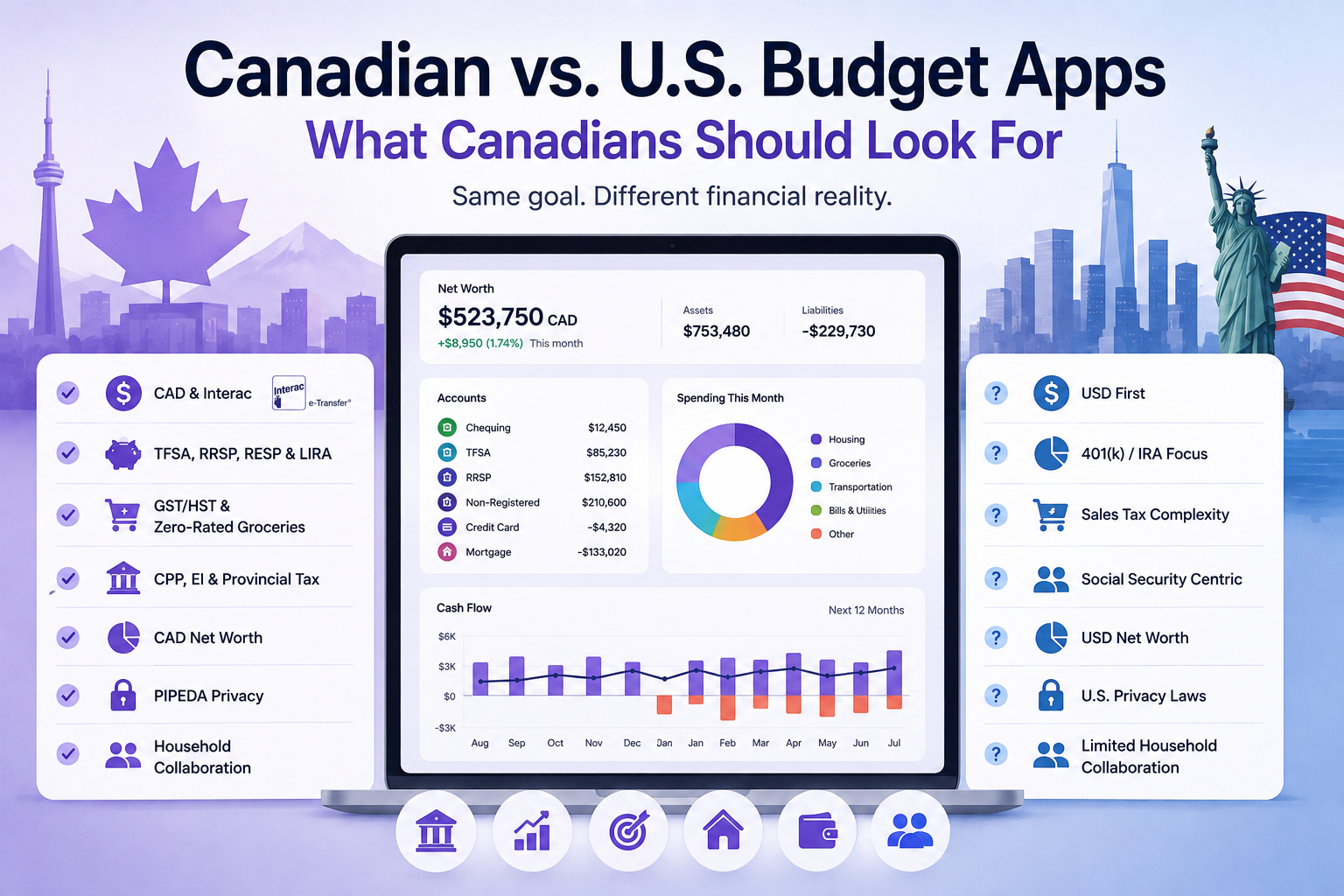
But as soon as you want one app to understand your broader financial picture — banking, investments, registered accounts, debt, net worth, retirement and household finances — Canadian context starts to matter much more.
A useful way to think about it is this:
Does the app merely work in Canada, or does it understand how Canadians actually manage money?
That's the comparison worth making.
U.S. finance apps aren't automatically bad choices for Canadians
It's worth getting this out of the way first.
Some excellent personal-finance products were built in the United States.
YNAB supports select Canadian financial institutions and lets users budget in Canadian dollars.
Monarch Money is available in Canada, supports Canadian institution connections and provides a broad financial dashboard with budgeting, investments, net worth and household collaboration.
So the useful argument isn't:
Canadian app good. American app bad.
It's:
How much Canadian context does your particular financial life require?
Someone who primarily wants a strong budgeting methodology may be completely happy with a product designed for a broader North American audience.
Someone trying to bring a TFSA, RRSP, FHSA, mortgage, Canadian brokerage accounts, debt planning, CPP/OAS retirement projections and a spouse's finances together may have a different set of requirements.
The deeper you go beyond basic budgeting, the more those differences tend to matter.
“Supports Canada” is really several different questions
When you see Canada on a product's supported-country list, break that claim into smaller pieces.
| Question | What you're really trying to learn |
|---|---|
| Does it connect to my institutions? | Can it reliably retrieve data from the banks, cards, credit unions and brokerages I actually use? |
| Does it understand CAD? | Can it report properly in Canadian dollars, including CAD/USD accounts where relevant? |
| Does it understand Canadian account types? | Are TFSA, RRSP, FHSA, RESP and LIRA treated as real account types rather than generic investments? |
| Does it handle investments well? | Can it show holdings and transactions, not merely an account balance? |
| Does its planning fit Canada? | Does retirement planning understand CPP and OAS? Does debt planning reflect the accounts you actually have? |
| Does it work for Canadian households? | Can partners manage a shared picture while retaining separate accounts and logins? |
| How is financial data handled? | What privacy rules apply, where is data stored, and how does the company make money? |
| What currency am I paying in? | Is the subscription billed in CAD or USD? |
Those questions are much more useful than asking whether an app has a Canadian flag on its website.
Start with the institutions you actually use
Bank connectivity is still the first practical test.
A financial app can have every feature you want and still be frustrating if it can't reliably retrieve data from your accounts.
For a Canadian household, those accounts might be spread across:
- RBC
- TD
- Scotiabank
- BMO
- CIBC
- National Bank
- Tangerine
- EQ Bank
- Simplii
- a provincial credit union
- Wealthsimple
- Questrade
- another brokerage or retirement provider
Don't stop at:
“Does it support Canadian banks?”
Ask:
“Does it support my combination of institutions and account types?”
That distinction matters because financial-data connectivity isn't uniform.
A provider may work well with one institution and poorly with another. A chequing account at an institution may connect differently from a brokerage or credit product at the same institution.
That's also why using multiple financial-data providers can be useful. If one provider has trouble with an institution, another may offer a better path.
There is no credible universal statistic that says Canadian apps always connect better than U.S. apps.
Judge the actual institutions you use.
Canadian financial connectivity is also changing
Canada is in the process of implementing its formal consumer-driven banking framework.
The goal is to let Canadians authorize financial institutions to securely share their financial data with approved service providers using standardized mechanisms rather than relying on older approaches such as credential-based screen scraping.
In June 2026, the federal government pre-published proposed Consumer-Driven Banking Regulations.
The proposed framework covers data including:
- chequing and savings
- payment products
- investments
- registered investments
- lending products
- balances
- transactions
- product information
Implementation is expected to happen in stages after the regulations are finalized.
That's significant progress, but it doesn't mean every Canadian budgeting app can suddenly connect to every Canadian financial institution through one universal API today.
For now, the quality of an app's existing connectivity strategy still matters.
If you want to go deeper into the security side, see our guide to Canadian bank sync and financial-data privacy.
CAD support should mean more than changing the dollar sign
At the most basic level, a Canadian budgeting app needs to let you budget in Canadian dollars.
But broader personal-finance software has a harder job.
Many Canadians hold some combination of:
- CAD chequing and savings
- USD bank accounts
- Canadian-listed investments
- U.S.-listed investments
- USD cash inside a brokerage
- assets valued in different currencies
Suppose you have:
- $20,000 CAD in cash
- $80,000 CAD in Canadian investments
- $25,000 USD in U.S. investments
A useful net-worth system shouldn't simply display:
$125,000
Those balances aren't all denominated in the same currency.
If your finances cross CAD and USD, look at:
- how the app handles multiple currencies
- whether conversion rates are used
- which currency the combined net worth is displayed in
- whether historical values are converted consistently
- whether the exchange-rate source is disclosed
For a basic budget, none of this may matter.
For an investment and net-worth platform, it matters a lot.
Canadian account types are more than different labels
This is one of the clearest differences between merely supporting Canadians and modelling Canadian finances.
Canadian households may have:
- TFSA
- RRSP
- FHSA
- RESP
- LIRA
- non-registered investment accounts
Those account types have different purposes, tax treatment, contribution rules and withdrawal considerations.
A platform doesn't necessarily need to become tax software.
But there's value in your TFSA being recognized as a TFSA, rather than requiring you to create:
Investment Account — “My TFSA”
The distinction becomes more important when software starts doing things beyond displaying balances.
For example:
- Can it identify registered and non-registered assets separately?
- Can it track contributions?
- Can you enter contribution room?
- Can goals be associated with an appropriate account?
- Does retirement planning understand what type of savings you're looking at?
Simply renaming a generic U.S. retirement-account category isn't the same thing.
If you're deciding which registered account should receive your next dollar, see our comparison of TFSA vs. RRSP vs. FHSA.
Don't confuse account balance with contribution room
Canadian registered accounts create another distinction that finance software should get right.
Suppose your TFSA contains $65,000 and you have $20,000 of unused contribution room.
Your TFSA asset is:
$65,000
Your unused contribution room is not another $20,000 asset.
Contribution room tells you how much you may be permitted to contribute. It isn't money you own.
The same principle matters when calculating net worth.
A useful Canadian financial dashboard should make it possible to understand registered accounts without accidentally treating account rules as assets.
We cover that more deeply in Canadian registered accounts and net worth.
Investment support can mean two very different things
Another feature worth examining carefully is “investment tracking.”
That can mean:
Level 1: account balance
TFSA — $74,820
Useful, but limited.
Level 2: investment detail
The platform can also show things such as:
- holdings
- quantities
- investment transactions
- gains and losses
- asset allocation
- account-level performance
If investments are a major part of your net worth, the difference matters.
And for Canadians, you then have a second question:
Does that investment functionality understand the registered account holding those investments?
This is where broader financial platforms start to separate themselves from straightforward budgeting apps.
Retirement planning is where geography becomes particularly obvious
You can budget groceries almost anywhere.
Retirement planning is much more country-specific.
American retirement software naturally talks about things such as:
- 401(k)s
- IRAs
- Social Security
A Canadian retirement picture may instead involve:
- RRSP
- TFSA
- employer pension
- CPP
- OAS
- non-registered investments
- retirement age
- CPP/OAS claiming age
That doesn't mean a U.S.-built app can't build Canadian retirement functionality.
It absolutely can.
The question is whether it has.
If retirement planning is part of what you want from your financial platform, check whether the assumptions and terminology match the system you'll actually retire under.
If you've ever opened a retirement tool as a Canadian and immediately been asked about your 401(k), you've already encountered the problem.
Interac e-Transfer matters — but probably not the way you think
A budgeting app doesn't need to send an Interac e-Transfer to understand Canadian spending.
What matters is how it handles the transactions created by the way Canadians move money.
Suppose your roommate sends you $500 by Interac e-Transfer for their share of rent.
Is that:
- income?
- reimbursement?
- a transfer?
- shared household contribution?
The right answer depends on what actually happened.
Similarly, moving money between your own chequing and savings accounts shouldn't suddenly make you $1,000 richer or poorer.
And paying your credit-card bill shouldn't count as another round of spending if the underlying purchases were already categorized.
So when evaluating transaction management, look for control over:
- transfers
- reimbursements
- transaction categories
- categorization rules
- transaction splits
- descriptions
- manual corrections
Canadian terminology matters, but good transaction logic matters even more.
Household finances are another useful test
Canada-specific functionality isn't only about government acronyms.
Households matter too.
A couple may have:
- personal chequing accounts
- one joint account
- individual credit cards
- a joint mortgage
- separate TFSAs
- separate RRSPs
- shared goals
A useful household-finance system should be able to bring those pieces into a shared picture without requiring everyone to use one username.
Look for functionality such as:
- separate user accounts
- household and personal views
- shared budgets
- shared goals
- appropriate permissions
- support for jointly and individually held accounts
If you want the practical budgeting side, see Budgeting With a Partner or Roommate in Canada.
For the account-access and security side, see sharing household finances without sharing banking passwords.
Privacy is more nuanced than “Canadian = private”
Canadian software is not automatically more private than American software.
And an application storing information in Canada isn't automatically compliant simply because the servers have a Canadian postal code.
What matters is the company's actual privacy and security practices.
PIPEDA establishes federal private-sector privacy standards in Canada, while Alberta, British Columbia and Quebec also have substantially similar private-sector privacy laws that may apply instead in some circumstances.
Financial information is generally considered sensitive, and Canadian privacy guidance expects safeguards appropriate to that sensitivity.
When evaluating a financial app, ask:
- What information does the company collect?
- Why is it collected?
- How is it used?
- Is it sold for advertising?
- Where is it stored?
- Is it encrypted?
- Who can access it?
- Can you export it?
- Can you delete it?
- How can you revoke financial-account access?
Also look at the business model.
There is a meaningful difference between:
You pay for the software.
and:
The software is free because the business earns money somewhere else.
Neither model automatically proves good or bad privacy.
But with financial software, it's worth understanding the exchange you're making.
Data residency is a separate question
Privacy law and data residency are related, but they're not the same thing.
If keeping financial data in Canada matters to you, ask where the platform actually hosts it.
“Canadian company” does not necessarily mean:
all financial data stays in Canada
And:
hosted in Canada
doesn't, by itself, tell you everything about:
- subprocessors
- backups
- analytics systems
- support access
- cross-border transfers
Read the privacy and security documentation rather than relying on a maple leaf in the footer.
Pricing can also be more Canadian than it looks
A subscription priced at:
$100/year
isn't necessarily $100 CAD.
Some international finance products charge Canadians in U.S. dollars.
That means the effective cost depends on:
- USD/CAD exchange rates
- card foreign-exchange fees
- applicable taxes
This isn't usually the deciding factor between two good products.
But it's worth comparing prices in the currency you'll actually pay.
When a U.S. app may be the better choice
There are plenty of situations where Canadian specialization shouldn't be your first criterion.
Suppose your main problem is:
“I need a budgeting system that forces me to make intentional decisions about every dollar.”
YNAB's budgeting methodology may matter much more to you than whether the product has a Canadian Retirement Planner.
Or perhaps you want a highly polished established dashboard with strong reporting and household collaboration.
Monarch may belong near the top of your list.
The right question is:
Which product is best at the job I actually need done?
Canadian specialization becomes more important as your required job expands.
For basic budgeting:
Canadian support may be enough.
For a broader all-in-one personal-finance platform:
Canadian financial context becomes much more valuable.
Where Finnomia fits
Full disclosure: this article is published by Finnomia.
Finnomia is built specifically around Canadian personal finance, but the reason we're building it isn't simply that Canadian software should replace American software.
It's because we wanted the broader functionality of an all-in-one financial platform while making Canadian financial life native to the product rather than an adaptation.
Finnomia brings together:
- bank and credit-card accounts
- transactions
- budgeting
- recurring bills and subscriptions
- goals
- debt
- investments
- registered accounts
- net worth
- cash-flow forecasting
- retirement planning
- household finances
Canadian accounts
Finnomia supports Canadian registered-account types including:
- TFSA
- RRSP
- FHSA
- RESP
- LIRA
Advanced users can track investment holdings and transactions and can enter their own contribution-room information.
Contribution room is user-maintained; Finnomia does not pull official contribution room from CRA.
Canadian retirement planning
Finnomia's Retirement Planner is built around Canadian assumptions including:
- CPP
- OAS
- retirement nest-egg projections
- claiming-age comparison
- saved scenarios
The results are estimates, not financial advice.
CAD and investments
Finnomia supports CAD-native financial reporting and can present CAD and USD investments together using Bank of Canada exchange-rate data rather than simply adding different currencies.
Debt planning
The Debt Freedom Planner supports:
- avalanche
- snowball
- hybrid payoff ordering
- extra monthly payments
- lump-sum payments
- payoff timelines
- saved scenarios
So the platform isn't limited to displaying what you owe. You can model different approaches to paying it off.
Household finances
Finnomia's Family plan supports separate household-member logins, shared budgets and Household/Personal views.
The goal is to bring household information together without turning one person's credentials into the household login.
Canadian financial connectivity
Finnomia currently uses Plaid for financial connections and is adding Flinks as a second connectivity provider.
The reason for using multiple providers is practical: no single connection network performs equally well across every Canadian bank, credit union, credit card, brokerage and account type.
Institutions currently supported include RBC, TD, Scotiabank, BMO, CIBC, National Bank, Tangerine, EQ Bank, Simplii, Wealthsimple and Questrade, along with many Canadian credit unions.
Connections are read-only.
Finnomia cannot move money and does not store your banking password.
Privacy and data
Finnomia is subscription-funded rather than advertising-funded.
Financial data is hosted in AWS Canada and encrypted in transit and at rest.
Finnomia is designed around Canadian privacy requirements, doesn't sell users' financial data to advertisers or data brokers, and lets users export or delete their information.
The functionality described above is already live.
A checklist before choosing any money app in Canada
Don't choose based on the company's home country alone.
Ask these questions instead:
Accounts
- Does it connect to the banks and credit unions I actually use?
- Does it support my brokerage?
- What happens when an account won't connect?
- Can I add manual accounts or import data?
Transactions and budgeting
- Can I fix categories?
- Can I create rules?
- Can I split transactions?
- Does it recognize transfers correctly?
- Can I customize the budget around how I actually spend?
Canadian financial life
- Can I properly identify TFSA, RRSP, FHSA, RESP and LIRA accounts?
- Does it understand CAD and USD holdings?
- Does retirement planning incorporate CPP and OAS?
- Does it support the Canadian financial questions I actually want to answer?
Broader planning
- Can it track net worth?
- Does it show investment holdings or only balances?
- Can it model debt payoff?
- Can it forecast cash flow?
- Can it track goals?
Household
- Can my partner have a separate login?
- Can we distinguish household and personal finances?
- Can we share budgets and goals without sharing banking credentials?
Privacy
- What data is collected?
- Where is it stored?
- How is it protected?
- Is financial data sold for advertising?
- Can I export and delete my information?
Cost
- Is pricing in CAD or USD?
- What's the actual annual cost after currency conversion?
If a product answers your important questions well, it belongs on your shortlist regardless of where the company started.
The difference is fit, not nationality
A Canadian doesn't automatically need a Canadian budgeting app.
And a U.S. finance app doesn't automatically become a poor choice when it crosses the border.
The difference is fit.
If all you need is:
Help me build and stick to a budget.
then a strong budgeting product that supports Canadian banks and CAD may be enough.
If what you want is:
Show me my spending, bills, budgets, debts, investments, registered accounts, net worth, future cash flow and retirement picture in one place.
then the details of the Canadian financial system become much harder to ignore.
That is the standard I'd use.
Not:
“Was this app built in Canada?”
But:
“How much adapting do I have to do before this app describes my actual financial life?”
If you want to compare the products themselves rather than the criteria, see our guide to the best Mint alternatives for Canadians.
And if Finnomia's approach fits what you're looking for, you can start a 14-day free trial.
This article was reviewed in August 2026 and provides general information, not financial advice. Product features, financial-data connections, privacy requirements and government programs can change. Verify current product and regulatory information when making a decision.