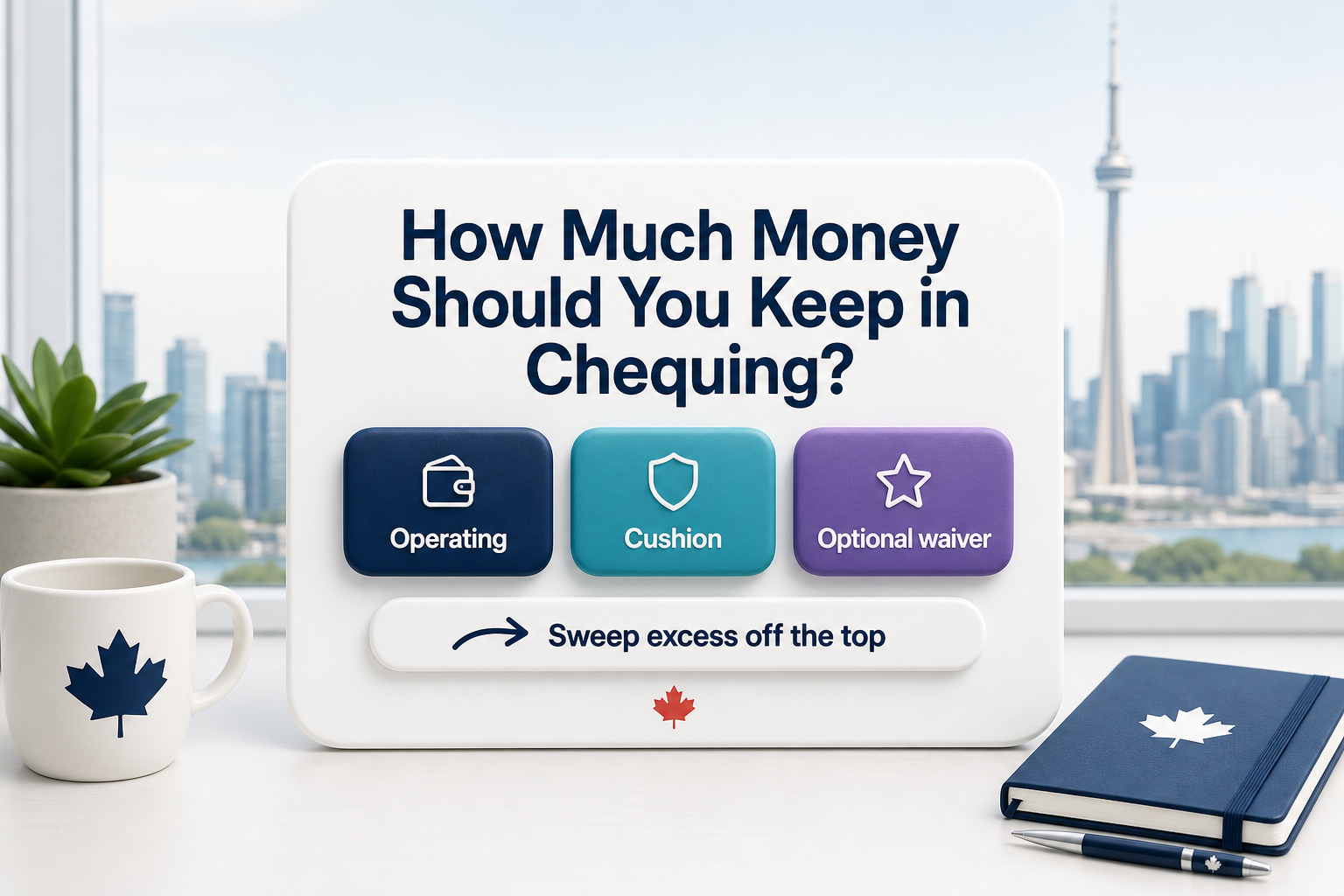
The job is the smallest chequing balance that still runs the bills — then whether a bank’s fee-waiver minimum is worth the interest that cash is not earning. It is not “one or two months of expenses.” That months-rule is a ranking-page habit, not FCAC.
This isn't a first budget — that's How to Budget in Canada. A month can still bounce when the totals work; the floor concept is cash flow versus budget. Watch the lowest days on your statements. This page decides what to do with the number.
As of 12 March 2026, federally regulated banks and federal credit unions may charge at most $10 NSF on a personal deposit account (not more than once in two business days; no NSF if the overdraft is under $10). Provincial credit unions may differ. The rest of those NSF rules are on that cash-flow page.
Three balances, not one months-rule
Operating balance — cash that must stay in chequing so known PADs and bills still clear before the next payday. Pull 30–60 days of statements. Circle the lowest cleared morning. List the named PADs still due before the next payday. Operating is about that pile, not monthly expenses × 1 or 2. FCAC: keep enough to cover bill payments and cheques so you avoid NSF and overdraft charges. That is a cover-the-bills instruction, not a months multiple.
Transaction cushion — a small extra so a debit, a PAD that posts a day early, or a weekend due-date doesn't kiss $0. Household choice, not official. Not 20–30% of two months. Not an emergency fund — How Much Emergency Fund Do I Need in Canada?.
Optional fee-waiver threshold — the bank’s minimum daily (or stated) balance that waives the monthly plan fee. Only if you stay on a paid account. FCAC: some packages waive the monthly fee if you keep a minimum; you may be charged the full monthly fee if the balance drops below even for one day. TD and BMO: end-of-day every day of the month. This layer is a daily floor, not an average.
Then move true excess — above the chosen floor — to savings or a HISA. Chequing usually doesn't accumulate interest (FCAC). Where emergency cash sits is HISA vs. TFSA for an Emergency Fund.
If the lowest day is already thin after the PAD pile left, raise the cushion. Don't invent a second month of lifestyle in chequing.
Whether the waiver is worth it
Extra cash parked for the waiver = waiver daily floor − transaction cushion. The operating PAD pile still leaves; it is not “extra.” If you cannot yet fund the waiver floor without starving PADs, don't chase the waiver this month.
Annual fee saved = monthly plan fee × 12.
Break-even yield = annual fee ÷ extra cash parked. If the HISA you would use pays less than break-even, holding the min beats paying the fee on that account. If it pays more, pay the fee (or switch) and earn.
Third path, and usually the money winner: a no-cost or low-cost account. FCAC Commitment (in force 1 December 2025): all Canadians can get a chequing account at no more than $4 a month; those accounts cannot require a minimum balance; at least 18 debit transactions. Named groups can get $0. Start with the FCAC no-cost and low-cost page and the Account Comparison Tool. Don't rank banks here.
FCAC’s own illustration — $12 waived at $2,000 → $144 a year — is savings-only. This page adds the opportunity-cost side.
Branch, teller, draft, or cash-deposit needs can justify a paid package. That is a feature decision, not a keep-two-months decision. If you switch, keep the old account open until PADs have moved.
Set the alert to the floor you actually chose
Federally regulated banks must send an e-alert without delay when a personal deposit account falls below the amount the customer set, or $100 default. Customizable or opt-out in writing. $100 is too low if the cushion is a few hundred dollars or the waiver floor is thousands. Set the alert just above the floor you actually chose. The alert is not a substitute for the floor. Provincial credit unions may differ. Don't recommend opting out.
Overdraft protection is a short-term backstop, not the operating balance. Credit is not remaining cash.
After payday, sweep the excess
Once the deposit has cleared: cleared chequing − remaining PADs before next pay − chosen daily floor (cushion or waiver) = sweepable.
Move that amount to savings or a HISA. If sweepable is negative, you cannot fund the waiver floor yet — keep the cash, don't PAC it. The bank instruction is How to Automate Savings Goals in Canada. Unused cash above the floor is a later glance in the 20-minute monthly money review.
If pay is every two weeks, the same three balances apply with a smaller PAD pile per deposit — How to Budget When You're Paid Biweekly. The sustainable savings amount is How Much Should You Save Each Month?.
Ellis’s next payday
The figures below are an illustrative example, not an average Canadian household. Bank fees and the 2.75% HISA rate are illustrations. Verify with the bank. Rates change. Not a product recommendation.
Ellis lives in Kamloops and is paid monthly on the 18th, net $3,420. Remaining 2026 paydays: Friday, 18 September; Sunday, 18 October (if the employer posts the prior or next business day, that is Friday 16 October or Monday 19 October); Wednesday, 18 November; Friday, 18 December. Rent PAD $1,520 on the 6th (October 6 is a Tuesday). Illustrative package: TD Every Day Chequing, monthly fee $11.95, waived if the end-of-day balance is $3,000 or more every day of the month. Chequing interest ≈ 0%. HISA illustration 2.75%. Groceries mostly on a card that is paid as a PAD, so chequing variable lives inside the cushion.
Lowest cleared morning from 60 days of statements: $190 on Thursday, 17 September 2026, the day before payday. Too thin. That $190 is the trough after the last cycle’s PADs, not the operating pile.
October PAD pile still due after the 18 September payday
| Date | Bill | Amount |
| --- | --- | ---: |
| 5 Oct (Mon) | Credit-card payment | $260 |
| 6 Oct (Tue) | Rent PAD | $1,520 |
| 9 Oct (Fri) | Car insurance PAD | $186 |
| 13 Oct (Tue) | Phone + internet PAD | $94 |
| 15 Oct (Thu) | Hydro PAD | $87 |
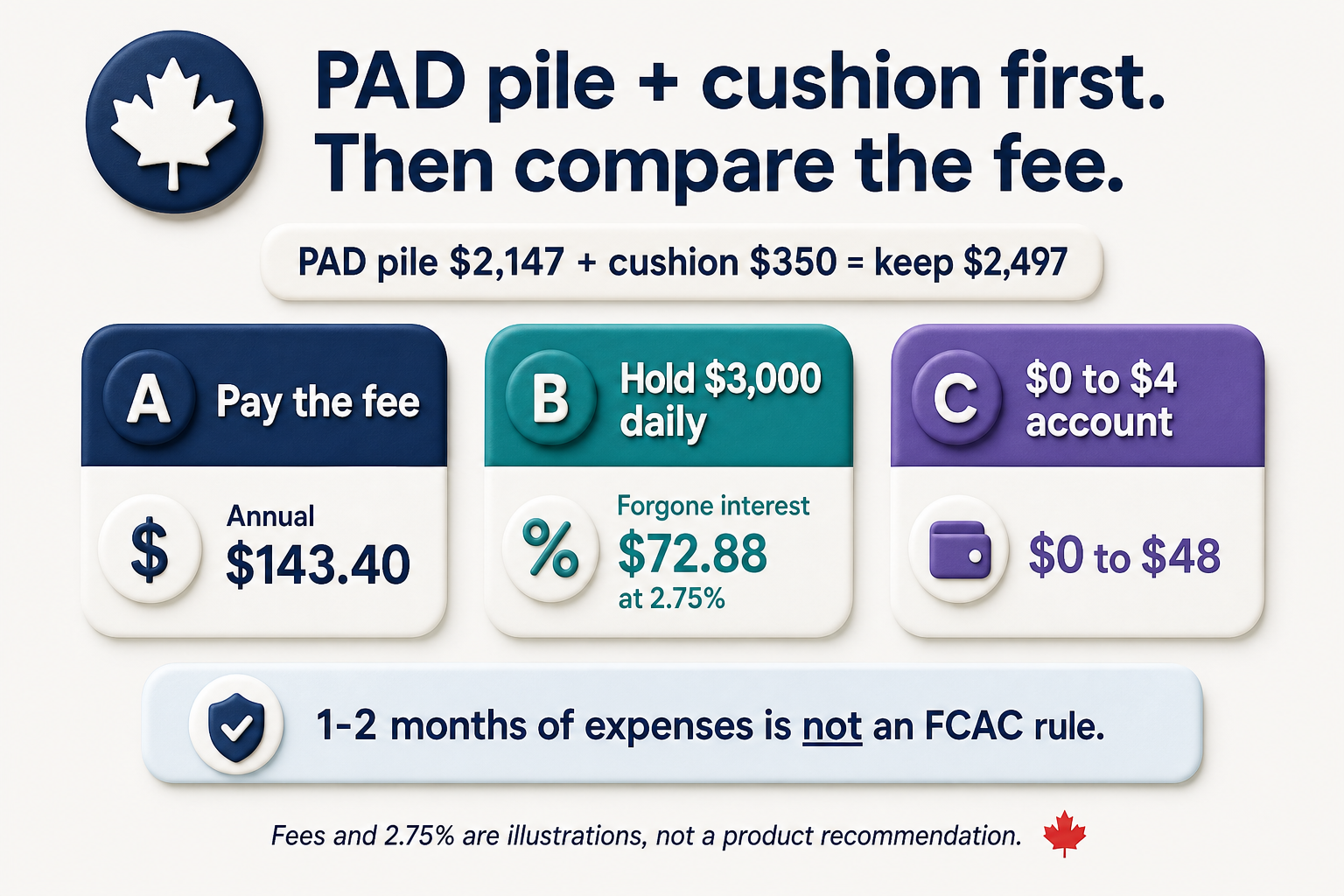
| | Operating (PAD pile) | $2,147 |
$260 + $1,520 + $186 + $94 + $87 = $2,147.
Cushion: Ellis chooses $350. Not 20–30% of two months.
Post-payday keep (operating + cushion): $2,147 + $350 = $2,497.
Friday 18 September: opening cleared $190 + pay $3,420 = $3,610.
Sweepable on the cushion path: $3,610 − $2,147 − $350 = $1,113.
Don't chase the $3,000 waiver with this deposit. Waiver is a daily floor of $3,000, including the trough. Post-payday cash needed to cover PADs and finish every day at $3,000 = $2,147 + $3,000 = $5,147. They have $3,610. Shortfall $1,537. Starving the PAD pile to look like $3,000 for a few days, then dipping on 15 October, still pays the $11.95 — one-day miss, no rebate. Build operating + cushion first.
Idle extra to hold a $3,000 daily waiver vs a $350 cushion = $3,000 − $350 = $2,650.
| Path | Daily floor | Annual plan fee | Extra idle vs $350 | Forgone interest @ 2.75% | Net cost vs a $0-fee account with a $350 floor |
| --- | ---: | ---: | ---: | ---: | ---: |
| A. Stay, pay the fee, floor = cushion | $350 | $143.40 ($11.95 × 12) | $0 | $0 | $143.40 |
| B. Stay, hold $3,000 every day | $3,000 | $0 | $2,650 | $72.88 | $72.88 |
| C. No/low-cost account, floor = cushion | $350 | $0–$48 ($0 / $4 × 12) | $0 | $0 | $0–$48 |
$2,650 × 0.0275 = $72.88. $11.95 × 12 = $143.40. Break-even yield on path B vs A: $143.40 ÷ $2,650 = 5.41%. At a 2.75% illustration, B beats A. C beats B on money unless Ellis needs branch, teller, draft, or cash-deposit features the $0–$4 account does not have. C isn't “always switch.” It's the path FCAC tells you to check first.
Fatter packages, same fraction, still illustrative: a $17.95 / $4,000 daily-min class idles $3,650 extra, costs $215.40 a year in fees or $100.38 in forgone 2.75%, break-even 5.90%. A $30.95 / $6,000 class idles $5,650, $371.40 vs $155.38, break-even 6.57%. At everyday ~2.75%, holding the min still beats paying those fees. At a promo 4.5% HISA, $2,650 × 0.045 = $119.25, still under $143.40. The path that flips the decision is C (no minimum), not a 5% everyday HISA. If a future everyday HISA exceeds the break-even yield, pay the fee or switch and earn — re-run the same fraction.
FCAC’s $12 / $2,000 / $144 example with the missing side: extra vs a $350 cushion = $1,650. $1,650 × 0.0275 = $45.38. $144 − $45.38 = $98.62 still “ahead” vs paying the fee; vs a $0-fee account the $1,650 should be earning $45.38, not sitting.
The months-rule, not as advice: 1.3 × Ellis’s whole $3,420 paycheque = $4,446 sitting in chequing. A 2-months-plus-30%-of-one-month stack = $7,866. Operating + cushion here is $2,497. The extra is idle, not safer PADs. Not an FCAC figure.
Alert, cushion path: around $400–$500, above $350, not the $100 default. Waiver path: just above $3,000 so a one-day dip is visible before month-end.
Sweep: Friday 18 September, after the $3,420 clears, PAC $1,113 to savings or a HISA. Sunday 18 October payday: re-run the same three numbers. Don't assume September’s $1,113 is still the right sweep.
What Ellis does not do this month: hold $3,000 (they don't have the trough yet); size 3–6 months in chequing; treat the $190 trough as “I need two months of expenses in this account.” Already on a $0-fee account: skip layer 3.
See the PAD pile, the floor, and the excess
Finnomia tracks upcoming bills and remaining category budgets so the operating number and the excess above the floor are visible. It doesn't hold accounts or move money. If you want those three numbers in one place, start a 30-day free trial.
How much should I keep in chequing in Canada?
The named PADs still due before the next payday, plus a small cushion you choose. Not one or two months of expenses. That is not an FCAC rule.
Is a $3,000 fee-waiver minimum worth it?
Only if the trough can sit at $3,000 every day, and only after you run annual fee ÷ extra idle cash against the HISA you would actually use. Check a $0–$4 no-minimum account first.
Should I set the low-balance alert to $100?
$100 is the federal default. Set it just above the floor you actually chose.
This article was published in September 2026 and is general information, not personalized financial advice. Bank fees, waiver thresholds, and HISA rates change — verify with the institution. NSF rules for provincial credit unions may differ. FCAC low-cost accounts cannot require a minimum balance.