
On this page
- Before you start
- Step 1: choose which debts belong in the plan
- Step 2: verify balances, rates and minimums
- Step 3: choose avalanche or snowball
- Step 4: add an affordable extra payment
- Step 5: review the timeline, not just the final date
- Step 6: keep the plan current
- How the payment rollover works
- One-time payments and windfalls
- How to treat promotional and variable rates
- Should savings come before extra debt payments?
- What the forecast cannot know
- Monthly debt-plan review
- Use the rest of your financial picture
How to Build a Debt Payoff Plan With Finnomia
A list of balances tells you what you owe. A debt payoff plan tells you which debt receives the next extra dollar, when each balance should reach zero and how much interest the plan may cost.
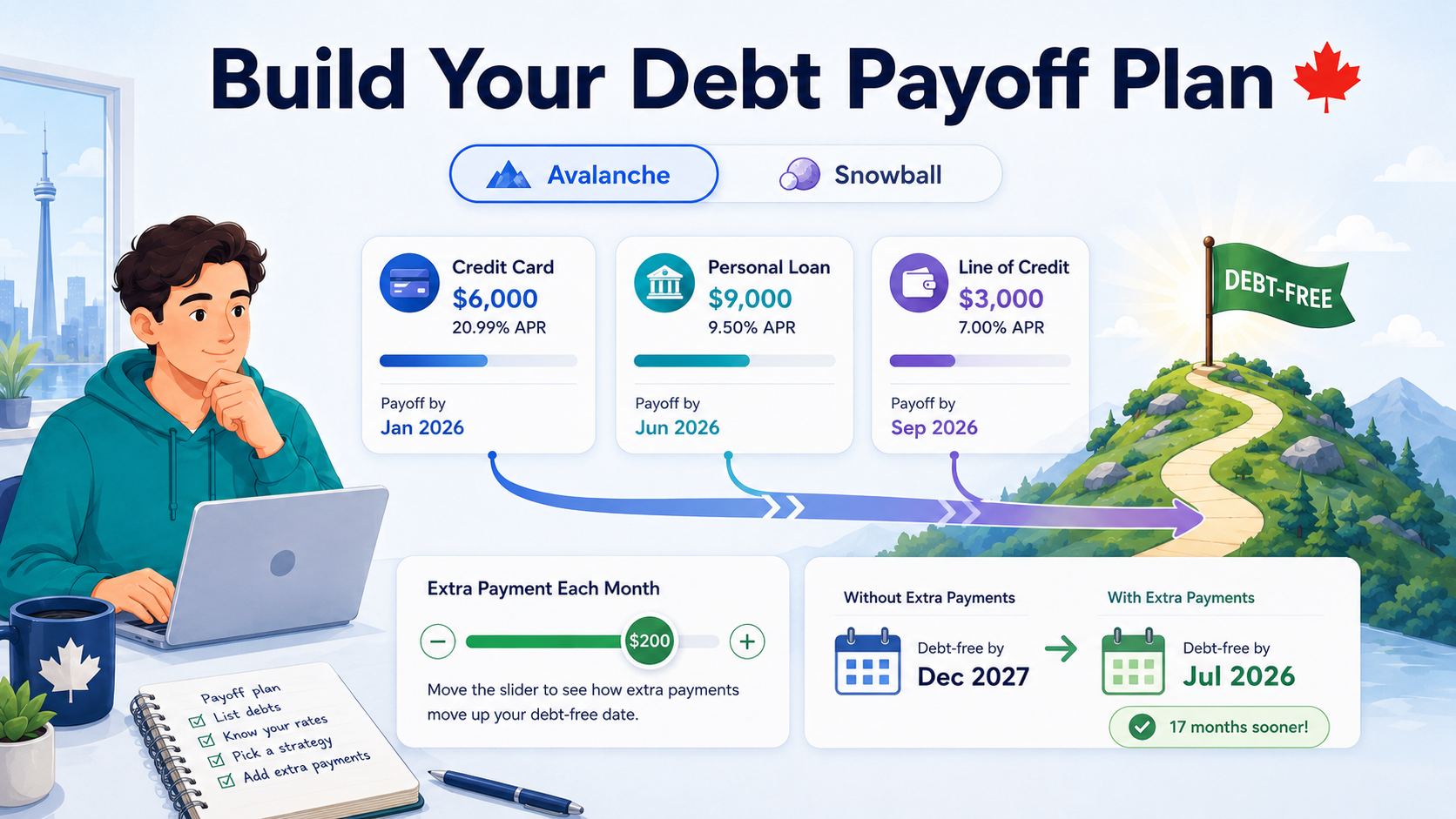
Finnomia’s Debt Freedom Planner brings credit cards, lines of credit, loans and—if you choose—your mortgage into one forecast. You can compare the avalanche and snowball methods, adjust extra payments and see the projected debt-free date change.
Before you start
Collect these details for every debt:
- current balance;
- annual interest rate (APR);
- required minimum payment;
- payment frequency;
- any promotional rate and expiry date; and
- whether the interest rate is fixed or variable.
Connected accounts may supply some balances and transactions, but confirm rates and required payments against the lender’s current statement.
Step 1: choose which debts belong in the plan
Include consumer debts you intend to actively pay down: credit cards, personal lines of credit, student loans, auto loans and personal loans.
Mortgages are optional. Including a mortgage gives you a complete debt-free date, but it can make the timeline much longer and obscure progress on higher-cost consumer debt. If your immediate goal is eliminating credit-card and line-of-credit balances, exclude the mortgage from that working plan and continue tracking it in net worth.
Step 2: verify balances, rates and minimums
The forecast is only as reliable as its inputs. A line of credit whose minimum covers little more than interest behaves very differently from an instalment loan with a fixed amortization.
For variable-rate debt, use the current rate and revisit the plan when the lender changes it. For a promotional credit card, model the rate that will apply during most of the payoff period—or create a reminder to update it before the promotion ends.
Step 3: choose avalanche or snowball
| Method | Extra payment goes to | Main advantage |
|---|---|---|
| Avalanche | Highest interest rate | Usually minimizes total interest |
| Snowball | Smallest balance | Creates faster early wins |
Both methods keep making minimum payments on every debt. When the target debt is paid off, its old payment rolls into the next debt.
The best method is the one you can follow. If motivation is not a concern, avalanche is usually the mathematical choice. If clearing an account would make the plan easier to sustain, snowball may be worth some additional interest.
Step 4: add an affordable extra payment
Do not build a forecast around your best-ever month. Choose an amount your budget and cash-flow forecast can support consistently.
For example:
| Debt | Balance | APR | Minimum |
|---|---|---|---|
| Credit card | $6,000 | 20.99% | $180 |
| Line of credit | $9,000 | 9.50% | $150 |
| Personal loan | $3,000 | 7.00% | $120 |
With a $400 monthly extra payment, avalanche targets the credit card first. Snowball targets the $3,000 personal loan first. Finnomia projects both schedules so you can compare the estimated payoff date and interest rather than choosing from slogans.
Step 5: review the timeline, not just the final date
Look for:
- the first debt-free milestone;
- the month each payment rolls forward;
- total interest under each strategy;
- the effect of increasing or reducing the extra payment; and
- any month where cash flow cannot support the plan.
The result is a forecast, not a lender statement. Actual interest can differ because of daily-interest calculations, rate changes, fees, payment timing and new transactions.
Step 6: keep the plan current
Update the plan when you:
- receive a rate change;
- make a one-time payment;
- add or refinance debt;
- change the monthly extra payment; or
- decide to include or exclude the mortgage.
Avoid adding new purchases to a card the plan assumes is shrinking. That makes the forecast and the real balance move in opposite directions.
How the payment rollover works
The power of a structured plan comes from keeping the total monthly debt payment steady as individual debts disappear.
Using the earlier example, assume the required minimums total $450 and you add $400. The household sends $850 toward debt each month. When the first debt is paid off, its former minimum and the extra payment move to the next target. You do not reduce the total to $670 simply because the $180 credit-card minimum is gone.
This rollover creates acceleration without requiring a new sacrifice each time. If cash flow changes, update the extra-payment assumption rather than silently departing from the plan.
One-time payments and windfalls
A tax refund, bonus, sale proceeds or gift can be tested as a one-time payment. Before applying all of it to debt, protect:
- upcoming bills;
- a basic emergency buffer;
- taxes owing on the windfall, if any; and
- near-term expenses that would otherwise return to credit.
Then compare which debt produces the most benefit. The highest-rate balance usually saves the most interest. A small-balance payoff may instead eliminate a required monthly payment and improve flexibility.
How to treat promotional and variable rates
Enter the rate that best represents the forecast period and add a review date.
For a 0% balance transfer that expires in six months, calculate whether the planned payments will clear the balance before expiry. If not, test the post-promotional rate. A plan that looks inexpensive at 0% can change sharply when the regular rate begins.
Variable-rate lines of credit should be reviewed whenever the lender changes the rate. Even if the target order does not change, total interest and the payoff date may.
Should savings come before extra debt payments?
It is rarely necessary to choose an absolute extreme. A practical sequence can be:
- keep all accounts current;
- build a starter emergency buffer;
- capture an employer match where appropriate;
- target high-interest consumer debt;
- expand the emergency fund; and
- balance lower-rate debt with long-term investing.
A 20% credit card and a 5% student loan create different trade-offs. The planner organizes the debt math; your budget, benefits and risk tolerance determine how aggressive the extra payment should be.
What the forecast cannot know
Debt projections use the balances, rates and payments available today. They cannot guarantee lender calculations or future behaviour. Differences can come from:
- interest compounded daily rather than monthly;
- statement-cycle timing;
- annual or transaction fees;
- variable-rate changes;
- skipped, late or additional payments;
- new purchases; and
- lender-specific minimum-payment formulas.
Use the plan as a decision and tracking tool. Your lender’s statement remains the record of the actual debt.
Monthly debt-plan review
- Confirm every minimum payment cleared.
- Update balances and changed interest rates.
- Reconcile any one-time payments.
- Check whether new card purchases are being paid in full.
- Roll the full payment forward after a payoff.
- Review the emergency buffer and next month’s cash flow.
- Celebrate the milestone without reopening the paid-off balance.
Use the rest of your financial picture
Debt payoff competes with other priorities. Keep a small emergency buffer so an unexpected bill does not return to the credit card. Capture recurring bills in the budget, test payments in cash-flow forecasting and review progress in net worth.
Finnomia combines those views: connected read-only accounts, customizable budgets, recurring bills, cash-flow forecasting, goals and the Debt Freedom Planner. Start with the free debt payoff calculator for a quick comparison, then use the in-app planner to maintain the strategy over time.
For a deeper method comparison, read debt payoff strategies in Canada.
Forecasts are estimates and do not change your lending agreements. Continue making at least every required payment.