
On this page
- A $4,200 monthly example
- What counts as a need?
- What counts as a want?
- What belongs in the 20% bucket?
- When the rule does not fit
- How to set it up in Finnomia
- A second example: when housing breaks the rule
- Classifying ambiguous expenses
- Annual and irregular costs still count
- Families and shared households
- What to do when the 20% is impossible
- A monthly review that takes ten minutes
- FAQ
The 50/30/20 Budget Rule for Canadians
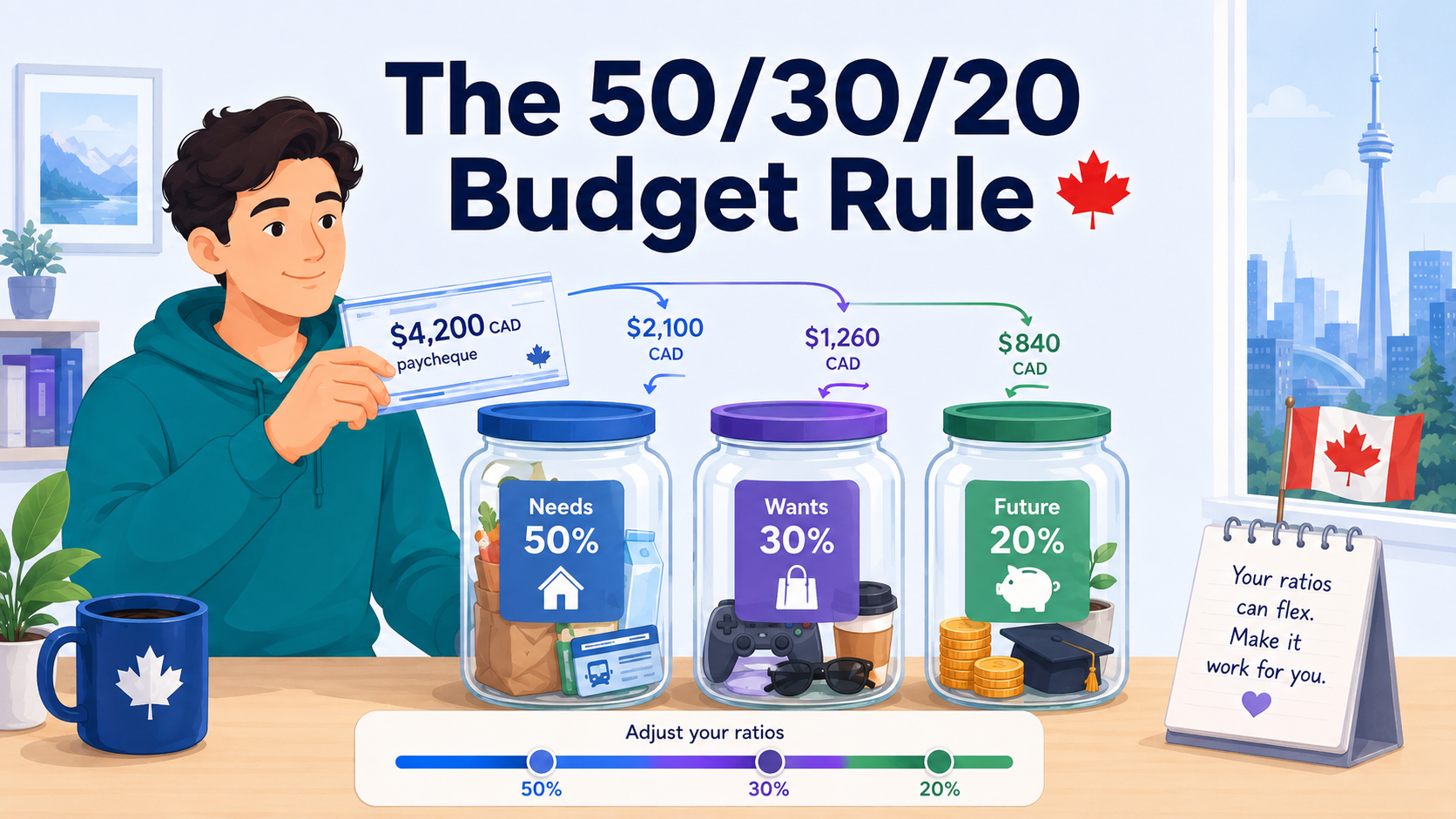
The 50/30/20 rule divides monthly take-home pay into three broad buckets:
- 50% for needs
- 30% for wants
- 20% for savings and extra debt repayment
It is a starting framework, not a law or government standard. If rent, childcare or debt pushes your real life outside the percentages, the answer is to adapt the framework—not pretend the numbers work.
A $4,200 monthly example
| Bucket | Percentage | Monthly amount |
|---|---|---|
| Needs | 50% | $2,100 |
| Wants | 30% | $1,260 |
| Savings and extra debt | 20% | $840 |
Use take-home pay: the amount that actually reaches your bank account after income tax, CPP, EI, pension contributions and payroll deductions.
What counts as a need?
Needs are expenses you must cover to live, work and meet legal or contractual obligations. They commonly include:
- rent or mortgage payments;
- basic utilities;
- groceries;
- necessary transportation;
- insurance;
- minimum debt payments;
- essential medication and health costs; and
- necessary childcare.
The boundary depends on the decision, not the merchant. A basic mobile plan may be necessary for work; the premium upgrade is a want. A car may be essential in a rural community; a more expensive model is not.
What counts as a want?
Wants improve comfort or enjoyment but can be reduced or delayed:
- restaurant meals and delivery;
- entertainment and streaming;
- non-essential shopping;
- premium travel;
- hobbies; and
- upgrades above a practical baseline.
This category is not “bad spending.” It is the flexible part of the budget. Naming it clearly helps you decide what you value most.
What belongs in the 20% bucket?
Use the final bucket to improve your future position:
- emergency-fund contributions;
- TFSA, RRSP or FHSA savings;
- other savings goals;
- investment contributions; and
- debt payments above the required minimum.
Minimum debt payments are generally needs because missing them has consequences. Extra payments belong here because they accelerate progress.
When the rule does not fit
If $4,200 of take-home pay comes with $2,400 rent, housing alone uses 57%. You cannot make needs equal 50% with better categorization.
Try one of these adaptations:
- Use your real baseline. A 65/15/20 plan can still protect a 20% future bucket.
- Set a smaller initial savings floor. Start at 5% or 10%, then increase it as debt or income changes.
- Separate fixed and flexible needs. This shows where changes are actually possible.
- Use the rule as a diagnostic. A persistent needs share above 70% may point to a housing, transportation or income problem that small cuts cannot solve.
For irregular income, calculate the percentages against a conservative planning income, not your best month. See irregular income budgeting in Canada.
How to set it up in Finnomia
- Review one to three months of transaction history.
- Group categories into needs, wants and future goals.
- Create category budgets using your real amounts.
- Set savings goals and extra debt payments.
- Review the ratios monthly and adjust without rewriting history.
A second example: when housing breaks the rule
Suppose take-home pay is $5,000 and the household has these costs:
| Category | Monthly amount |
|---|---|
| Rent and utilities | $2,600 |
| Other needs | $1,000 |
| Wants | $650 |
| Savings and extra debt | $750 |
| Total | $5,000 |
The result is 72% needs, 13% wants and 15% future goals. Calling $1,100 of essential costs “wants” would make the pie chart prettier without improving the household’s finances.
A better response is to keep the honest 72/13/15 baseline and work on the structural constraint. The household might target 20% for the future after a debt is repaid, at lease renewal, when childcare changes or after income increases.
Classifying ambiguous expenses
Some purchases contain both a need and a want. Use a consistent rule rather than debating every transaction.
- Housing: the affordable baseline is a need; optional upgrades are wants.
- Transportation: reliable transport required for work is a need; premium features are wants.
- Food: basic groceries are needs; restaurant meals are usually wants.
- Internet and phone: a functional plan may be a need; upgrades and additional services are wants.
- Clothing: necessary replacement is a need; discretionary fashion is a want.
- Debt: the required minimum is a need; accelerated repayment belongs in the future bucket.
Split a material expense when useful. Do not spend more time classifying a $6 purchase than the decision is worth.
Annual and irregular costs still count
Property tax, insurance, gifts, car maintenance and annual subscriptions can disappear from a one-month snapshot. Convert them to monthly amounts through sinking funds.
If car insurance is $1,800 annually, assign $150 a month to the relevant bucket. Without that adjustment, the ordinary months look artificially easy and the renewal month looks like an emergency.
Families and shared households
Apply the method to the money actually managed together. A couple sharing all expenses may use total household take-home pay. Roommates who share only rent and utilities may each use a personal 50/30/20 plan and maintain a separate shared-expense calculation.
Decide how reimbursements and transfers will be categorized so they do not appear as additional spending. Finnomia’s household features preserve separate user accounts while supporting shared household views and budgets.
What to do when the 20% is impossible
Start with a smaller protected amount rather than waiting for a perfect month. Even 2% or 5% creates a repeatable system. Then look for the largest available lever:
- refinance or prioritize high-cost debt;
- review housing at the next realistic decision point;
- reduce vehicle costs;
- cancel low-value recurring commitments;
- use benefits or employer matching; or
- increase income through a sustainable change.
The framework should reveal the constraint, not shame the household for having one.
A monthly review that takes ten minutes
- Calculate actual needs, wants and future contributions.
- Identify the largest variance from plan.
- Decide whether it was exceptional or recurring.
- Change one budget amount or behaviour for next month.
- Check that savings and extra debt payments actually occurred.
Finnomia’s customizable budgets and categorization let you use 50/30/20 as a high-level view while keeping the detailed categories needed for everyday decisions.
If you want every dollar assigned before the month begins, try zero-based budgeting. For the full setup process, read how to budget in Canada.
FAQ
Is 50/30/20 based on gross or net income?
It is normally applied to take-home pay.
Is paying off debt part of the 20%?
Minimum payments usually sit under needs; payments above the minimum fit the 20% future bucket.
Do I have to hit the percentages exactly?
No. The value is in seeing the trade-off among essential costs, lifestyle and future progress.