
On this page
- What is worth tracking?
- What to save for each major purchase
- Connect the document to the transaction
- Use a simple warranty tracker
- Do you need the original paper receipt?
- Track return deadlines separately
- Keep repair and service history with the purchase
- Household records are different from tax records
- Protect sensitive information
- A ten-minute monthly routine
- How Finnomia helps
- Frequently asked questions
Sixteen months after buying an appliance, it stops working. You remember the store and can find the charge on your credit card, but the receipt, model number and warranty terms have vanished.
A transaction record proves that money changed hands. It may not show exactly what you bought, the serial number, the warranty period or whether the purchase included an extended service plan.
The solution is not to photograph every coffee receipt. Build a small system for purchases whose documentation could save meaningful money or time.
What is worth tracking?
Keep detailed records for purchases that are:
- Expensive to replace or repair
- Covered by a manufacturer or extended warranty
- Eligible for return or price protection
- Identified by a model or serial number
- Used for insurance claims
- Shared household assets
- Potentially deductible for business or tax purposes
Common examples include appliances, electronics, furniture, tools, bicycles, sporting equipment, jewellery and major home repairs.
Routine groceries and low-cost consumables generally need no long-term file unless the purchase has a specific tax, reimbursement or safety reason.
What to save for each major purchase
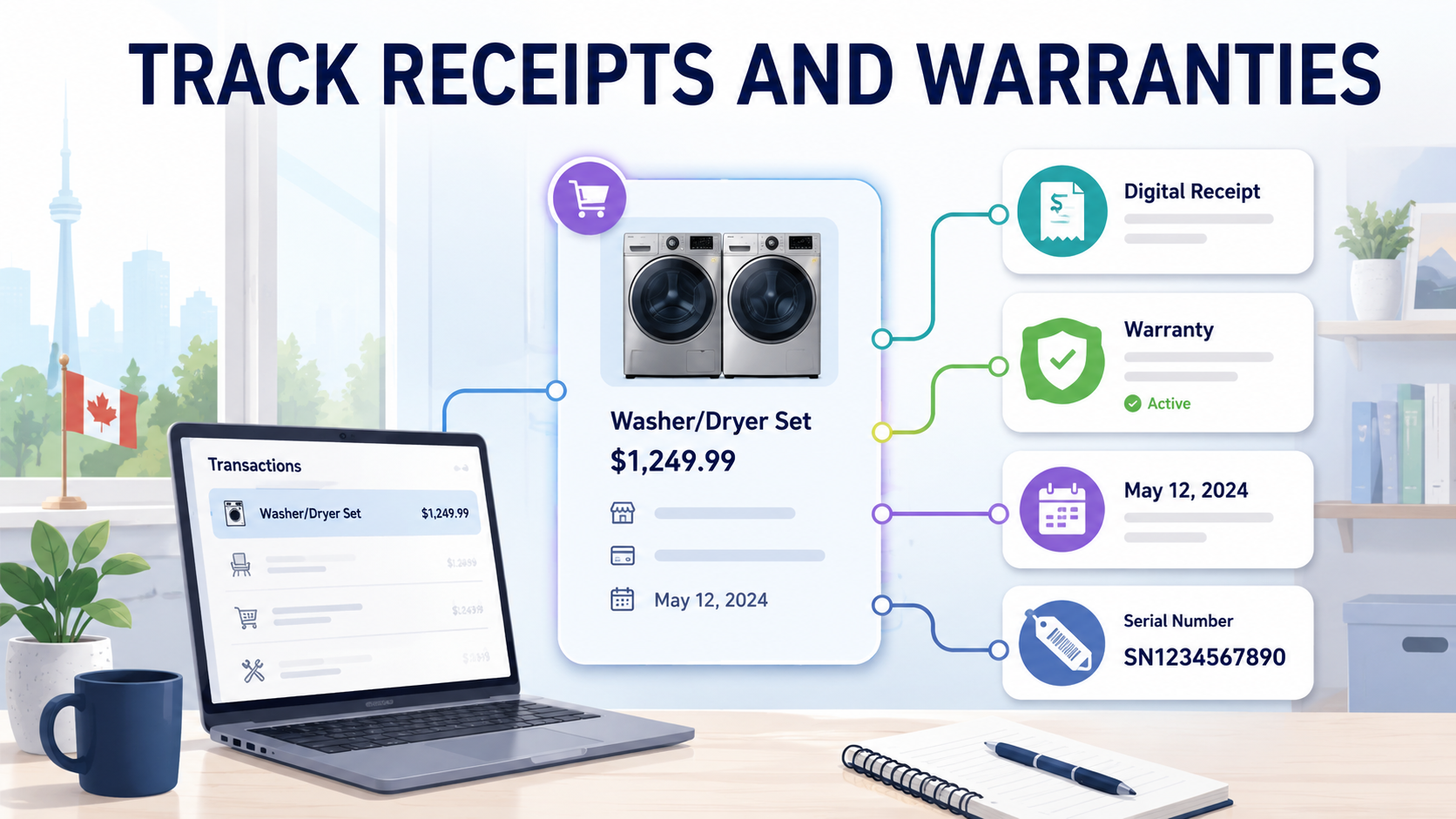
For a useful record, capture:
- Item name and short description
- Purchase date
- Merchant
- Total price and taxes
- Payment method
- Receipt or invoice
- Model and serial number
- Warranty length and expiry date
- Return deadline
- Extended-warranty or service-contract terms
- Delivery, installation and repair records
- Relevant photos
The Government of Canada’s Office of Consumer Affairs notes that warranty claims may require documents such as warranty information and original sales receipts. A credit-card statement may support your case, but it is not a substitute for every detail on the receipt.
Connect the document to the transaction
A folder full of files named IMG_4821.jpg is technically an archive but practically difficult to use.
Use a consistent name such as:
2026-08-14_Canadian-Tire_Cordless-Drill_299-99.pdf
Then connect it with the corresponding transaction in your financial records. Add a note or tag for the product, model, warranty end date and household member responsible for it.
This produces two useful paths to the same information:
- Search by merchant or date in the transaction history.
- Search by product or model in the document archive.
Finnomia supports attaching receipt files to transactions, with multiple attachments useful when a purchase has a receipt, warranty document and product photo.
Use a simple warranty tracker
A compact table is enough:
| Item | Purchased | Price | Warranty ends | Documents |
|---|---|---|---|---|
| Laptop | Aug. 14, 2026 | $1,699 | Aug. 14, 2027 | Receipt, serial, warranty |
| Dishwasher | May 2, 2026 | $1,250 | May 2, 2028 | Invoice, warranty, installation |
| Winter tires | Oct. 21, 2025 | $1,080 | See tread terms | Receipt, product terms |
If the warranty terms depend on registration, maintenance or usage, record that requirement rather than only an expiry date.
Do you need the original paper receipt?
Requirements vary by merchant, manufacturer and type of claim. A clear digital copy is easier to preserve, but some processes may ask for original documentation.
When the purchase is important:
- Read the return and warranty terms.
- Photograph or scan the entire receipt immediately.
- Keep the paper original if the terms require it or the risk justifies it.
- Record where the original is stored.
Thermal receipts can fade, which makes prompt digital capture useful. Ensure the image includes the merchant, date, items, total and transaction details.
Track return deadlines separately
The return period is usually much shorter than the warranty period. Record the date as soon as the purchase is made and set a reminder when:
- You are testing whether an item works for your needs.
- A price adjustment may be available.
- Installation or delivery must occur before acceptance.
- A trial or service contract converts into a paid commitment.
Do not assume Canadian stores are legally required to accept a non-defective return simply because you changed your mind. Refund and exchange policies can depend on the seller and applicable provincial or territorial consumer law.
Keep repair and service history with the purchase
For appliances, vehicles, equipment and home systems, add:
- Dates of service
- Work performed
- Parts replaced
- Service provider
- Amount paid
- Remaining parts or labour warranty
This record can support a future warranty claim, help diagnose repeat failures and provide useful information when selling the item.
Household records are different from tax records
This article focuses on consumer purchases and warranties. Business expenses, rental-property records, medical claims and other tax-related documents can have formal retention requirements.
Do not discard tax records based on the expiry of a product warranty. Follow CRA guidance and obtain professional advice when the treatment is unclear.
Protect sensitive information
Receipts and invoices can contain names, partial payment details, addresses, membership numbers and information about what your household owns.
Use an account protected by a strong, unique password and multi-factor authentication where available. Give household members only the access they need. Avoid leaving unprotected receipt images in shared public folders.
A ten-minute monthly routine
Once a month:
- Review unusually large household transactions.
- Attach or file receipts for purchases worth tracking.
- Add model, serial and warranty information.
- Note returns or registrations that still require action.
- Discard low-value paper receipts that no longer serve a purpose, subject to any tax or legal requirement.
The best recordkeeping system is selective. If you try to preserve everything forever, the important records become harder to find.
How Finnomia helps
Finnomia lets you attach JPEG, PNG, WebP or PDF receipt files directly to a transaction, add useful context and review the purchase alongside the rest of your household spending. That makes the financial record more useful than a merchant name and amount alone.
It also supports the broader reason for tracking: understanding which large purchases changed the month and preserving the details you may need later.
If you want that picture in one Canadian place, start a 14-day free trial.
Frequently asked questions
Is a credit-card statement enough for a warranty claim?
It may help demonstrate the date and merchant, but it often lacks the item, model and warranty information. Preserve the itemized receipt and warranty terms when possible.
How long should I keep a receipt?
Keep it through the return period and applicable warranty or service-contract period. Retain it longer when needed for insurance, ownership, resale, tax or legal purposes.
Should I upload every receipt?
Usually not. Prioritize items with meaningful replacement cost, a warranty, a return deadline or another recordkeeping requirement.
Sources
- Office of Consumer Affairs: Warranties
- Office of Consumer Affairs: After you buy
- Office of Consumer Affairs: Refunds and exchanges
This is general information, not tax, legal, or financial advice.