
On this page
- Credit card vs. line of credit at a glance
- When a credit card can actually be cheaper
- The advantage disappears when you carry the card balance
- A line of credit starts charging immediately
- The biggest LOC trap: the minimum payment
- Minimum payment and payoff payment are not the same thing
- What if you move credit-card debt to a LOC?
- But only if you keep paying $500
- The second trap: using the credit card again
- Lower interest is helpful. Lower debt is the goal.
- What about credit-card cash advances?
- What about balance transfers?
- Balance transfer vs. LOC
- Credit card vs. LOC for purchases
- Credit limits aren't assets
- Variable LOC rates can change the comparison
- Credit-card rates can change too
- Should you pay the credit card or LOC first?
- What about a personal loan?
- When consolidation makes sense
- When I'd leave the debt on the card
- How to compare the two using your own numbers
- How Finnomia approaches the comparison
- A lower rate is an opportunity, not a solution
- Frequently asked questions
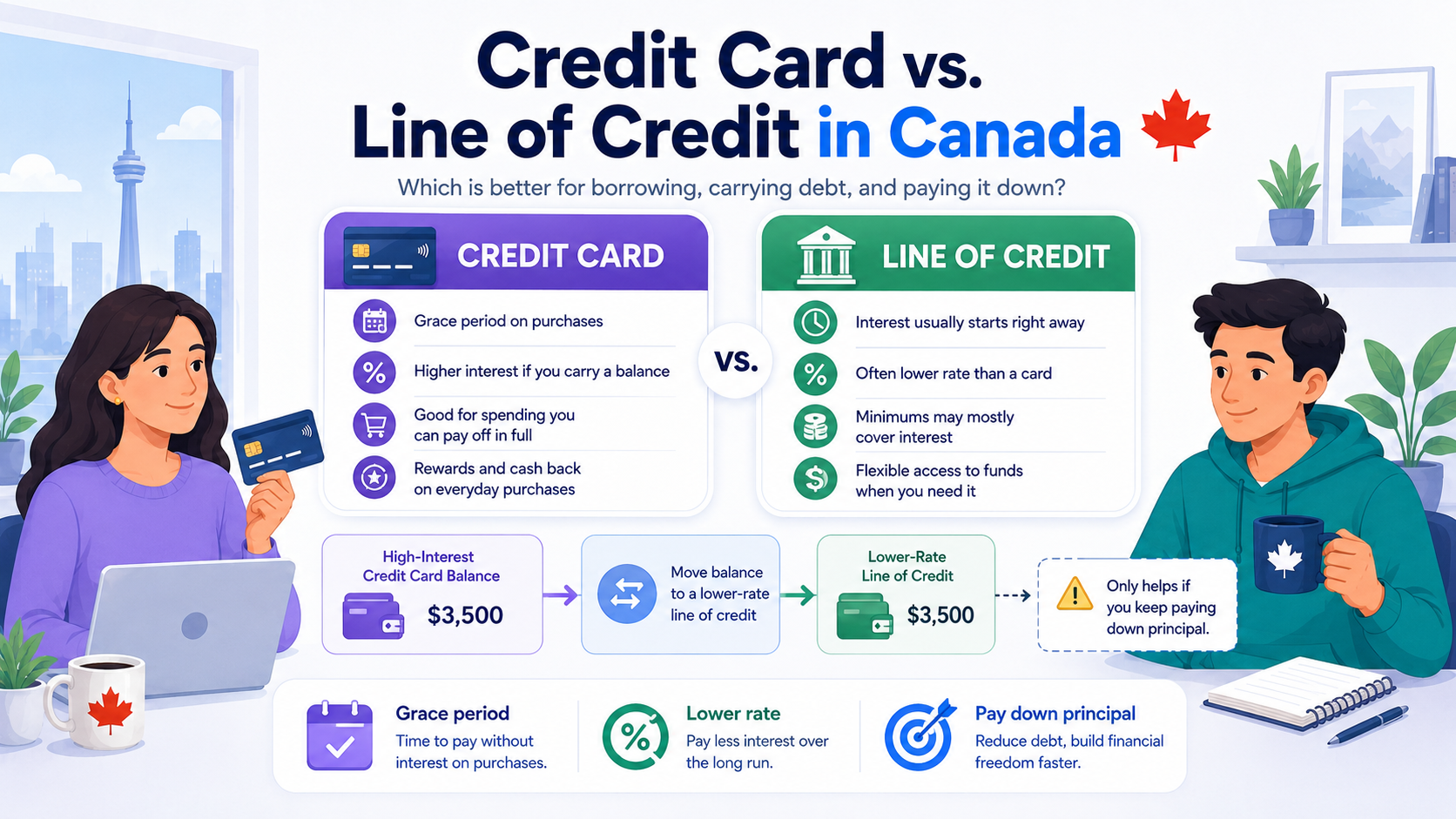
A credit card and a line of credit can both let you borrow money.
But they work very differently.
A credit card can give you an interest-free period on purchases if you pay the statement balance in full by the due date.
A line of credit usually begins charging interest as soon as you borrow.
On the other hand, a line of credit will often have a lower interest rate than a credit card.
That leads to a useful rule of thumb:
A credit card can be excellent for spending you will pay off in full. A line of credit can be less expensive for debt you actually need to carry.
But there's an important catch.
Moving $8,000 from a high-interest credit card to a lower-rate line of credit doesn't eliminate $8,000 of debt.
It changes where the debt lives.
And if you pay off the card with the LOC and then start using the card again, you can end up with both balances.
So the real comparison is about more than interest rates.
It's about:
- when interest begins
- how minimum payments work
- whether the rate can change
- how quickly principal gets paid down
- whether the new borrowing actually replaces the old debt
Credit card vs. line of credit at a glance
| Credit card | Line of credit | |
|---|---|---|
| Type of credit | Revolving | Revolving |
| Interest on purchases | Can be avoided if statement is paid in full by due date | Usually begins as soon as money is borrowed |
| Grace period | At least 21 days on purchases from federally regulated issuers | Generally not an interest-free borrowing product |
| Typical rate relationship | Usually higher | Usually lower than a credit card |
| Rate type | Often fixed for the account, subject to agreement | Usually variable |
| Minimum payment | Small portion of balance or another formula in agreement | Often approximately monthly interest |
| Does minimum reduce principal? | Usually at least somewhat, depending on balance and formula | Not necessarily |
| Available credit returns after repayment | Yes | Yes |
| Good fit | Purchases you can pay in full; convenience | Borrowing that needs to be repaid over time |
| Main danger | Carrying expensive revolving balances | Paying interest indefinitely without reducing principal |
The most important difference isn't simply:
20% versus 10%
It's how you use the product.
When a credit card can actually be cheaper
Suppose you buy:
$1,500 of furniture
with a credit card.
Your statement arrives.
You pay the entire statement balance by the due date.
Interest paid:
$0
For purchases, federally regulated credit-card issuers must provide a grace period of at least 21 days.
That grace period begins at the end of the billing period.
If you pay the statement balance in full by the due date, your normal purchases can avoid interest.
A line of credit works differently.
Borrow:
$1,500
from the LOC today, and interest will generally begin accumulating today.
So despite having a lower advertised rate, the LOC could actually cost more than the credit card for a short-term purchase you were going to pay off completely anyway.
That's why:
“LOC rates are lower”
doesn't mean:
“Always use a LOC instead of a credit card.”
For someone who reliably pays the card in full, the credit card's grace period is extremely valuable.
The advantage disappears when you carry the card balance
Now change the example.
You put:
$1,500
on the credit card.
But you can't pay it in full.
The remaining balance begins accumulating interest according to the card agreement.
Credit-card rates are generally much higher than rates on lines of credit.
FCAC uses example rates such as:
- 19% on regular purchases
- 22% on cash advances
Those are examples, not Canadian averages.
Your actual rates are the ones shown on your statement and credit agreement.
Once you're carrying a meaningful balance month after month, the credit card can become expensive very quickly.
That's when comparing it with a lower-rate LOC starts to make more sense.
A line of credit starts charging immediately
A personal line of credit lets you borrow up to a predetermined limit.
Suppose your limit is:
$20,000
and you borrow:
$5,000
You pay interest on the $5,000 you've actually borrowed, not the unused $15,000.
But unlike ordinary credit-card purchases that qualify for a grace period, LOC interest generally starts from the day you borrow.
LOC rates are also commonly variable.
That means the rate can rise or fall over time.
Your current rate should therefore be treated as:
today's borrowing cost
not necessarily the rate you'll have for the entire payoff period.
The biggest LOC trap: the minimum payment
This is arguably the most important difference between a LOC and an ordinary instalment loan.
FCAC says the minimum payment on a personal LOC is usually approximately equal to the monthly interest.
Imagine:
LOC balance: $10,000
Monthly interest:
$75
Minimum payment:
approximately $75
You pay:
$75
Amount of principal eliminated:
approximately $0
You made the required payment.
You're current.
But you still owe roughly:
$10,000
If you keep making interest-only payments, there may be no meaningful debt-free date at all.
That's why a LOC needs a deliberate principal-payment plan.
Minimum payment and payoff payment are not the same thing
This distinction is worth making explicit.
Required minimum
The amount necessary to keep the account current.
Payoff payment
The amount necessary to actually move the balance toward zero at the pace you want.
For a LOC, those numbers can be dramatically different.
If the lender requires:
$80
but you want the debt gone, your budget might deliberately pay:
$500
or:
$750
instead.
The difference reduces principal.
For help deciding how much your monthly budget can realistically support, see:
/blog/budgeting-while-paying-debt
What if you move credit-card debt to a LOC?
This can make financial sense.
Suppose you owe:
$8,000
on a credit card at:
20.99%
and you're approved for a LOC at an illustrative:
10%
The 10% rate here is only an example. There is no universal Canadian LOC rate.
Assume you pay:
$500 per month
and make no new purchases.
Using a simplified monthly-interest calculation:
| Credit card | LOC | |
|---|---|---|
| Starting debt | $8,000 | $8,000 |
| Illustrative APR | 20.99% | 10% |
| Monthly payment | $500 | $500 |
| Approx. payoff | 19 months | 18 months |
| Approx. interest | $1,467 | $622 |
| Approx. interest savings | — | $845 |
Moving the balance in this illustration saves roughly:
$845 in interest
even though the payoff date only moves by about one month.
Why?
Because much more of each $500 payment reaches principal instead of being consumed by interest.
That's the potential value of refinancing expensive debt.
But only if you keep paying $500
Here's where things frequently go wrong.
The credit card required a larger minimum.
The LOC requires only:
the monthly interest
So after moving the debt, the borrower thinks:
“Great. My required payment is much lower now.”
and starts sending only the LOC minimum.
The interest rate improved.
The payoff strategy got worse.
A lower rate does not help nearly as much if the payment falls with it.
The better approach is usually to think:
“I lowered the interest rate. Now I'll keep making the payment I was already able to afford.”
That allows more of every payment to reduce principal.
The second trap: using the credit card again
Suppose you move:
$8,000
from your credit card to a LOC.
Now:
Credit card balance: $0
LOC balance: $8,000
Your card suddenly has available credit again.
A few months later:
- $900 car repair
- $600 travel
- $400 restaurants
- $1,100 miscellaneous spending
Now you have:
LOC: $7,000
plus:
Credit card: $3,000
Instead of consolidating debt, you expanded it.
FCAC specifically warns that consolidation won't solve the problem if the underlying spending habits continue.
That doesn't mean you necessarily have to close the card.
It means the payoff plan needs an explicit rule for what happens to it after consolidation.
Lower interest is helpful. Lower debt is the goal.
Debt consolidation can create a psychological trap:
The expensive debt disappeared, so the problem is solved.
It didn't disappear.
It moved.
A successful consolidation should result in something like:
Before
Credit card: $8,000
After
LOC: $8,000
Six months later
LOC: $5,300
not:
LOC: $7,000 + credit card: $3,000
Track total debt, not just the balance of the original card.
What about credit-card cash advances?
Cash advances are a different category from ordinary purchases.
They generally:
- don't receive the normal grace period
- begin charging interest immediately
- may have a higher interest rate than purchases
- may include an additional fee
That makes the comparison with a LOC very different.
For an ordinary purchase you can pay in full, the credit card can cost:
$0 interest
For a cash advance, the LOC may be much more competitive because both start charging interest immediately and the LOC will often have the lower rate.
If you need cash borrowing, compare the actual LOC terms before using a credit-card cash advance.
What about balance transfers?
A balance-transfer credit card can sometimes compete with—or beat—a LOC for short-term debt repayment.
Suppose you're offered:
0% promotional interest for 12 months
with a:
3% transfer fee
on an:
$8,000
balance.
Transfer fee:
$240
New balance:
$8,240
To eliminate that balance during the 12-month promotion, you'd need to pay approximately:
$687 per month
ignoring other charges.
If your budget can sustain that, the balance transfer could be very attractive.
But the important questions are:
- What is the transfer fee?
- How long does the promotion last?
- What does the interest rate become afterward?
- What happens if you miss a payment?
- Does the promotional rate apply only to the transferred balance?
- Can your budget realistically clear it before expiry?
A low promotional rate is only useful if there's a plan for the balance before the promotion ends.
Balance transfer vs. LOC
A simple way to think about the choice:
Balance transfer
Potentially stronger when:
- the promotional rate is extremely low
- you can repay the debt during the promotional period
- the transfer fee is reasonable
- you're confident you won't lose the promotion
Line of credit
Potentially stronger when:
- repayment will take longer
- the LOC rate is materially below the card rate
- you want more flexibility around the payment schedule
- you're prepared to make deliberate principal payments
Neither is automatically better.
Calculate the total cost under your actual offer.
Credit card vs. LOC for purchases
If you're not already carrying debt, the comparison changes.
Credit card may be better when:
- you're buying normal goods or services
- you'll pay the statement balance in full
- you value the grace period
- you want the consumer protections or features associated with the card
- the purchase fits your existing budget
LOC may be better when:
- you know repayment will take several months
- the LOC rate is materially lower
- there isn't a cheaper financing alternative
- you have a clear principal-repayment schedule
A LOC shouldn't turn an unaffordable purchase into an affordable one.
It's still borrowed money.
Credit limits aren't assets
Suppose you have:
Credit-card limit: $15,000
LOC limit: $25,000
Unused credit:
$40,000
Your net worth did not increase by:
$40,000
That's borrowing capacity, not cash or an asset.
If you borrow $10,000 from the LOC:
- cash may temporarily increase
- liabilities increase by the same $10,000
Borrowing doesn't create wealth.
It creates an obligation.
Variable LOC rates can change the comparison
Suppose your LOC currently charges:
10%
and your card charges:
20.99%
The LOC appears clearly cheaper.
But LOC rates are commonly variable.
If the rate rises to:
12%
the LOC is still cheaper in this example, but the advantage has narrowed.
If you're using a LOC for a multi-year repayment plan, recalculate the projected payoff when the rate changes materially.
You don't need to track the Bank of Canada's overnight rate to run your household debt plan.
Track the rate that actually appears on your LOC statement.
That's the number affecting your interest.
Credit-card rates can change too
Credit cards aren't completely static.
Your issuer may increase the rate under conditions set out in the agreement.
Missing required payments can also have consequences, including potentially:
- higher interest
- loss of promotional rates
- credit-score damage
Use the rate currently shown on the account and understand what triggers a change.
Should you pay the credit card or LOC first?
If you already have balances on both, you're now dealing with a debt-payoff strategy question.
A simple avalanche approach says:
Pay the higher interest rate first.
Suppose:
Credit card: 20.99%
LOC: 10%
You'd normally:
- make the required payment on the LOC
- make the required payment on the card
- direct additional debt money toward the card
Once the card reaches $0, roll its payment into the LOC.
If motivation is more important to you, a snowball strategy may instead prioritize whichever balance is smallest.
We compare those approaches in:
/blog/avalanche-vs-snowball-canada
For the broader payoff framework:
/blog/debt-payoff-strategies-canada
What about a personal loan?
A personal loan can provide another option when you need to carry debt.
Unlike a revolving LOC, a personal loan generally gives you:
- a fixed amount upfront
- regular scheduled payments
- a defined repayment term
That forced amortization can be useful.
A borrower who struggles to reduce LOC principal may find the structure of a personal loan easier to follow because the regular payment is designed to move the debt toward zero.
Depending on the product, the rate may be:
- fixed
- variable
Compare:
- rate
- fees
- payment
- term
- total repayment cost
- early-payment rules
A lower monthly payment isn't automatically a cheaper loan if it achieves that payment by extending the debt for several more years.
When consolidation makes sense
I'd seriously consider moving credit-card debt to a LOC or consolidation product when:
- the new interest rate is materially lower
- fees don't erase the savings
- you can maintain or increase the existing monthly payment
- you have a clear debt-free target
- you won't rebuild the paid-off card
- the new product doesn't introduce unacceptable risk
The rate difference should serve the payoff plan.
It shouldn't become permission to borrow more.
When I'd leave the debt on the card
Moving a balance isn't automatically necessary.
You might leave it where it is when:
- the remaining balance is small
- it will be paid off very quickly
- transfer or setup fees outweigh the savings
- you have a very low promotional card rate
- the alternative borrowing rate isn't materially better
- moving it would add unnecessary complexity
Calculate before moving.
Don't refinance a debt just because another product's headline APR is lower.
How to compare the two using your own numbers
For each debt, gather:
Credit card
- balance
- purchase rate
- cash-advance rate if applicable
- minimum payment
- promotional terms
- transfer offers
Line of credit
- balance
- current interest rate
- minimum payment
- whether the rate is variable
- fees if any
Then model:
Scenario A
Keep the credit-card debt where it is.
Scenario B
Move it to the LOC and make the same monthly payment.
Scenario C
Move it to the LOC but pay only the new minimum.
Scenario C is especially important.
It shows whether lowering the required payment accidentally turns a shorter debt problem into a much longer one.
You can compare your own balances with Finnomia's free debt-payoff calculator:
/tools/debt-payoff
How Finnomia approaches the comparison
Finnomia is the Canadian personal-finance platform behind this blog.
The Debt Freedom Planner lets Advanced users model debts including:
- credit cards
- lines of credit
- loans
- manually added debts
You can then compare payoff scenarios using:
- current balances
- interest rates
- required payments
- additional monthly payments
- lump-sum payments
- avalanche ordering
- snowball ordering
- hybrid strategies
That means you can model something like:
Scenario A
Keep the $8,000 credit-card balance at its current rate.
Scenario B
Move the $8,000 to a lower-rate LOC but keep making $500 payments.
Then compare:
- payoff date
- interest
- payment allocation
- milestones
The Debt Freedom Planner doesn't decide whether a lender will approve a LOC or what rate you'll receive.
It lets you model the financial consequences of the terms you're actually offered.
Finnomia currently uses Plaid for financial connectivity and is adding Flinks as a second provider to improve connectivity across Canadian financial institutions.
Connections are read-only.
Finnomia cannot move your money and doesn't store your banking password.
The budgeting and Debt Freedom Planner functionality described here is already live.
A lower rate is an opportunity, not a solution
The difference between a credit card and a line of credit isn't simply:
high rate vs. low rate
A credit card may give you a valuable interest-free grace period when you pay purchases in full.
A line of credit generally starts charging interest immediately.
But if you're already carrying debt, the LOC's lower rate can potentially save substantial interest.
The danger is what happens next.
If you move:
$8,000 credit card → $8,000 LOC
you still owe:
$8,000
The opportunity is to use the lower rate to make every payment more effective.
The mistake is using the lower minimum to slow repayment—or filling the credit card again.
So if you're considering moving debt, ask three questions:
Is the new rate meaningfully lower?
Will I keep making a strong principal payment?
Will the old debt stay gone?
If the answer to all three is yes, moving expensive revolving debt to a lower-rate product can be extremely useful.
If not, you've mostly rearranged the debt.
Next, see how those balances fit into the broader payoff order in:
/blog/debt-payoff-strategies-canada
Frequently asked questions
Is a line of credit better than a credit card?
It depends on how you're using it.
A credit card can be cheaper for ordinary purchases if you pay the statement balance in full and avoid interest.
A LOC will often have a lower rate when you need to carry debt, but interest generally starts immediately.
Is a line of credit interest-free if I pay it quickly?
Generally no.
Unlike ordinary credit-card purchases that qualify for a grace period, LOC interest generally starts from the day you borrow.
Is a LOC interest rate usually lower than a credit card?
FCAC says LOC rates are usually lower than rates on credit cards or personal loans.
Your actual rate depends on the lender, product and borrower.
Why isn't my line of credit balance going down?
The required payment on many LOCs is approximately the monthly interest.
If you're only paying the interest, principal may not decline.
You need to deliberately pay more than the interest amount to move the balance toward zero.
Should I transfer credit-card debt to a line of credit?
It may make sense if the LOC rate is meaningfully lower and the savings exceed any fees.
The strategy works best when you continue making strong payments and avoid rebuilding the credit-card balance.
Should I pay my credit card or line of credit first?
If you're using a highest-interest-first strategy, direct extra payments toward whichever debt currently has the higher rate while continuing all required minimum payments.
Is a balance transfer better than a LOC?
It can be if the promotional rate and fee are attractive and you can repay the balance before the promotion expires.
If repayment will take longer, a lower-rate LOC may offer a more predictable option.
Run both scenarios using the actual terms you're being offered.
Does a LOC have a minimum payment?
Yes.
FCAC says the minimum is usually approximately the monthly interest.
Paying only that amount may not reduce principal.
Does a credit card have an interest-free grace period in Canada?
Federally regulated credit-card issuers must provide at least a 21-day grace period on purchases.
That grace period does not apply to cash advances, cash-like transactions or balance transfers.
Should I close my credit card after transferring the balance?
Not necessarily.
Closing an account can affect your available credit and credit history.
But if leaving the card available makes it likely you'll rebuild the balance, you may need a strategy to restrict or stop using it.
The important goal is preventing new debt from replacing the debt you just consolidated.
This article was reviewed in August 2026 and provides general information, not personalized financial or credit advice. Interest rates, lending criteria, promotional terms and fees vary by lender and borrower. Use the rates and terms in your own agreements when comparing borrowing options.