
On this page
- The five-stage process
- Stage 1: Gather the full household picture
- Stage 2: Calculate the normal monthly baseline
- Stage 3: Build in the expenses that are not monthly
- Stage 4: Decide what changes on purpose
- Stage 5: Give each household member a workable role
- Choose the right budgeting method afterward
- What to do when the month does not match the plan
- A simple monthly routine
- How Finnomia helps
- Frequently asked questions
A budget built from guesses often fails for a predictable reason: it describes the month you think you have, not the month you actually live.
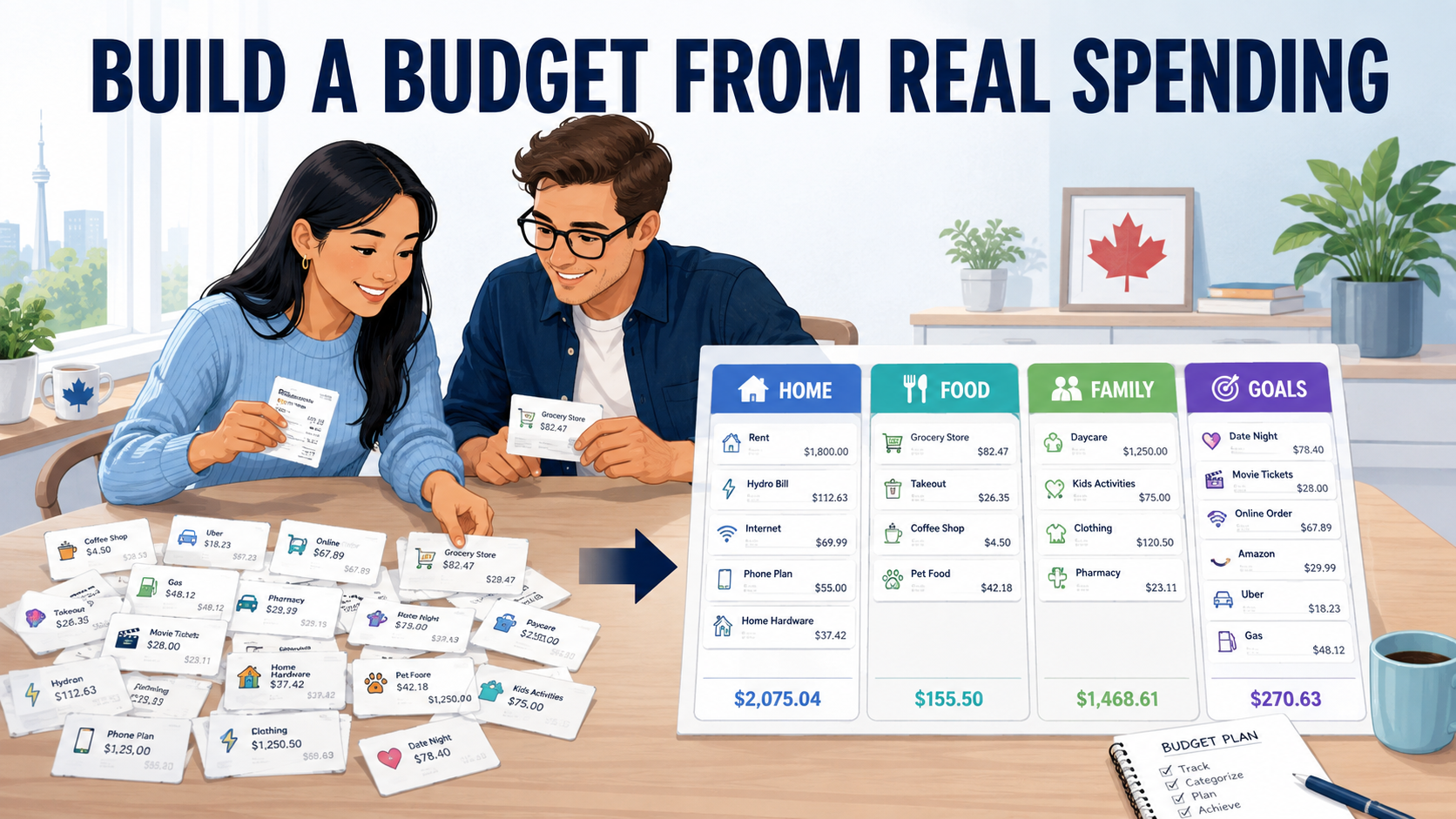
If you have never tracked household spending consistently, begin with observation. Use two or three months of transactions to establish a baseline, identify irregular costs and then decide what you want to change.
This “track first, budget second” approach is especially useful for couples and families. It avoids turning the first budgeting conversation into a negotiation over arbitrary limits.
The five-stage process
- Gather household income and transactions.
- Establish the cost of a normal month.
- Add monthly provisions for irregular expenses.
- Choose intentional changes and savings goals.
- Review the result together and adjust.
The outcome should be a budget that guides decisions—not a forensic accounting project that nobody wants to maintain.
Stage 1: Gather the full household picture
Choose at least two complete calendar months. Three months gives a better baseline; six or more helps when spending is seasonal.
Include:
- Take-home pay and dependable benefits
- Joint and individual accounts used for household costs
- Credit-card purchases
- Recurring bills and subscriptions
- Cash withdrawals
- Savings and investment transfers
- Debt payments
Keep transfers separate from expenses. Moving money from chequing to savings is progress, not consumption. Paying a credit-card bill is not another grocery expense after the grocery transaction has already been counted.
If your totals do not make sense, complete a spending audit before setting targets.
Stage 2: Calculate the normal monthly baseline
Start with broad categories that help you make decisions:
| Category group | Examples |
|---|---|
| Home | Rent or mortgage, property tax, utilities, repairs |
| Food | Groceries, restaurants, delivery |
| Transportation | Vehicle payments, transit, fuel, maintenance |
| Family | Child care, clothing, activities, school costs |
| Health | Prescriptions, dental, therapy, insurance |
| Lifestyle | Entertainment, hobbies, travel, subscriptions |
| Financial | Interest, fees, debt repayment, savings goals |
You can add detail later. Fifty categories do not create a better budget if nobody reviews them.
For fixed costs, use the actual monthly amount. For variable spending, calculate an average and examine the range. If groceries were $950, $1,180 and $1,020, a $700 grocery budget is not a serious first draft unless you already know what behaviour will change.
Stage 3: Build in the expenses that are not monthly
List predictable annual and seasonal costs, estimate the next occurrence and divide by the number of months available.
Suppose the family expects:
- $1,200 for holiday travel in eight months: reserve $150 monthly.
- $900 for summer activities in six months: reserve $150 monthly.
- $600 for annual insurance in twelve months: reserve $50 monthly.
- $1,500 for home maintenance over a year: reserve $125 monthly.
Those provisions add $475 to the household’s real monthly cost. Without them, the budget will appear successful until the bills arrive.
These are sometimes called sinking funds. They are for expected expenses, while an emergency fund protects against events you could not reasonably schedule.
Stage 4: Decide what changes on purpose
Now compare dependable take-home income with the full baseline.
| Monthly plan | Current baseline | New plan |
|---|---|---|
| Take-home income | $8,500 | $8,500 |
| Essential and committed costs | $5,300 | $5,300 |
| Flexible lifestyle spending | $1,500 | $1,250 |
| Irregular-expense provisions | $650 | $650 |
| Savings and goals | $750 | $1,050 |
| Remaining buffer | $300 | $250 |
The family did not promise to transform every category. It identified $250 of flexible spending it was willing to redirect and assigned most of the existing surplus to savings.
Focus the first revision on one to three changes. A budget that requires constant restraint across twenty categories is harder to sustain than one based on a few deliberate priorities.
Stage 5: Give each household member a workable role
Shared budgeting does not require combining every account or scrutinizing every personal purchase.
Agree on:
- Which expenses are shared
- How contributions to shared costs are calculated
- Which goals belong to the household
- What each person can spend independently
- How frequently the budget is reviewed
- Who handles administrative tasks such as bills or reimbursements
The system should provide visibility without creating a parent-child dynamic between adults. Separate logins and clear permissions are safer and healthier than sharing banking passwords.
For more, see How to Build a Shared Household Budget in Canada.
Choose the right budgeting method afterward
Once you understand the baseline, you can apply a method:
- 50/30/20: a broad comparison between needs, wants and savings.
- Zero-based budgeting: assign every dollar of income a purpose.
- Category limits: set targets only for the areas you want to manage.
- Pay-yourself-first: automate a sustainable savings amount, then manage the remainder.
The method is a control system layered on top of your real numbers. It cannot compensate for missing expenses.
What to do when the month does not match the plan
Do not treat every variance as failure. Ask why it happened:
- Timing: a bill landed earlier or later than expected.
- Estimation: the original target was unrealistic.
- Trade-off: the household consciously spent more in one category and less elsewhere.
- Exception: a genuinely unusual expense occurred.
- Behaviour: spending did not match the agreed priority.
Then choose a response: revise the estimate, move money between categories, reduce another expense or accept a smaller contribution that month. Quietly putting the difference on a credit card only hides the decision.
A simple monthly routine
Once a month:
- Review uncategorized and large transactions.
- Confirm recurring bills and upcoming irregular costs.
- Compare the budget with actual spending.
- Check progress toward goals and debt reduction.
- Make one or two adjustments for the next month.
The first review may take an hour. A stable system should eventually take much less.
How Finnomia helps
Finnomia provides customizable budgets, transaction categorization, recurring bills, household finances with separate accounts, goals, cash-flow forecasting, investments and net-worth tracking in one Canadian personal-finance platform.
That lets a household build its plan from real activity, see future obligations and connect monthly decisions with longer-term progress.
If you want that picture in one Canadian place, start a 14-day free trial.
Frequently asked questions
Should we track spending before making a budget?
Yes, if you do not already know where the money goes. You can still set temporary boundaries, but use the first few months to replace estimates with evidence.
Should every purchase have its own category?
No. Use enough detail to support decisions. Track large or unusual purchases individually when you may need their context later.
How often should a household budget change?
Review monthly and revise when income, housing, child care, debt or goals change. A budget is a current plan, not a permanent contract.
Source
This is general information, not tax, legal, or financial advice.